Neon White
A first-person speedrunning game where weapon cards double as movement abilities across very short levels.
Where Neon White comes up1 episode or test
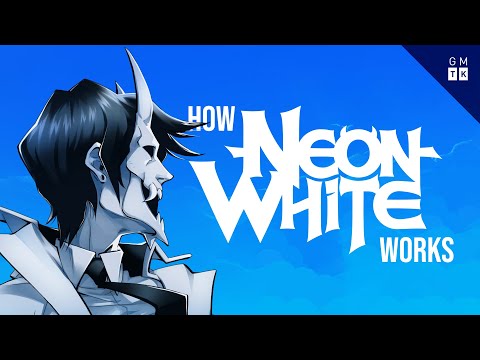
Neon White turned speedrunning into a staged loop. Levels run 20 to 30 seconds, and its Insight medals (bronze to ace, plus a secret red) unlock friends' times, a timer, a ghost, a shortcut hint and global ranks. Testers who never retried prompted the system. Lesson: keep attempts short, make movement satisfying, and gate tools behind progress so players discover the replay loop.
- 1First runEverything locked, just a play-through
- 2Bronze medalUnlocks friends' times
- 3Silver medalAdds a timer and a ghost
- 4Gold medalHint to a secret shortcut
- 5Ace medalOpens the global leaderboards
From Mark Brown on Neon White
What was said about Neon White
1Speedrunning without the thousand hours
Neon White compresses speedrunning's mastery loop into minutes instead of years. Real speedrunning can take thousands of hours; a top Ocarina of Time runner says he spent more than 4,500. Neon White lets players learn a move set, retry, find shortcuts and slowly improve within minutes or a few hours.
Mark Brown named it 2022's most innovative game because it gets ordinary players to retry and optimise. Creator Ben Esposito says that if you never go back to improve your time, you're not really playing Neon White. "You get to feel like an AGDQ superstar. Without the time commitment."
Each card is both a weapon and a movement move. Players shoot demons with a card or discard it for a double jump, forward dash, rocket jump, hookshot or ground pound, moves borrowed from other platformers.
A first clear takes a few hours, but that is not the point of the game; optimising runs is.
2How the prototype turned into a speedrun game
- Shooter mixed with deck builder
- Random weapons dealt mid-fight
- Did not work
- Breadcrumb trail of chosen cards
- Friends started racing levels
- Traded best times
One design change exposed the speedrunning game
From Ben Esposito on Neon White's prototype
Swapping random card draws for hand-placed cards revealed the fun. The first version mixed a shooter with a deck builder that dealt random weapons mid-fight, which did not work. When Ben Esposito laid a breadcrumb trail of chosen cards, his friends started racing the levels and trading best times.
Changing one design element exposed a speedrunning game that was already there.
Esposito aimed for a few players to love it, not everyone to like it. His previous game, Donut County, used simple controls to appeal to as many people as possible. Neon White instead blends Counter-Strike surf maps, Toonami anime, Dreamcast aesthetics and visual novel dialogue.
"Ben wanted to make a game that a few people would absolutely love."
3The Insight medal system
Insight was built because playtesters never retried a level. Testers blasted through the levels once and moved on, so the team built Insight to orient people to the true fun of the game: replaying for better times.
When the best way to play isn't obvious, the reward structure can teach it.
Each medal unlocks the next optimisation tool. Everything starts locked, so a first run is just a play-through. Bronze unlocks friends' times, silver adds a timer and a ghost, gold gives a hint to a secret shortcut, and ace opens the global leaderboards.
Moving from bronze to silver to gold gives visible proof of progress, easing the player from stumbling finisher to speedrunner without being told how to play. Players say "it's almost impossible to move on without, at the very least, a gold medal."
Old leaderboards and ghosts, staged so nearly everyone uses them. Leaderboards date back to arcades and ghosts to early racing games. In most games time trials belong to a few elite players while the rest watch on YouTube; Neon White's gradual sequencing pulls in ordinary players.
A secret red medal rewards the best without shaming the rest. A fifth, hidden red medal is earned only by beating Ben Esposito's own times.
Mark Brown compares it to Assault Android Cactus's hidden medals, which reward top players "without demoralising those who can't make the grade."
4Short levels and forgiving movement make retrying the default
Levels of 20 to 30 seconds make another attempt feel cheap. A stage may take only 20 or 30 seconds, so failure costs little and iteration becomes the core loop.
"They're always quick enough to encourage another go."
Movement fun enough that repeating a level never feels like a chore. Tight, responsive movement plus forgiveness features like coyote time and edge rounding make replays enjoyable and a better run feel within reach.
Each retry brings less hesitation and more accuracy as the layout becomes familiar. "It's crystal clear that with just a bit more skill, a bit more accuracy, a bit more practice, you could totally do it better."
5The obvious route is a decoy
Clean visuals mark the easy route so players read it at speed. White buildings, green plants pointing the way, staircases and archways, and enemies and cards placed like a dotted line lay out the path from start to finish.
The look is "intended for clarity and zero ambiguity," so fast players focus on execution, not navigation.
Every level hides a faster shortcut behind the obvious path. The easy route is a red herring; each level has a secret shortcut, and the gold medal's reward is a hint showing where to break away.
This turns optimising into problem solving. An ace needs practice, problem solving and "a dollop of skill."
A deep skill ceiling lets players discover hidden tech themselves. Chasing aces and global ranks, players search YouTube and learn tricks like parrying bullets for a speed boost.
That discovery gives a speedrunner's sense of finding hidden tech: "wait, you can parry bullets in this game to get a speed boost?"
How Neon White Lets You Speedrun Speedrunning
Its Insight medal system (bronze, silver, gold, ace, plus a secret red) unlocks friends' times, a timer and ghost, a shortcut hint and global leaderboards. Levels last 20 to 30 seconds with tight movement, and testers who never retried led to Insight being built.
Neon White compresses speedrunning's mastery loop into minutes instead of years. Real speedrunning can take thousands of hours; a top Ocarina of Time runner says he spent more than 4,500. Neon White lets players learn a move set, retry, find shortcuts and slowly improve within minutes or a few hours.
Mark Brown named it 2022's most innovative game because it gets ordinary players to retry and optimise. Creator Ben Esposito says that if you never go back to improve your time, you're not really playing Neon White. "You get to feel like an AGDQ superstar. Without the time commitment."
Each card is both a weapon and a movement move. Players shoot demons with a card or discard it for a double jump, forward dash, rocket jump, hookshot or ground pound, moves borrowed from other platformers.
A first clear takes a few hours, but that is not the point of the game; optimising runs is.
Swapping random card draws for hand-placed cards revealed the fun. The first version mixed a shooter with a deck builder that dealt random weapons mid-fight, which did not work. When Ben Esposito laid a breadcrumb trail of chosen cards, his friends started racing the levels and trading best times.
Changing one design element exposed a speedrunning game that was already there.
Esposito aimed for a few players to love it, not everyone to like it. His previous game, Donut County, used simple controls to appeal to as many people as possible. Neon White instead blends Counter-Strike surf maps, Toonami anime, Dreamcast aesthetics and visual novel dialogue.
"Ben wanted to make a game that a few people would absolutely love."
Insight was built because playtesters never retried a level. Testers blasted through the levels once and moved on, so the team built Insight to orient people to the true fun of the game: replaying for better times.
When the best way to play isn't obvious, the reward structure can teach it.
Each medal unlocks the next optimisation tool. Everything starts locked, so a first run is just a play-through. Bronze unlocks friends' times, silver adds a timer and a ghost, gold gives a hint to a secret shortcut, and ace opens the global leaderboards.
Moving from bronze to silver to gold gives visible proof of progress, easing the player from stumbling finisher to speedrunner without being told how to play. Players say "it's almost impossible to move on without, at the very least, a gold medal."
Old leaderboards and ghosts, staged so nearly everyone uses them. Leaderboards date back to arcades and ghosts to early racing games. In most games time trials belong to a few elite players while the rest watch on YouTube; Neon White's gradual sequencing pulls in ordinary players.
A secret red medal rewards the best without shaming the rest. A fifth, hidden red medal is earned only by beating Ben Esposito's own times.
Mark Brown compares it to Assault Android Cactus's hidden medals, which reward top players "without demoralising those who can't make the grade."
Levels of 20 to 30 seconds make another attempt feel cheap. A stage may take only 20 or 30 seconds, so failure costs little and iteration becomes the core loop.
"They're always quick enough to encourage another go."
Movement fun enough that repeating a level never feels like a chore. Tight, responsive movement plus forgiveness features like coyote time and edge rounding make replays enjoyable and a better run feel within reach.
Each retry brings less hesitation and more accuracy as the layout becomes familiar. "It's crystal clear that with just a bit more skill, a bit more accuracy, a bit more practice, you could totally do it better."
Clean visuals mark the easy route so players read it at speed. White buildings, green plants pointing the way, staircases and archways, and enemies and cards placed like a dotted line lay out the path from start to finish.
The look is "intended for clarity and zero ambiguity," so fast players focus on execution, not navigation.
Every level hides a faster shortcut behind the obvious path. The easy route is a red herring; each level has a secret shortcut, and the gold medal's reward is a hint showing where to break away.
This turns optimising into problem solving. An ace needs practice, problem solving and "a dollop of skill."
A deep skill ceiling lets players discover hidden tech themselves. Chasing aces and global ranks, players search YouTube and learn tricks like parrying bullets for a speed boost.
That discovery gives a speedrunner's sense of finding hidden tech: "wait, you can parry bullets in this game to get a speed boost?"
More in Games
 Games
Nintendo
A Zelda adventure where Princess Zelda copies objects and monsters as echoes to solve puzzles and fight.
 Games
The Legend of Zelda: Breath of the Wild
Nintendo's long-running action-adventure series about Link exploring Hyrule, solving puzzles and fighting Ganon.
 Games
Dead Space
A major video game publisher and the guest's employer.
 G
 29 sources · 94 tips
Mind Over Magnet
A puzzle platformer where you escape a factory using a magnet and a magnetic field.
 Games
Far Cry 2
An open world action game where you recruit and play any of London's citizens.
 Games
God of War
A combat-focused action adventure game from Santa Monica Studio with Norse mythology and light puzzles.
Mind Over Magnet
Mark Brown's first game, a puzzle game he made while learning Unity.
 Games
Dishonored
A first-person stealth action game from Arkane with supernatural powers and the Clockwork Mansion level.