
The Sims
A life simulation game where players guide autonomous characters through daily needs and relationships.
Where The Sims comes up3 episodes and tests
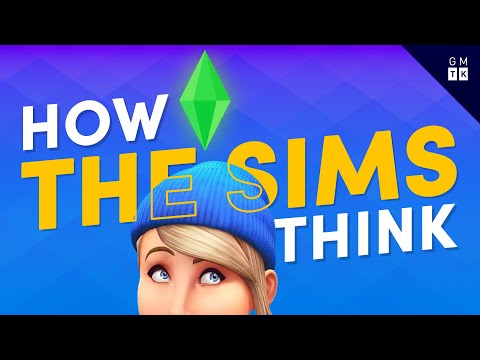 Gcreator of Game Maker's Toolkit testThe Genius AI Behind The Sims
 Gcreator of Game Maker's Toolkit test10 Game Design Lessons from 10 Years of GMTK
 Gcreator of Game Maker's Toolkit testThe 100 Games That Taught Me Game Design
The Sims ran on simple utility AI: objects advertise what they offer, and each Sim scores offers against eight decaying motives, then picks randomly among the top options. Maxis cut a realistic urinal rule because random choice was funnier. The lesson: design AI for interesting play, not realism, and leave needs unmet and gaps open so players have a story to tell.
- 1Objects advertise offersBed +10 energy, toilet +20 bladder
- 2Weigh by current needSeparate curve per motive
- 3Pick randomly among topNever meets needs perfectly
- 4Act, then needs decayEight motives, -100 to +100
From Maxis design talks on The Sims AI
What was said about The Sims
1The utility AI behind every Sim's choices
Objects advertise what they offer, and each Sim scores those offers. A bed broadcasts "sleep on me for +10 energy" and a toilet offers +20 bladder. With no command, a Sim lists every object in the house, weighs the offers against its needs and acts on a top one.
In The Sims 1 a Sim has eight motives (hunger, hygiene, fun, energy, bladder, social, comfort, room), each from -100 to +100, decaying at rates tuned to roughly eight hours of sleep and three meals a day. Will Wright took the idea from SimAnt, where ants follow pheromones and Sims follow fridges and TVs.
Weight each offer by current need, with a separate curve per motive. A well-rested Sim damps the bed's energy score and an exhausted one boosts it sharply. Each motive has its own curve, so a starving Sim eats rather than watches TV even when the raw rewards are equal.
The curves follow Maslow's hierarchy: hunger, bladder, hygiene and energy matter most when low, while fun, social and comfort grow more attractive as the Sim gets happier. Distance and personality also change the score (a serious Sim reads instead of playing pinball), and a phone call or school bus overrides everything.
Pick randomly among the top options so Sims stay imperfect. A Sim chooses one of the top-scoring interactions at random rather than the single best, so it never feels robotic and never meets its needs perfectly.
The leftover unmet needs are deliberate: they give the player something to do.
Keeping data on objects lets the game grow without new AI code. Because knowledge lives on objects, Maxis can add hundreds of objects and endless expansion packs without touching the rest of the code. All four games in the franchise use this utility AI.
The same system lets a Sim act lifelike in any house the player builds.
A simple system can feel magical if it serves interesting play. Mark Brown cites The Sims' AI as simpler than it appears, arguing good game AI gives the most interesting gameplay, not the most lifelike behavior. He describes the game as an ant farm of AI people you can watch or control.
Will Wright zoomed in from SimCity to individual households. Quote: "the point of AI is not to try and pass The Turing Test - it's to present interesting gameplay."
2Traits, social context and hand-written rules in The Sims 3
Traits are just extra motives, which makes every Sim unique. The Sims 3 replaced personality meters with traits that add motives objects can advertise to. Five slots from about 60 traits give roughly 5 million possible Sims.
A couch potato needs the TV as much as it needs to pee, and evil Sims are offered scaring Sims, stealing candy from a child or writing trolling comments. Traits also change idle behavior (a clumsy Sim trips) and acting on them earns bonus moodlets.
Temporary context motives make Sims behave fittingly in any setting. A Sim entering a gym gets a "be in gym" motive that treadmills satisfy and loses it on leaving; hosts get hospitality motives and guests get acceptable-behavior motives.
Traits can override the norm: at a picnic strangers are discouraged from joining, but an "inappropriate" Sim sits with them to make them uncomfortable. The Sims Medieval applies work motives only while a Sim is on the clock.
Ranked hand-written rules cover social cases motives can't. Conversations and house visits run on rules with an input, conditions and an output, and the most specific matching rule wins. Maxis wrote thousands of rules for hundreds of conversation topics.
A joke gets a laugh from a Sim with a good sense of humour, an insult if the relationship is sour, and boredom if repeated. A guest who sleeps in the host's bed gets a warning, then is kicked out. Because rules sit in a stack ranked by specificity, they can't clash or loop.
3Towns, lots and background Sims
Towns and lots have their own needs and hand motives to Sims. The Sims 3 neighborhood aims for a 50/50 gender balance and about 80% employment, checked at midnight. A restaurant wanting about 8 diners outside at meal times gives nearby Sims an "eat outside" motive.
The restaurant favors Sims with traits like culinary and discourages frugal ones, so the same needs model scales from person to place.
Off-screen Sims are faked cheaply and snapped to a chart when seen. Background Sims are scored once a day only for big life changes like getting a job, falling in love or marrying, weighted by traits, relationships and careers.
When one becomes a foreground Sim, its motives snap to a designer-made time-of-day chart, so it isn't hungry just after lunch. Neighbours look like they live full lives off camera, but they don't.
4Knowing what not to simulate
- Sims leave gap between urinals
- Realistic behavior
- Predictable and dull
- Sims pick urinals at random
- Less realistic
- Funnier moments
Rule removed before launch
From Maxis developers on The Sims
Autonomy must not be so smart the player has nothing to do. Maxis added free will because micromanaging a family's needs got tedious, but tuned it so needs still go unmet and the player remains the director.
Quote: "they can't be so smart that the player can just sit back and do nothing."
Maxis cut a realistic rule because randomness was funnier. Maxis added a rule that Sims leave a gap between urinals, then removed it before launch because following it was predictable and dull, while random choice made funnier moments.
Quote: "when the Sim followed that rule it was just kind of predictable and dull."
Ambiguity like Simlish leaves room for players' imagination. Maxis tried English, Navajo, Estonian and Ukrainian before having two improv comics invent Simlish, so players fill the gaps themselves.
Ambiguity also hides moments where the simulation goes wrong. EA's Matt Brown: "If we used actual language, the game would flatten and shrink, and everyone would be having the same experience."
A last-minute comic maker let players share their Sim stories. Playtests showed players building elaborate stories around their Sim families, so Maxis added a tool to screenshot, caption and publish comics to EA's website. It was extremely popular.
Will Wright: "It was fascinating to me how readily people would build a story around this."
Autonomy follows the player's lead and never undoes their story. Using improv's "yes, and", Sims eat and use the bathroom on their own but won't quit a job, romance a random Sim or break up a couple the player paired.
If a player has a male Sim flirt with men, the game treats him as bi or gay and runs with it.
5Similar examples from other apps
These are about other apps, not The Sims: examples from the same sources that help explain it.
XCOM enemies use the same utility scoring to choose where to move. An XCOM enemy scores every tile it can reach by distance, flanking, angle, cover bonus, visibility and proximity, then moves to the best one.
The same scoring idea can also drive procedural generation of worlds that meet set requirements.
10 Game Design Lessons from 10 Years of GMTK
Its AI is a simple system that creates magical experiences. Good game AI is whatever gives the most interesting gameplay, not the most lifelike behavior.
A simple system can feel magical if it serves interesting play. Mark Brown cites The Sims' AI as simpler than it appears, arguing good game AI gives the most interesting gameplay, not the most lifelike behavior. He describes the game as an ant farm of AI people you can watch or control.
Will Wright zoomed in from SimCity to individual households. Quote: "the point of AI is not to try and pass The Turing Test - it's to present interesting gameplay."
The 100 Games That Taught Me Game Design
It is an ant farm of AI people that you can watch or control. Will Wright zoomed in from SimCity to individual households.
A simple system can feel magical if it serves interesting play. Mark Brown cites The Sims' AI as simpler than it appears, arguing good game AI gives the most interesting gameplay, not the most lifelike behavior. He describes the game as an ant farm of AI people you can watch or control.
Will Wright zoomed in from SimCity to individual households. Quote: "the point of AI is not to try and pass The Turing Test - it's to present interesting gameplay."
The Genius AI Behind The Sims
Runs on utility AI where objects advertise what they offer (a bed gives +10 energy, a toilet +20 bladder) and each Sim scores offers against eight decaying motives. It picks randomly among top options, and cut the urinal rule because random choice was funnier.
Objects advertise what they offer, and each Sim scores those offers. A bed broadcasts "sleep on me for +10 energy" and a toilet offers +20 bladder. With no command, a Sim lists every object in the house, weighs the offers against its needs and acts on a top one.
In The Sims 1 a Sim has eight motives (hunger, hygiene, fun, energy, bladder, social, comfort, room), each from -100 to +100, decaying at rates tuned to roughly eight hours of sleep and three meals a day. Will Wright took the idea from SimAnt, where ants follow pheromones and Sims follow fridges and TVs.
Weight each offer by current need, with a separate curve per motive. A well-rested Sim damps the bed's energy score and an exhausted one boosts it sharply. Each motive has its own curve, so a starving Sim eats rather than watches TV even when the raw rewards are equal.
The curves follow Maslow's hierarchy: hunger, bladder, hygiene and energy matter most when low, while fun, social and comfort grow more attractive as the Sim gets happier. Distance and personality also change the score (a serious Sim reads instead of playing pinball), and a phone call or school bus overrides everything.
Pick randomly among the top options so Sims stay imperfect. A Sim chooses one of the top-scoring interactions at random rather than the single best, so it never feels robotic and never meets its needs perfectly.
The leftover unmet needs are deliberate: they give the player something to do.
Keeping data on objects lets the game grow without new AI code. Because knowledge lives on objects, Maxis can add hundreds of objects and endless expansion packs without touching the rest of the code. All four games in the franchise use this utility AI.
The same system lets a Sim act lifelike in any house the player builds.
Traits are just extra motives, which makes every Sim unique. The Sims 3 replaced personality meters with traits that add motives objects can advertise to. Five slots from about 60 traits give roughly 5 million possible Sims.
A couch potato needs the TV as much as it needs to pee, and evil Sims are offered scaring Sims, stealing candy from a child or writing trolling comments. Traits also change idle behavior (a clumsy Sim trips) and acting on them earns bonus moodlets.
Temporary context motives make Sims behave fittingly in any setting. A Sim entering a gym gets a "be in gym" motive that treadmills satisfy and loses it on leaving; hosts get hospitality motives and guests get acceptable-behavior motives.
Traits can override the norm: at a picnic strangers are discouraged from joining, but an "inappropriate" Sim sits with them to make them uncomfortable. The Sims Medieval applies work motives only while a Sim is on the clock.
Ranked hand-written rules cover social cases motives can't. Conversations and house visits run on rules with an input, conditions and an output, and the most specific matching rule wins. Maxis wrote thousands of rules for hundreds of conversation topics.
A joke gets a laugh from a Sim with a good sense of humour, an insult if the relationship is sour, and boredom if repeated. A guest who sleeps in the host's bed gets a warning, then is kicked out. Because rules sit in a stack ranked by specificity, they can't clash or loop.
Towns and lots have their own needs and hand motives to Sims. The Sims 3 neighborhood aims for a 50/50 gender balance and about 80% employment, checked at midnight. A restaurant wanting about 8 diners outside at meal times gives nearby Sims an "eat outside" motive.
The restaurant favors Sims with traits like culinary and discourages frugal ones, so the same needs model scales from person to place.
Off-screen Sims are faked cheaply and snapped to a chart when seen. Background Sims are scored once a day only for big life changes like getting a job, falling in love or marrying, weighted by traits, relationships and careers.
When one becomes a foreground Sim, its motives snap to a designer-made time-of-day chart, so it isn't hungry just after lunch. Neighbours look like they live full lives off camera, but they don't.
Autonomy must not be so smart the player has nothing to do. Maxis added free will because micromanaging a family's needs got tedious, but tuned it so needs still go unmet and the player remains the director.
Quote: "they can't be so smart that the player can just sit back and do nothing."
Maxis cut a realistic rule because randomness was funnier. Maxis added a rule that Sims leave a gap between urinals, then removed it before launch because following it was predictable and dull, while random choice made funnier moments.
Quote: "when the Sim followed that rule it was just kind of predictable and dull."
Ambiguity like Simlish leaves room for players' imagination. Maxis tried English, Navajo, Estonian and Ukrainian before having two improv comics invent Simlish, so players fill the gaps themselves.
Ambiguity also hides moments where the simulation goes wrong. EA's Matt Brown: "If we used actual language, the game would flatten and shrink, and everyone would be having the same experience."
A last-minute comic maker let players share their Sim stories. Playtests showed players building elaborate stories around their Sim families, so Maxis added a tool to screenshot, caption and publish comics to EA's website. It was extremely popular.
Will Wright: "It was fascinating to me how readily people would build a story around this."
Autonomy follows the player's lead and never undoes their story. Using improv's "yes, and", Sims eat and use the bathroom on their own but won't quit a job, romance a random Sim or break up a couple the player paired.
If a player has a male Sim flirt with men, the game treats him as bi or gay and runs with it.
XCOM enemies use the same utility scoring to choose where to move. An XCOM enemy scores every tile it can reach by distance, flanking, angle, cover bonus, visibility and proximity, then moves to the best one.
The same scoring idea can also drive procedural generation of worlds that meet set requirements.
More in Games
 Games
Nintendo
A Zelda adventure where Princess Zelda copies objects and monsters as echoes to solve puzzles and fight.
 Games
The Legend of Zelda: Breath of the Wild
Nintendo's long-running action-adventure series about Link exploring Hyrule, solving puzzles and fighting Ganon.
 Games
Dead Space
A major video game publisher and the guest's employer.
 G
 29 sources · 94 tips
Mind Over Magnet
A puzzle platformer where you escape a factory using a magnet and a magnetic field.
 Games
Far Cry 2
An open world action game where you recruit and play any of London's citizens.
 Games
God of War
A combat-focused action adventure game from Santa Monica Studio with Norse mythology and light puzzles.
Mind Over Magnet
Mark Brown's first game, a puzzle game he made while learning Unity.
 Games
Dishonored
A first-person stealth action game from Arkane with supernatural powers and the Clockwork Mansion level.