Snake Pass
A 3D platformer where you guide a snake named Noodle with no jump button.
Where Snake Pass comes up1 episode or test
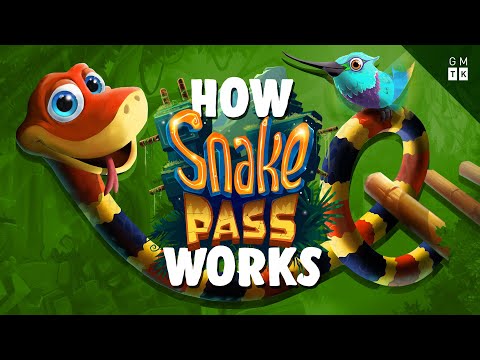
Snake Pass removed the jump from a 3D platformer, turning it into a climbing game where Noodle's 35 collision spheres make the body both tool and enemy. Optional grip and tail-lift aids and optional collectibles let players tune difficulty. Reception split between frustrating mess and fantastic challenge. The lesson: cutting a staple mechanic can open new design space, but a demanding, unusual control scheme will divide players.
- 1Build a physics ropeSeb Liese learning Unreal Engine
- 2Forget the ceilingRope fell and coiled interestingly
- 3Add controls and headBecame the Snake Pass tech demo
- 4Cut the jumpIdeas about what snakes could do failed
- 5Climb by windingBody wraps around vertical structures
From Mark Brown, Game Maker's Toolkit
What was said about Snake Pass
1How the snake idea started
A prototype mistake became the game's core mechanic. Designer Seb Liese was learning Unreal Engine by building a physics rope and forgot to attach it to the ceiling. When he pressed play it fell and coiled in an interesting way, so he made it controllable and added a head.
Liese won his job at Sumo Digital with user-made LittleBigPlanet levels, and his first task there was to learn Unreal Engine. The rope became the tech demo for Snake Pass.
The core idea came from real snakes, not other games. Liese had kept pet snakes and had been a biology teacher, so he knew how snakes move. Sumo borrowed trappings from Spyro and Banjo-Kazooie, but the central mechanic came from the real world.
Mark Brown sets this alongside Miyamoto turning music, pets and gardening into games, and Lucas Pope basing Papers, Please on passport checks he met while travelling. Quote: "it's beneficial to look for inspiration beyond other games."
2Removing the jump
Asking what the snake couldn't do turned a demo into a game. Early ideas built on what the snake could do (sneaking and killing, coiling and springing, growing and shrinking by eating fruit) all failed. The team cut jumping, which every 3D platformer hero does constantly, and the game became about climbing vertical structures the snake winds around.
Brown generalizes the move: ask what a shooter where you can't shoot, or a driving game where you can't brake, would be. Dropping the jump forced changes to almost everything known about 3D platformers, starting with the controls. Quote: "the team had stop thinking about what the snake could do - and instead think about what the snake can't do."
3The body as both asset and enemy
- 1Steer only the headStick, A to lift, trigger forward
- 235 spheres trail behindEach tracks what it touches
- 3Wrap body round pillarBends create grip
- 4Gravity pulls dangling bodyNoodle slips and falls
From Mark Brown, Game Maker's Toolkit
The player steers only the head while the body decides success. Noodle's head is controlled directly while 35 collision spheres trail behind, each tracking what it touches, what its neighbours touch, and whether it is part of a bend. Wrapping the body around a pillar creates grip, but a body dangling over an edge makes Noodle slip and fall.
The result is a tug-of-war between upward momentum, sticky friction and sinking gravity, with the body only halfway under the player's control. Anchor points let Noodle swing underneath platforms. Quote: "This thing that is simultaneously both your greatest asset and your biggest enemy."
Gravity and your own body replace enemies as the danger. Snake Pass makes gravity pulling on Noodle's body the main opponent instead of enemies that can kill you. Brown argues that adding enemies leads to a combat system and a game like every other one.
Quote: "having something like gravity, or your own body be an enemy can lead to new gameplay and new ways of thinking"
Familiar buttons were repurposed to fit a snake. The stick moves the head on a flat axis relative to the camera, holding A (normally jump) lifts the head and releasing lets gravity drop it, and the right trigger drives it forward. Together this lets players aim the head at any point in 3D space.
Holding the trigger stretches the body spheres, so real speed requires a serpentine zig-zag.
4Mastery and letting players set their own difficulty
Players learn advanced moves by experimenting, not from a tutorial. The tutorial ends quickly and advanced climbing and anchoring techniques are never taught, so players build a repertoire of moves through practice. Seb Liese says getting better at anything triggers a part of the brain that makes it pleasant, and that self-improvement is the appeal.
The team knew the controls were difficult but not impossible. Brown says he could mess around with the climbing for hours.
Optional aids soften the controls without being required. Holding the left trigger makes Noodle grip tighter for more friction, and pressing Y has the hummingbird Doodle lift the tail. Neither is needed to get around.
Quote: "Neither of these are necessary to get around, but they are helping hands if you need them."
Optional collectibles let players choose how hard the game gets. Each level requires only three key stones, while blue bubbles and gold coins demand extra exploration and climbing skill for players who want more challenge.
Quote: "it's up to you how hard the game really gets."
5How levels raise and relax the challenge
Difficulty rises by making slipping easier and falls costlier. Bamboo rods lose their end caps, gaps and angles vary, and while early puzzles sit over safe ground, later frames hang over spikes, fire and thin air. Moving platforms force a body position that stays safe when the platform flips upside down.
Water was added as a breather, not another obstacle. In lakes Noodle can move easily and freely for the first time, giving a brief respite from the constant danger of falling.
Quote: "not every new mechanic needs to add to the challenge."
6A bold design that divides players
An unusual control scheme split opinion, a trade-off worth accepting. As many people call Snake Pass a frustrating mess as call it a fantastic challenge. Mark Brown concludes this is the price of trying something bold and is worth paying because original games keep the medium fresh.
It launched in a crowded year of 3D platformers including Mario Odyssey, the Crash Bandicoot remake and A Hat in Time, with music by Donkey Kong Country composer David Wise. Quote: "That's the price you'll pay for trying something bold - but I think it's worth it."
How Snake Pass Became a Platformer Without Jumping
Removed the jump so the game became about climbing, with 35 collision spheres trailing the head and the body as both asset and enemy. Optional grip and tail-lift aids and optional collectibles let players tune difficulty, and opinion is divided between frustrating mess and fantastic challenge.
A prototype mistake became the game's core mechanic. Designer Seb Liese was learning Unreal Engine by building a physics rope and forgot to attach it to the ceiling. When he pressed play it fell and coiled in an interesting way, so he made it controllable and added a head.
Liese won his job at Sumo Digital with user-made LittleBigPlanet levels, and his first task there was to learn Unreal Engine. The rope became the tech demo for Snake Pass.
The core idea came from real snakes, not other games. Liese had kept pet snakes and had been a biology teacher, so he knew how snakes move. Sumo borrowed trappings from Spyro and Banjo-Kazooie, but the central mechanic came from the real world.
Mark Brown sets this alongside Miyamoto turning music, pets and gardening into games, and Lucas Pope basing Papers, Please on passport checks he met while travelling. Quote: "it's beneficial to look for inspiration beyond other games."
Asking what the snake couldn't do turned a demo into a game. Early ideas built on what the snake could do (sneaking and killing, coiling and springing, growing and shrinking by eating fruit) all failed. The team cut jumping, which every 3D platformer hero does constantly, and the game became about climbing vertical structures the snake winds around.
Brown generalizes the move: ask what a shooter where you can't shoot, or a driving game where you can't brake, would be. Dropping the jump forced changes to almost everything known about 3D platformers, starting with the controls. Quote: "the team had stop thinking about what the snake could do - and instead think about what the snake can't do."
The player steers only the head while the body decides success. Noodle's head is controlled directly while 35 collision spheres trail behind, each tracking what it touches, what its neighbours touch, and whether it is part of a bend. Wrapping the body around a pillar creates grip, but a body dangling over an edge makes Noodle slip and fall.
The result is a tug-of-war between upward momentum, sticky friction and sinking gravity, with the body only halfway under the player's control. Anchor points let Noodle swing underneath platforms. Quote: "This thing that is simultaneously both your greatest asset and your biggest enemy."
Gravity and your own body replace enemies as the danger. Snake Pass makes gravity pulling on Noodle's body the main opponent instead of enemies that can kill you. Brown argues that adding enemies leads to a combat system and a game like every other one.
Quote: "having something like gravity, or your own body be an enemy can lead to new gameplay and new ways of thinking"
Familiar buttons were repurposed to fit a snake. The stick moves the head on a flat axis relative to the camera, holding A (normally jump) lifts the head and releasing lets gravity drop it, and the right trigger drives it forward. Together this lets players aim the head at any point in 3D space.
Holding the trigger stretches the body spheres, so real speed requires a serpentine zig-zag.
Players learn advanced moves by experimenting, not from a tutorial. The tutorial ends quickly and advanced climbing and anchoring techniques are never taught, so players build a repertoire of moves through practice. Seb Liese says getting better at anything triggers a part of the brain that makes it pleasant, and that self-improvement is the appeal.
The team knew the controls were difficult but not impossible. Brown says he could mess around with the climbing for hours.
Optional aids soften the controls without being required. Holding the left trigger makes Noodle grip tighter for more friction, and pressing Y has the hummingbird Doodle lift the tail. Neither is needed to get around.
Quote: "Neither of these are necessary to get around, but they are helping hands if you need them."
Optional collectibles let players choose how hard the game gets. Each level requires only three key stones, while blue bubbles and gold coins demand extra exploration and climbing skill for players who want more challenge.
Quote: "it's up to you how hard the game really gets."
Difficulty rises by making slipping easier and falls costlier. Bamboo rods lose their end caps, gaps and angles vary, and while early puzzles sit over safe ground, later frames hang over spikes, fire and thin air. Moving platforms force a body position that stays safe when the platform flips upside down.
Water was added as a breather, not another obstacle. In lakes Noodle can move easily and freely for the first time, giving a brief respite from the constant danger of falling.
Quote: "not every new mechanic needs to add to the challenge."
An unusual control scheme split opinion, a trade-off worth accepting. As many people call Snake Pass a frustrating mess as call it a fantastic challenge. Mark Brown concludes this is the price of trying something bold and is worth paying because original games keep the medium fresh.
It launched in a crowded year of 3D platformers including Mario Odyssey, the Crash Bandicoot remake and A Hat in Time, with music by Donkey Kong Country composer David Wise. Quote: "That's the price you'll pay for trying something bold - but I think it's worth it."
More in Games
 Games
Nintendo
A Zelda adventure where Princess Zelda copies objects and monsters as echoes to solve puzzles and fight.
 Games
The Legend of Zelda: Breath of the Wild
Nintendo's long-running action-adventure series about Link exploring Hyrule, solving puzzles and fighting Ganon.
 Games
Dead Space
A major video game publisher and the guest's employer.
 G
 29 sources · 94 tips
Mind Over Magnet
A puzzle platformer where you escape a factory using a magnet and a magnetic field.
 Games
Far Cry 2
An open world action game where you recruit and play any of London's citizens.
 Games
God of War
A combat-focused action adventure game from Santa Monica Studio with Norse mythology and light puzzles.
Mind Over Magnet
Mark Brown's first game, a puzzle game he made while learning Unity.
 Games
Dishonored
A first-person stealth action game from Arkane with supernatural powers and the Clockwork Mansion level.