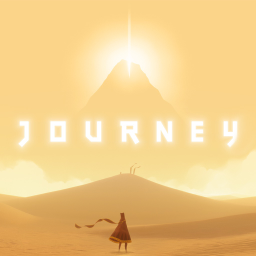
Journey
A game studio that made Journey.
Where Journey comes up5 episodes and tests
 GMark Brown is the creator of Game Maker's Toolkit; Luke Muscat is the designer of Fruit Ninja, Jetpack Joyride and Feed the Deep testWhat's the Point of Prototyping?
 Gcreator of Game Maker's Toolkit testHow To Think Like A Game Designer
 Gcreator of Game Maker's Toolkit testThe Games That Designed Themselves
 Gcreator of Game Maker's Toolkit testHow Level Design Can Tell a Story
 Gcreator of Game Maker's Toolkit testWhy Nathan Drake Doesn't Need a Compass
Journey was prototyped in Flash before touching the PlayStation 3, and the team iterated freely around one fixed theme, love. Flower's designer cut level-ups and time limits that clashed with calm. Journey climbs for strength, falls for loss, and uses color and a distant mountain to guide players. Lesson: prototype cheaply, fix one emotional theme, cut clashing features, and guide through level design.
- Level-up system
- Spells
- Resource management
- Time limits
- No level-up system
- No spells
- No resource management
- No time limits
Fun doesn't always help the emotion you want
From thatgamecompany on Flower
What was said about Journey
1How thatgamecompany found Journey through iteration
Journey was iterated freely, but always around the fixed theme of love. Sunni Pavolic of thatgamecompany says the studio iterated heavily on Journey, always with the idea that it would explore love.
That one unchangeable element gave the team a direction and narrowed the range of ideas they might discover and develop. "This gave everyone on the team a singular direction to follow."
Journey was first prototyped in Macromedia Flash, not on PlayStation 3. Thatgamecompany built a Journey prototype in Flash before making anything for the PlayStation 3, its target platform.
The lesson drawn is to prototype in whatever medium answers the design question fastest, even outside the final engine: "use whatever tools let you get to the idea quickly."
2How Journey's world tells its story
Journey maps its emotional arc onto climbing, falling and color. Climbing conveys strength and progress, falling conveys loss. Each area has its own palette: orange for calm desert mystery, dark green for the spooky graveyard, white for biting cold, bright blue for rebirth.
The principle is that the level's physical shape follows the story, so the lowest story point is also the lowest place in the world.
A distant mountain gives players a goal without maps or arrows. Journey keeps a mountain visible on the horizon as the place players work toward, the job Walt Disney gave the castle at Disneyland's center (a "weenie").
Journey is cited alongside Uncharted, Half-Life 2's Citadel and Mirror's Edge as games that guide players with subconscious level design cues rather than HUD navigation. The landmark gives "something to work towards and a static position to aid navigation."
3Cutting standard game features from Flower
Flower dropped expected game systems that clashed with calm. Flower once had a level-up system, spells, resource management and time limits, and Jenova Chen's team removed them because they conflicted with relaxation, calm and peace.
The takeaway is that standard genre features can work against the intended feeling: "fun doesn't always help the emotion you want to deliver."
What's the Point of Prototyping?
It built a Journey prototype in Macromedia Flash before making anything for the PlayStation 3.
Journey was first prototyped in Macromedia Flash, not on PlayStation 3. Thatgamecompany built a Journey prototype in Flash before making anything for the PlayStation 3, its target platform.
The lesson drawn is to prototype in whatever medium answers the design question fastest, even outside the final engine: "use whatever tools let you get to the idea quickly."
How To Think Like A Game Designer
Jenova Chen's team removed level-ups, spells, resource management and time limits because they clashed with relaxation, calm and peace. Fun does not always deliver the emotion you want.
Flower dropped expected game systems that clashed with calm. Flower once had a level-up system, spells, resource management and time limits, and Jenova Chen's team removed them because they conflicted with relaxation, calm and peace.
The takeaway is that standard genre features can work against the intended feeling: "fun doesn't always help the emotion you want to deliver."
The Games That Designed Themselves
thatgamecompany iterated heavily but always around the fixed theme of love, which gave the team direction and narrowed what they might discover.
Journey was iterated freely, but always around the fixed theme of love. Sunni Pavolic of thatgamecompany says the studio iterated heavily on Journey, always with the idea that it would explore love.
That one unchangeable element gave the team a direction and narrowed the range of ideas they might discover and develop. "This gave everyone on the team a singular direction to follow."
How Level Design Can Tell a Story
It uses climbing for strength and falling for loss. Orange means calm desert mystery, dark green the spooky graveyard, white biting cold and bright blue rebirth.
Journey maps its emotional arc onto climbing, falling and color. Climbing conveys strength and progress, falling conveys loss. Each area has its own palette: orange for calm desert mystery, dark green for the spooky graveyard, white for biting cold, bright blue for rebirth.
The principle is that the level's physical shape follows the story, so the lowest story point is also the lowest place in the world.
Why Nathan Drake Doesn't Need a Compass
Uses the distant mountain as a landmark that players work toward, the same job as a weenie. Is one of the studios that guides players with subconscious level design cues rather than maps or arrows.
A distant mountain gives players a goal without maps or arrows. Journey keeps a mountain visible on the horizon as the place players work toward, the job Walt Disney gave the castle at Disneyland's center (a "weenie").
Journey is cited alongside Uncharted, Half-Life 2's Citadel and Mirror's Edge as games that guide players with subconscious level design cues rather than HUD navigation. The landmark gives "something to work towards and a static position to aid navigation."
More in Games
 Games
Nintendo
A Zelda adventure where Princess Zelda copies objects and monsters as echoes to solve puzzles and fight.
 Games
The Legend of Zelda: Breath of the Wild
Nintendo's long-running action-adventure series about Link exploring Hyrule, solving puzzles and fighting Ganon.
 Games
Dead Space
A major video game publisher and the guest's employer.
 G
 29 sources · 94 tips
Mind Over Magnet
A puzzle platformer where you escape a factory using a magnet and a magnetic field.
 Games
Far Cry 2
An open world action game where you recruit and play any of London's citizens.
 Games
God of War
A combat-focused action adventure game from Santa Monica Studio with Norse mythology and light puzzles.
Mind Over Magnet
Mark Brown's first game, a puzzle game he made while learning Unity.
 Games
Dishonored
A first-person stealth action game from Arkane with supernatural powers and the Clockwork Mansion level.