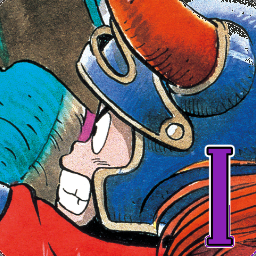
Dragon Quest
A Japanese console RPG series that simplified Western computer RPGs for a mass audience.
Where Dragon Quest comes up1 episode or test

Dragon Quest (1986, Famicom) took Wizardry's menu combat and Ultima's overworld, cut the complexity, and left players choosing only a name. It became a national craze with sequels selling millions. The lesson: simplify a niche genre, fit its input to the platform, and bring it to the most accessible hardware. The school-day release ban is a myth; Enix chose that itself.
- Played on home computers
- Hardcore crowd designs own character
- Typed input
- Played on Famicom, spring 1986
- Only choice is your name
- Command list built for controller
Simplified RPGs became playable by everyone
From Mark Brown on Dragon Quest
What was said about Dragon Quest
1How Dragon Quest stripped down Wizardry and Ultima for the Famicom
Dragon Quest combined Wizardry's combat with Ultima's overworld. Yuji Horii loved Wizardry and Koichi Nakamura loved Ultima, so battles took Wizardry's menu of options with large colourful sprites, and the overworld took Ultima's small walking characters with towns and castles as single tiles.
Both 1981 games had huge followings in Japan. "And so the final game combines the best of both."
Cutting choices made a niche, complex genre playable by everyone. The only character choice is your name; stats are preset and levelling is straightforward. Horii saw RPGs as niche and complex and wanted them to engage everyone, including younger players.
Famicom hardware limits also forced some of the simplification. Mark Brown calls the result "a distillation of a distillation of a distillation of Dungeons & Dragons."
They replaced typed input with a command list built for a controller. Porting their text adventure Portopia Serial Murder Case to the Famicom, Horii and Nakamura swapped the text parser for a command list. The same menu approach carried into Dragon Quest's battles.
Horii made Portopia after reading about Western text adventures. It is seen as the defining visual novel and inspired Hideo Kojima.
The core loop kept Wizardry's growth: fight, earn XP, level up, re-equip. Horii said the pleasure he took from Wizardry was "the idea of building up experience and getting stronger and buying new weapons," and that progression loop became Dragon Quest's backbone.
Akira Toriyama's art turned a generic blob enemy into a mascot. Horii's slime sketch was a retread of Wizardry's boring blob; Toriyama, then starting work on Dragon Ball, redrew it as funny, characterful and mascot-like.
Paired with irreverent, manga-inspired dialogue, the art made the game feel native to its Japanese audience and approachable.
2Why Dragon Quest split RPGs into Japanese and Western traditions
A niche genre took off once it reached the most accessible platform. RPGs found a big audience in the West when home computers like the Apple II arrived, and in Japan only once they reached the Famicom with Dragon Quest in spring 1986.
Japanese computer RPGs like The Black Onyx and Dragon Slayer came first but the genre needed a console to take off.
Platform and audience, not source material, decided how the genre evolved. Console limits and a wish for accessibility pushed Dragon Quest toward a predefined hero and a story, which became the mould for Japanese RPGs. Western RPGs stayed on computers for a hardcore crowd who role-play a character they design themselves.
Western designers drew straight from D&D, while Japanese designers drew from copies of copies. Decide which promise your game makes before designing its character system.
Dragon Quest's success got rival publishers to greenlight their own RPGs. After it, publishers approved Final Fantasy, Phantasy Star and Digital Devil Story. Final Fantasy went on to sell abroad far more than Dragon Quest did.
Other designers bent the formula: Shigesato Itoi made the parody Mother, and Sweet Home copied the command list and turn-based battles, with its planned 3D remake becoming Resident Evil.
3The national craze and the school-day release myth
Dragon Quest became a national event, and the release-day rule was Enix's own choice. Sequels sold millions, and Enix agreed on its own not to release games on school days. The popular story that a government law forced this is a myth.
Dragon Quest XI still launched on a Saturday in Japan.
4Mystery Dungeon: running the same playbook on Rogue
Nakamura localised another Western game and built a 30-plus game series. Having struck gold with a Japanese take on Western RPGs, Nakamura copied Rogue, a weird American PC game a colleague was obsessed with, to make Mystery Dungeon, which now has more than 30 games.
It keeps Rogue's random generation and permadeath, with spin-offs featuring Final Fantasy, Pokemon, Etrian Odyssey and Dragon Quest.
The Birth of the Japanese RPG | Design Icons
Released in spring 1986 on the Famicom, it took Wizardry's menu combat and Ultima's overworld, left players choosing only a name, and became a national craze with sequels selling millions. The law banning school-day releases is a myth, since Enix chose that itself.
Dragon Quest combined Wizardry's combat with Ultima's overworld. Yuji Horii loved Wizardry and Koichi Nakamura loved Ultima, so battles took Wizardry's menu of options with large colourful sprites, and the overworld took Ultima's small walking characters with towns and castles as single tiles.
Both 1981 games had huge followings in Japan. "And so the final game combines the best of both."
Cutting choices made a niche, complex genre playable by everyone. The only character choice is your name; stats are preset and levelling is straightforward. Horii saw RPGs as niche and complex and wanted them to engage everyone, including younger players.
Famicom hardware limits also forced some of the simplification. Mark Brown calls the result "a distillation of a distillation of a distillation of Dungeons & Dragons."
They replaced typed input with a command list built for a controller. Porting their text adventure Portopia Serial Murder Case to the Famicom, Horii and Nakamura swapped the text parser for a command list. The same menu approach carried into Dragon Quest's battles.
Horii made Portopia after reading about Western text adventures. It is seen as the defining visual novel and inspired Hideo Kojima.
The core loop kept Wizardry's growth: fight, earn XP, level up, re-equip. Horii said the pleasure he took from Wizardry was "the idea of building up experience and getting stronger and buying new weapons," and that progression loop became Dragon Quest's backbone.
Akira Toriyama's art turned a generic blob enemy into a mascot. Horii's slime sketch was a retread of Wizardry's boring blob; Toriyama, then starting work on Dragon Ball, redrew it as funny, characterful and mascot-like.
Paired with irreverent, manga-inspired dialogue, the art made the game feel native to its Japanese audience and approachable.
A niche genre took off once it reached the most accessible platform. RPGs found a big audience in the West when home computers like the Apple II arrived, and in Japan only once they reached the Famicom with Dragon Quest in spring 1986.
Japanese computer RPGs like The Black Onyx and Dragon Slayer came first but the genre needed a console to take off.
Platform and audience, not source material, decided how the genre evolved. Console limits and a wish for accessibility pushed Dragon Quest toward a predefined hero and a story, which became the mould for Japanese RPGs. Western RPGs stayed on computers for a hardcore crowd who role-play a character they design themselves.
Western designers drew straight from D&D, while Japanese designers drew from copies of copies. Decide which promise your game makes before designing its character system.
Dragon Quest's success got rival publishers to greenlight their own RPGs. After it, publishers approved Final Fantasy, Phantasy Star and Digital Devil Story. Final Fantasy went on to sell abroad far more than Dragon Quest did.
Other designers bent the formula: Shigesato Itoi made the parody Mother, and Sweet Home copied the command list and turn-based battles, with its planned 3D remake becoming Resident Evil.
Dragon Quest became a national event, and the release-day rule was Enix's own choice. Sequels sold millions, and Enix agreed on its own not to release games on school days. The popular story that a government law forced this is a myth.
Dragon Quest XI still launched on a Saturday in Japan.
Nakamura localised another Western game and built a 30-plus game series. Having struck gold with a Japanese take on Western RPGs, Nakamura copied Rogue, a weird American PC game a colleague was obsessed with, to make Mystery Dungeon, which now has more than 30 games.
It keeps Rogue's random generation and permadeath, with spin-offs featuring Final Fantasy, Pokemon, Etrian Odyssey and Dragon Quest.
More in Games
 Games
Nintendo
A Zelda adventure where Princess Zelda copies objects and monsters as echoes to solve puzzles and fight.
 Games
The Legend of Zelda: Breath of the Wild
Nintendo's long-running action-adventure series about Link exploring Hyrule, solving puzzles and fighting Ganon.
 Games
Dead Space
A major video game publisher and the guest's employer.
 G
 29 sources · 94 tips
Mind Over Magnet
A puzzle platformer where you escape a factory using a magnet and a magnetic field.
 Games
Far Cry 2
An open world action game where you recruit and play any of London's citizens.
 Games
God of War
A combat-focused action adventure game from Santa Monica Studio with Norse mythology and light puzzles.
Mind Over Magnet
Mark Brown's first game, a puzzle game he made while learning Unity.
 Games
Dishonored
A first-person stealth action game from Arkane with supernatural powers and the Clockwork Mansion level.