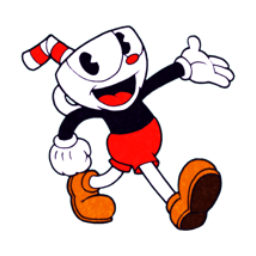
Cuphead
A run 'n' gun boss rush game styled like a 1930s cartoon.
Where Cuphead comes up2 episodes and tests
 Gcreator of Game Maker's Toolkit testHow Cuphead's Bosses (Try to) Kill You
 Gcreator of Game Maker's Toolkit testWhat Makes Celeste's Assist Mode Special
Cuphead builds boss fights around forced movement, finite learnable patterns, and layered phases, so players survive more than they win. Von Bon Bon draws three sub bosses from five, then adds jelly bean soldiers and a shotgun. Its Simple Mode, shown beside normal mode with little explanation, cut phases and locked the ending, which Celeste's Assist Mode avoided. Lesson: teach assists clearly and never strip progress.
- 1See the telegraphWind-up animation warns of the attack
- 2Get hit anywayNearly everyone is hit by the laser
- 3Recognise the warningNext time the animation is familiar
- 4Learn fixed outcomesCat always splits into four mice
- 5Predict and outsmartSmall self-taught epiphanies stack up
From Mark Brown's Cuphead boss analysis
What was said about Cuphead
1Boss attacks built to make you move
Cuphead designs boss attacks to force movement, not just to deal damage. Attacks exist so that standing still and shooting never works: the player has to run, jump, dash and parry while firing. Bosses use straight lines, arcs, boomerangs, splits, zig zags, sine waves, aimed shots and slow chasers.
Aimed shots fire at your current position, so staying put gets you hit, and slow chasers follow you only for a while. The fights are modelled on 1990s run 'n' gun games like Contra 3 and Gunstar Heroes, where the bosses were the stars. "The boss's attacks are ultimately, about making you move."
Change a projectile's speed and size to tune the same pattern's difficulty. Cuphead reuses its attack patterns across fights and makes them easier or harder by altering how fast and how big the projectiles are.
This lets a designer ramp up difficulty without inventing a new pattern each time.
2Memory, reaction and telegraphed attacks
Keep attack outcomes few and fixed so players can learn the boss. The dragon's fireball goes up, down or both, and the cat always splits into exactly four mice, never three or five. Small, self-taught discoveries stack up until the player can predict and outsmart the boss.
Learning the boss becomes a big part of beating it, which feels good after taking a beating. "These mini self-taught epiphanies stack up, to the point where you can now predict and outsmart the boss at every turn."
Pair predictable patterns with unpredictable timing so players must react too. Players know the cat will split into four mice but not when or where, and the dragon chooses between a fireball and a psychic ray. The fight tests reaction as well as memory.
Telegraph attacks, and size the warning to the threat. The dragon has separate wind-up animations for its psychic attack and fireball, walking flames yell before they jump, and sometimes text gives the warning. Bigger, harder attacks get longer build ups.
The length of the telegraph sets difficulty: longer is easier, shorter is harder. Players have very few hit points and can't heal mid-fight, so a missed warning costs a lot.
Let a harsh first hit teach what a telegraph means. Cuphead's screen-sized laser is announced by an animation, yet nearly every player is hit by it the first time. Next time they recognise the animation.
"In Cuphead, death is made part of the learning process."
3Layered patterns and boss phases
Raise difficulty by stacking simple patterns rather than hardening one. The puppet fires two bullet types at once, the mermaid pairs an electric eel with a column of sea urchins, and the clown fight sends a telegraphed rollercoaster across the screen every few seconds.
Environmental forces add load too: a fan pushes you left, a water jet pushes you up, platforms move and treasure chests fall. In the clown fight, the horse's colour shows which attack is coming.
Split long fights into phases instead of piling on health. The frog brothers Ribby and Croak move from flies and punches, to bouncing balls and a desk fan, to a slot machine with three dodging mini games. Each phase has its own patterns to learn.
Phases give small moments of satisfaction throughout, add surprise, and raise the stakes because losing sends you back to phase one. "Just giving the boss a million health points is rarely that fun."
4Baroness Von Bon Bon: memory, reaction and skill in one fight
- 1Random sub bossDrawn from a pool of five
- 2Add jelly bean soldiersPhase two piles on tiny soldiers
- 3Add candy floss shotgunPhase three hits once-safe ground
- 4Walking castle chaseHoming head and rock candy wheels
From Mark Brown's Cuphead boss analysis
Randomise sub bosses so memory alone can't win. Von Bon Bon's first three phases each draw a sub boss at random from a pool of five: Candy Corn, Gobstopper, Cupcake, Chocolate and Gumball Machine. Each covers the screen differently and needs a different style of dodging.
Candy Corn moves in straight lines and turns at the edges or middle, Gobstopper follows you, Cupcake jumps diagonally and slams down, Chocolate splits in eight directions, and Gumball Machine shuffles in a small area spilling sweets.
Add a layer each phase so learned safe spots stop being safe. Phase two adds tiny jelly bean soldiers and phase three adds Von Bon Bon's candy floss shotgun, which hits ground that was safe a moment ago. The final phase has her chase you in a walking castle while her thrown head homes in and rock candy wheels bounce along the ground.
"What you learned was a safe zone is now right in the firing line, so you'll have to make new plans quickly."
The best boss fights balance memory, reaction and execution skill. Von Bon Bon asks for learned patterns, reactions to random sub bosses and telegraphs, and tight control to dodge chasing and layered attacks. Most Cuphead bosses keep these three in balance.
"This boss is a delicate balance of memory, reaction, and skill."
5Surviving the boss rather than defeating it
Easy killing makes Cuphead fights about outlasting the boss. Holding the button shoots endlessly, targets are huge, and parrying and EX attacks are optional, so dodging is the real challenge and players often feel they survived rather than won.
Mark Brown argues the best boss fights only let the boss die when the player uses real mastery of the mechanics. "It's often more about outlasting the boss, than defeating it."
6Simple Mode and how it shaped Celeste's Assist Mode
Simple Mode sits beside normal mode before every fight, barely explained. The prompt appears before each boss right next to normal mode with little description, giving the easier path equal weight with the intended one. It inspired Celeste's Assist Mode, which took the opposite approach.
The suggested fix is to explain an assist option before the player sees it and not present it alongside the normal mode. "It pops up before every fight, right next to normal mode, and doesn't really explain what it does."
Simple Mode cuts content and locks players out of the ending. It removes whole boss phases, so players miss those animations, and wins on it don't count. The final boss and ending require beating every level on normal mode.
"Beating a boss on simple mode doesn't actually count the fight as a win."
7Similar examples from other apps
These are about other apps, not Cuphead: examples from the same sources that help explain it.
Super Meat Boy's Little Horn leans entirely on memory and fails. Little Horn repeats the same attacks every time, too fast to react to on a first try, so the fight becomes learning the pattern and entering the right commands.
Once the pattern is known, little skill is needed to beat him, the imbalance Cuphead's bosses mostly avoid.
What Makes Celeste's Assist Mode Special
Its Simple Mode appears before every fight next to normal mode with little explanation, cuts boss phases, and wins don't count. The ending stays locked behind normal mode wins. It inspired Celeste's Assist Mode.
Simple Mode sits beside normal mode before every fight, barely explained. The prompt appears before each boss right next to normal mode with little description, giving the easier path equal weight with the intended one. It inspired Celeste's Assist Mode, which took the opposite approach.
The suggested fix is to explain an assist option before the player sees it and not present it alongside the normal mode. "It pops up before every fight, right next to normal mode, and doesn't really explain what it does."
Simple Mode cuts content and locks players out of the ending. It removes whole boss phases, so players miss those animations, and wins on it don't count. The final boss and ending require beating every level on normal mode.
"Beating a boss on simple mode doesn't actually count the fight as a win."
How Cuphead's Bosses (Try to) Kill You
Its bosses force movement with varied projectile patterns, mixing memorisable attacks, telegraphed surprises and layered phases. Baroness Von Bon Bon draws three random sub bosses from five, then adds jelly bean soldiers and a candy floss shotgun. Killing bosses is easy with infinite shooting and huge targets, so fights often feel like surviving rather than winning.
Cuphead designs boss attacks to force movement, not just to deal damage. Attacks exist so that standing still and shooting never works: the player has to run, jump, dash and parry while firing. Bosses use straight lines, arcs, boomerangs, splits, zig zags, sine waves, aimed shots and slow chasers.
Aimed shots fire at your current position, so staying put gets you hit, and slow chasers follow you only for a while. The fights are modelled on 1990s run 'n' gun games like Contra 3 and Gunstar Heroes, where the bosses were the stars. "The boss's attacks are ultimately, about making you move."
Change a projectile's speed and size to tune the same pattern's difficulty. Cuphead reuses its attack patterns across fights and makes them easier or harder by altering how fast and how big the projectiles are.
This lets a designer ramp up difficulty without inventing a new pattern each time.
Keep attack outcomes few and fixed so players can learn the boss. The dragon's fireball goes up, down or both, and the cat always splits into exactly four mice, never three or five. Small, self-taught discoveries stack up until the player can predict and outsmart the boss.
Learning the boss becomes a big part of beating it, which feels good after taking a beating. "These mini self-taught epiphanies stack up, to the point where you can now predict and outsmart the boss at every turn."
Pair predictable patterns with unpredictable timing so players must react too. Players know the cat will split into four mice but not when or where, and the dragon chooses between a fireball and a psychic ray. The fight tests reaction as well as memory.
Telegraph attacks, and size the warning to the threat. The dragon has separate wind-up animations for its psychic attack and fireball, walking flames yell before they jump, and sometimes text gives the warning. Bigger, harder attacks get longer build ups.
The length of the telegraph sets difficulty: longer is easier, shorter is harder. Players have very few hit points and can't heal mid-fight, so a missed warning costs a lot.
Let a harsh first hit teach what a telegraph means. Cuphead's screen-sized laser is announced by an animation, yet nearly every player is hit by it the first time. Next time they recognise the animation.
"In Cuphead, death is made part of the learning process."
Raise difficulty by stacking simple patterns rather than hardening one. The puppet fires two bullet types at once, the mermaid pairs an electric eel with a column of sea urchins, and the clown fight sends a telegraphed rollercoaster across the screen every few seconds.
Environmental forces add load too: a fan pushes you left, a water jet pushes you up, platforms move and treasure chests fall. In the clown fight, the horse's colour shows which attack is coming.
Split long fights into phases instead of piling on health. The frog brothers Ribby and Croak move from flies and punches, to bouncing balls and a desk fan, to a slot machine with three dodging mini games. Each phase has its own patterns to learn.
Phases give small moments of satisfaction throughout, add surprise, and raise the stakes because losing sends you back to phase one. "Just giving the boss a million health points is rarely that fun."
Randomise sub bosses so memory alone can't win. Von Bon Bon's first three phases each draw a sub boss at random from a pool of five: Candy Corn, Gobstopper, Cupcake, Chocolate and Gumball Machine. Each covers the screen differently and needs a different style of dodging.
Candy Corn moves in straight lines and turns at the edges or middle, Gobstopper follows you, Cupcake jumps diagonally and slams down, Chocolate splits in eight directions, and Gumball Machine shuffles in a small area spilling sweets.
Add a layer each phase so learned safe spots stop being safe. Phase two adds tiny jelly bean soldiers and phase three adds Von Bon Bon's candy floss shotgun, which hits ground that was safe a moment ago. The final phase has her chase you in a walking castle while her thrown head homes in and rock candy wheels bounce along the ground.
"What you learned was a safe zone is now right in the firing line, so you'll have to make new plans quickly."
The best boss fights balance memory, reaction and execution skill. Von Bon Bon asks for learned patterns, reactions to random sub bosses and telegraphs, and tight control to dodge chasing and layered attacks. Most Cuphead bosses keep these three in balance.
"This boss is a delicate balance of memory, reaction, and skill."
Easy killing makes Cuphead fights about outlasting the boss. Holding the button shoots endlessly, targets are huge, and parrying and EX attacks are optional, so dodging is the real challenge and players often feel they survived rather than won.
Mark Brown argues the best boss fights only let the boss die when the player uses real mastery of the mechanics. "It's often more about outlasting the boss, than defeating it."
Super Meat Boy's Little Horn leans entirely on memory and fails. Little Horn repeats the same attacks every time, too fast to react to on a first try, so the fight becomes learning the pattern and entering the right commands.
Once the pattern is known, little skill is needed to beat him, the imbalance Cuphead's bosses mostly avoid.
More in Games
 Games
Nintendo
A Zelda adventure where Princess Zelda copies objects and monsters as echoes to solve puzzles and fight.
 Games
The Legend of Zelda: Breath of the Wild
Nintendo's long-running action-adventure series about Link exploring Hyrule, solving puzzles and fighting Ganon.
 Games
Dead Space
A major video game publisher and the guest's employer.
 G
 29 sources · 94 tips
Mind Over Magnet
A puzzle platformer where you escape a factory using a magnet and a magnetic field.
 Games
Far Cry 2
An open world action game where you recruit and play any of London's citizens.
 Games
God of War
A combat-focused action adventure game from Santa Monica Studio with Norse mythology and light puzzles.
Mind Over Magnet
Mark Brown's first game, a puzzle game he made while learning Unity.
 Games
Dishonored
A first-person stealth action game from Arkane with supernatural powers and the Clockwork Mansion level.