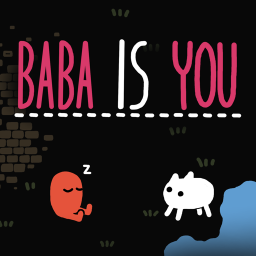
Baba Is You
A block-pushing puzzle game where you rewrite the game's rules by moving word blocks.
Where Baba Is You comes up2 episodes and tests
 Gcreator of Game Maker's Toolkit, discussing Hempuli's puzzle design process testHow Baba Is You Makes Brain Busting Puzzles
 Gcreator of Game Maker's Toolkit testThe Games That Designed Themselves
Baba Is You began as a 2017 Nordic Game Jam winner and grew to about 219 levels, named most inventive game of 2019. Arvi Teikari builds each level backward from its solution, blocks easy answers, and teaches one concept per puzzle through levels, not tutorials. Lesson: constrain the player, prototype cheaply at a jam, and playtest widely to catch unintended solutions.
- Jam theme "Not There"Nordic Game Jam sparks logic-operator idea
- Rules as pushable blocks"Ice Is Not Melt" meets Sokoban pushing
- Jam version winsPrototype built and tested in a weekend
- Full game shipsAbout 219 levels
- Most inventive gameGMTK pick, ahead of Outer Wilds
From Game Maker's Toolkit on Baba Is You
What was said about Baba Is You
1From a 2017 Nordic Game Jam idea to 2019's most inventive game
A jam theme became a logic-rule hook combined with block pushing. At the 2017 Nordic Game Jam, the theme "Not There" made Arvi Teikari think of logic operators like "Not". He pictured a block of ice that doesn't melt in lava because of the rule "Ice Is Not Melt", and mixed that with Sokoban-style block pushers like Snakebird and Stephen's Sausage Roll.
The jam version won. Two years later the game had about 219 levels, and Game Maker's Toolkit named it the most inventive game of 2019, ahead of Disco Elysium, Untitled Goose Game, Outer Wilds and Heaven's Vault.
Game jams make experimenting cheap because you can drop the idea. A jam lets you build a prototype from your head in a weekend and toss it if it fails. Baba Is You is one of the games that started this way.
Quote: "you are not committed to the idea for longer than the game jam takes".
Rules as pushable word blocks let players rewrite the game's logic. Removing "Stop" from "Wall Is Stop" lets you walk through walls, changing "Flag Is Win" to "Rock Is Win" makes the rock the goal, and pushing "Rock" into "Baba Is You" turns the main character into a boulder.
The goal is never simply to reach the flag: you rewrite the rules until the goal becomes reachable, and each level is built around one "aha!" moment.
2Building each level backwards from the solution
- 1Pick a cool interactionAsk what would be cool to see
- 2Fix the solutione.g. "Baba Is Move"
- 3Block every shortcutLocked doors, hedges, words stuck in corners
- 4Player walks it backwardsOpens each locked door in turn
From Arvi Teikari via Game Maker's Toolkit
Start from an interaction worth seeing, then build a level that forces it. Teikari asks what would be cool to see, then designs a level where the player has to use that interaction. Ideas include "Pull" letting Keke drag a key across a lake, "Has" dropping a box on each death that turns back into Keke, and a teleporter moving rules instead of objects.
Quote: "I try to figure out what kind of level do I have to build so that when the player is playing the level they have to use that interaction".
Restriction, not freedom, is what makes an open rule system puzzling. An open-ended rule system invites easy answers, so Baba Is You limits players with which words are on screen, sentences pushed against walls or behind fences, and a cramped grid.
Quote: "So the designer's job is actually to lock you in and force restrictions on you."
Each obstacle exists to close off one shortcut to the intended trick. Teikari calls it reverse engineering: start with the solution, then add restrictions that rule out simpler routes. In Baba Doesn't Respond the answer is "Baba Is Move", protected by a locked door, a reed that turns deadly, a hedge that shortens Baba's run-up, and a "Move" word stuck in a corner so the sentence must be made on the far left edge.
Belts give Baba a long path, Chu Chu Rocket style. "Door Is Shut And Open" alone would be too easy. The player then walks the same path in reverse, opening each locked door in turn until reaching a simple final answer.
Stacked impossible problems lure the player toward the one answer left. In Tiny Pond the water is "Shut" and Baba is "Open", so touching it destroys Baba; "Key Is Open" fails because there's no "Push"; "Key Is You" still dies at the water; and there aren't enough words to be key and Baba at once. The only way forward is "Flag Is Key", giving you two keys so you can sacrifice one.
The setup states the core contradiction plainly: you need to be Open without vanishing. Quote: "The set-up for the stage walked us right into the central problem of the level".
Leftover decoys are fine, but never red herrings or busy work. Some unneeded pieces and even unintended solutions stay in, as long as they don't trivialise the real answer.
Quote: "they're never red herrings or pointless busy work - they're about leading the player to the catch at the centre of the puzzle."
3Teaching the rules without a tutorial
Early level solutions each teach one core concept. Level 1 forces you to break "Wall Is Stop" and make "Flag Is Win", the two basic actions. Level 2 has you play as a wall made of flags, teaching that nothing has value except through a rule.
A later level teaches that "Lava Is Push" overrides "Lava Is Hot" and that two crossing sentences can share one "Is" block.
Every new word gets an intro puzzle where its basic function is the trick. Operators like "And" and words like "Open" and "Shut" each get a dedicated introductory puzzle, placed at the start of a world.
Teikari finds them by exhausting the meaningful interactions between elements. Quote: "eventually I get levels where the 'trick' is mostly just the basic functionality of a specific element in itself".
Later levels reuse earlier tricks so hard puzzles feel fair. Tiny Pond builds on Jelly Throne, where you control two characters, and its sacrifice trick returns in Unreachable Shores, where one Keke is sacrificed.
As a first level, Tiny Pond would stump a new player. Quote: "playing Baba Is You means constantly adding to an ever expanding knowledge base that grows with every stage you play."
4Surprise, odd words and exploring every interaction
Aim for surprise and laughter over punishing difficulty. Levels play on assumptions: players try to unlock the door when they actually need to unlock the wall, and a YouTuber laughs on realising there was no "Wall Is Stop" rule.
Quote: "I was confining myself to this stupid little area and I didn't need to."
Strange words push the rule system to its meta limits. "Empty" controls empty space, "Make" leaves a trail, "More" duplicates keys until they fill the space, "Text" lets rules manipulate rules, and "Level" lets you move the whole screen around the map.
Teikari follows a Braid-style aim, like Jonathan Blow's, to explore every interaction. "Not" flips rules and was the game's original idea.
5Cutting words and expert playtesting
Cut mechanics that are costly to build or hazy and dull. "Stick", which clumped objects together, was cut because "it created nightmare programming problems", and "Safe" was cut as hazy and uninteresting.
Some weaker pieces remain: "Swap" is a weaker "Tele", and the stage with Keke trapped under words is awkward. With 200-odd stages, a few won't land for everyone.
Expert puzzle designers as testers caught unintended solutions. Testers included the designers of Ending, A Good Snowman Is Hard To Build, Pipe Push Paradise, Starseed Pilgrim, Minit and The Witness, who found alternative solutions and sharpened stages.
Teikari: "I'm extremely thankful for how much testers have done for the game".
6Similar examples from other apps
These are about other apps, not Baba Is You: examples from the same sources that help explain it.
Scribblenauts shows how unrestricted freedom invites one easy answer. In Scribblenauts, half of the levels can be finished by writing the word jetpack, the contrast used to explain why Baba Is You restricts its words and space.
The Games That Designed Themselves
Arvi Teikari dreamed it up at a game jam, where a prototype can be thrown away without long commitment.
Game jams make experimenting cheap because you can drop the idea. A jam lets you build a prototype from your head in a weekend and toss it if it fails. Baba Is You is one of the games that started this way.
Quote: "you are not committed to the idea for longer than the game jam takes".
How Baba Is You Makes Brain Busting Puzzles
Designer Arvi Teikari builds each level backwards from the solution, locking off easy answers so players reach one 'aha!' moment. It grew from a 2017 Nordic Game Jam winner to about 219 levels, and was named the most inventive game of 2019.
A jam theme became a logic-rule hook combined with block pushing. At the 2017 Nordic Game Jam, the theme "Not There" made Arvi Teikari think of logic operators like "Not". He pictured a block of ice that doesn't melt in lava because of the rule "Ice Is Not Melt", and mixed that with Sokoban-style block pushers like Snakebird and Stephen's Sausage Roll.
The jam version won. Two years later the game had about 219 levels, and Game Maker's Toolkit named it the most inventive game of 2019, ahead of Disco Elysium, Untitled Goose Game, Outer Wilds and Heaven's Vault.
Rules as pushable word blocks let players rewrite the game's logic. Removing "Stop" from "Wall Is Stop" lets you walk through walls, changing "Flag Is Win" to "Rock Is Win" makes the rock the goal, and pushing "Rock" into "Baba Is You" turns the main character into a boulder.
The goal is never simply to reach the flag: you rewrite the rules until the goal becomes reachable, and each level is built around one "aha!" moment.
Start from an interaction worth seeing, then build a level that forces it. Teikari asks what would be cool to see, then designs a level where the player has to use that interaction. Ideas include "Pull" letting Keke drag a key across a lake, "Has" dropping a box on each death that turns back into Keke, and a teleporter moving rules instead of objects.
Quote: "I try to figure out what kind of level do I have to build so that when the player is playing the level they have to use that interaction".
Restriction, not freedom, is what makes an open rule system puzzling. An open-ended rule system invites easy answers, so Baba Is You limits players with which words are on screen, sentences pushed against walls or behind fences, and a cramped grid.
Quote: "So the designer's job is actually to lock you in and force restrictions on you."
Each obstacle exists to close off one shortcut to the intended trick. Teikari calls it reverse engineering: start with the solution, then add restrictions that rule out simpler routes. In Baba Doesn't Respond the answer is "Baba Is Move", protected by a locked door, a reed that turns deadly, a hedge that shortens Baba's run-up, and a "Move" word stuck in a corner so the sentence must be made on the far left edge.
Belts give Baba a long path, Chu Chu Rocket style. "Door Is Shut And Open" alone would be too easy. The player then walks the same path in reverse, opening each locked door in turn until reaching a simple final answer.
Stacked impossible problems lure the player toward the one answer left. In Tiny Pond the water is "Shut" and Baba is "Open", so touching it destroys Baba; "Key Is Open" fails because there's no "Push"; "Key Is You" still dies at the water; and there aren't enough words to be key and Baba at once. The only way forward is "Flag Is Key", giving you two keys so you can sacrifice one.
The setup states the core contradiction plainly: you need to be Open without vanishing. Quote: "The set-up for the stage walked us right into the central problem of the level".
Leftover decoys are fine, but never red herrings or busy work. Some unneeded pieces and even unintended solutions stay in, as long as they don't trivialise the real answer.
Quote: "they're never red herrings or pointless busy work - they're about leading the player to the catch at the centre of the puzzle."
Early level solutions each teach one core concept. Level 1 forces you to break "Wall Is Stop" and make "Flag Is Win", the two basic actions. Level 2 has you play as a wall made of flags, teaching that nothing has value except through a rule.
A later level teaches that "Lava Is Push" overrides "Lava Is Hot" and that two crossing sentences can share one "Is" block.
Every new word gets an intro puzzle where its basic function is the trick. Operators like "And" and words like "Open" and "Shut" each get a dedicated introductory puzzle, placed at the start of a world.
Teikari finds them by exhausting the meaningful interactions between elements. Quote: "eventually I get levels where the 'trick' is mostly just the basic functionality of a specific element in itself".
Later levels reuse earlier tricks so hard puzzles feel fair. Tiny Pond builds on Jelly Throne, where you control two characters, and its sacrifice trick returns in Unreachable Shores, where one Keke is sacrificed.
As a first level, Tiny Pond would stump a new player. Quote: "playing Baba Is You means constantly adding to an ever expanding knowledge base that grows with every stage you play."
Aim for surprise and laughter over punishing difficulty. Levels play on assumptions: players try to unlock the door when they actually need to unlock the wall, and a YouTuber laughs on realising there was no "Wall Is Stop" rule.
Quote: "I was confining myself to this stupid little area and I didn't need to."
Strange words push the rule system to its meta limits. "Empty" controls empty space, "Make" leaves a trail, "More" duplicates keys until they fill the space, "Text" lets rules manipulate rules, and "Level" lets you move the whole screen around the map.
Teikari follows a Braid-style aim, like Jonathan Blow's, to explore every interaction. "Not" flips rules and was the game's original idea.
Cut mechanics that are costly to build or hazy and dull. "Stick", which clumped objects together, was cut because "it created nightmare programming problems", and "Safe" was cut as hazy and uninteresting.
Some weaker pieces remain: "Swap" is a weaker "Tele", and the stage with Keke trapped under words is awkward. With 200-odd stages, a few won't land for everyone.
Expert puzzle designers as testers caught unintended solutions. Testers included the designers of Ending, A Good Snowman Is Hard To Build, Pipe Push Paradise, Starseed Pilgrim, Minit and The Witness, who found alternative solutions and sharpened stages.
Teikari: "I'm extremely thankful for how much testers have done for the game".
Scribblenauts shows how unrestricted freedom invites one easy answer. In Scribblenauts, half of the levels can be finished by writing the word jetpack, the contrast used to explain why Baba Is You restricts its words and space.
More in Games
 Games
Nintendo
A Zelda adventure where Princess Zelda copies objects and monsters as echoes to solve puzzles and fight.
 Games
The Legend of Zelda: Breath of the Wild
Nintendo's long-running action-adventure series about Link exploring Hyrule, solving puzzles and fighting Ganon.
 Games
Dead Space
A major video game publisher and the guest's employer.
 G
 29 sources · 94 tips
Mind Over Magnet
A puzzle platformer where you escape a factory using a magnet and a magnetic field.
 Games
Far Cry 2
An open world action game where you recruit and play any of London's citizens.
 Games
God of War
A combat-focused action adventure game from Santa Monica Studio with Norse mythology and light puzzles.
Mind Over Magnet
Mark Brown's first game, a puzzle game he made while learning Unity.
 Games
Dishonored
A first-person stealth action game from Arkane with supernatural powers and the Clockwork Mansion level.