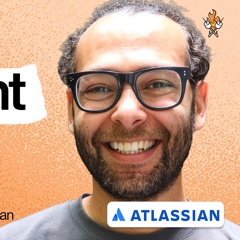
Sherif Mansour
Head of AI and Product Craft at Atlassian
Where to hear and read about Sherif Mansour1 episode or test
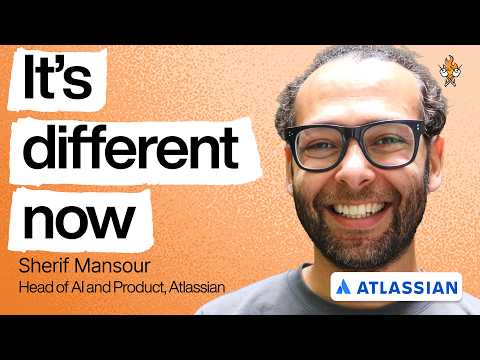
Sherif Mansour is Head of AI and Product Craft at Atlassian, where he has worked 17 years and was Confluence's first PM. The thing most worth learning from him is that a PM's job is to fill context gaps so the whole team shares one brain, because with AI making building cheap, direction is the bottleneck.
They don't own decision making. PMs own decision making velocity.
The new rules of product management in the AI era | Sherif Mansour (Head of AI, Atlassian)
Sherif Mansour: the story and the lessons
1Who Sherif Mansour is
Mansour has spent 17 years at Atlassian and now leads its AI work. He is Head of AI and Product Craft and sits on the exec team. He was Confluence's first PM.
At Confluence he saw product engineers help PMs scale by carrying shared context. No term existed for the role, so he defined it in a post.
He is an artist PM and jokes that he is the worst general manager type. At Atlassian it is a running joke that he is the worst general manager type, yet he is on the exec team as head of AI.
The joking makes it safe for others to share their weaknesses. His partner Jamille is his opposite, and each shines where the other is weak. He says joking at work is also how he handles his nerves.
Scaling product teams was the hardest thing he did at Atlassian. Past 20 or 30 people, trust breaks, shared brains break and an us-and-them culture forms.
Early in his career he vented to his manager that the team was blocked on him. She told him to spend more time on strategic things, and he saw he was too busy planning sprints.
2Mansour's view of the PM job: build a shared brain
Mansour says a PM's job is to fill context gaps. He names three contexts: the customer, the product and market, and the business. The aim is a team that can decide without waiting.
If one backlog card seems more important than another, that is context the team lacks. He tells PMs to run away from the Jira backlog.
PMs own decision velocity, not the decisions themselves. Being the bottleneck on every decision is a sign the PM has not shared enough context.
His line: "They don't own decision making. PMs own decision making velocity."
He puts engineers in customer interviews instead of sending summaries. Engineers' own aha moments build far more empathy than a handed-over report. Engineers also staff booths at Atlassian's European customer event.
"I try never to do customer interviews without engineers in the room."
An engineer who watched customers invented checkbox tasks in 2010. Confluence customers put red stars (not done) and green stars (done) in meeting notes. After the call, an engineer proposed a checkbox users could tick, and no one had put tasks in a web document editor before.
The usage data alone only suggested shipping more icons.
He wants a PM to hold no extra power over the team. A squad PM has no reports, so influence without authority is the job. The alternative to handing over a spec is getting everyone on board with the vision.
If you disagree with a roadmap item, either your belief has not been shared with the team, or you are wrong.
3What Atlassian's AI builder experiment taught Mansour
Atlassian's all-AI-builder squads went back to their crafts after about a month. The squads had no PM or designer, and members came from different crafts. After about a month, everyone returned to their traditional jobs.
In the first weeks one PM called it unbelievable and said they were moving faster than ever. Mansour's reaction was doubt about whether that was where it would land.
He concluded that throughput is cheap and direction is the bottleneck. Where a company has dozens to tens of thousands of engineers, the problem is direction, not how quick you can pump things out. Startups and zero-to-one projects still need everyone to do anything.
A PM on his team put it this way: "We realized throughput's not our problem. Direction's our problem." His rule is direct the ship, don't row it.
The mockup era showed him that tool access does not make you a specialist. Balsamiq promised everyone could do mockups, and Atlassian adopted many mockup tools. He learned that PMs are some of the worst solution designers in the world.
"AI is really good at amplifying your strengths and equally it amplifies your weaknesses." Artist PMs end up making better mockups.
He tells PMs to name the team's context gap before picking an AI use. For a customer empathy gap, involve the team and use AI to fill it faster. A vision gap can be helped by prototyping, and a market gap by agents running analysis.
Shipping production code is rarely the bottleneck to speed up, except at startups or new teams.
He runs AI builder weeks where every craft stops and tinkers. Engineering, design and PM all pause normal work for a week to experiment with AI together.
Juniors tend to show demos and tools, while seniors gravitate to slop, evals and quality. That shows who explores and who stress-tests.
He sees PM demand rising because teams need people to steer. Job market data shows PM with the most open roles, engineering slowing and design flat. User research has only about 108 open roles globally.
Many people expected AI to make the PM role redundant, and that did not happen.
4How Mansour hires, places and grows PMs
He sorts PMs into general manager, scientist and artist types. Geoff Redfern created the triangle at Atlassian. A general manager thinks in TAM, profit and revenue, a scientist is hypothesis driven, and an artist is led by emotion, vision and experience.
Mansour says picking one framework and sticking with it is what matters. Few people do all three well, though many are fine at all three for zero-to-one work.
He asks candidates for a favorite product and how to improve it. A general manager sizes the TAM, a scientist starts from a hypothesis and tests variants, and an artist paints a visual vision then works back to the problems.
Atlassian uses the triangle in calibration and hiring, and asks what kind of PM a team needs before adding one. He has seen struggling PMs regain energy after moving to a different type of project.
He favors artist PMs because taste differentiates when software is cheap. When everyone has the same intelligence and similar features, experience becomes the differentiator. He doubts that one agent interface will win.
In APM take-home Looms, one candidate walked through graphs, business case and TAM, while another walked the end-to-end journey to build an emotional connection. He read the second as an early artist streak. Another signal is the person who grabs the whiteboard marker and draws.
He hires juniors because they carry no old habits to unlearn. Mansour recalls 38% of juniors being more likely to adopt new tools than seniors. Seniors spot AI slop quickly, so the two groups complement each other.
Atlassian has over-indexed on juniors because it has an established workforce that must change. Its Sydney APM cohort mixed arts, law, technology and computer science backgrounds, and he looks for critical thinking and curiosity.
He asks candidates what new culture they would bring. He defines culture as how work gets done. He pushes past answers like "I use it to summarize stuff".
"AI native" is a relative term, so he looks for new ways of working instead.
He tells people to run toward their natural strengths. Leaning into strengths beats fixing weaknesses. Early in a career, he says, do career discovery the way you would do product discovery.
"find the thing you're good at and run for the heels towards that direction and ignore everything else."
He handed Rachel a growing product after spotting her scientist brain. While a new product was growing, he saw that Rachel had a scientist brain. He stepped aside and asked her to take it over.
He says a leader's job is to spot the opening, which may mean moving someone to another team. A sign you are good at something is that people praise a project of yours.
5How Mansour approaches product strategy
He starts from the solution when discovering what to productize. Three and a half years ago Atlassian debated putting a general chat and custom agents into Rovo, against the safer idea of a summarize button on Confluence pages. Chat on a whiteboard was a clumsy way to group sticky notes, so the team turned it into a select-and-group feature.
Nearly 10 million agents run in loops each month in Jira and Confluence, and common ones like AI triage became native features. He calls it paving the cow path, though he doubts it covers most cases.
For strategy he lists assets, lists beliefs, then looks for the link. "Where do we play, how do we win" can only be answered from what is unique about your company and product. At Amazon, a huge book inventory led Bezos to ask what else needs a ridiculously large inventory, and the answer was the everything store.
He warns that teams now talk to too few humans, because dashboards make it easy to stay behind a screen.
He says bolting AI onto existing workflows is often the right move. Customers have modeled billions of workflows in Jira, many outside software, such as app store approvals and telecom complaints. Atlassian let agents be added to columns and cards.
He admits it "sounds dirty" and would not market it as bolting on. Agents run millions of times with measurable value, and a weak agent gets improved or removed.
He cites Gemini in Google Maps as a lesson in workflow proximity. The AI knew the trip, so his family played quiz games about their destination without leaving the map. It kept the kids off screens for about 30 minutes.
"it's such a lesson in product workflow proximity."
He treats product advice as bound to its context. He says every piece of product advice has an equally good opposite. He backs an AI builder on zero-to-one projects even in large organizations, and equally advocates starting with the problem.
Advice only transfers when you understand where it worked, so he asks why it worked.
6How Mansour leads, and handles founders and disagreement
Atlassian runs two manager models, matched to each person's strengths. One manages 10 to 15 people and acts as a coach. The other manages three or four and owns a project. Most managers have eight or nine reports.
Several distinguished PMs and engineers work at exec level as individual contributors, and many people move between IC and manager tracks by season.
He says new PM managers go hands off too quickly. The best managers at Atlassian join the team and help it get through outcomes. In a product review a weak manager says it isn't simple enough, and a strong one says let's explore some options together.
Space for the team still matters, but not by zooming out completely.
With visionary founders he assumes they are right and he is wrong. He pictures the leader on chapter 10 of a movie, himself on chapter three and the team on chapter one. He asks what made them reach that conclusion.
In his experience founders have been right 99% of the time, because they have thought about the problem longer. Following orders without conviction is the dangerous path.
When he disagrees, he asks who owns the decision. He asks "are you the decision maker or am I?" and backs whoever owns the call. To the team he gives the pros and cons of each option, then the decision.
Leaders often say "I disagree, but I want you to own it." He says the best PMs argue against themselves, and he asks in reviews, "why would we not do this?"
He asks powerful people to label how strong their opinion is. Dharmesh Shah's hashtags mark an opinion as an FYI, a suggestion, a recommendation or a plea. The PM asks about conviction and plays it back at the end.
Atlassian's founders say things like "strong opinion, not my decision." The playback sorts each opinion into a conviction to explore or an input the team decides on.
He urges leaders to make room for someone else's career. He says everyone is a product of someone who made room for them, and asks who you are creating opportunities for.
If no name comes to mind, he says, find someone you believe in and give them a go. He sums it up as remember where you came from.

The new rules of product management in the AI era | Sherif Mansour (Head of AI, Atlassian)
Sherif Mansour argues that a PM's core job is building a shared brain by filling context gaps, and that AI makes direction, taste and diverse teams more valuable, not less. His team's experiment with all-AI-builder squads ended with everyone returning to their crafts, and PM job openings are now growing fastest.
Mansour has spent 17 years at Atlassian and now leads its AI work. He is Head of AI and Product Craft and sits on the exec team. He was Confluence's first PM.
At Confluence he saw product engineers help PMs scale by carrying shared context. No term existed for the role, so he defined it in a post.
He is an artist PM and jokes that he is the worst general manager type. At Atlassian it is a running joke that he is the worst general manager type, yet he is on the exec team as head of AI.
The joking makes it safe for others to share their weaknesses. His partner Jamille is his opposite, and each shines where the other is weak. He says joking at work is also how he handles his nerves.
Scaling product teams was the hardest thing he did at Atlassian. Past 20 or 30 people, trust breaks, shared brains break and an us-and-them culture forms.
Early in his career he vented to his manager that the team was blocked on him. She told him to spend more time on strategic things, and he saw he was too busy planning sprints.
Mansour says a PM's job is to fill context gaps. He names three contexts: the customer, the product and market, and the business. The aim is a team that can decide without waiting.
If one backlog card seems more important than another, that is context the team lacks. He tells PMs to run away from the Jira backlog.
PMs own decision velocity, not the decisions themselves. Being the bottleneck on every decision is a sign the PM has not shared enough context.
His line: "They don't own decision making. PMs own decision making velocity."
He puts engineers in customer interviews instead of sending summaries. Engineers' own aha moments build far more empathy than a handed-over report. Engineers also staff booths at Atlassian's European customer event.
"I try never to do customer interviews without engineers in the room."
An engineer who watched customers invented checkbox tasks in 2010. Confluence customers put red stars (not done) and green stars (done) in meeting notes. After the call, an engineer proposed a checkbox users could tick, and no one had put tasks in a web document editor before.
The usage data alone only suggested shipping more icons.
He wants a PM to hold no extra power over the team. A squad PM has no reports, so influence without authority is the job. The alternative to handing over a spec is getting everyone on board with the vision.
If you disagree with a roadmap item, either your belief has not been shared with the team, or you are wrong.
Atlassian's all-AI-builder squads went back to their crafts after about a month. The squads had no PM or designer, and members came from different crafts. After about a month, everyone returned to their traditional jobs.
In the first weeks one PM called it unbelievable and said they were moving faster than ever. Mansour's reaction was doubt about whether that was where it would land.
He concluded that throughput is cheap and direction is the bottleneck. Where a company has dozens to tens of thousands of engineers, the problem is direction, not how quick you can pump things out. Startups and zero-to-one projects still need everyone to do anything.
A PM on his team put it this way: "We realized throughput's not our problem. Direction's our problem." His rule is direct the ship, don't row it.
The mockup era showed him that tool access does not make you a specialist. Balsamiq promised everyone could do mockups, and Atlassian adopted many mockup tools. He learned that PMs are some of the worst solution designers in the world.
"AI is really good at amplifying your strengths and equally it amplifies your weaknesses." Artist PMs end up making better mockups.
He tells PMs to name the team's context gap before picking an AI use. For a customer empathy gap, involve the team and use AI to fill it faster. A vision gap can be helped by prototyping, and a market gap by agents running analysis.
Shipping production code is rarely the bottleneck to speed up, except at startups or new teams.
He runs AI builder weeks where every craft stops and tinkers. Engineering, design and PM all pause normal work for a week to experiment with AI together.
Juniors tend to show demos and tools, while seniors gravitate to slop, evals and quality. That shows who explores and who stress-tests.
He sees PM demand rising because teams need people to steer. Job market data shows PM with the most open roles, engineering slowing and design flat. User research has only about 108 open roles globally.
Many people expected AI to make the PM role redundant, and that did not happen.
He sorts PMs into general manager, scientist and artist types. Geoff Redfern created the triangle at Atlassian. A general manager thinks in TAM, profit and revenue, a scientist is hypothesis driven, and an artist is led by emotion, vision and experience.
Mansour says picking one framework and sticking with it is what matters. Few people do all three well, though many are fine at all three for zero-to-one work.
He asks candidates for a favorite product and how to improve it. A general manager sizes the TAM, a scientist starts from a hypothesis and tests variants, and an artist paints a visual vision then works back to the problems.
Atlassian uses the triangle in calibration and hiring, and asks what kind of PM a team needs before adding one. He has seen struggling PMs regain energy after moving to a different type of project.
He favors artist PMs because taste differentiates when software is cheap. When everyone has the same intelligence and similar features, experience becomes the differentiator. He doubts that one agent interface will win.
In APM take-home Looms, one candidate walked through graphs, business case and TAM, while another walked the end-to-end journey to build an emotional connection. He read the second as an early artist streak. Another signal is the person who grabs the whiteboard marker and draws.
He hires juniors because they carry no old habits to unlearn. Mansour recalls 38% of juniors being more likely to adopt new tools than seniors. Seniors spot AI slop quickly, so the two groups complement each other.
Atlassian has over-indexed on juniors because it has an established workforce that must change. Its Sydney APM cohort mixed arts, law, technology and computer science backgrounds, and he looks for critical thinking and curiosity.
He asks candidates what new culture they would bring. He defines culture as how work gets done. He pushes past answers like "I use it to summarize stuff".
"AI native" is a relative term, so he looks for new ways of working instead.
He tells people to run toward their natural strengths. Leaning into strengths beats fixing weaknesses. Early in a career, he says, do career discovery the way you would do product discovery.
"find the thing you're good at and run for the heels towards that direction and ignore everything else."
He handed Rachel a growing product after spotting her scientist brain. While a new product was growing, he saw that Rachel had a scientist brain. He stepped aside and asked her to take it over.
He says a leader's job is to spot the opening, which may mean moving someone to another team. A sign you are good at something is that people praise a project of yours.
He starts from the solution when discovering what to productize. Three and a half years ago Atlassian debated putting a general chat and custom agents into Rovo, against the safer idea of a summarize button on Confluence pages. Chat on a whiteboard was a clumsy way to group sticky notes, so the team turned it into a select-and-group feature.
Nearly 10 million agents run in loops each month in Jira and Confluence, and common ones like AI triage became native features. He calls it paving the cow path, though he doubts it covers most cases.
For strategy he lists assets, lists beliefs, then looks for the link. "Where do we play, how do we win" can only be answered from what is unique about your company and product. At Amazon, a huge book inventory led Bezos to ask what else needs a ridiculously large inventory, and the answer was the everything store.
He warns that teams now talk to too few humans, because dashboards make it easy to stay behind a screen.
He says bolting AI onto existing workflows is often the right move. Customers have modeled billions of workflows in Jira, many outside software, such as app store approvals and telecom complaints. Atlassian let agents be added to columns and cards.
He admits it "sounds dirty" and would not market it as bolting on. Agents run millions of times with measurable value, and a weak agent gets improved or removed.
He cites Gemini in Google Maps as a lesson in workflow proximity. The AI knew the trip, so his family played quiz games about their destination without leaving the map. It kept the kids off screens for about 30 minutes.
"it's such a lesson in product workflow proximity."
He treats product advice as bound to its context. He says every piece of product advice has an equally good opposite. He backs an AI builder on zero-to-one projects even in large organizations, and equally advocates starting with the problem.
Advice only transfers when you understand where it worked, so he asks why it worked.
Atlassian runs two manager models, matched to each person's strengths. One manages 10 to 15 people and acts as a coach. The other manages three or four and owns a project. Most managers have eight or nine reports.
Several distinguished PMs and engineers work at exec level as individual contributors, and many people move between IC and manager tracks by season.
He says new PM managers go hands off too quickly. The best managers at Atlassian join the team and help it get through outcomes. In a product review a weak manager says it isn't simple enough, and a strong one says let's explore some options together.
Space for the team still matters, but not by zooming out completely.
With visionary founders he assumes they are right and he is wrong. He pictures the leader on chapter 10 of a movie, himself on chapter three and the team on chapter one. He asks what made them reach that conclusion.
In his experience founders have been right 99% of the time, because they have thought about the problem longer. Following orders without conviction is the dangerous path.
When he disagrees, he asks who owns the decision. He asks "are you the decision maker or am I?" and backs whoever owns the call. To the team he gives the pros and cons of each option, then the decision.
Leaders often say "I disagree, but I want you to own it." He says the best PMs argue against themselves, and he asks in reviews, "why would we not do this?"
He asks powerful people to label how strong their opinion is. Dharmesh Shah's hashtags mark an opinion as an FYI, a suggestion, a recommendation or a plea. The PM asks about conviction and plays it back at the end.
Atlassian's founders say things like "strong opinion, not my decision." The playback sorts each opinion into a conviction to explore or an input the team decides on.
He urges leaders to make room for someone else's career. He says everyone is a product of someone who made room for them, and asks who you are creating opportunities for.
If no name comes to mind, he says, find someone you believe in and give them a go. He sums it up as remember where you came from.
More from Atlassian
 Guest
Megan Cook
Head of Product, Jira at Atlassian
 Atlassian1 source · 19 tips
 Guest
Tanguy Crusson
Head of Jira Product Discovery, Atlassian
Atlassian1 source · 16 tipsCarilu Dietrich
Former Head of Marketing at Atlassian (through IPO); advisor to CEOs and CMOs of hypergrowth B2B companies
Atlassian1 source · 20 tips