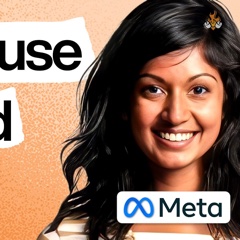
Mona Sarantakos
VP of Product, Meta Superintelligence Labs
Where to hear and read about Mona Sarantakos1 episode or test

Mona Sarantakos is VP of Product at Meta Superintelligence Labs and led product for Muse, Meta's personal agent, from day one. The lesson most worth taking from her is to hold an agent's launch until trust is earned, then make it feel like the user's own.
the last thing you want to talk to you is a corporate logo
Meta’s Muse: How we launched the most successful consumer product this year | Mona Sarantakos
Mona Sarantakos: the story and the lessons
1How Mona Sarantakos came to build Muse
Sarantakos is a ten-year Meta veteran who rarely speaks in public. She is VP of Product at Meta Superintelligence Labs and has led Muse product from day one. Before the podcast she had about five Threads posts and one LinkedIn post.
Zuckerberg has hinted that Muse is the fastest-growing consumer AI product of all time. It reached the number one spot in the App Store.
She was rebuilding Meta AI from scratch when Muse started. She had worked on the Meta AI assistant for about two years and was zero basing it, meaning starting over instead of optimizing something that wasn't working. Her H1 brief guessed consumer agents would arrive around the end of 2026 or 2027.
The Meta AI team was strong enough that a few people could peel off to experiment.
A weekend with OpenClaw on a Raspberry Pi started it all. At the end of January, Nat Friedman pinged a few colleagues. Mona ran OpenClaw on a Raspberry Pi because Mac Minis were sold out, and connected email, calendar and home automation.
A prompt of a few words produced a Monday briefing of school and calendar items, and she felt on top of her personal life for the first time. Her husband said "That is so not safe." She calls it "a ping that just ended up consuming me completely", with no workstream or team attached.
The weekend showed a consumer version had to be far safer. Using the agent with broad access, the team saw it needed to be much safer, easier to set up and scalable. They stayed informal while prototyping and mobilized a proper team only once they were sure there was a product.
Zuckerberg's earlier writing on personal superintelligence seemed to be coming true with this harness around the models.
2Why Muse waited seven months to launch
Sarantakos held launch until trust was earned. The product was fully working end to end by spring, and most of the remaining months went to raising the quality bar and testing with growing groups. Employees dogfooded it and external alpha testers joined, so real feedback arrived by summer.
The team's saying is "trust is a must". She argues that an early launch with a bunch of issues loses user trust for good, and that "if you don't trust the agent, you're never going to use it." She would change nothing about the timing, even though other agents appeared first.
She built her own eval bar because industry benchmarks fell short. No benchmark fit a product with personal context that can buy things, so the team wrote its own bar and red teamed heavily. Every new capability reopened the security surface.
Adding the browser opened new attack paths that had to be closed before shipping. So far there has been no catastrophic problem. She notes unknown unknowns remain, so Muse will never be perfect.
Evals sit in four categories and three priority tiers. The categories are safety, capability, behavioral and use case. Always-priority evals, with safety as the example, must pass before anything ships. Secondary evals can trade off slightly, and teams add feature-level evals.
Safety covers prompt injection and general harm. Capability covers browser use and task completion. Behavioral covers follow-up questions and understanding intent. PMs, engineers and researchers write them, with agents assisting.
The system prompt and behavioral spec are handwritten, with no AI help. Agents help write evals, but humans must review the data and handwrite the core specs. Prompt distributions must be checked against real product behavior.
Mona says issues always appear when people skip reviewing the data. She calls the handwriting rule a funny recent trend.
Agent swarms supplied the multi-turn data evals needed. Meta AI chats were mostly single-turn, but Muse is back-and-forth, so there was no production data to build evals from. Swarms read conversations, create synthetic data and return dumps that feed the evals.
Engineers now swarm each new model, or any suspected problem, to learn whether it is real. Most existing data was about coding, while Muse tasks look like weekly meal planning.
She makes every PM read swarm output to feel user pain. Dashboards only showed metrics moving, while swarms surfaced cases like ten people blocked while shopping on one website.
"If you don't have that empathy and you can't feel the pain, you will never develop good products." She says constant anxiety and users' pain drive her, and she acts when the product fails them.
3How Sarantakos shaped what Muse is and how it feels
She kept a corporate logo off a personal agent. Jolly began as a throwaway prototype creature that lead designer Alex Cornell made with a one-shot prompt. It was named Jollybot after his nickname for his daughter, "Jolly Bug".
Every few months someone said Muse couldn't launch with a stuffed animal at the top, so Mona called Jolly "our cockroach". A replacement logo was ready and Jolly nearly died. About a week before launch, Zuckerberg's love of the avatar, the team's resistance and employee affection kept it. Users can now make their own avatars.
Setting the principle early made the logo fight non-arbitrary. The team stated early that Muse belongs to the user, with Meta supplying only guardrails and a charter that keeps the agent lawful. A logo completely violated that principle.
Because the principle came first, rejecting a logo was "not a random rationale". Mona tells PMs that inside a giant company they still have agency, because Zuckerberg or Friedman will hear them out.
Zuckerberg moved the goal from task completion to helping users reach goals. The team had fixated on completing tasks such as purchases. Zuckerberg pushed the purpose to making people's lives better, which means knowing what the user is trying to do and their priorities.
That led to the idea of dreaming, a 24/7 agent that thinks about you, plus more proactive suggestions and the goals tab. Engineers' eyes lit up once proactive help became the goal.
She chose chat bubbles so Muse feels like messaging a person. Most AI products, including Meta AI, are moving toward a large canvas with essay-style answers, and most people expected Muse to be a reskinned Meta AI. The team reasoned that people reach a personal assistant over chat, so the pattern should feel familiar.
Long answers are annoying in a bubble, so the team had to decide how to break up thoughts. Open questions remain, such as whether a carousel feels odd in a thread you would expect in iMessage.
She backed a single main chat and added side chats later. Threads made sense when models could not remember earlier turns, but Muse remembers everything, as a human assistant would. Employees split sharply, and the team joked about "team main chat" and "team side chat" t-shirts.
Side chats were added because enough people wanted mental separation, though the agent still knows every conversation. Mona is "rider die" for main chat and does not use side chats. The Muse leads group made these calls, not the executives.
Shopping surprised her by becoming a top use case. Mona had predicted personal productivity, health and personal finance. Dogfooders began shopping heavily, so the team added use-case evals for it.
"I did not think shopping was going to be as big of a use case as it's become." Home automation faded outside the OpenClaw crowd. Engineering manager Christine tops the dogfooders, and Mona jokes about taking her credit card.
She wants shopping agents to cut chores and keep the browsing. People enjoy browsing and inspiration, so agents should narrow choices rather than replace discovery. Choice paralysis can lead to buying nothing.
Toilet paper tomorrow is a chore to automate, while outfits are fun to browse. She sees early merchant partners as co-designers, since there was no master plan.
4How Sarantakos runs a tiny team
She kept the core team tiny and gave PMs only where needed. The early team was about 10 people, mostly engineers plus designer Alex Cornell, and the whole effort stayed under 100. Four PMs covered everything.
Zero-to-one areas often needed a builder, not a PM, so the team built something and reacted to it. A PM came in once the work had to fold into the product or ship at launch. "Communication management and decision making had to be very very tight." The cost is that "you don't sleep a lot and there's not a lot of buffer."
She lets engineers cook before writing specs. Many features began with one or two engineers going away for a few days with a rough idea and returning with a prototype. It works because the team is talent dense, with high product sense and taste.
"You got to let the engineers cook." Sometimes Mona planted the kernel herself and had no idea it could go so far. It requires autonomy and a lot of trust.
Working prototypes replaced abstract design debates. Seeing a working prototype lets people say they love or hate it, which moves faster than debating 2D designs. Before, an engineer spent three months building and sunk cost made it hard to say "I hate this".
Mona can build enough of an idea to talk it through, though she says nobody wants her writing code into the codebase. AI also makes internal tools cheap, which removes a long-standing pain point. Leaders reviewed phone prototypes in small rooms instead of slide reviews.
She hires PMs first for product taste. Engineers are product-minded themselves, so the PM's role is to be the voice of the customer and hold a high bar. Execution still matters, but taste and product instinct come first.
Because it is easy to build and deploy, "AI slop is very easy to put out into the world", and sloppy products go unused. Mona says "product taste now is the most important thing."
Working with leadership felt like a startup. Mona made no slides until August, just before launch, and said she had forgotten how. Meetings booked for minutes with Zuckerberg could run an hour.
Friedman shaped the engineering and was deeply involved in designing the Sentinel, a backstop outside the core agent. Wang shaped the model and the launch, and pushed the team out the door: "I think it's ready. Just go." She had never built a product at Meta this way in ten years.
The first prototype nearly died before a board meeting. Alex Cornell built a plain chat thread with a feed in days, and it won people over because it felt personal. An hour before the board demo the whole thing broke, and the engineer and Alex fixed it five minutes before the meeting.
Mona says it "could have gone a very different way within minutes" and thinks about the universe where "maybe Muse was never born."
5What Sarantakos learned about activation and onboarding
She says word of mouth is the strongest activation lever. Most people ask why they need another AI when they already have a chatbot, and ads with slogans like "personal super intelligence" didn't land. At a gathering, a power user passed her phone around and showed how she used Muse, and two parents downloaded it on the spot.
Mona compares it to the early days of ChatGPT, when friends talked about it over dinner. She calls shared stories "100%" the most effective lever, for Muse and for agents in general.
She fixed first-prompt freeze with starter packs. Most first prompts are "hi" or "what's the weather". The ideas tab offers packs of starters, so the user only has to say "let's do it" and Muse starts the work.
Mona says it has gone relatively well, though it is still hard for people to conceive of what the agent can do. The team also spent a lot of effort on Muse's first and second messages.
Onboarding must change as later adopters replace early ones. The first cohort already knew roughly what an agent was and came to test whether Muse was safer and to push its limits. Later cohorts ask how it differs from the AI they already use.
Muse now serves onboarding variants based on where users come from and their likely exposure. Mona says they have not figured it out, and expects more users sharing stories to help.
6Mistakes and hard lessons from Muse
Two Muses in one chat exposed the discretion problem. Early on, two colleagues' Muses, Fu and Quinn, chatted together before the team had thought about discretion. One woman's Muse revealed to the other that she had seen a doctor the day before.
The two Muses later fought in a passive-aggressive way, and one user scolded her AI before they held a peace talk. The team concluded they were not ready for multi-agent experiences, and that shared context between agents is one of the harder problems.
Success made the work personal and frightening for her. Mona is 44 and calls Muse the most personal product she has built, because the team built it for themselves first. Users share deep context, such as an agent that runs a kid's sports team or one that plans meals and books doctors for a single-mom nurse.
She says "it's terrifying" because she wants it to be perfect. Non-determinism is hard for a PM whose "history of my life is control".
7Where Sarantakos thinks personal agents go next
She expects the agent to leave the app and become ambient. Mona says Muse is "sort of trapped in an app" today. She expects it in glasses and on charm devices, "whatever that might be".
Meta's mindset is that everybody could have one, so it must scale and be affordable. She hopes it becomes "an equalizer in some ways."
Her test for an agent is whether she has to babysit it. Today users feed an agent like a Tamagotchi and keep giving it context. Better context and capability should build trust and let it act autonomously.
"At the point where I'm babysitting an agent, might as well do it myself." She can picture the near term and the distant ambient future, but the phase in between is unclear.
She sees health and finances as the next value after saved time. So far the agent has mostly saved Mona time, which she finds scarce. She thinks agents could help with side hustles, new businesses and financial security.
Users can tell Muse what is and isn't working and it sends the team a report. One neighbor sends weekly feedback and names Mona in it so it gets noticed.

Meta’s Muse: How we launched the most successful consumer product this year | Mona Sarantakos
Mona Sarantakos explains how a team of about 10 people turned a weekend with OpenClaw into Muse, Meta's personal agent, and why they waited seven months to launch. It covers evals, agent swarms, activation, design bets and PM hiring, and ends with Muse as the #1 app in the App Store.
Sarantakos is a ten-year Meta veteran who rarely speaks in public. She is VP of Product at Meta Superintelligence Labs and has led Muse product from day one. Before the podcast she had about five Threads posts and one LinkedIn post.
Zuckerberg has hinted that Muse is the fastest-growing consumer AI product of all time. It reached the number one spot in the App Store.
She was rebuilding Meta AI from scratch when Muse started. She had worked on the Meta AI assistant for about two years and was zero basing it, meaning starting over instead of optimizing something that wasn't working. Her H1 brief guessed consumer agents would arrive around the end of 2026 or 2027.
The Meta AI team was strong enough that a few people could peel off to experiment.
A weekend with OpenClaw on a Raspberry Pi started it all. At the end of January, Nat Friedman pinged a few colleagues. Mona ran OpenClaw on a Raspberry Pi because Mac Minis were sold out, and connected email, calendar and home automation.
A prompt of a few words produced a Monday briefing of school and calendar items, and she felt on top of her personal life for the first time. Her husband said "That is so not safe." She calls it "a ping that just ended up consuming me completely", with no workstream or team attached.
The weekend showed a consumer version had to be far safer. Using the agent with broad access, the team saw it needed to be much safer, easier to set up and scalable. They stayed informal while prototyping and mobilized a proper team only once they were sure there was a product.
Zuckerberg's earlier writing on personal superintelligence seemed to be coming true with this harness around the models.
Sarantakos held launch until trust was earned. The product was fully working end to end by spring, and most of the remaining months went to raising the quality bar and testing with growing groups. Employees dogfooded it and external alpha testers joined, so real feedback arrived by summer.
The team's saying is "trust is a must". She argues that an early launch with a bunch of issues loses user trust for good, and that "if you don't trust the agent, you're never going to use it." She would change nothing about the timing, even though other agents appeared first.
She built her own eval bar because industry benchmarks fell short. No benchmark fit a product with personal context that can buy things, so the team wrote its own bar and red teamed heavily. Every new capability reopened the security surface.
Adding the browser opened new attack paths that had to be closed before shipping. So far there has been no catastrophic problem. She notes unknown unknowns remain, so Muse will never be perfect.
Evals sit in four categories and three priority tiers. The categories are safety, capability, behavioral and use case. Always-priority evals, with safety as the example, must pass before anything ships. Secondary evals can trade off slightly, and teams add feature-level evals.
Safety covers prompt injection and general harm. Capability covers browser use and task completion. Behavioral covers follow-up questions and understanding intent. PMs, engineers and researchers write them, with agents assisting.
The system prompt and behavioral spec are handwritten, with no AI help. Agents help write evals, but humans must review the data and handwrite the core specs. Prompt distributions must be checked against real product behavior.
Mona says issues always appear when people skip reviewing the data. She calls the handwriting rule a funny recent trend.
Agent swarms supplied the multi-turn data evals needed. Meta AI chats were mostly single-turn, but Muse is back-and-forth, so there was no production data to build evals from. Swarms read conversations, create synthetic data and return dumps that feed the evals.
Engineers now swarm each new model, or any suspected problem, to learn whether it is real. Most existing data was about coding, while Muse tasks look like weekly meal planning.
She makes every PM read swarm output to feel user pain. Dashboards only showed metrics moving, while swarms surfaced cases like ten people blocked while shopping on one website.
"If you don't have that empathy and you can't feel the pain, you will never develop good products." She says constant anxiety and users' pain drive her, and she acts when the product fails them.
She kept a corporate logo off a personal agent. Jolly began as a throwaway prototype creature that lead designer Alex Cornell made with a one-shot prompt. It was named Jollybot after his nickname for his daughter, "Jolly Bug".
Every few months someone said Muse couldn't launch with a stuffed animal at the top, so Mona called Jolly "our cockroach". A replacement logo was ready and Jolly nearly died. About a week before launch, Zuckerberg's love of the avatar, the team's resistance and employee affection kept it. Users can now make their own avatars.
Setting the principle early made the logo fight non-arbitrary. The team stated early that Muse belongs to the user, with Meta supplying only guardrails and a charter that keeps the agent lawful. A logo completely violated that principle.
Because the principle came first, rejecting a logo was "not a random rationale". Mona tells PMs that inside a giant company they still have agency, because Zuckerberg or Friedman will hear them out.
Zuckerberg moved the goal from task completion to helping users reach goals. The team had fixated on completing tasks such as purchases. Zuckerberg pushed the purpose to making people's lives better, which means knowing what the user is trying to do and their priorities.
That led to the idea of dreaming, a 24/7 agent that thinks about you, plus more proactive suggestions and the goals tab. Engineers' eyes lit up once proactive help became the goal.
She chose chat bubbles so Muse feels like messaging a person. Most AI products, including Meta AI, are moving toward a large canvas with essay-style answers, and most people expected Muse to be a reskinned Meta AI. The team reasoned that people reach a personal assistant over chat, so the pattern should feel familiar.
Long answers are annoying in a bubble, so the team had to decide how to break up thoughts. Open questions remain, such as whether a carousel feels odd in a thread you would expect in iMessage.
She backed a single main chat and added side chats later. Threads made sense when models could not remember earlier turns, but Muse remembers everything, as a human assistant would. Employees split sharply, and the team joked about "team main chat" and "team side chat" t-shirts.
Side chats were added because enough people wanted mental separation, though the agent still knows every conversation. Mona is "rider die" for main chat and does not use side chats. The Muse leads group made these calls, not the executives.
Shopping surprised her by becoming a top use case. Mona had predicted personal productivity, health and personal finance. Dogfooders began shopping heavily, so the team added use-case evals for it.
"I did not think shopping was going to be as big of a use case as it's become." Home automation faded outside the OpenClaw crowd. Engineering manager Christine tops the dogfooders, and Mona jokes about taking her credit card.
She wants shopping agents to cut chores and keep the browsing. People enjoy browsing and inspiration, so agents should narrow choices rather than replace discovery. Choice paralysis can lead to buying nothing.
Toilet paper tomorrow is a chore to automate, while outfits are fun to browse. She sees early merchant partners as co-designers, since there was no master plan.
She kept the core team tiny and gave PMs only where needed. The early team was about 10 people, mostly engineers plus designer Alex Cornell, and the whole effort stayed under 100. Four PMs covered everything.
Zero-to-one areas often needed a builder, not a PM, so the team built something and reacted to it. A PM came in once the work had to fold into the product or ship at launch. "Communication management and decision making had to be very very tight." The cost is that "you don't sleep a lot and there's not a lot of buffer."
She lets engineers cook before writing specs. Many features began with one or two engineers going away for a few days with a rough idea and returning with a prototype. It works because the team is talent dense, with high product sense and taste.
"You got to let the engineers cook." Sometimes Mona planted the kernel herself and had no idea it could go so far. It requires autonomy and a lot of trust.
Working prototypes replaced abstract design debates. Seeing a working prototype lets people say they love or hate it, which moves faster than debating 2D designs. Before, an engineer spent three months building and sunk cost made it hard to say "I hate this".
Mona can build enough of an idea to talk it through, though she says nobody wants her writing code into the codebase. AI also makes internal tools cheap, which removes a long-standing pain point. Leaders reviewed phone prototypes in small rooms instead of slide reviews.
She hires PMs first for product taste. Engineers are product-minded themselves, so the PM's role is to be the voice of the customer and hold a high bar. Execution still matters, but taste and product instinct come first.
Because it is easy to build and deploy, "AI slop is very easy to put out into the world", and sloppy products go unused. Mona says "product taste now is the most important thing."
Working with leadership felt like a startup. Mona made no slides until August, just before launch, and said she had forgotten how. Meetings booked for minutes with Zuckerberg could run an hour.
Friedman shaped the engineering and was deeply involved in designing the Sentinel, a backstop outside the core agent. Wang shaped the model and the launch, and pushed the team out the door: "I think it's ready. Just go." She had never built a product at Meta this way in ten years.
The first prototype nearly died before a board meeting. Alex Cornell built a plain chat thread with a feed in days, and it won people over because it felt personal. An hour before the board demo the whole thing broke, and the engineer and Alex fixed it five minutes before the meeting.
Mona says it "could have gone a very different way within minutes" and thinks about the universe where "maybe Muse was never born."
She says word of mouth is the strongest activation lever. Most people ask why they need another AI when they already have a chatbot, and ads with slogans like "personal super intelligence" didn't land. At a gathering, a power user passed her phone around and showed how she used Muse, and two parents downloaded it on the spot.
Mona compares it to the early days of ChatGPT, when friends talked about it over dinner. She calls shared stories "100%" the most effective lever, for Muse and for agents in general.
She fixed first-prompt freeze with starter packs. Most first prompts are "hi" or "what's the weather". The ideas tab offers packs of starters, so the user only has to say "let's do it" and Muse starts the work.
Mona says it has gone relatively well, though it is still hard for people to conceive of what the agent can do. The team also spent a lot of effort on Muse's first and second messages.
Onboarding must change as later adopters replace early ones. The first cohort already knew roughly what an agent was and came to test whether Muse was safer and to push its limits. Later cohorts ask how it differs from the AI they already use.
Muse now serves onboarding variants based on where users come from and their likely exposure. Mona says they have not figured it out, and expects more users sharing stories to help.
Two Muses in one chat exposed the discretion problem. Early on, two colleagues' Muses, Fu and Quinn, chatted together before the team had thought about discretion. One woman's Muse revealed to the other that she had seen a doctor the day before.
The two Muses later fought in a passive-aggressive way, and one user scolded her AI before they held a peace talk. The team concluded they were not ready for multi-agent experiences, and that shared context between agents is one of the harder problems.
Success made the work personal and frightening for her. Mona is 44 and calls Muse the most personal product she has built, because the team built it for themselves first. Users share deep context, such as an agent that runs a kid's sports team or one that plans meals and books doctors for a single-mom nurse.
She says "it's terrifying" because she wants it to be perfect. Non-determinism is hard for a PM whose "history of my life is control".
She expects the agent to leave the app and become ambient. Mona says Muse is "sort of trapped in an app" today. She expects it in glasses and on charm devices, "whatever that might be".
Meta's mindset is that everybody could have one, so it must scale and be affordable. She hopes it becomes "an equalizer in some ways."
Her test for an agent is whether she has to babysit it. Today users feed an agent like a Tamagotchi and keep giving it context. Better context and capability should build trust and let it act autonomously.
"At the point where I'm babysitting an agent, might as well do it myself." She can picture the near term and the distant ambient future, but the phase in between is unclear.
She sees health and finances as the next value after saved time. So far the agent has mostly saved Mona time, which she finds scarce. She thinks agents could help with side hustles, new businesses and financial security.
Users can tell Muse what is and isn't working and it sends the team a report. One neighbor sends weekly feedback and names Mona in it so it gets noticed.
More from Meta
 Guest
Marily Nika
AI product lead at Meta Reality Labs, former Google PM, teaches AI Product Management on Maven and at Harvard
 Meta1 source · 15 tips
 Founder story
Mark Zuckerberg
Founder and CEO of Meta
Meta 1 source · 20 tips
 Guest
Naomi Gleit
Head of Product at Meta, employee #29 and longest-serving executive besides Mark Zuckerberg
Meta1 source · 18 tips