
Meta
The parent company of Facebook, Instagram, WhatsApp and Threads, run by Mark Zuckerberg.
Meta is the main paid channel for many consumer apps, and it works when creative does the targeting. Avatar and pain-point ads beat click-bait on trial-to-paid (about 25%), and roughly 1 in 85 ads won at one app that spent $1.5M to $1.8M. Risks: account bans, wrong-fit customers from fast growth, and platform dependence. Test creatives at volume and check quality by cohort.
- 1Make many creativesCreatives now do the targeting
- 2Meta picks a favoriteAbout 80% of spend goes there
- 3About 1 in 85 winsOne video takes most spend
- 4Losers buy the learningAbout $800k wasted finding winners
- 5Winners pay it backHundreds of thousands in profit
From Alex, Nick Lawton and Marcus Burke on podcasts
What was said about Meta
1On Meta, the creative does the targeting
After Andromeda, better creative beats tinkering with targeting in Ads Manager. Since Meta's Andromeda update, much of the targeting happens through the creatives themselves. One subscription app team spends less time on bids and targeting settings, which are largely out of their control, and more on making better content.
They feed their highest-intent users back to Meta and use a custom dashboard to check which trials truly come from Meta. Nick Lawton calls Ads Manager "a big scary monster." Quote: "a lot of the targeting on meta is specifically done through the creatives."
Test creatives at high volume, because about 1 in 85 wins. Alex's app found that one video out of 85 would take most of the ad spend and work. Of roughly $1.5 to 1.8 million in total spend, something like $800k was wasted, while the winners paid back hundreds of thousands in profit.
Much of the waste was the cost of learning which kind of video Meta favored, so the whole operation was planned around producing enough ads to find winners often enough. Losers are the price of finding the winner.
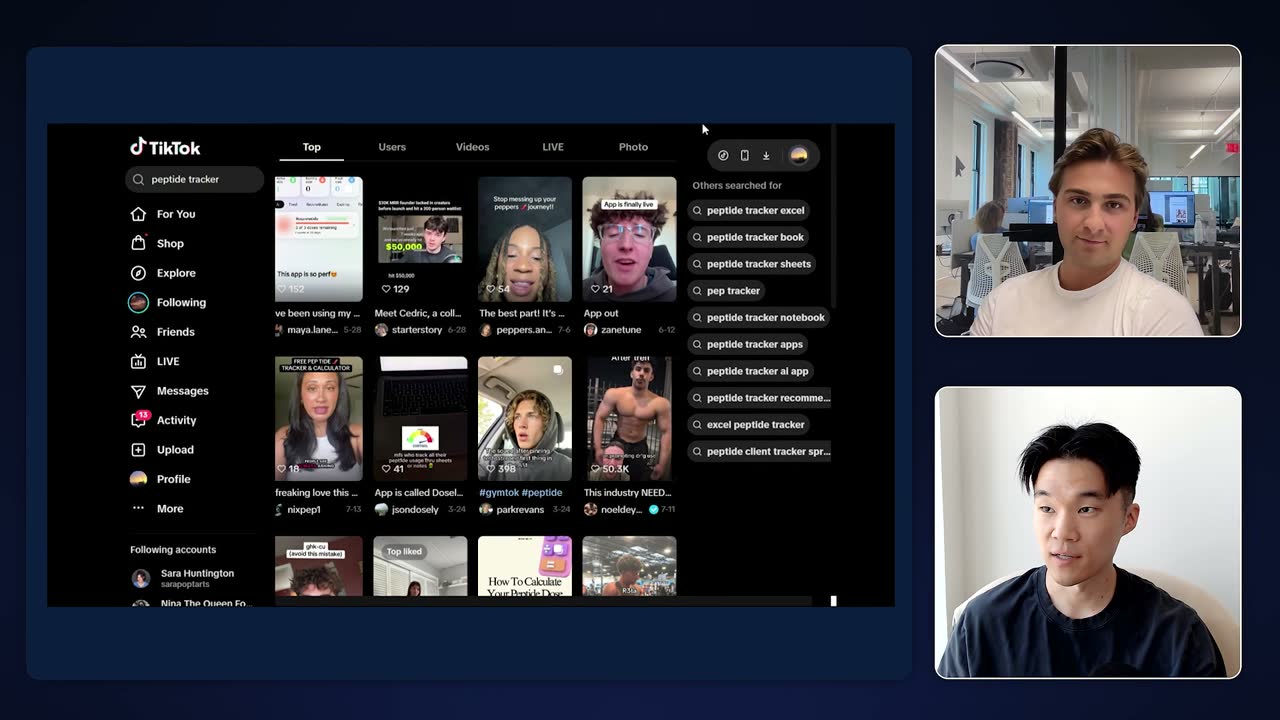
TikTok search for 'peptide tracker' showing competing UGC videos and related searches to study formats. A winning ad needs both Meta's prediction and the audience to favor it. A technically excellent creative can still fail. One that looked great took $20K of spend and did not work however the team sliced it.
Alex's rule: "It has to be both a Meta match and an audience match." Do your best on quality and accept that the platform decides the rest.
Odd, cluttered static ads can beat polished ones, so test them. Cedric Roberge's ads person made a crowded square static listing about eight pieces of information in about 2 minutes with ChatGPT. It became the best performing ad at under $2 per install, against a $2.50 average.
Cedric thought it was "way too cluttered" but now makes more variants, including cleaner ones aimed at men or women. The lesson he drew: let teammates try ideas you disagree with.
Message, media, content type and funnel together decide who Meta reaches. Marcus Burke's formula is "message plus media plus content type times funnel equals audience." Video skews to a younger Instagram Reels audience, statics to Facebook feed and older users, and street interview styles skew younger than raw text walls.
To scale, add new pain-point messages, new formats and media types, or new funnels (web or app store), then check where ads were delivered to learn from it.
Web funnels let Meta learn faster than app installs do. Rise Science runs web onboarding, which ad platforms treat as standard e-commerce with no delayed data or broken attribution from app privacy limits. The algorithm finds people faster and creative results show up sooner, while on app you may wait a week or two depending on budget.
Rise's older web audience tilts toward Facebook over Instagram, though the channels perform about the same and creative decides results. Leon Sasson calls the faster iteration cycle "a huge unlock."
2Buying users who pay, not the cheapest trials
Click-bait ads bring cheap trials that rarely convert; target real pain points. Ethan Ethier's team started Meta ads in January 2026 and got a baseline trial-to-paid in about a month to set allowable acquisition cost. Click-bait ads produced cheap trials but trial-to-paid dropped sharply, so they switched to ads built on customer avatars and the pain points the app solves.
Avatars came from customer surveys and warm traffic, and they kept iterating on winners. Meta trial-to-paid sits around 25%, below their YouTube traffic. Quote: "we want people to start the trial at the cheapest cost, but also we don't want just anyone to start the trial."
Compare cost per trial with trial-to-paid by age bucket. Marcus Burke collects age during onboarding to see trial-to-paid by age, then maps it against cost per target. Young traffic buys cheap trials that convert worst, while someone 65 plus might cost 100% more per trial but convert much better.
In his example chart, 25 to 34 was the most expensive bucket. The point is not to let Meta simply buy the cheapest trials.
Use value rules to make Meta bid more for older users. Keep targeting broad and set value rules telling Meta that someone 45 plus is, for example, 30 to 40% more valuable. This works around trial-to-paid landing about 7 days later, too late for the algorithm to react.
Also make ads that appeal to older people, since low spend on them often comes from not making content for them.
Fast Meta growth can bring in the wrong customers. Pok Pok, whose main paid channel is Meta and especially Instagram, learned that it can grow fast there while acquiring worse-fit customers. Melissa Cash calls Meta "the golden handcuffs."
Pok Pok now invests in brand, partnerships such as a collab with Calm, and a brand department started about six months before the interview to bring in more organic and better customers.
3Structuring ad sets so Meta doesn't starve good ads
With little budget, put every ad in one ad set. Multiple ad sets would require doubling or quadrupling budget. Marcus Burke advises putting everything in one, seeing what wins, repeating weekly and learning patterns step by step.
Split by message and media only once ads are near break-even or you have funding to speed up learning.
To scale, split ad sets by format and message with their own budgets. Left alone, Meta pours budget into one best ad or message, concentrating about 80% of spend on its favorite within an ad set. Burke clusters creatives by media type, style (text walls, memes, UGC video) and message (overthinking, anxious attachment), with budgets and cost-per-target goals per ad set, for example five ad sets.
Meme ad sets must deliver traffic at about half the price because their quality is lower. Quote: "I'm not looking for the very best ad and only like serve to that audience. I'm looking to scale."
Give outlier ads their own ad set so they get delivery. Chart each ad's placement mix against cost per target. Ads with good cost per target that spent 40 to 50% of budget on Facebook feed got starved when mixed with others, so Burke pulls them into a separate ad set with its own budget.
Keep broad targeting and all placements, and compare them with the other ads to learn why they deliver differently.
4Creator content as the Meta ad engine
Run winning organic creator videos as Meta ads, not scripted copies. Cedric Roberge takes videos that already won on TikTok and Instagram, runs them on Meta and raises budget weekly on winners, at about $2.50 per download on roughly $400 a day. Scripts given to creators to mimic other GLP apps failed and lost money.
Pok Pok does the same with its paid creator program: content that pops off is then promoted with ads, which is how it adapted to weaker classic influencer marketing. Cedric's rule of thumb is that under $5 per download is good.
Build Meta ads that don't depend on the founder-influencer. Ethan Ethier's team runs Meta ads with B-roll, testimonials and AI-made statics instead of Jeremy, to solve "the bus problem" of all growth relying on his YouTube channel.
Jeremy's time stays on long-form YouTube, which they judge the highest-ROI activity, while clippers post on Reels and TikTok and their viral hooks inform future videos.
Manage Meta in-house so ads don't over-promise the product. The same team chose in-house Meta management over an agency to get someone passionate about the product who would "promote the app in a way that isn't faking anything."
The goal is a seamless handoff from the ad to the product experience.
Use Meta for conversions and TikTok Spark ads for cheap reach. Spark ads push organic videos into the For You page but have no button, so only CPM is attributable. Meta ads have a button and track conversions, so Nick Lawton sees real scale and attribution coming from Meta.
Spark ads suit videos that already carry a strong organic call to action.
5Platform risk: bans, policy and dependence on Meta
Expect Meta account bans and keep appealing until you recover. Alex's accounts were restricted or banned six to eight times, some permanently, even without breaking policy, and they always got them back.
Early on, support is offshore and can't fix much, so appeal persistently and explain why you should be allowed to advertise. At higher spend, a Meta rep and a warmed-up account help. Quote: "a lot of people would quit the first or the second time."
Meta tolerates some categories TikTok rejects, like peptide content. TikTok keeps rejecting Cedric Roberge's Spark ads and removing videos because peptide content reads as medical advice. Meta is more lenient and performs better, and rival GLP apps in the Health and Fitness top 100 run only Meta ads.
His app ranks around 250 and aims for the top 100. He also spends about $150 a day on Apple Search Ads.
A business built only on Meta ads should diversify or sell. Bans or CPMs doubling can wreck a paid-only business whose profit rests on a "loaded-dice game of statistics." Alex sold Boost App Social for seven figures in January after a four to five month negotiation, partly to take chips off the table.
He now mixes in organic growth at Screens.design.
6How Meta's ad auction prices in user value
Meta's auction adds organic value to the bid so ads and posts compete together. Peter Sellis credits Meta's 2010 to 2020 ads team with solving the modern auction: each bid factors in the organic value to the user, so advertisers pay more to reach people who may not want to be reached.
He suggests that in chat products like ChatGPT, trust could replace organic value as that term, and that maximizing trust likely correlates with retention and advertiser value. He points to Amazon search showing 16 ads before the first result as eroding trust. Quote: "how influenced I should be should essentially be how much trust I'm trading off."
7Instagram's smaller pods and the product staff role
- 2 to 3 Android, iOS, server each
- PM, designer, data scientist, researcher
- More design by committee
- Four to six generalist engineers
- One product staff lead
- Core team of six or seven
- Specialists added only when needed
Fewer people, faster moves
From Adam Mosseri on a podcast
Meta replaced 13-person teams with pods of four to six engineers. Teams used to include 2 to 3 each of Android, iOS and server engineers plus a PM, designer, data scientist and researcher. Now pods run with four to six generalist engineers and a product staff lead, so core teams are usually six or seven people.
Specialists are added only when needed, such as a senior data scientist for pricing or a senior designer for a novel experience. Adam Mosseri says fewer people means faster moves and "a little bit less design by committee."
The product staff role blends PM, design, data and research using AI tools. Meta evolved the PM into a generalist who does part of each specialist's job with internal AI tools. A Reels creation drop-off waterfall that needed a data scientist a year earlier can now be pulled by product staff directly.
Pods can run with four engineers and one product staff and no dedicated designer, data scientist or researcher.
Keep hiring juniors in every function to grow future seniors. Mosseri warns against staffing functions only with senior people, since nobody would be left to become the next senior specialist.
Shrink teams if needed, and move people not on a path to senior into generalist roles as a soft landing.
Treat AI token spend as a budget and skip token leaderboards. Meta has no token limits yet but manages spend by shutting down silly projects. Mosseri calls token leaderboards a terrible idea because "it's not that hard to build a token incinerator."
He expects caps if a strong engineer's burn approaches their salary, sized to trust in ROI-positive use, as with GPUs, labeling budgets and headcount.
Meta's large AI push gained little productivity compared with Anthropic. Boris Cherny, once responsible for code quality across Facebook, Instagram and WhatsApp, says a year of work by hundreds of Meta engineers gave a few percentage points of productivity, while Anthropic saw a 200% rise in pull requests per engineer.
His takeaway is to under-resource projects a little at the start, for example one engineer per project, so people lean on AI to automate.
8Lessons from people who worked at Meta
New managers should spend their first stretch as ICs. Fiona Fung spent her first quarter at Meta as an IC after 11 years at Microsoft, before leading Marketplace, smart glasses and the Orion AR effort. Teammates said they appreciated her using what they built.
She has managers keep making PRs part time to stay close to the product. Quote: "give yourself that maker time to actually type deep into the code."
Prepare for the Meta PM interview with an AI coach and human mocks. Zevi Arnovitz built a Claude project coach fed with frameworks and told it not to flatter him, had Claude play the candidate for questions he couldn't mock, and used an agent to rank the most frequently asked questions.
He says human mocks, found through cold LinkedIn outreach, were "the biggest game changer." He got the job, and engineers there now ask him to teach his no-code workflow.

Meta’s head of product on working with Mark Zuckerberg, early growth tactics, and more | Naomi Gleit
Naomi Gleit is its head of product, after 19 years since employee number 29. Its hardest cross-team projects ship through canonical docs, shared goals and clear meetings, and its small group of long-tenured leaders gives Mark honest feedback.
Meta's auction adds organic value to the bid so ads and posts compete together. Peter Sellis credits Meta's 2010 to 2020 ads team with solving the modern auction: each bid factors in the organic value to the user, so advertisers pay more to reach people who may not want to be reached.
He suggests that in chat products like ChatGPT, trust could replace organic value as that term, and that maximizing trust likely correlates with retention and advertiser value. He points to Amazon search showing 16 ads before the first result as eroding trust. Quote: "how influenced I should be should essentially be how much trust I'm trading off."

Meta
Serves about 4 billion monthly users and won through Zuckerberg's absolute control and long-term bets. Apple's tracking change and TikTok cut its value 72% in 2022, and Reality Labs has lost about $60 billion since 2019.
After Andromeda, better creative beats tinkering with targeting in Ads Manager. Since Meta's Andromeda update, much of the targeting happens through the creatives themselves. One subscription app team spends less time on bids and targeting settings, which are largely out of their control, and more on making better content.
They feed their highest-intent users back to Meta and use a custom dashboard to check which trials truly come from Meta. Nick Lawton calls Ads Manager "a big scary monster." Quote: "a lot of the targeting on meta is specifically done through the creatives."
Click-bait ads bring cheap trials that rarely convert; target real pain points. Ethan Ethier's team started Meta ads in January 2026 and got a baseline trial-to-paid in about a month to set allowable acquisition cost. Click-bait ads produced cheap trials but trial-to-paid dropped sharply, so they switched to ads built on customer avatars and the pain points the app solves.
Avatars came from customer surveys and warm traffic, and they kept iterating on winners. Meta trial-to-paid sits around 25%, below their YouTube traffic. Quote: "we want people to start the trial at the cheapest cost, but also we don't want just anyone to start the trial."
Build Meta ads that don't depend on the founder-influencer. Ethan Ethier's team runs Meta ads with B-roll, testimonials and AI-made statics instead of Jeremy, to solve "the bus problem" of all growth relying on his YouTube channel.
Jeremy's time stays on long-form YouTube, which they judge the highest-ROI activity, while clippers post on Reels and TikTok and their viral hooks inform future videos.
Manage Meta in-house so ads don't over-promise the product. The same team chose in-house Meta management over an agency to get someone passionate about the product who would "promote the app in a way that isn't faking anything."
The goal is a seamless handoff from the ad to the product experience.
AI and product management | Marily Nika (Meta, Google)
Marily Nika is a product lead at Meta, working on metaverse avatars and identity.
Fast Meta growth can bring in the wrong customers. Pok Pok, whose main paid channel is Meta and especially Instagram, learned that it can grow fast there while acquiring worse-fit customers. Melissa Cash calls Meta "the golden handcuffs."
Pok Pok now invests in brand, partnerships such as a collab with Calm, and a brand department started about six months before the interview to bring in more organic and better customers.
Run winning organic creator videos as Meta ads, not scripted copies. Cedric Roberge takes videos that already won on TikTok and Instagram, runs them on Meta and raises budget weekly on winners, at about $2.50 per download on roughly $400 a day. Scripts given to creators to mimic other GLP apps failed and lost money.
Pok Pok does the same with its paid creator program: content that pops off is then promoted with ads, which is how it adapted to weaker classic influencer marketing. Cedric's rule of thumb is that under $5 per download is good.
90 minutes of unfiltered product advice from Snap and Discord’s product chief | Peter Sellis
Its team from 2010 to 2020 solved the modern ads auction by factoring the organic value to the user into each bid, letting organic and ad content share one auction.
After Andromeda, better creative beats tinkering with targeting in Ads Manager. Since Meta's Andromeda update, much of the targeting happens through the creatives themselves. One subscription app team spends less time on bids and targeting settings, which are largely out of their control, and more on making better content.
They feed their highest-intent users back to Meta and use a custom dashboard to check which trials truly come from Meta. Nick Lawton calls Ads Manager "a big scary monster." Quote: "a lot of the targeting on meta is specifically done through the creatives."
Use Meta for conversions and TikTok Spark ads for cheap reach. Spark ads push organic videos into the For You page but have no button, so only CPM is attributable. Meta ads have a button and track conversions, so Nick Lawton sees real scale and attribution coming from Meta.
Spark ads suit videos that already carry a strong organic call to action.

Do This Before Running ANY Paid Social Media Marketing
Its AI can handle audience, placements, optimization and budget, and hook rate and hold rate can be added as custom metrics in its ads platform. Meta is usually enough to study for competitor ads.
Meta replaced 13-person teams with pods of four to six engineers. Teams used to include 2 to 3 each of Android, iOS and server engineers plus a PM, designer, data scientist and researcher. Now pods run with four to six generalist engineers and a product staff lead, so core teams are usually six or seven people.
Specialists are added only when needed, such as a senior data scientist for pricing or a senior designer for a novel experience. Adam Mosseri says fewer people means faster moves and "a little bit less design by committee."
The product staff role blends PM, design, data and research using AI tools. Meta evolved the PM into a generalist who does part of each specialist's job with internal AI tools. A Reels creation drop-off waterfall that needed a data scientist a year earlier can now be pulled by product staff directly.
Pods can run with four engineers and one product staff and no dedicated designer, data scientist or researcher.
Keep hiring juniors in every function to grow future seniors. Mosseri warns against staffing functions only with senior people, since nobody would be left to become the next senior specialist.
Shrink teams if needed, and move people not on a path to senior into generalist roles as a soft landing.
Treat AI token spend as a budget and skip token leaderboards. Meta has no token limits yet but manages spend by shutting down silly projects. Mosseri calls token leaderboards a terrible idea because "it's not that hard to build a token incinerator."
He expects caps if a strong engineer's burn approaches their salary, sized to trust in ROI-positive use, as with GPUs, labeling budgets and headcount.

Why 90% of their paid traffic goes to a quiz, not the App Store
Meta ads started in January 2026 and trial-to-paid there is about 25%, below YouTube traffic. After the Andromeda update, targeting happens mostly through the creative, so the team spends less time in Ads Manager. Click-bait ads gave cheap trials but trial-to-paid dropped sharply, so they use avatar and pain-point ads.
Odd, cluttered static ads can beat polished ones, so test them. Cedric Roberge's ads person made a crowded square static listing about eight pieces of information in about 2 minutes with ChatGPT. It became the best performing ad at under $2 per install, against a $2.50 average.
Cedric thought it was "way too cluttered" but now makes more variants, including cleaner ones aimed at men or women. The lesson he drew: let teammates try ideas you disagree with.
Run winning organic creator videos as Meta ads, not scripted copies. Cedric Roberge takes videos that already won on TikTok and Instagram, runs them on Meta and raises budget weekly on winners, at about $2.50 per download on roughly $400 a day. Scripts given to creators to mimic other GLP apps failed and lost money.
Pok Pok does the same with its paid creator program: content that pops off is then promoted with ads, which is how it adapted to weaker classic influencer marketing. Cedric's rule of thumb is that under $5 per download is good.
Meta tolerates some categories TikTok rejects, like peptide content. TikTok keeps rejecting Cedric Roberge's Spark ads and removing videos because peptide content reads as medical advice. Meta is more lenient and performs better, and rival GLP apps in the Health and Fitness top 100 run only Meta ads.
His app ranks around 250 and aims for the top 100. He also spends about $150 a day on Apple Search Ads.

How to Dominate for Decades | Doug Leone, Sequoia Capital
Cited as one of the companies that kept compounding long after its IPO. Instagram is credited with helping save it.
Message, media, content type and funnel together decide who Meta reaches. Marcus Burke's formula is "message plus media plus content type times funnel equals audience." Video skews to a younger Instagram Reels audience, statics to Facebook feed and older users, and street interview styles skew younger than raw text walls.
To scale, add new pain-point messages, new formats and media types, or new funnels (web or app store), then check where ads were delivered to learn from it.
Compare cost per trial with trial-to-paid by age bucket. Marcus Burke collects age during onboarding to see trial-to-paid by age, then maps it against cost per target. Young traffic buys cheap trials that convert worst, while someone 65 plus might cost 100% more per trial but convert much better.
In his example chart, 25 to 34 was the most expensive bucket. The point is not to let Meta simply buy the cheapest trials.
Use value rules to make Meta bid more for older users. Keep targeting broad and set value rules telling Meta that someone 45 plus is, for example, 30 to 40% more valuable. This works around trial-to-paid landing about 7 days later, too late for the algorithm to react.
Also make ads that appeal to older people, since low spend on them often comes from not making content for them.
With little budget, put every ad in one ad set. Multiple ad sets would require doubling or quadrupling budget. Marcus Burke advises putting everything in one, seeing what wins, repeating weekly and learning patterns step by step.
Split by message and media only once ads are near break-even or you have funding to speed up learning.
To scale, split ad sets by format and message with their own budgets. Left alone, Meta pours budget into one best ad or message, concentrating about 80% of spend on its favorite within an ad set. Burke clusters creatives by media type, style (text walls, memes, UGC video) and message (overthinking, anxious attachment), with budgets and cost-per-target goals per ad set, for example five ad sets.
Meme ad sets must deliver traffic at about half the price because their quality is lower. Quote: "I'm not looking for the very best ad and only like serve to that audience. I'm looking to scale."
Give outlier ads their own ad set so they get delivery. Chart each ad's placement mix against cost per target. Ads with good cost per target that spent 40 to 50% of budget on Facebook feed got starved when mixed with others, so Burke pulls them into a separate ad set with its own budget.
Keep broad targeting and all placements, and compare them with the other ads to learn why they deliver differently.

The Anti-Addictive Playbook Behind Pok Pok's 9X Subscriber Growth | Melissa Cash
Still Pok Pok's main paid channel, which Melissa calls the golden handcuffs, with Instagram as the key platform. Fast growth there can bring in the wrong customers, so Pok Pok is investing in brand.
New managers should spend their first stretch as ICs. Fiona Fung spent her first quarter at Meta as an IC after 11 years at Microsoft, before leading Marketplace, smart glasses and the Orion AR effort. Teammates said they appreciated her using what they built.
She has managers keep making PRs part time to stay close to the product. Quote: "give yourself that maker time to actually type deep into the code."

#1 UGC EXPERT Reveals How To Market Consumer Apps
Meta ads have a button and track conversions, so real scale and attribution come from it. Nick calls Ads Manager a big scary monster, and SideShift aims to make paid work like running a UGC campaign.
Test creatives at high volume, because about 1 in 85 wins. Alex's app found that one video out of 85 would take most of the ad spend and work. Of roughly $1.5 to 1.8 million in total spend, something like $800k was wasted, while the winners paid back hundreds of thousands in profit.
Much of the waste was the cost of learning which kind of video Meta favored, so the whole operation was planned around producing enough ads to find winners often enough. Losers are the price of finding the winner.
TikTok search for 'peptide tracker' showing competing UGC videos and related searches to study formats. A winning ad needs both Meta's prediction and the audience to favor it. A technically excellent creative can still fail. One that looked great took $20K of spend and did not work however the team sliced it.
Alex's rule: "It has to be both a Meta match and an audience match." Do your best on quality and accept that the platform decides the rest.
Expect Meta account bans and keep appealing until you recover. Alex's accounts were restricted or banned six to eight times, some permanently, even without breaking policy, and they always got them back.
Early on, support is offshore and can't fix much, so appeal persistently and explain why you should be allowed to advertise. At higher spend, a Meta rep and a warmed-up account help. Quote: "a lot of people would quit the first or the second time."
A business built only on Meta ads should diversify or sell. Bans or CPMs doubling can wreck a paid-only business whose profit rests on a "loaded-dice game of statistics." Alex sold Boost App Social for seven figures in January after a four to five month negotiation, partly to take chips off the table.
He now mixes in organic growth at Screens.design.
The Web2App Playbook: Scale Your App Without App Store Limits
Delivers whatever event it is told to chase, so click goals bring clicks that never buy. It needs about 50 events per week, so small budgets should start with registration or initiate checkout.
Web funnels let Meta learn faster than app installs do. Rise Science runs web onboarding, which ad platforms treat as standard e-commerce with no delayed data or broken attribution from app privacy limits. The algorithm finds people faster and creative results show up sooner, while on app you may wait a week or two depending on budget.
Rise's older web audience tilts toward Facebook over Instagram, though the channels perform about the same and creative decides results. Leon Sasson calls the faster iteration cycle "a huge unlock."
The rise of taste, human authenticity and judgment in an AI world | Adam Mosseri (Head of IG)
It moved from teams of about 13 people to pods of four to six engineers plus a product staff lead. It sets no token limits yet but treats token spend as a managed resource, and Mosseri calls token leaderboards a terrible idea.
Meta's large AI push gained little productivity compared with Anthropic. Boris Cherny, once responsible for code quality across Facebook, Instagram and WhatsApp, says a year of work by hundreds of Meta engineers gave a few percentage points of productivity, while Anthropic saw a 200% rise in pull requests per engineer.
His takeaway is to under-resource projects a little at the start, for example one engineer per project, so people lean on AI to automate.
Profitable Apps Going Broke? Here's Why
In the example, half of the restored $10,000 budget goes to Meta once the creative and funnel work, since Meta delivers more efficiently at higher spend. A $5,000 week-four spend at 175% ROAS returns close to $9,000.
Prepare for the Meta PM interview with an AI coach and human mocks. Zevi Arnovitz built a Claude project coach fed with frameworks and told it not to flatter him, had Claude play the candidate for questions he couldn't mock, and used an agent to rank the most frequently asked questions.
He says human mocks, found through cold LinkedIn outreach, were "the biggest game changer." He got the job, and engineers there now ask him to teach his no-code workflow.
I speedran an ai app to $100k in 70 days.
Meta tolerates peptide ads that TikTok rejects, so paid spend of about $400 a day goes there. Winning organic creator posts perform well as Meta ads, and a cluttered static graphic got under $2 per download.
How to Build a $2M/Month App (Copy Me)
Within one ad set it concentrates about 80% of spend on its favorite ad. Value rules can raise bids 30 to 40% for 45 plus users, since trial-to-paid lands about 7 days later, too late for the algorithm.
What happens after coding is solved? | Fiona Fung (Claude Code & Cowork)
Fiona spent her first quarter at Meta as an IC after 11 years at Microsoft, which taught her to change what made her successful. She led Marketplace, smart glasses and the Orion AR glasses effort there.
This Fitness App Makes $200K a Month Using Only AI Video Ads
Serves as the distribution layer in the growth stack, and its Ads Library lets anyone inspect a rival's live ads and click through to their funnel. Apple restrictions have made scaling through Meta harder with app store payments.
Copy This Facebook Ads Strategy, It'll Blow Up Your App
Meta ads drove the app's growth, but the accounts took six to eight bans, some permanent, and recovery meant long fights with offshore support. Only about 1 in 85 ads won, because Meta's prediction and the audience both had to approve a creative.
How to Create High-Converting AI UGC Ads in Minutes (No Creators Needed)
Meta campaigns need a steady supply of good creatives to work, and most people fail at producing enough of them. Its ads library is one source of inspiration that CreateUGC's inspiration section replaces.
Evan Spiegel, Snapchat: Building a Multi-Billion Dollar Company
Spiegel says Meta's brand is one people don't want near their face, so it leans on Ray-Ban, and he doubts its low-margin volume strategy builds a durable hardware business.
Why Web Onboarding Should Sell The Problem, Not The Solution – Leon Sasson, Rise Science
Rise's older web audience tilts toward Facebook over Instagram, though channels perform about the same and creative decides results. Web ads feed Meta cleaner data than app ads, so its algorithm learns faster.
Head of Claude Code: What happens after coding is solved | Boris Cherny
Hundreds of engineers working for a year produced only a few percentage points of productivity gain, in contrast with Anthropic's 200% gain. Cherny was responsible for code quality across Facebook, Instagram and WhatsApp.
How a Meta PM ships products without ever writing code | Zevi Arnovitz
Where the guest is a PM; his engineers there ask him to teach them his workflow. He prepared for the interviews with an AI coach and human mock interviews, which mattered most.
How Fitbod Uses AI to Hyperpersonalize Strength Workouts
It is Fitbod's biggest paid channel and where the next scale is likely to come from. Facebook ads began around 2017 and Meta has since grown much more sophisticated.
If You’re Running Paid App Ads, You NEED to Watch This
An indie app spending only $3,000 a month on Meta from late August 2024 nearly doubled its organic sales by December 2024, while Meta itself was credited with almost no sales. Meta ads drive downloads that they never get credit for.
Copy This Meta Ads Strategy to Scale Your Web2App Campaigns (Part 2/2)
Optimizing on purchase at launch sends random users until the pixel learns, costing hundreds or even $1,000. Proxy events give about 10 times more signals, and about $50 a day for 7 to 10 days trains the pixel. Raise budgets 20 to 25% every few days and duplicate winners instead of editing them.
Google Part III: The AI Company. Google is amazingly well-positioned... will they win in AI?
Zuckerberg offered up to $800 million for DeepMind, about twice what Google paid, but would not let it stay independent. Facebook, Instagram and Reels borrowed the pattern recognition that Google Brain's cat paper showed.
The Beginner's Guide to Meta Ads for Web2App Campaigns (Part 1/2)
Meta ads bring 80 to 90% of web funnel traffic, and its algorithm learns best from standard events like Purchase. Send events from both pixel and Conversion API with the same event ID, FBP and FBC, or Meta counts two purchases and misallocates budget.
Daniel Ek, Spotify | David Senra
Ek spent most of a week in Zuckerberg's meetings and interviewed the whole executive team. He learned how a weekly large-group meeting of 20 to 25 people works and copied several practices.
App Marketing On A Budget: My Proven $0 To $10k Strategy (2025)
A niche app scaled spend from $600 in August to $3,000 a month at about $1.50 to $2 per install using interest targeting, roughly breaking even. Meta undercounted installs, and its ads also lifted App Store search downloads, and pushed one app from $7,000 to $8,000 a month past $10,000.
How One AI Feature Supercharged Photoroom’s Growth
Meta was Photoroom's biggest and fastest-scaling paid channel, since small business owners were already there. Before and after creatives drove the CPI drop.
An inside look at X’s Community Notes | Keith Coleman & Jay Baxter
Meta adopted Community Notes and now uses it as its main fact-checking tool.
7 Favorite App Growth Case Studies of 2024 (And What You Can Learn From Them)
Meta ads started in August 2023 with under $1,000 of spend and grew installs from none to about 3,000. Meta reports only about 50 to 60% of real installs, so December's reported $6.80 cost per install was really under $4.
An operator’s guide to product strategy | Chandra Janakiraman (CPO at VRChat, ex-Meta, Headspace)
Chandra ran the strategy process several times here. For Oculus and Portal it gave nearly identical pillars aimed at driving hardware sales via software, yet Oculus succeeded and Portal was sunset after 18 months. A privacy team's aspiration was to move the needle on consumer trust.
The ultimate guide to paid growth | Timothy Davis (Shopify)
Reach is almost pay for play. Davis builds lookalike ad sets at 1%, 2 to 4%, 5 to 7% and 8% plus, and runs only the 1% set on a tight budget.
Vision, conviction, and hype: How to build 0 to 1 inside a company | Mihika Kapoor (Product, Figma)
It boiled the PM role down to product sense and execution. Its phrases "feedback as a gift" and "every superpower has a shadow" shaped her management style.
The Anatomy of a High-Performing UGC Ad
Recommended as the best first platform for UGC video ads because it has the most complete tools and covers Facebook and Instagram. Suggests one Advantage Plus campaign with two creatives, plus a broad audience, and installing the Facebook SDK so it can find likely installers.
Kunal Shah on winning in India, second-order thinking, the philosophy of startups, and more
Kunal guesses it earns only $3 to $4 per Indian user per year, so India is a user farm. Its utility pitch for its headset helps Apple position Vision Pro as costly and exclusive.
Product management theater | Marty Cagan (Silicon Valley Product Group)
Cagan says Zuckerberg is very good at product, and Facebook's strong leadership on strategy and cross-functional teams solved very hard problems. He offers it as an example of empowerment that is not top-down control.
What AI means for your product strategy | Paul Adams (CPO of Intercom)
Google saw it as an existential threat. Adams's research there showed people wanted better ways to reach small groups of family and friends, and Zuckerberg required mobile mock-ups during the mobile shift.
Nvidia Part III: The Dawn of the AI Era (2022-2023)
It hired Yann LeCun and, with Google, absorbed most top AI researchers. AI feeds turned Instagram into a $100 to $500 billion asset, and its ad targeting runs on many Nvidia GPUs.
Leveraging growth advisors, mastering SEO, and honing your craft | Luc Levesque (Shopify, Meta)
Luc grew Messenger, Instagram and WhatsApp here, and it runs as an execution machine focused only on impact. Recruiting him took seven months and involved the whole exec team and his wife. Facebook also won with a viral loop of photo tag emails.
Mobile User Acquisition: How to Get Started and What You Need
Leads Singular's ROI index alongside Google. Singular has a blog post on media mix modeling written with Meta.
More in Marketing & growth tools
 Marketing & growth tools
App Masters
An app marketing and growth consultancy run by Steve P. Young, which also hosts a podcast.
115 sources · 465 tipsApple Search Ads
Apple's ad platform for promoting apps in the App Store.
44 sources · 132 tips Marketing & growth tools
Sensor Tower
An app intelligence and ASO platform with keyword rankings, competitor research and download estimates.
42 sources · 90 tips Marketing & growth tools
Mobile Action
An app store optimization and mobile marketing intelligence platform.
28 sources · 81 tips Marketing & growth tools
HubSpot
A CRM and marketing software platform built for small and medium businesses.
14 sources · 41 tips Marketing & growth tools
AdMob
Google's mobile ad monetization platform with mediation, open bidding and unified payments for app developers.
10 sources · 47 tips Marketing & growth tools
AppsFlyer
A mobile attribution and marketing analytics platform for app marketers.
17 sources · 30 tips Marketing & growth tools
Google Ads
Google's advertising platform for search, display and app campaigns.
15 sources · 31 tips