
$100M Leads
Alex Hormozi's book on how to get strangers to want what you sell.
Where $100M Leads comes up1 episode or test

Hormozi treated $100M Leads as a product to test: 19 drafts, a full rewrite after draft 12, and A/B tested titles ('how to get strangers' won 71% to 29%). The back cover cites 20,000 new leads per day across 16 industries. Lesson: test positioning before committing, rebuild the outline, and let each free asset earn the next step, since inbound interest also feeds his deal flow.
- Subtitle test loser
- 29%
- Subtitle test winner
- 71%
Shorter subtitle won, 71% to 29%
From Alex Hormozi on $100M Leads
What was said about $100M Leads
1Testing the title, subtitle and cover of $100M Leads
The title and subtitle were picked by A/B tests, not taste. Hormozi tested title words in pairs: advertising beat promotion, leads beat advertising, and leads narrowly beat marketing. In the subtitle, 'how to get strangers' beat 'how to get more strangers' 71% to 29%, and keeping 'how to' beat dropping it 70% to 30%.
His guess is that leads are the output of advertising, and nobody wants to advertise; they want leads. He also tested three or four magnet icons and kept the series look, and he argues that writing the book is far harder than testing the cover, so the testing is worth doing. Quote: "I AB tested the heck out of this."
Design the cover for strangers, not existing fans. Readers of the first book would likely buy the second anyway, so the cover is built for people who have never heard of Hormozi and decide in a split second what the book does and what it pays off.
A realistic image beat a cartoon version, even though the cartoon matched the first book.
The back cover is a sales letter of blind bullets. Each chapter was rewritten as a bullet stating its benefit without saying what it is, alongside a promise of 2x, 10x or 100x more leads and a proof line of 20,000 new leads per day across 16 industries using eight 'never-go-hungry' playbooks.
Specific details such as a 'six-part ad framework' that gets more people, 'especially strangers', to want what you sell signal that he has thought hard about the problem. The pitch leans on the claim that small businesses fail first from lack of leads, with running out of money second.
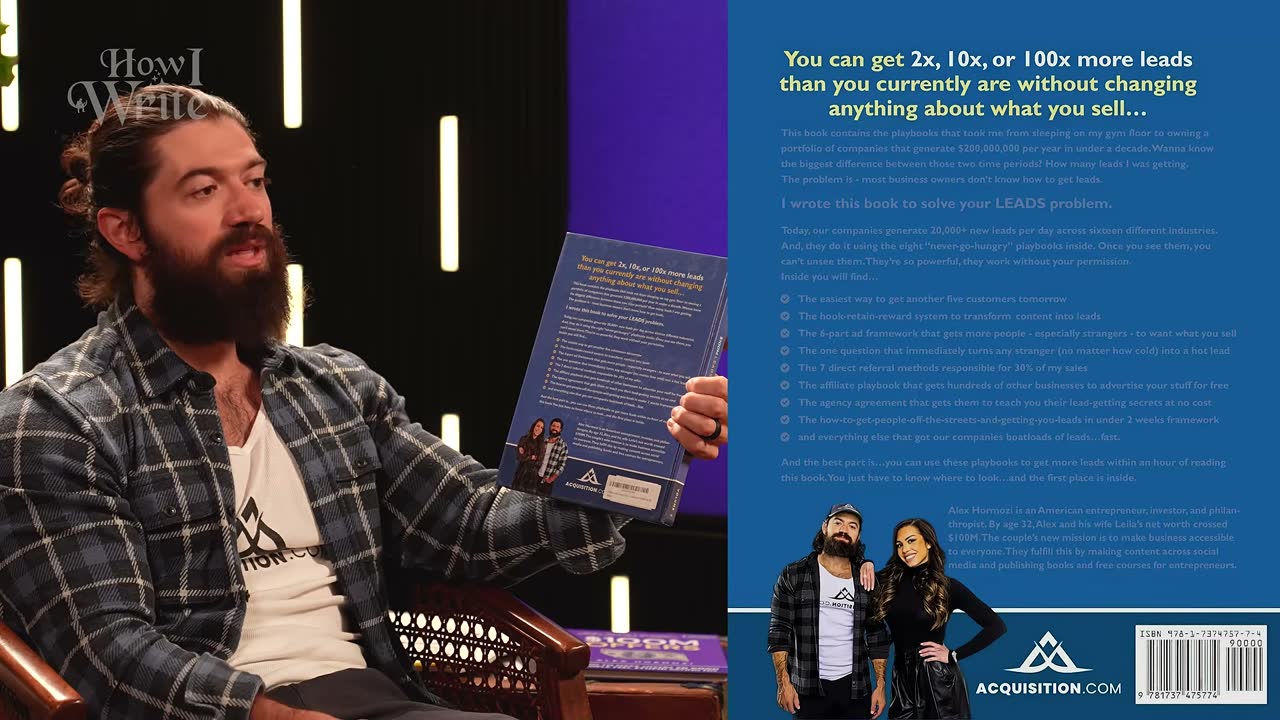
Back cover of "$100M Leads" as a mini sales letter: headline promise, proof, blind-benefit bullets.
2Writing the book through 19 drafts
Build the book through the table of contents, and expect to redo it. Hormozi outlined $100M Leads through its table of contents, which he calls the hardest thing he works on, rewriting it from the top whenever he tired of a version. Pages of messy outlines, iPad sketches and discarded structures narrowed to one clean contents page, after which he says the writing was easy.
He wants chapter headings descriptive enough that a reader can decide whether to buy from the contents page alone. Quote: "the table content is the hardest thing I spend my time on."
Only about 10% of the early ideas survived. He kept roughly 10% of the ideas in the early outlines. His original leverage through line was cut, while a few small lines on an early page became the second half of the book.
A whole page of ideas became one paragraph, and the more-new-better idea he loved started near the end of the outline. His point is that writers cannot predict which ideas will matter, and that about two-thirds of the insight arrives during writing.
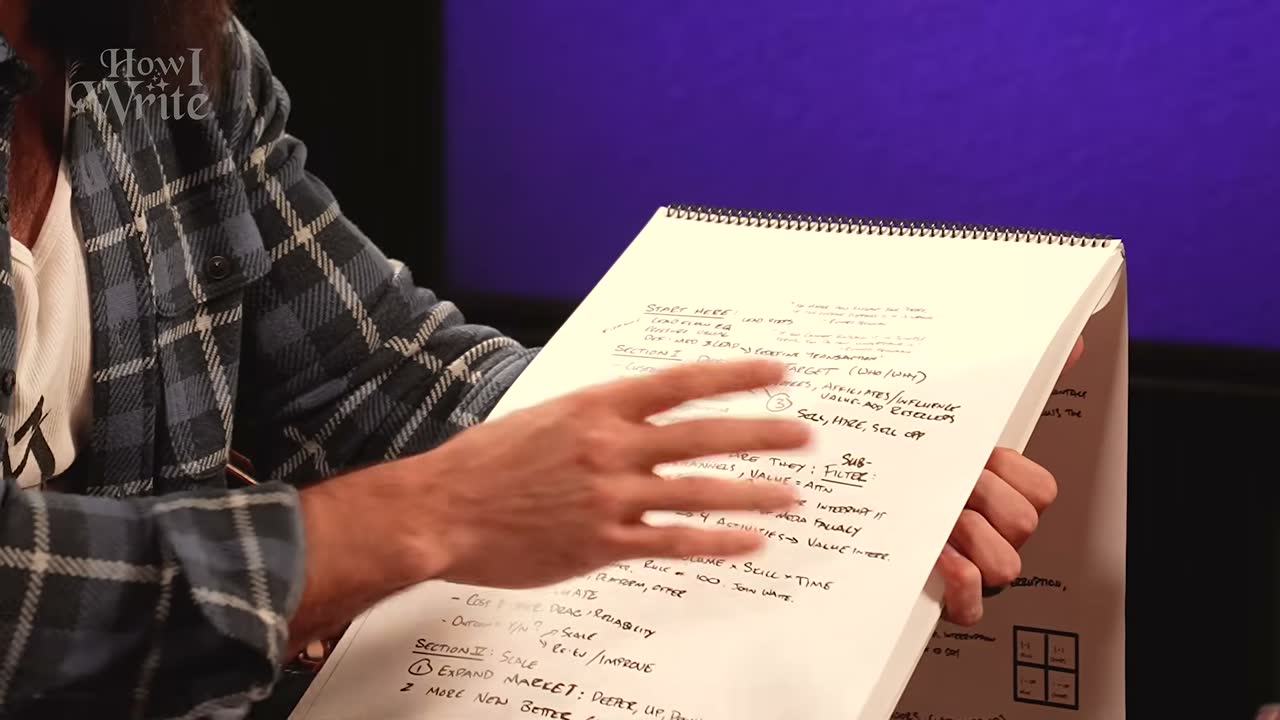
Hormozi's handwritten rewrite of the $100M Leads outline, from "Start Here" to "Section V: Scale." Clarity came from many drafts that cut words and sections. The book took 19 drafts. Hormozi thought draft 12 was done, then rewrote the book after ten readers gave feedback.
Each coat of editing crunches the text into fewer, simpler words. When many readers flag the same section he usually deletes it, and cutting three chapters made the book read 'like reading downhill'.
Write the words first and draw the final diagrams last. He drafts text with highlighted-caps markers where pictures go, then adds rough doodles, and draws final ones only at the very end.
Final drawings come last because they contain numbers, and moving paragraphs around would force him to redo them.
3Why the book serves Hormozi's investing business
The book generates inbound interest that feeds proprietary deal flow. As investors, Hormozi's team wants proprietary deal flow, and unlimited inbound interest tilts supply and demand in their favor.
Content and books lead to advisory events and then his headquarters, and each step has to give enough value to earn the next.

Copywriting Masterclass, #1 Creator Mistake, 1M Books Sold — Alex Hormozi
Went through 19 drafts, with a full rewrite after draft 12 and ten readers' feedback. Title and subtitle were A/B tested (Leads beat advertising, promotion and marketing; 'how to get strangers' won 71% to 29%), and the back cover is a sales letter of blind bullets citing 20,000 new leads per day across 16 industries. As investors, they want proprietary deal flow, and unlimited inbound interest tilts supply and demand their way. After content and books come the advisory events and his headquarters, each of which has to give enough value to earn the next.
The title and subtitle were picked by A/B tests, not taste. Hormozi tested title words in pairs: advertising beat promotion, leads beat advertising, and leads narrowly beat marketing. In the subtitle, 'how to get strangers' beat 'how to get more strangers' 71% to 29%, and keeping 'how to' beat dropping it 70% to 30%.
His guess is that leads are the output of advertising, and nobody wants to advertise; they want leads. He also tested three or four magnet icons and kept the series look, and he argues that writing the book is far harder than testing the cover, so the testing is worth doing. Quote: "I AB tested the heck out of this."
Design the cover for strangers, not existing fans. Readers of the first book would likely buy the second anyway, so the cover is built for people who have never heard of Hormozi and decide in a split second what the book does and what it pays off.
A realistic image beat a cartoon version, even though the cartoon matched the first book.
The back cover is a sales letter of blind bullets. Each chapter was rewritten as a bullet stating its benefit without saying what it is, alongside a promise of 2x, 10x or 100x more leads and a proof line of 20,000 new leads per day across 16 industries using eight 'never-go-hungry' playbooks.
Specific details such as a 'six-part ad framework' that gets more people, 'especially strangers', to want what you sell signal that he has thought hard about the problem. The pitch leans on the claim that small businesses fail first from lack of leads, with running out of money second.
Back cover of "$100M Leads" as a mini sales letter: headline promise, proof, blind-benefit bullets. Build the book through the table of contents, and expect to redo it. Hormozi outlined $100M Leads through its table of contents, which he calls the hardest thing he works on, rewriting it from the top whenever he tired of a version. Pages of messy outlines, iPad sketches and discarded structures narrowed to one clean contents page, after which he says the writing was easy.
He wants chapter headings descriptive enough that a reader can decide whether to buy from the contents page alone. Quote: "the table content is the hardest thing I spend my time on."
Only about 10% of the early ideas survived. He kept roughly 10% of the ideas in the early outlines. His original leverage through line was cut, while a few small lines on an early page became the second half of the book.
A whole page of ideas became one paragraph, and the more-new-better idea he loved started near the end of the outline. His point is that writers cannot predict which ideas will matter, and that about two-thirds of the insight arrives during writing.
Hormozi's handwritten rewrite of the $100M Leads outline, from "Start Here" to "Section V: Scale." Clarity came from many drafts that cut words and sections. The book took 19 drafts. Hormozi thought draft 12 was done, then rewrote the book after ten readers gave feedback.
Each coat of editing crunches the text into fewer, simpler words. When many readers flag the same section he usually deletes it, and cutting three chapters made the book read 'like reading downhill'.
Write the words first and draw the final diagrams last. He drafts text with highlighted-caps markers where pictures go, then adds rough doodles, and draws final ones only at the very end.
Final drawings come last because they contain numbers, and moving paragraphs around would force him to redo them.
The book generates inbound interest that feeds proprietary deal flow. As investors, Hormozi's team wants proprietary deal flow, and unlimited inbound interest tilts supply and demand in their favor.
Content and books lead to advisory events and then his headquarters, and each step has to give enough value to earn the next.
More in Education
 Education
Duolingo
A language learning app built around daily streaks and short lessons.



 47 sources · 132 tips
 Education
Headway
A book summary and self-growth app that sells subscriptions through a long web quiz funnel.
 10 sources · 36 tips
 Education
Blinkist
A nonfiction book summary app that turns books into short audio and text reads.
 16 sources · 17 tips
 Education
StudyFetch
An AI study platform that turns course materials into practice tests, flashcards and tutoring sessions.
4 sources · 31 tips Education
Coconote
An AI study app that records and transcribes lectures and creates notes, summaries and flashcards.
3 sources · 30 tips Education
Reforge
A company offering courses on product and growth, now also building AI products like Reforge Insights.
10 sources · 13 tips Education
Coursiv
An AI learning app that teaches beginners practical AI tools through short lessons and challenges.
2 sources · 17 tips Education
Unacademy
An Indian online learning platform offering courses for exam preparation and other subjects.
2 sources · 6 tips