
Unacademy
An Indian online learning platform offering courses for exam preparation and other subjects.
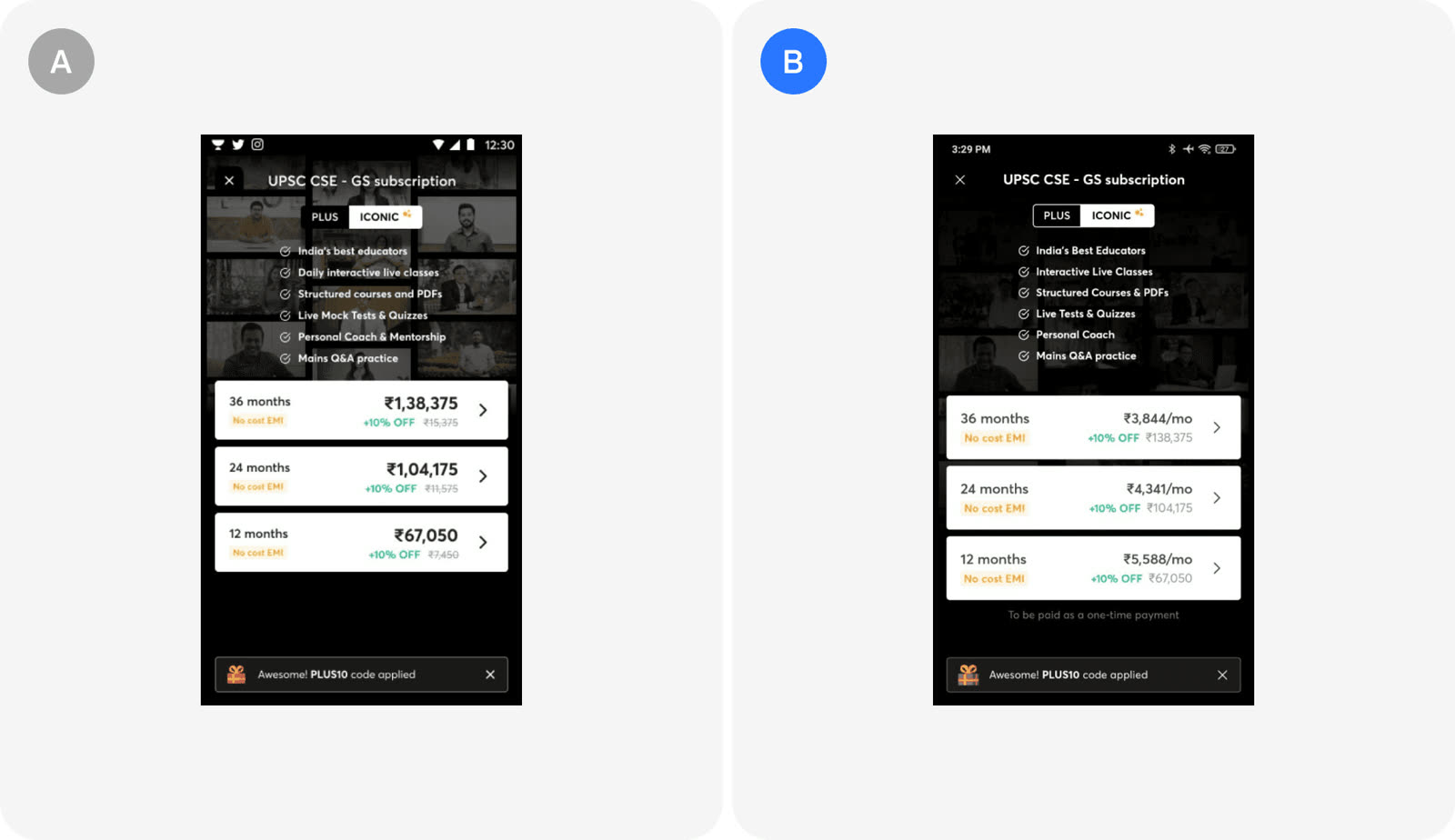
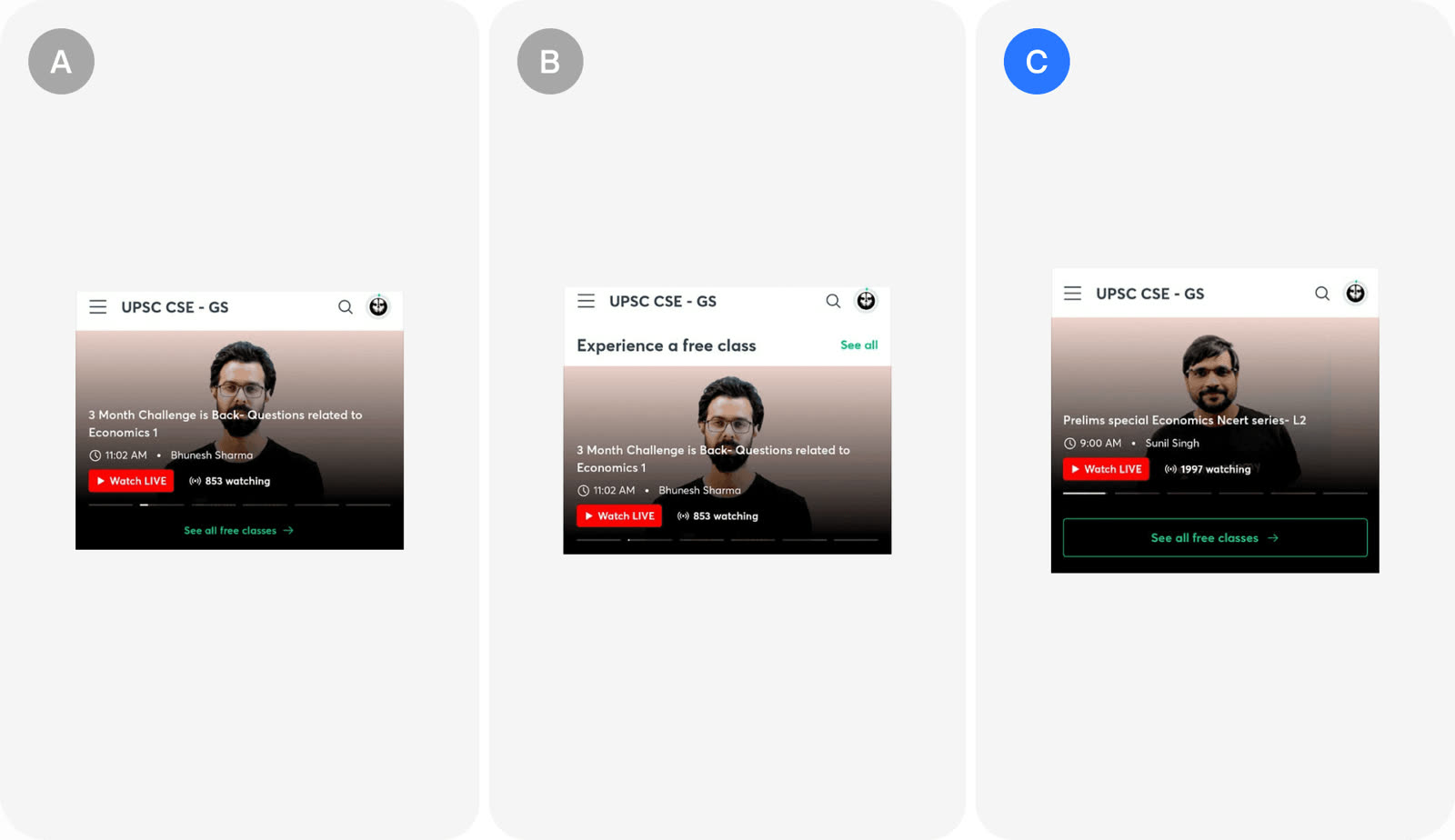
Unacademy ran small UI experiments on pricing and CTAs. Showing a monthly price instead of the full course price lifted click-through 13.5%, reported at 100% significance. On a "See all free classes" CTA, a thin-bordered button drew 13k clicks versus 9k for the original and 7k for the variant matching existing UI. Test price framing and secondary CTA styling before changing prices or assuming consistency wins.
- Full course price as headline
- Large lump sum
- Per-month cost as headline
- Same price, only display changed
+13.5% click-through rate, 100% significance
From Unacademy pricing page A/B test
What was said about Unacademy
Showing the monthly price instead of the full course price lifted clicks. On the pricing page, Unacademy made the per month cost the headline number instead of the total course price. The monthly variant produced 13.5% more click-through rate, reported at 100% significance.
The hypothesis was that a smaller recurring figure is easier to judge than a large lump sum, so learners grasp the value faster. Only the display changed, not the price, which makes this a low-cost test of framing. The team measured click-through rate and reported significance alongside the lift.
Version A and version B as Unacademy tested them. A thin-bordered 'See all free classes' button beat the original and the UI-matching variant. Unacademy ran a three-way test on the CTA of its class carousel, with users split equally. The thin-bordered Variant C drew 13k clicks, against 9k for the original and 7k for Variant B.
Variant B, styled to match the app's existing UI components, did worst of the three, so consistency with the design system did not make the CTA more discoverable. The goal was to surface trending classes, measured by a single metric: clicks on the carousel CTA. The equal split made the counts directly comparable.
Version A and version B as Unacademy tested them.

Highlighting monthly pricing: Unacademy's A/B test
Tested showing the monthly price instead of the full course price on its pricing page. The monthly framing raised click-through rate by 13.5%, reported at 100% significance.
Showing the monthly price instead of the full course price lifted clicks. On the pricing page, Unacademy made the per month cost the headline number instead of the total course price. The monthly variant produced 13.5% more click-through rate, reported at 100% significance.
The hypothesis was that a smaller recurring figure is easier to judge than a large lump sum, so learners grasp the value faster. Only the display changed, not the price, which makes this a low-cost test of framing. The team measured click-through rate and reported significance alongside the lift.
Version A and version B as Unacademy tested them.
Optimal CTA design: Unacademy's A/B test
Ran a three-way A/B test on the "See all free classes" CTA on its class carousel to surface trending classes. The thin-bordered Variant C drew 13k clicks versus 9k for the original and 7k for the variant matching existing UI, with users split equally.
A thin-bordered 'See all free classes' button beat the original and the UI-matching variant. Unacademy ran a three-way test on the CTA of its class carousel, with users split equally. The thin-bordered Variant C drew 13k clicks, against 9k for the original and 7k for Variant B.
Variant B, styled to match the app's existing UI components, did worst of the three, so consistency with the design system did not make the CTA more discoverable. The goal was to surface trending classes, measured by a single metric: clicks on the carousel CTA. The equal split made the counts directly comparable.
Version A and version B as Unacademy tested them.
More in Education
 Education
Duolingo
A language learning app built around daily streaks and short lessons.


 47 sources · 132 tips
 Education
Headway
A book summary and self-growth app that sells subscriptions through a long web quiz funnel.
 10 sources · 36 tips
 Education
Blinkist
A nonfiction book summary app that turns books into short audio and text reads.
 16 sources · 17 tips
 Education
StudyFetch
An AI study platform that turns course materials into practice tests, flashcards and tutoring sessions.
4 sources · 31 tips Education
Coconote
An AI study app that records and transcribes lectures and creates notes, summaries and flashcards.
3 sources · 30 tips Education
Reforge
A company offering courses on product and growth, now also building AI products like Reforge Insights.
10 sources · 13 tips Education
Coursiv
An AI learning app that teaches beginners practical AI tools through short lessons and challenges.
2 sources · 17 tips Education
ClassDojo
A classroom communication app connecting teachers, parents and kids, with optional paid extras and new learning products.
2 sources · 17 tips