
StudyFetch
An AI study platform that turns course materials into practice tests, flashcards and tutoring sessions.
StudyFetch grew to 7 million+ students and 2 billion+ creator views, passing $10M ARR, by scaling from founder videos to hundreds of creators, with no venture money for its first 18 months. A lecture hall demo drew about 75 million views. Lesson: make the product the video, vet creators by comment engagement, and favor TikTok for conversion, since some Instagram virals converted poorly.
- 1Film own screen demosFirst TikTok: 3 million views overnight
- 2Make product the hookLecture hall video: around 75 million views
- 3Scale creators in stages1 to 5 to 20 to ~400
- 4Review every videoEach approved before it goes live
- 5Post 100+ videos dailyProgram passed 2 billion views
From StudyFetch founders and Kieran on podcasts
What was said about StudyFetch
1Why the founders scrapped an essay tool to build a tutor
The founders killed a profitable essay writer because it helped students cheat. Their bootstrapped tool took a topic and produced an essay, and it grew fast on TikTok once ChatGPT launched. They asked whether it was sustainable and whether they wanted to help students cheat their way through life, answered no, and launched StudyFetch on September 15, 2023 as the opposite.
The essay tool started when GPT-3's API convinced Esan Durrani AI would change the world, and he first used it on his own coursework. StudyFetch ran without venture money for about 18 months, then raised an $11.5 million Series A from Owl Ventures and the College Board, skipping seed and pre-seed, with a founding team of seven.
Interviewing 120 to 150 students showed they needed understanding, not just speed. Before launch the team interviewed over 120 to 150 college students about what was missing from their education. The gap was not only saving time but understanding oversized, poorly presented course material, which answer engines like Chegg and Course Hero did not address.
Students face thousand-page textbooks and constantly changing content. The founders had feared students would not care about a tool that teaches, but the second StudyFetch video they posted blew up.
2The learn engine and the guided study plan
StudyFetch optimizes its AI for learning outcomes, not fast answers. Durrani calls horizontal chatbots productivity tools built to finish a task fast, the opposite of learning. The learn engine uses data from students who studied a topic like supply and demand to surface the modalities that led to mastery for the next student.
He compares it to picking the best Meta ad by conversion data. Students upload lecture slides, textbooks and notes, and an AI tutor named Sparky answers from their own course material.
A study plan replaced a pile of features users didn't know how to start. Early features were picked partly for how well they would spread on social media, and as the set grew students were unsure where to begin. The study plan now orders the tools, for example a practice test, then three flashcard sessions, then a tutoring session.
Durrani: "especially for consumer product, it's so important to to actually show the user the value instead of them trying to pull it out of you."
Giving overwhelmed students one place to start is credited for better grades. Students often never begin because there is too much material, so uploading it all and getting a first step helps. The company reports 92% of active students see better grades and study up to 30% less, but shows no study design or comparison group.
Med students use it most, as their hub. Case studies find the biggest gains among students with learning differences, lifting the lowest grades in a class and narrowing the achievement gap.
3The lecture hall videos that proved the product
The first videos were plain screen demos filmed by a team member. On launch day the CEO asked Kieran, who had never made a product TikTok, to film videos: a camera pointed at a computer screen at his desk and in lectures, showing features in real time. The first TikTok got 3 million views overnight and tens of thousands of signups.
Kieran credits timing and luck for part of that first hit. The point of the founder-made videos was to prove the message before adding creators.
Videos convert when the product itself is the reason they work. The lecture hall video showed notes streaming onto the screen live while the filmer's hands stayed off the keyboard. It drew around 75 million views (over 76 million organic on Instagram by another count) and hundreds of thousands of signups.
A video about something else that loops the product in during the last 5 seconds does not convert well, so StudyFetch designs features to be visual with a wow factor before filming. Durrani: "the underlying thing that makes a product go viral is is it actually useful to people?"
4Scaling to hundreds of creators
Scale creators in stages only after your own videos prove the format. After the founder-made videos worked, StudyFetch grew the pool from one person to five, to 20, to about 400 over the next school year. The creator program has since produced over 2 billion views.
Quality and brand consistency limit how fast the pool can grow. The count has ranged from hundreds to almost a thousand depending on the goal.
Volume works on TikTok, and adopting it early made creators easy to get. Hundreds of creators post over 100 short videos a day across TikTok and Instagram, because one viral video can offset nine flops. The team found this by trial and error in 2023, before the tactic was well known, which kept the bar for attracting good creators low.
Durrani treats a strategy as saturated once larger corporate companies start using it. Old videos keep earning views even after three months without posting, so he sees the program as mostly brand marketing.
Every creator video is reviewed before it goes live. Even with hundreds of creators, the team approves each video. Posting schedules run in Asana, and in-house tools built on TikTok's API plus spreadsheets track views and engagement over time.
"We actually review every single video before it gets posted."
A full-time team scouts creators and manages them daily. An outbound group sources and negotiates through TikTok and Instagram DMs, email and sometimes LinkedIn, alongside an inbound application site. Full-time creative managers talk with creators daily about formats, and a head of the program oversees both.
Contractors failed because of misaligned incentives and low dedication. Instagram stars are cross-checked on TikTok and skipped if they don't perform there.
Creators get a base rate plus a view bonus. StudyFetch pays $100 for every 100,000 views on TikTok or Instagram on top of a base that has ranged from $50 to $2,500 per video. Normal UGC creators earn a couple hundred to a couple thousand dollars a month.
Great creators get base pay even without large audiences, and the listing is pitched as a way to earn a lot to attract motivated people.
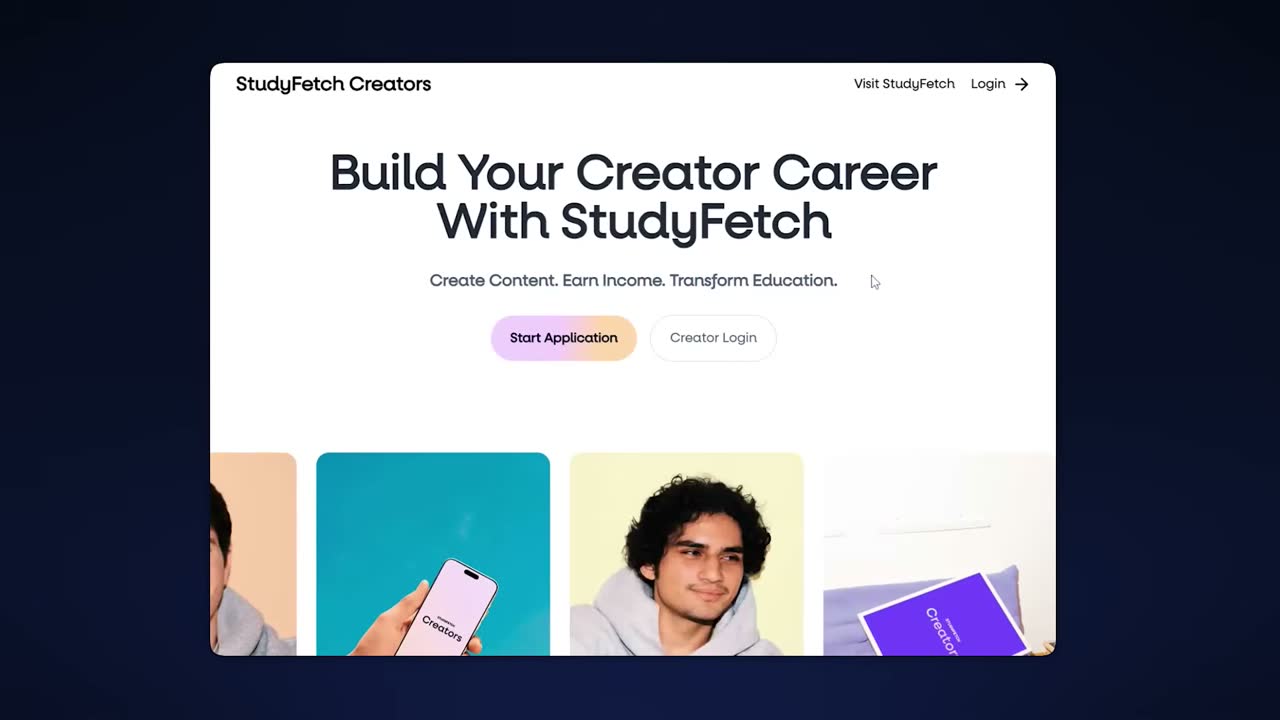
StudyFetch Creators site, the inbound application page paired with outbound creator recruiting. Real relationships with creators fight creative fatigue. Creators posting 20 to 30 videos a month eventually run low on ideas, so an internal team builds relationships and helps them succeed in their own right, positioning the program almost like consulting.
"creative fatigue is definitely a real thing."
A skilled marketing generalist can learn TikTok. Kieran had never made a TikTok before joining and now runs the whole marketing engine. He sees short-form as a formula of trial, adaptation and decisions from test results.
A TikTok Shop background adds selling skill and current format knowledge, which avoids recycling year-old trends.
5How StudyFetch picks creators and reads results
Judge creators and videos by comments, not view counts. A commenter is paying attention even while scrolling, so comments proportional to views signal a real following, even at 10,000 views. A 160,000 view video with 1,600 bookmarks and 33 comments about the platform counted as decent.
Social feedback arrives within 24 hours through likes to views and comment sentiment, so check how many comments are about the product. Influencers with views but no real following fail when moved to a new account.
Hire creators who know how to sell an outcome. TikTok Shop creators earn on commission, so they must make videos that convert. StudyFetch also favors creators with past brand partnerships or UGC work and tells them to sell the outcome, such as better grades.
Let each creator keep their natural style and pick the CTA to match. Comedy creators stay comedic and lifestyle creators weave the product in two or three times. Demo videos get a hard CTA with the website in the last 4 to 5 seconds; brand-led creators use a soft one.
A Harvard student's lifestyle videos showed the study calendar, flashcards and a quiz between scenes like getting a matcha, with no heavy CTA.
Aim for over 80% US viewers and favor TikTok over Reels. TikTok's audience is higher intent than Instagram's, and the US converts best. Some Instagram viral videos reached audiences abroad and converted close to none, while TikTok virals converted well.
Non-US creators are steered to TikTok rather than Reels.
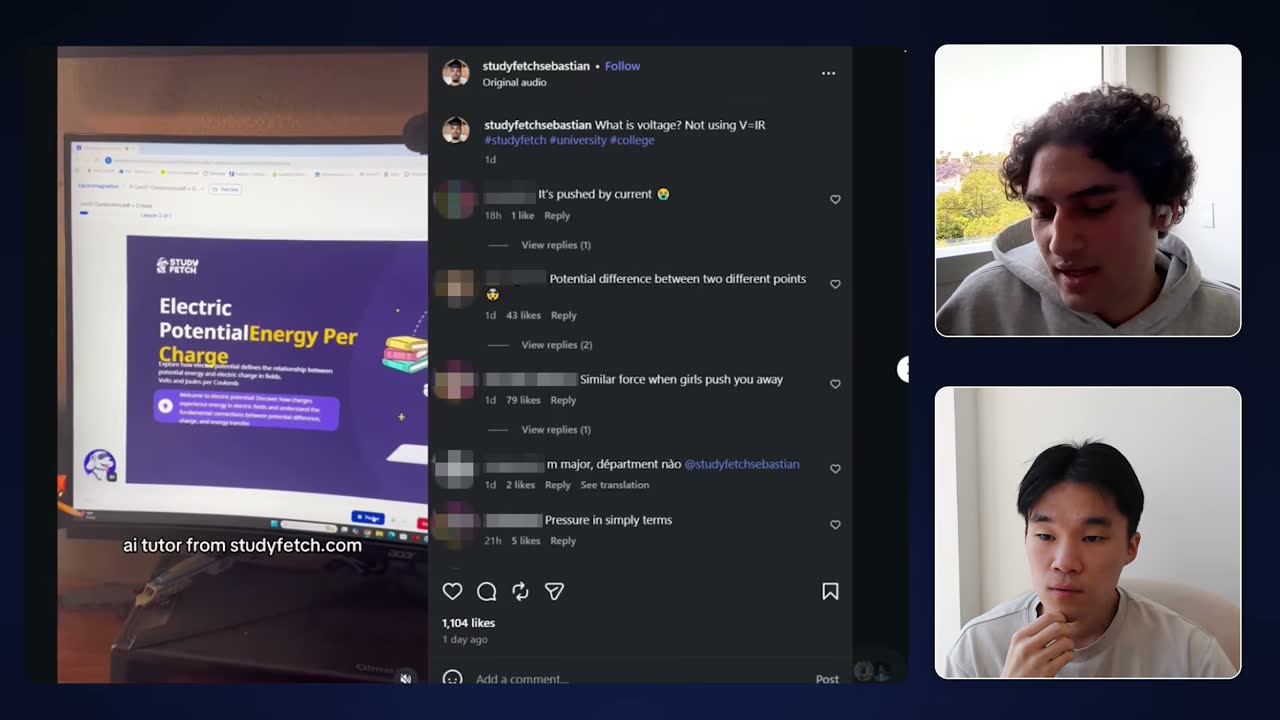
Study Fetch creator's Instagram Reel 'What is voltage?' with 1,104 likes and comments, showing the AI tutor.
6Influencers on zero-follower brand accounts
- Base $50 to $2,500 per video
- Plus $100 per 100K views
- Tight direction, hard CTA
- Roughly $10,000 a month
- ~750K followers, a video a day
- Familiarity, no push to convert
Run both: 10 to 20 times cost, better conversion
From Kieran on StudyFetch's creator program
Influencers start fresh StudyFetch accounts that their fans follow over to. An influencer with about 750,000 followers opened a separate StudyFetch-branded account and posted about daily, and many followers came over. Followers associate her face with school, so they take the product seriously.
StudyFetch built this because audiences now recognize UGC as straight-up ads, and Kieran calls it "our version of what's next." No failure rates, cost per signup or retention are given for these accounts.
Expect these deals to cost 10 to 20 times a normal UGC creator. Deals run about five figures a month, roughly $10,000 for a video a day from a creator with about 750,000 followers. Influencers first quoted main-account rates for 20 to 30 videos, so deals became higher-end retainers.
Rates have fallen as the strategy spread. Bonus-heavy contracts with a lower base can work when the creator expects many views.
Run influencers for halo and performance creators for conversion together. Influencers build familiarity with no push to convert, while performance creators get tight direction and a specific call to action. Viewers who have heard of StudyFetch from influencers convert better on the performance videos.
StudyFetch runs normal creators, influencer accounts and sponsored posts at once, shifting the weight by monthly or quarterly goals, with new signings roughly an even mix. No attribution data separates the three.
Treat influencer account deals as a numbers game. Even influencers with strong engagement can flop on a new account from shadow bans or reaching the wrong audience, and some outreach fails from misalignment. Test several influencers rather than betting on one.
7From virality at all costs to the right audience and brand
StudyFetch shifted from chasing views to viewers who want the product. Early on any viral view brought signups. As short-form saturated, the focus moved to med students and type A learners who don't mind an ad, and the brand name sits in every creator's account name.
The change came gradually. Kieran: "It was virality at all costs."
Tie the creator program to the brand and the rest of marketing. Big companies often hire a creator specialist who doesn't know what other teams do, so TikTok content clashes with billboards and the main account. After the Series A, StudyFetch also funded higher-quality brand content such as cafe pop-ups on the main account.
The aim is an emotional connection and marketing the brand, not only the product.
Source ideas from other niches and keep testing after failures. Internal viral dashboards ping the team when a video trends in other niches so concepts can be borrowed. Kieran warns founders against dropping a channel after one failed attempt.
Problem-solution videos worked well years ago but are harder now because of copycats.
8Honen: the learning engine for workforce training
The same engine now powers Honen, a course-creation tool for training teams. Honen starts with trades, and plumbers' unions are early adopters. NVIDIA partnered with StudyFetch because it knows how to engage learners, and an untrained marketer finished an internal cold-calling course in about 90 minutes.
StudyFetch teaches other people's content, while Honen teaches new content created within it. No revenue or customer numbers are given.
9Shipping and building in public on TikTok
Ship AI features in public where your customers already spend time. StudyFetch packs in features like recording class notes, turning notes into outlines and pulling terms from diagrams, and ships them on TikTok, Instagram and Discord as acquisition. It uses TikTok because college students go there for homework help and study tips.
Phil Carter argues AI apps should ship monthly, increasingly weekly or daily, because product market fit keeps moving. Rik Haandrikman notes building in public only works when the public is your audience.

How StudyFetch Used Creator-Led Growth to Hit $10M+ ARR in 3 Years
Grew to 7 million+ students and 2 billion+ creator-driven views by scaling from founder-made videos to about 400 creators. It reports 92% of active students see better grades and study up to 30% less, though no study design is shown.
The founders killed a profitable essay writer because it helped students cheat. Their bootstrapped tool took a topic and produced an essay, and it grew fast on TikTok once ChatGPT launched. They asked whether it was sustainable and whether they wanted to help students cheat their way through life, answered no, and launched StudyFetch on September 15, 2023 as the opposite.
The essay tool started when GPT-3's API convinced Esan Durrani AI would change the world, and he first used it on his own coursework. StudyFetch ran without venture money for about 18 months, then raised an $11.5 million Series A from Owl Ventures and the College Board, skipping seed and pre-seed, with a founding team of seven.
Interviewing 120 to 150 students showed they needed understanding, not just speed. Before launch the team interviewed over 120 to 150 college students about what was missing from their education. The gap was not only saving time but understanding oversized, poorly presented course material, which answer engines like Chegg and Course Hero did not address.
Students face thousand-page textbooks and constantly changing content. The founders had feared students would not care about a tool that teaches, but the second StudyFetch video they posted blew up.
StudyFetch optimizes its AI for learning outcomes, not fast answers. Durrani calls horizontal chatbots productivity tools built to finish a task fast, the opposite of learning. The learn engine uses data from students who studied a topic like supply and demand to surface the modalities that led to mastery for the next student.
He compares it to picking the best Meta ad by conversion data. Students upload lecture slides, textbooks and notes, and an AI tutor named Sparky answers from their own course material.
A study plan replaced a pile of features users didn't know how to start. Early features were picked partly for how well they would spread on social media, and as the set grew students were unsure where to begin. The study plan now orders the tools, for example a practice test, then three flashcard sessions, then a tutoring session.
Durrani: "especially for consumer product, it's so important to to actually show the user the value instead of them trying to pull it out of you."
Giving overwhelmed students one place to start is credited for better grades. Students often never begin because there is too much material, so uploading it all and getting a first step helps. The company reports 92% of active students see better grades and study up to 30% less, but shows no study design or comparison group.
Med students use it most, as their hub. Case studies find the biggest gains among students with learning differences, lifting the lowest grades in a class and narrowing the achievement gap.
The first videos were plain screen demos filmed by a team member. On launch day the CEO asked Kieran, who had never made a product TikTok, to film videos: a camera pointed at a computer screen at his desk and in lectures, showing features in real time. The first TikTok got 3 million views overnight and tens of thousands of signups.
Kieran credits timing and luck for part of that first hit. The point of the founder-made videos was to prove the message before adding creators.
Videos convert when the product itself is the reason they work. The lecture hall video showed notes streaming onto the screen live while the filmer's hands stayed off the keyboard. It drew around 75 million views (over 76 million organic on Instagram by another count) and hundreds of thousands of signups.
A video about something else that loops the product in during the last 5 seconds does not convert well, so StudyFetch designs features to be visual with a wow factor before filming. Durrani: "the underlying thing that makes a product go viral is is it actually useful to people?"
Scale creators in stages only after your own videos prove the format. After the founder-made videos worked, StudyFetch grew the pool from one person to five, to 20, to about 400 over the next school year. The creator program has since produced over 2 billion views.
Quality and brand consistency limit how fast the pool can grow. The count has ranged from hundreds to almost a thousand depending on the goal.
Volume works on TikTok, and adopting it early made creators easy to get. Hundreds of creators post over 100 short videos a day across TikTok and Instagram, because one viral video can offset nine flops. The team found this by trial and error in 2023, before the tactic was well known, which kept the bar for attracting good creators low.
Durrani treats a strategy as saturated once larger corporate companies start using it. Old videos keep earning views even after three months without posting, so he sees the program as mostly brand marketing.
Every creator video is reviewed before it goes live. Even with hundreds of creators, the team approves each video. Posting schedules run in Asana, and in-house tools built on TikTok's API plus spreadsheets track views and engagement over time.
"We actually review every single video before it gets posted."
Real relationships with creators fight creative fatigue. Creators posting 20 to 30 videos a month eventually run low on ideas, so an internal team builds relationships and helps them succeed in their own right, positioning the program almost like consulting.
"creative fatigue is definitely a real thing."
Judge creators and videos by comments, not view counts. A commenter is paying attention even while scrolling, so comments proportional to views signal a real following, even at 10,000 views. A 160,000 view video with 1,600 bookmarks and 33 comments about the platform counted as decent.
Social feedback arrives within 24 hours through likes to views and comment sentiment, so check how many comments are about the product. Influencers with views but no real following fail when moved to a new account.
Run influencers for halo and performance creators for conversion together. Influencers build familiarity with no push to convert, while performance creators get tight direction and a specific call to action. Viewers who have heard of StudyFetch from influencers convert better on the performance videos.
StudyFetch runs normal creators, influencer accounts and sponsored posts at once, shifting the weight by monthly or quarterly goals, with new signings roughly an even mix. No attribution data separates the three.
Tie the creator program to the brand and the rest of marketing. Big companies often hire a creator specialist who doesn't know what other teams do, so TikTok content clashes with billboards and the main account. After the Series A, StudyFetch also funded higher-quality brand content such as cafe pop-ups on the main account.
The aim is an emotional connection and marketing the brand, not only the product.
The same engine now powers Honen, a course-creation tool for training teams. Honen starts with trades, and plumbers' unions are early adopters. NVIDIA partnered with StudyFetch because it knows how to engage learners, and an untrained marketer finished an internal cold-calling course in about 90 minutes.
StudyFetch teaches other people's content, while Honen teaches new content created within it. No revenue or customer numbers are given.

The EXACT System to Go From 0-$10M+ With Your App
Grew to 7 million users and over 2 billion video views in about two and a half years, with seven-figure monthly revenue and no venture money for its first 18 months. It runs hundreds of creators plus influencers on fresh zero-follower accounts, and its December 2023 lecture hall video hit 75 million views.
The founders killed a profitable essay writer because it helped students cheat. Their bootstrapped tool took a topic and produced an essay, and it grew fast on TikTok once ChatGPT launched. They asked whether it was sustainable and whether they wanted to help students cheat their way through life, answered no, and launched StudyFetch on September 15, 2023 as the opposite.
The essay tool started when GPT-3's API convinced Esan Durrani AI would change the world, and he first used it on his own coursework. StudyFetch ran without venture money for about 18 months, then raised an $11.5 million Series A from Owl Ventures and the College Board, skipping seed and pre-seed, with a founding team of seven.
StudyFetch optimizes its AI for learning outcomes, not fast answers. Durrani calls horizontal chatbots productivity tools built to finish a task fast, the opposite of learning. The learn engine uses data from students who studied a topic like supply and demand to surface the modalities that led to mastery for the next student.
He compares it to picking the best Meta ad by conversion data. Students upload lecture slides, textbooks and notes, and an AI tutor named Sparky answers from their own course material.
The first videos were plain screen demos filmed by a team member. On launch day the CEO asked Kieran, who had never made a product TikTok, to film videos: a camera pointed at a computer screen at his desk and in lectures, showing features in real time. The first TikTok got 3 million views overnight and tens of thousands of signups.
Kieran credits timing and luck for part of that first hit. The point of the founder-made videos was to prove the message before adding creators.
Videos convert when the product itself is the reason they work. The lecture hall video showed notes streaming onto the screen live while the filmer's hands stayed off the keyboard. It drew around 75 million views (over 76 million organic on Instagram by another count) and hundreds of thousands of signups.
A video about something else that loops the product in during the last 5 seconds does not convert well, so StudyFetch designs features to be visual with a wow factor before filming. Durrani: "the underlying thing that makes a product go viral is is it actually useful to people?"
Scale creators in stages only after your own videos prove the format. After the founder-made videos worked, StudyFetch grew the pool from one person to five, to 20, to about 400 over the next school year. The creator program has since produced over 2 billion views.
Quality and brand consistency limit how fast the pool can grow. The count has ranged from hundreds to almost a thousand depending on the goal.
A full-time team scouts creators and manages them daily. An outbound group sources and negotiates through TikTok and Instagram DMs, email and sometimes LinkedIn, alongside an inbound application site. Full-time creative managers talk with creators daily about formats, and a head of the program oversees both.
Contractors failed because of misaligned incentives and low dedication. Instagram stars are cross-checked on TikTok and skipped if they don't perform there.
Creators get a base rate plus a view bonus. StudyFetch pays $100 for every 100,000 views on TikTok or Instagram on top of a base that has ranged from $50 to $2,500 per video. Normal UGC creators earn a couple hundred to a couple thousand dollars a month.
Great creators get base pay even without large audiences, and the listing is pitched as a way to earn a lot to attract motivated people.
StudyFetch Creators site, the inbound application page paired with outbound creator recruiting. A skilled marketing generalist can learn TikTok. Kieran had never made a TikTok before joining and now runs the whole marketing engine. He sees short-form as a formula of trial, adaptation and decisions from test results.
A TikTok Shop background adds selling skill and current format knowledge, which avoids recycling year-old trends.
Judge creators and videos by comments, not view counts. A commenter is paying attention even while scrolling, so comments proportional to views signal a real following, even at 10,000 views. A 160,000 view video with 1,600 bookmarks and 33 comments about the platform counted as decent.
Social feedback arrives within 24 hours through likes to views and comment sentiment, so check how many comments are about the product. Influencers with views but no real following fail when moved to a new account.
Hire creators who know how to sell an outcome. TikTok Shop creators earn on commission, so they must make videos that convert. StudyFetch also favors creators with past brand partnerships or UGC work and tells them to sell the outcome, such as better grades.
Let each creator keep their natural style and pick the CTA to match. Comedy creators stay comedic and lifestyle creators weave the product in two or three times. Demo videos get a hard CTA with the website in the last 4 to 5 seconds; brand-led creators use a soft one.
A Harvard student's lifestyle videos showed the study calendar, flashcards and a quiz between scenes like getting a matcha, with no heavy CTA.
Aim for over 80% US viewers and favor TikTok over Reels. TikTok's audience is higher intent than Instagram's, and the US converts best. Some Instagram viral videos reached audiences abroad and converted close to none, while TikTok virals converted well.
Non-US creators are steered to TikTok rather than Reels.
Study Fetch creator's Instagram Reel 'What is voltage?' with 1,104 likes and comments, showing the AI tutor. Influencers start fresh StudyFetch accounts that their fans follow over to. An influencer with about 750,000 followers opened a separate StudyFetch-branded account and posted about daily, and many followers came over. Followers associate her face with school, so they take the product seriously.
StudyFetch built this because audiences now recognize UGC as straight-up ads, and Kieran calls it "our version of what's next." No failure rates, cost per signup or retention are given for these accounts.
Expect these deals to cost 10 to 20 times a normal UGC creator. Deals run about five figures a month, roughly $10,000 for a video a day from a creator with about 750,000 followers. Influencers first quoted main-account rates for 20 to 30 videos, so deals became higher-end retainers.
Rates have fallen as the strategy spread. Bonus-heavy contracts with a lower base can work when the creator expects many views.
Run influencers for halo and performance creators for conversion together. Influencers build familiarity with no push to convert, while performance creators get tight direction and a specific call to action. Viewers who have heard of StudyFetch from influencers convert better on the performance videos.
StudyFetch runs normal creators, influencer accounts and sponsored posts at once, shifting the weight by monthly or quarterly goals, with new signings roughly an even mix. No attribution data separates the three.
Treat influencer account deals as a numbers game. Even influencers with strong engagement can flop on a new account from shadow bans or reaching the wrong audience, and some outreach fails from misalignment. Test several influencers rather than betting on one.
StudyFetch shifted from chasing views to viewers who want the product. Early on any viral view brought signups. As short-form saturated, the focus moved to med students and type A learners who don't mind an ad, and the brand name sits in every creator's account name.
The change came gradually. Kieran: "It was virality at all costs."
Tie the creator program to the brand and the rest of marketing. Big companies often hire a creator specialist who doesn't know what other teams do, so TikTok content clashes with billboards and the main account. After the Series A, StudyFetch also funded higher-quality brand content such as cafe pop-ups on the main account.
The aim is an emotional connection and marketing the brand, not only the product.
Source ideas from other niches and keep testing after failures. Internal viral dashboards ping the team when a video trends in other niches so concepts can be borrowed. Kieran warns founders against dropping a channel after one failed attempt.
Problem-solution videos worked well years ago but are harder now because of copycats.

The AI Growth Playbook for Subscription Apps – Phil Carter, Elemental Growth
Packs in many AI features, such as recording class notes, turning notes into outlines and pulling terms from diagrams. It ships in public on TikTok, Instagram and Discord to gain users.
Ship AI features in public where your customers already spend time. StudyFetch packs in features like recording class notes, turning notes into outlines and pulling terms from diagrams, and ships them on TikTok, Instagram and Discord as acquisition. It uses TikTok because college students go there for homework help and study tips.
Phil Carter argues AI apps should ship monthly, increasingly weekly or daily, because product market fit keeps moving. Rik Haandrikman notes building in public only works when the public is your audience.
Insights from RevenueCat’s 2026 State of Subscription Apps Report
Uses TikTok for growth because college students go there for homework help and study tips.
Ship AI features in public where your customers already spend time. StudyFetch packs in features like recording class notes, turning notes into outlines and pulling terms from diagrams, and ships them on TikTok, Instagram and Discord as acquisition. It uses TikTok because college students go there for homework help and study tips.
Phil Carter argues AI apps should ship monthly, increasingly weekly or daily, because product market fit keeps moving. Rik Haandrikman notes building in public only works when the public is your audience.
More in Education
 Education
Duolingo
A language learning app built around daily streaks and short lessons.

 47 sources · 132 tips
 Education
Headway
A book summary and self-growth app that sells subscriptions through a long web quiz funnel.
 10 sources · 36 tips
 Education
Blinkist
A nonfiction book summary app that turns books into short audio and text reads.
16 sources · 17 tips Education
Coconote
An AI study app that records and transcribes lectures and creates notes, summaries and flashcards.
3 sources · 30 tips Education
Reforge
A company offering courses on product and growth, now also building AI products like Reforge Insights.
10 sources · 13 tips Education
Coursiv
An AI learning app that teaches beginners practical AI tools through short lessons and challenges.
2 sources · 17 tips Education
Unacademy
An Indian online learning platform offering courses for exam preparation and other subjects.
2 sources · 6 tips Education
ClassDojo
A classroom communication app connecting teachers, parents and kids, with optional paid extras and new learning products.
2 sources · 17 tips