
Coconote
An AI study app that records and transcribes lectures and creates notes, summaries and flashcards.
Coconote, an AI lecture-notes app, hit $100K ARR in 45 days, $1M in 4 months and $6.7M ARR in about two years with no paid ads or VC, then sold to Quizlet at roughly 18 months. Gains came from a longer onboarding (+16% trials), login after the paywall, and a cancel-flow trial extension (saved 27%). Lesson: optimize for conversion, not views; a viral brain rot video barely converted.
- Launch with hard paywallOne free note, then required trial
- $100K ARREach founder put in about $10K
- $1M ARROrganic short-form creator videos
- $2M ARRStill no paid ads
- About $5M ARRNear 50% EBITDA margins
- $6.7M ARRAcquired by Quizlet
From Coconote founders Zack and Brett
What was said about Coconote
1Bootstrapping to $6.7M ARR and a sale to Quizlet
Charging from day one turned early revenue into momentum and growth capital. Coconote launched in April 2024 with a scoped-down product, one free note and then a required trial, essentially a hard paywall. It crossed $100K ARR in 45 days, $1M in 4 months, $2M in 5 months, about $5M after a year and $6.7M ARR in about two years, with no VC and no paid ads.
Each founder put in about $10K, and margins stayed near 50% EBITDA from inception to the acquisition, with over 2 million registered users. Zack watched the RevenueCat chart from day one, treating paying customers as a stronger signal than Mixpanel usage events. He cites a line he attributes to Sam Altman: "momentum is like oxygen for a startup."
Earlier failed projects taught them to plan distribution before building. Coconote blends three earlier experiments: Crew, a music app that drove hundreds of thousands of sign-ups with UGC-style TikTok and Reels, a GPT-3 Chrome extension that summarized posts and videos, and a GPT-4 Siri replacement. From his venture-backed studio Scout, Zack concluded "if you build it, they will not come," so short-form video and an ADHD angle were chosen from the start.
Existing AI note-takers targeted professionals, and student web apps were not taken seriously, so there were almost no AI study apps at launch. Friends would have said no one pays for apps aimed at college students; Zack argues a better framework is "what happens if it does work."
Four flexible engineers and cheap early AI spend kept the company lean. Four engineers built native apps, each working beyond a main strength, such as an iOS engineer also doing back-end work. The founders paid little attention to LLM costs early, used startup credits for the first year, and made cost decisions later as they grew.
Audio transcription cost more than the LLM calls, and a minimal free tier kept AI costs small. They argue models get cheaper over time, so worrying about margins early risks poor decisions.
2Problem-framed videos versus viral novelty
From Coconote founders Zack and Brett
The PDF to brain rot videos went hugely viral and barely converted. A feature that turned pasted text into a Minecraft parkour video drew 100 to 200 million views and about 3,000 trial starts in a few days, which converted to roughly $25,000 against a theoretical $360,000. One video got 41 million views and 4.5 million likes but drove no revenue.
It was meant as a Trojan horse to pull students into the study features, but it reached a younger audience with less disposable income and framed the app as a toy. Zack: "If you frame your product as a novel toy, people are going to treat it like a toy." The founders would rather have a 10 million view video that targets their audience than a 40 million view novelty one.
Lecture-hall demos with a fast hook aimed at the paying parent. Videos posted March to May 2024 opened with "My mom just changed my college life forever" and cut within two to three seconds to a screen recording of a lecture. One reached 18 million views, about 99% organic, with nearly all views in the first two months.
The creator brief was to picture a mother and daughter at student orientation and ask who you would pitch a $130 notetaker to, since the user and the buyer may differ. The founders call a shock hook plus demo a lazy format that only works while the product is novel; later content has to frame the app as a solution to a real problem.
Paid ads never reached first-purchase profitability, so organic creators stayed the engine. Coconote tried paid ads aiming for first-purchase profitability and never got there. Clips cut by an outside agency from raw creator footage beat their organic-style creative but still fell short.
Neither founder gave ads half their time, and an agency has weaker incentives than the founders. "There's very few growth channels that you can halfass if you want them to work." Paid boosts of organic videos were minimal and rarely worked.
3The creator team: Navy SEALs, not the Navy
A few small, undiscovered creators beat a large influencer roster. About 30 creators were tried in the first two months and only three made a big difference, one of whom ran the main account and generated hundreds of millions of views. The team peaked at 10 to 12 part-time contractors, and the founders looked for 5K to 10K follower creators with good engagement and a Gmail in their bio.
If the bio email is at an agency, you are too late. Talent came from Handshake, Instagram and TikTok DMs, email, referrals and a Spanish tutor with no content experience who became a top creator within nine months and now makes Spanish content for Latin America. None of the creators would call themselves influencers; they see themselves as marketers. The founders tried posting themselves, but the account got banned.
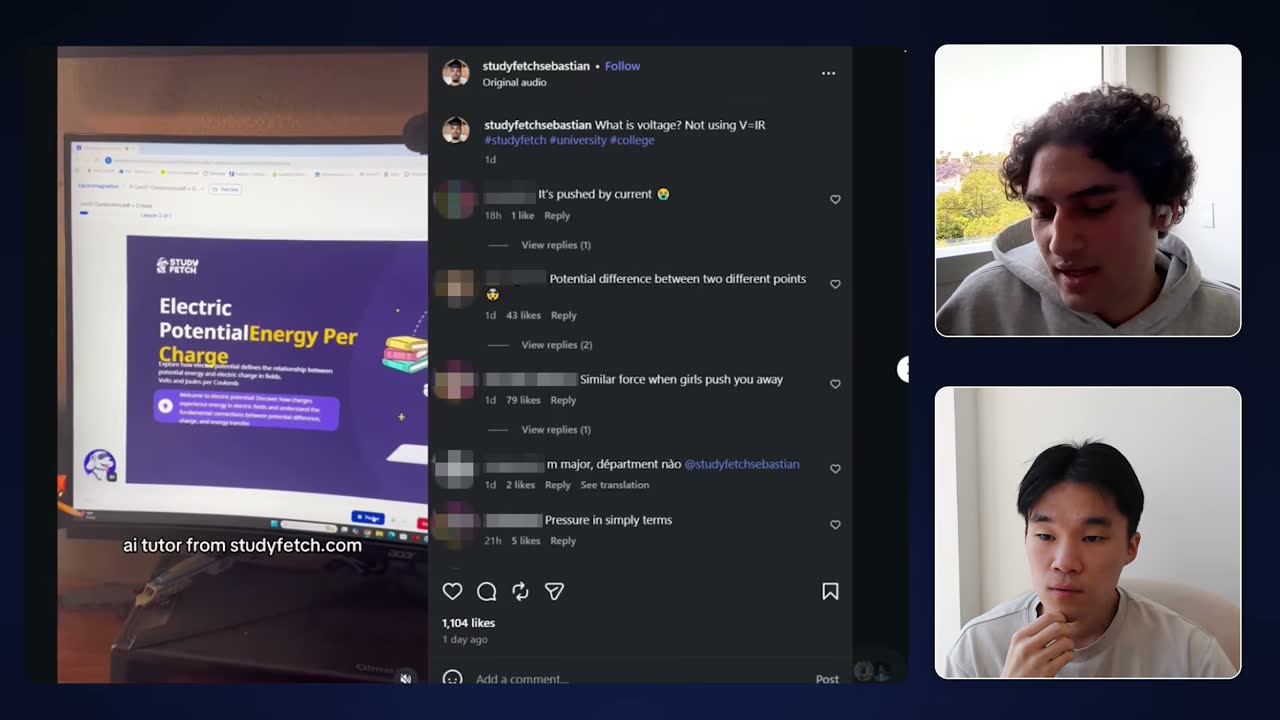
Study Fetch creator's Instagram Reel 'What is voltage?' with 1,104 likes and comments, showing the AI tutor. Creators are interviewed by the founder and coached on downfunnel metrics. The founder interviews every creator, usually deciding in 15 to 30 minutes, and there is one coach per 12 creators who reviews content and walks creators through metrics. Creators are judged on a pyramid: want to win (Slack engagement, on time, camera on), study virality (guess why a video went viral with views hidden), then create original scripts and trends.
There are no quizzes and no fixed curriculum, and creators specialize, some on camera, some faceless editors. The team was led by Allison, who had produced hundreds of millions of views herself and was first reached by DM; creators need a leader they respect. During the days a 20 to 30 million view video goes viral, the team can see its exact downfunnel impact.
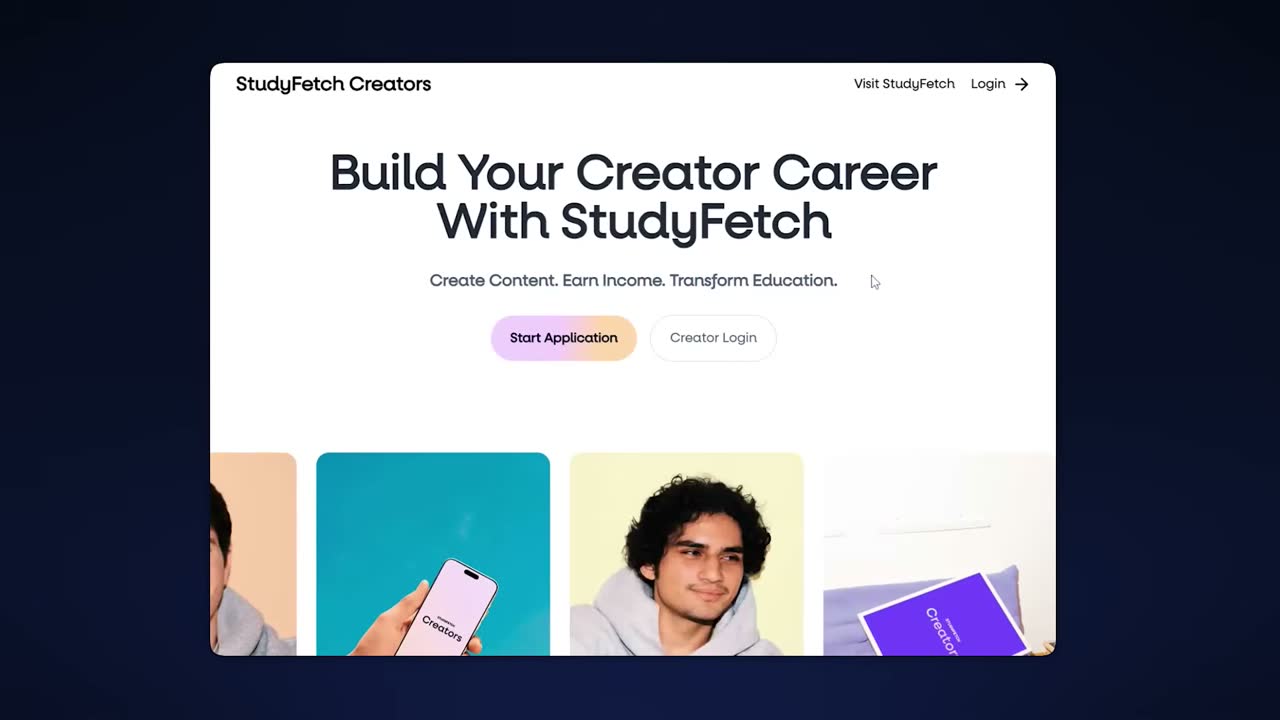
StudyFetch Creators site, the inbound application page paired with outbound creator recruiting. Creators got eye-catching app screens that real users never see. The recording and transcribing screens in viral videos were creator-only versions, such as a huge rainbow wave with the app name in big text. Creators sit in Slack with engineers and request more hidden screens.
A 2 million view video mixed 2048 with studying and sent viewers to helpmestudy.com, which redirected to Coconote.
4The onboarding, paywall and cancel flow tests
Doubling onboarding length in one jump lifted trial conversion 16%. Testing one or two screens at a time gave small wins, so they roughly doubled onboarding from about five screens to about 13 (15 in another account), adding personalization such as what the user studies, social proof, permissions and account steps. Trial starts rose 16%.
It sits before a hard paywall, aiming for a trial start in the first session or 24 hours. No baseline or sample size is given for the 16%.
Login moved after the paywall, and the paywall after a full recording. Login as the first screen caused about 10% drop-off; moving account creation to the end, after the paywall, was their biggest onboarding win. They also let users record an entire lecture, an hour or more, before showing the paywall, which was another big win.
Apple and Google already identify the buyer, so no account is needed to purchase, but linking store purchase state to the account afterward takes some plumbing.
A seven-day trial extension at cancel beat discounts and pauses. Trial users who went to cancel were asked whether they just needed more time and offered seven more days. It saved about 27% of people in the cancel flow, and web cancellation flows overall kept 25% of would-be cancellers.
It was tested against 30% off and a 3-month summer pause and won "by far." Only a smaller share of those saved went on to pay, but it keeps users on auto-renew, which is hard to win back once turned off.
5Premium pricing for students
Raising the annual price from $99 to $129 brought more users and revenue. Coconote launched at $99 a year and $19.99 a month, with about 80% of subscribers on annual. An early test at $129 produced "more users and more revenues at the same time."
They kept a premium price because students stop writing their own notes and trust the app not to lose recordings; cheaper competitors can lose audio on a phone call because Apple's audio APIs are hard to use reliably. No sample sizes or churn rates are given.
6Why students stay and how the app is pitched
Recording lectures is a daily, identity-linked habit that builds lock-in. Students record daily or several times a week, and notes accumulate across related courses such as physics 1, 2 and 3. Brett looks for this pattern of identity plus repeated action, as in Ladder, AllTrails and Strava.
Recording also gives passive value: students can relax in class knowing the lecture can be replayed. Brett also wants a wow factor, since copycats appear fast once an app hits.
Customers' own words became the App Store pitch. Asked how they would describe the app, most customers said they use it to "never miss a key detail," and that line went on the first App Store preview screen. The first screenshot also says "great for ADHD," matching the short-form content.
Zack likens it to political campaigns repeating what resonates with voters: "listen to how your customers describe your product and then say that back to them."
7Selling to Quizlet
A banker ran the sale so the founders could keep growing the business. Inbound strategic interest began when the app was a couple of months old, and Quizlet acquired it about 18 months after launch, closing in December. Revenue roughly doubled during the deal process.
They used Creative Partners, asked for a ballpark range early, and told neither the team nor, in detail, their families until close, since deals tend to fall apart in the last week. Deal terms were not shared.

COPY this ai app's $6.7m/yr marketing strategy
Reached $100K ARR in 45 days, $1M in 4 months and about $5M after a year with no VC, then sold to Quizlet around 18 months after launch. Over 2 million registered users, over 50% EBITDA, a four-engineer team, and a 10 to 12 person part-time creator team. Doubling onboarding to about 13 screens lifted trial conversion 16%, and a 7-day trial extension at cancel saved 27% of users in that flow.
The PDF to brain rot videos went hugely viral and barely converted. A feature that turned pasted text into a Minecraft parkour video drew 100 to 200 million views and about 3,000 trial starts in a few days, which converted to roughly $25,000 against a theoretical $360,000. One video got 41 million views and 4.5 million likes but drove no revenue.
It was meant as a Trojan horse to pull students into the study features, but it reached a younger audience with less disposable income and framed the app as a toy. Zack: "If you frame your product as a novel toy, people are going to treat it like a toy." The founders would rather have a 10 million view video that targets their audience than a 40 million view novelty one.

$6.7M ARR, No Paid Ads, and an Exit to Quizlet in 2 Years – Brett Bauman & Zack Hargett, Coconote
Reached $100K ARR in 45 days, $1M in 4 months and $6.7M ARR in about two years with no paid ads, then sold to Quizlet. Launched at $99 a year, tested $129 and won, with about 80% of subscribers on annual and roughly 50% EBITDA margins.
Charging from day one turned early revenue into momentum and growth capital. Coconote launched in April 2024 with a scoped-down product, one free note and then a required trial, essentially a hard paywall. It crossed $100K ARR in 45 days, $1M in 4 months, $2M in 5 months, about $5M after a year and $6.7M ARR in about two years, with no VC and no paid ads.
Each founder put in about $10K, and margins stayed near 50% EBITDA from inception to the acquisition, with over 2 million registered users. Zack watched the RevenueCat chart from day one, treating paying customers as a stronger signal than Mixpanel usage events. He cites a line he attributes to Sam Altman: "momentum is like oxygen for a startup."
Earlier failed projects taught them to plan distribution before building. Coconote blends three earlier experiments: Crew, a music app that drove hundreds of thousands of sign-ups with UGC-style TikTok and Reels, a GPT-3 Chrome extension that summarized posts and videos, and a GPT-4 Siri replacement. From his venture-backed studio Scout, Zack concluded "if you build it, they will not come," so short-form video and an ADHD angle were chosen from the start.
Existing AI note-takers targeted professionals, and student web apps were not taken seriously, so there were almost no AI study apps at launch. Friends would have said no one pays for apps aimed at college students; Zack argues a better framework is "what happens if it does work."
Four flexible engineers and cheap early AI spend kept the company lean. Four engineers built native apps, each working beyond a main strength, such as an iOS engineer also doing back-end work. The founders paid little attention to LLM costs early, used startup credits for the first year, and made cost decisions later as they grew.
Audio transcription cost more than the LLM calls, and a minimal free tier kept AI costs small. They argue models get cheaper over time, so worrying about margins early risks poor decisions.
The PDF to brain rot videos went hugely viral and barely converted. A feature that turned pasted text into a Minecraft parkour video drew 100 to 200 million views and about 3,000 trial starts in a few days, which converted to roughly $25,000 against a theoretical $360,000. One video got 41 million views and 4.5 million likes but drove no revenue.
It was meant as a Trojan horse to pull students into the study features, but it reached a younger audience with less disposable income and framed the app as a toy. Zack: "If you frame your product as a novel toy, people are going to treat it like a toy." The founders would rather have a 10 million view video that targets their audience than a 40 million view novelty one.
Lecture-hall demos with a fast hook aimed at the paying parent. Videos posted March to May 2024 opened with "My mom just changed my college life forever" and cut within two to three seconds to a screen recording of a lecture. One reached 18 million views, about 99% organic, with nearly all views in the first two months.
The creator brief was to picture a mother and daughter at student orientation and ask who you would pitch a $130 notetaker to, since the user and the buyer may differ. The founders call a shock hook plus demo a lazy format that only works while the product is novel; later content has to frame the app as a solution to a real problem.
Paid ads never reached first-purchase profitability, so organic creators stayed the engine. Coconote tried paid ads aiming for first-purchase profitability and never got there. Clips cut by an outside agency from raw creator footage beat their organic-style creative but still fell short.
Neither founder gave ads half their time, and an agency has weaker incentives than the founders. "There's very few growth channels that you can halfass if you want them to work." Paid boosts of organic videos were minimal and rarely worked.
A few small, undiscovered creators beat a large influencer roster. About 30 creators were tried in the first two months and only three made a big difference, one of whom ran the main account and generated hundreds of millions of views. The team peaked at 10 to 12 part-time contractors, and the founders looked for 5K to 10K follower creators with good engagement and a Gmail in their bio.
If the bio email is at an agency, you are too late. Talent came from Handshake, Instagram and TikTok DMs, email, referrals and a Spanish tutor with no content experience who became a top creator within nine months and now makes Spanish content for Latin America. None of the creators would call themselves influencers; they see themselves as marketers. The founders tried posting themselves, but the account got banned.
Study Fetch creator's Instagram Reel 'What is voltage?' with 1,104 likes and comments, showing the AI tutor. Creators are interviewed by the founder and coached on downfunnel metrics. The founder interviews every creator, usually deciding in 15 to 30 minutes, and there is one coach per 12 creators who reviews content and walks creators through metrics. Creators are judged on a pyramid: want to win (Slack engagement, on time, camera on), study virality (guess why a video went viral with views hidden), then create original scripts and trends.
There are no quizzes and no fixed curriculum, and creators specialize, some on camera, some faceless editors. The team was led by Allison, who had produced hundreds of millions of views herself and was first reached by DM; creators need a leader they respect. During the days a 20 to 30 million view video goes viral, the team can see its exact downfunnel impact.
StudyFetch Creators site, the inbound application page paired with outbound creator recruiting. Creators got eye-catching app screens that real users never see. The recording and transcribing screens in viral videos were creator-only versions, such as a huge rainbow wave with the app name in big text. Creators sit in Slack with engineers and request more hidden screens.
A 2 million view video mixed 2048 with studying and sent viewers to helpmestudy.com, which redirected to Coconote.
Doubling onboarding length in one jump lifted trial conversion 16%. Testing one or two screens at a time gave small wins, so they roughly doubled onboarding from about five screens to about 13 (15 in another account), adding personalization such as what the user studies, social proof, permissions and account steps. Trial starts rose 16%.
It sits before a hard paywall, aiming for a trial start in the first session or 24 hours. No baseline or sample size is given for the 16%.
Login moved after the paywall, and the paywall after a full recording. Login as the first screen caused about 10% drop-off; moving account creation to the end, after the paywall, was their biggest onboarding win. They also let users record an entire lecture, an hour or more, before showing the paywall, which was another big win.
Apple and Google already identify the buyer, so no account is needed to purchase, but linking store purchase state to the account afterward takes some plumbing.
A seven-day trial extension at cancel beat discounts and pauses. Trial users who went to cancel were asked whether they just needed more time and offered seven more days. It saved about 27% of people in the cancel flow, and web cancellation flows overall kept 25% of would-be cancellers.
It was tested against 30% off and a 3-month summer pause and won "by far." Only a smaller share of those saved went on to pay, but it keeps users on auto-renew, which is hard to win back once turned off.
Recording lectures is a daily, identity-linked habit that builds lock-in. Students record daily or several times a week, and notes accumulate across related courses such as physics 1, 2 and 3. Brett looks for this pattern of identity plus repeated action, as in Ladder, AllTrails and Strava.
Recording also gives passive value: students can relax in class knowing the lecture can be replayed. Brett also wants a wow factor, since copycats appear fast once an app hits.
Customers' own words became the App Store pitch. Asked how they would describe the app, most customers said they use it to "never miss a key detail," and that line went on the first App Store preview screen. The first screenshot also says "great for ADHD," matching the short-form content.
Zack likens it to political campaigns repeating what resonates with voters: "listen to how your customers describe your product and then say that back to them."
A banker ran the sale so the founders could keep growing the business. Inbound strategic interest began when the app was a couple of months old, and Quizlet acquired it about 18 months after launch, closing in December. Revenue roughly doubled during the deal process.
They used Creative Partners, asked for a ballpark range early, and told neither the team nor, in detail, their families until close, since deals tend to fall apart in the last week. Deal terms were not shared.
The EXACT System to Go From 0-$10M+ With Your App
Had a similar lecture video that reached 50 to 100 million views, showing novelty of the product drove the reach.
Charging from day one turned early revenue into momentum and growth capital. Coconote launched in April 2024 with a scoped-down product, one free note and then a required trial, essentially a hard paywall. It crossed $100K ARR in 45 days, $1M in 4 months, $2M in 5 months, about $5M after a year and $6.7M ARR in about two years, with no VC and no paid ads.
Each founder put in about $10K, and margins stayed near 50% EBITDA from inception to the acquisition, with over 2 million registered users. Zack watched the RevenueCat chart from day one, treating paying customers as a stronger signal than Mixpanel usage events. He cites a line he attributes to Sam Altman: "momentum is like oxygen for a startup."
Earlier failed projects taught them to plan distribution before building. Coconote blends three earlier experiments: Crew, a music app that drove hundreds of thousands of sign-ups with UGC-style TikTok and Reels, a GPT-3 Chrome extension that summarized posts and videos, and a GPT-4 Siri replacement. From his venture-backed studio Scout, Zack concluded "if you build it, they will not come," so short-form video and an ADHD angle were chosen from the start.
Existing AI note-takers targeted professionals, and student web apps were not taken seriously, so there were almost no AI study apps at launch. Friends would have said no one pays for apps aimed at college students; Zack argues a better framework is "what happens if it does work."
Four flexible engineers and cheap early AI spend kept the company lean. Four engineers built native apps, each working beyond a main strength, such as an iOS engineer also doing back-end work. The founders paid little attention to LLM costs early, used startup credits for the first year, and made cost decisions later as they grew.
Audio transcription cost more than the LLM calls, and a minimal free tier kept AI costs small. They argue models get cheaper over time, so worrying about margins early risks poor decisions.
The PDF to brain rot videos went hugely viral and barely converted. A feature that turned pasted text into a Minecraft parkour video drew 100 to 200 million views and about 3,000 trial starts in a few days, which converted to roughly $25,000 against a theoretical $360,000. One video got 41 million views and 4.5 million likes but drove no revenue.
It was meant as a Trojan horse to pull students into the study features, but it reached a younger audience with less disposable income and framed the app as a toy. Zack: "If you frame your product as a novel toy, people are going to treat it like a toy." The founders would rather have a 10 million view video that targets their audience than a 40 million view novelty one.
Lecture-hall demos with a fast hook aimed at the paying parent. Videos posted March to May 2024 opened with "My mom just changed my college life forever" and cut within two to three seconds to a screen recording of a lecture. One reached 18 million views, about 99% organic, with nearly all views in the first two months.
The creator brief was to picture a mother and daughter at student orientation and ask who you would pitch a $130 notetaker to, since the user and the buyer may differ. The founders call a shock hook plus demo a lazy format that only works while the product is novel; later content has to frame the app as a solution to a real problem.
Paid ads never reached first-purchase profitability, so organic creators stayed the engine. Coconote tried paid ads aiming for first-purchase profitability and never got there. Clips cut by an outside agency from raw creator footage beat their organic-style creative but still fell short.
Neither founder gave ads half their time, and an agency has weaker incentives than the founders. "There's very few growth channels that you can halfass if you want them to work." Paid boosts of organic videos were minimal and rarely worked.
A few small, undiscovered creators beat a large influencer roster. About 30 creators were tried in the first two months and only three made a big difference, one of whom ran the main account and generated hundreds of millions of views. The team peaked at 10 to 12 part-time contractors, and the founders looked for 5K to 10K follower creators with good engagement and a Gmail in their bio.
If the bio email is at an agency, you are too late. Talent came from Handshake, Instagram and TikTok DMs, email, referrals and a Spanish tutor with no content experience who became a top creator within nine months and now makes Spanish content for Latin America. None of the creators would call themselves influencers; they see themselves as marketers. The founders tried posting themselves, but the account got banned.
Study Fetch creator's Instagram Reel 'What is voltage?' with 1,104 likes and comments, showing the AI tutor. Creators are interviewed by the founder and coached on downfunnel metrics. The founder interviews every creator, usually deciding in 15 to 30 minutes, and there is one coach per 12 creators who reviews content and walks creators through metrics. Creators are judged on a pyramid: want to win (Slack engagement, on time, camera on), study virality (guess why a video went viral with views hidden), then create original scripts and trends.
There are no quizzes and no fixed curriculum, and creators specialize, some on camera, some faceless editors. The team was led by Allison, who had produced hundreds of millions of views herself and was first reached by DM; creators need a leader they respect. During the days a 20 to 30 million view video goes viral, the team can see its exact downfunnel impact.
StudyFetch Creators site, the inbound application page paired with outbound creator recruiting. Doubling onboarding length in one jump lifted trial conversion 16%. Testing one or two screens at a time gave small wins, so they roughly doubled onboarding from about five screens to about 13 (15 in another account), adding personalization such as what the user studies, social proof, permissions and account steps. Trial starts rose 16%.
It sits before a hard paywall, aiming for a trial start in the first session or 24 hours. No baseline or sample size is given for the 16%.
Login moved after the paywall, and the paywall after a full recording. Login as the first screen caused about 10% drop-off; moving account creation to the end, after the paywall, was their biggest onboarding win. They also let users record an entire lecture, an hour or more, before showing the paywall, which was another big win.
Apple and Google already identify the buyer, so no account is needed to purchase, but linking store purchase state to the account afterward takes some plumbing.
A seven-day trial extension at cancel beat discounts and pauses. Trial users who went to cancel were asked whether they just needed more time and offered seven more days. It saved about 27% of people in the cancel flow, and web cancellation flows overall kept 25% of would-be cancellers.
It was tested against 30% off and a 3-month summer pause and won "by far." Only a smaller share of those saved went on to pay, but it keeps users on auto-renew, which is hard to win back once turned off.
Raising the annual price from $99 to $129 brought more users and revenue. Coconote launched at $99 a year and $19.99 a month, with about 80% of subscribers on annual. An early test at $129 produced "more users and more revenues at the same time."
They kept a premium price because students stop writing their own notes and trust the app not to lose recordings; cheaper competitors can lose audio on a phone call because Apple's audio APIs are hard to use reliably. No sample sizes or churn rates are given.
Recording lectures is a daily, identity-linked habit that builds lock-in. Students record daily or several times a week, and notes accumulate across related courses such as physics 1, 2 and 3. Brett looks for this pattern of identity plus repeated action, as in Ladder, AllTrails and Strava.
Recording also gives passive value: students can relax in class knowing the lecture can be replayed. Brett also wants a wow factor, since copycats appear fast once an app hits.
Customers' own words became the App Store pitch. Asked how they would describe the app, most customers said they use it to "never miss a key detail," and that line went on the first App Store preview screen. The first screenshot also says "great for ADHD," matching the short-form content.
Zack likens it to political campaigns repeating what resonates with voters: "listen to how your customers describe your product and then say that back to them."
A banker ran the sale so the founders could keep growing the business. Inbound strategic interest began when the app was a couple of months old, and Quizlet acquired it about 18 months after launch, closing in December. Revenue roughly doubled during the deal process.
They used Creative Partners, asked for a ballpark range early, and told neither the team nor, in detail, their families until close, since deals tend to fall apart in the last week. Deal terms were not shared.
More in Education
 Education
Duolingo
A language learning app built around daily streaks and short lessons.


 47 sources · 132 tips
 Education
Headway
A book summary and self-growth app that sells subscriptions through a long web quiz funnel.
 10 sources · 36 tips
 Education
Blinkist
A nonfiction book summary app that turns books into short audio and text reads.
16 sources · 17 tips Education
StudyFetch
An AI study platform that turns course materials into practice tests, flashcards and tutoring sessions.
4 sources · 31 tips Education
Reforge
A company offering courses on product and growth, now also building AI products like Reforge Insights.
10 sources · 13 tips Education
Coursiv
An AI learning app that teaches beginners practical AI tools through short lessons and challenges.
2 sources · 17 tips Education
Unacademy
An Indian online learning platform offering courses for exam preparation and other subjects.
2 sources · 6 tips Education
ClassDojo
A classroom communication app connecting teachers, parents and kids, with optional paid extras and new learning products.
2 sources · 17 tips