
Duolingo
A language learning app built around daily streaks and short lessons.
Duolingo grew mostly through word of mouth from free users, with about 10% subscribing and over 80% of revenue from subscriptions. Easing streak rules lifted 7+ day streaks over 40%, and "Try for $0.00" raised trial starts and conversion. It runs about 400 concurrent tests. Lesson: keep free value strong, reduce friction, and make paywalls clear, not pushy.
- 1Keep free value strongPractice Hub, Explain My Answer made free
- 2Free users spread wordWord of mouth drives most growth
- 3Huge base keeps growingHobby learners of every language
- 4About 10% subscribeSubscriptions bring over 80% of revenue
From CPO Cem Kansu on podcasts
What was said about Duolingo
1Why Duolingo keeps its free product strong
Free users are the growth engine, so free value stays strong. About 10% of users subscribe and subscriptions bring in over 80% of revenue, but word of mouth from free users drives most growth whether or not they ever pay. Duolingo moved Practice Hub and Explain My Answer from paid to free and accepted the revenue loss.
Explain My Answer started in the top paid tier because LLM costs were high. When costs fell, a test showed revenue dropped if it went free, and Duolingo moved it to free anyway. Quote from CPO Cem Kansu: "free users are our marketing engine."
Avoid the premium trap: paywalling free features works briefly, then stalls. Kansu says moving free features behind a paywall turns every metric green for about 6 months to a year, then stops working, and invites a rival to offer the same thing free within about two years.
Duolingo grew early because Rosetta Stone and similar rivals were paid and expensive. Its chief product officer coined the term "premium trap" for locking features to hit quarterly revenue. The claim rests on Kansu's judgment rather than published numbers.
Duolingo's freemium playbook fits a huge funnel, not most apps. Freemium works for Duolingo because it teaches the basics of every language to a vast base of hobby learners and monetizes a slice. Phil Carter says hard paywalls convert 5x better and suit most apps; one client's freemium shift cut subscriber conversion by more than 50% and was pulled within weeks.
BoldVoice ignores basic learners and charges $150 to $200 a year to professionals whose alternative is a coach costing hundreds of dollars an hour; Praktika likewise targets serious career English. Anada Lakra warns against combining pieces of different apps' playbooks into a "mishmash strategy."
2From crowdsourced translation to Duolingo Plus
The first business model, crowdsourced translation, failed on price and quality. Duolingo launched as a free website that sold learners' sentence translations to outlets like CNN and BuzzFeed. It earned a little, but learners translated poorly and rivals could always undercut on price.
Fixing quality pulled resources from teaching toward running a translation business. By 2016, when Kansu joined, the model was dropped and the company was searching for the next one.
Streak repair, sold for about $1 to $3, was the first purchase. Users cared enough about their streak that a good share would pay a dollar or two to repair a broken one, which proved Duolingo could monetize extras while keeping education free.
Luis von Ahn had publicly promised never to add ads, in-app purchases or subscriptions; Duolingo built all three, in that order, monetizing only the "bells and whistles." Margins plans the same model: free core features, with streak freezes, streak rescue and cosmetics paid.
Monetizing required investor pressure and a mission-driven culture shift. Around 2016 a Capital G board member told Luis the next round should be the last before a monetization plan, and Kansu's sole job became figuring out how to make money.
Many of the roughly 60 employees saw the company as almost a nonprofit. The message became that revenue funds the mission. Duolingo already had tens of millions of users when it started monetizing.
A janky one-month ad-free purchase proved demand before building a subscription. After reviews asked to pay to remove ads, Duolingo tested a one-time ad-free month at $3, $5 and $10. It sold far better than expected, leading to Duolingo Plus in 2017 with no ads, offline use and a "support the mission" line.
Early buyers were roughly half mission supporters and half people wanting no ads. Quote: "Even though we created the most bizarre package to sell, people want to buy this."
Unlimited hearts tied the subscription to real usage friction. Folding the hearts pacing mechanic into the subscription with unlimited hearts, plus custom practice, was a turning point that lifted both conversion and subscription retention.
Many users want new content rather than practicing old content, so removing the limit had real value.
3Ads that protect the lesson
Ads run only after a completed lesson, with dicey categories blocked. Duolingo shows ads after a lesson, never before or during, and retention stayed mostly neutral across ad tests. It blocks gambling, sketchy games and anything unsafe for young audiences or brands, even at a revenue cost.
The team dogfoods placements, since an app-open ad can look fine in metrics but feel awful. It started on AdMob, then added Facebook, Flurry and Unity, and asked networks to drop formats like ads with three exit buttons. Mojo's interviewer still cites the full-screen, unskippable post-lesson ad as aggressive monetization.
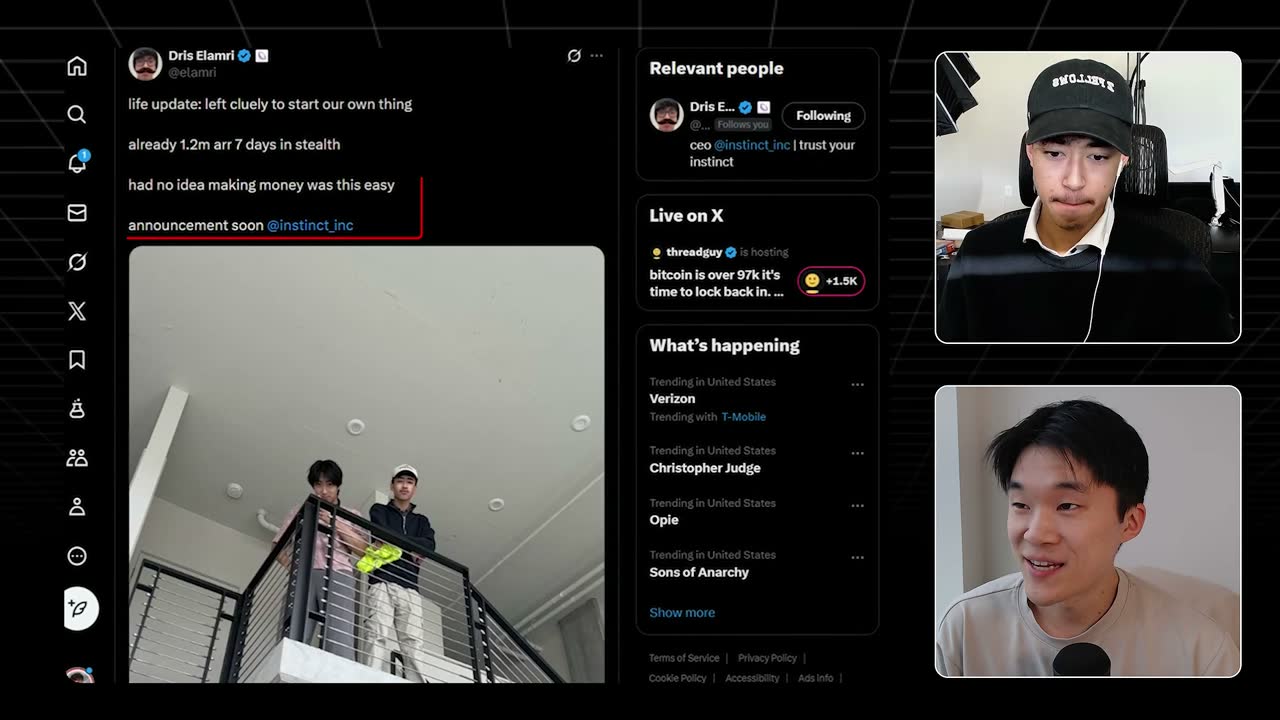
Dris Elamri's tweet announcing he left Cluely and hit $1.2M ARR seven days into stealth. Count complaints per million DAUs to put backlash in perspective. In 2016, while deciding whether to launch ads, Kansu found complaints about the missing Finnish course were 3x the complaints about ads.
Pair complaint counts with retention, app closes and review trends from A/B tests; retention was neutral to slightly down in most ad tests. Without this, every negative comment feels like the world is falling apart.

Roy Lee's tweet launching Cluely, "cheat on everything," with its cinematic demo video showing the AI overlay listening. Machine learning chooses between paid ads and ads for Duolingo's own subscription. After each lesson a model picks a programmatic ad or an internal ad for Super, Max or the Duolingo English Test, optimizing LTV with likelihood to purchase as the objective, and backs off after someone sees the same Super ad three times.
It replaced fixed ratios of ads per tier, which Anmol Tiwari called "quite an inefficient way to operate," using signals like past taps on a plan and interest in video call. A bandit picks which Super creative shows to whom, and Tiwari says personalization has barely scratched the surface.
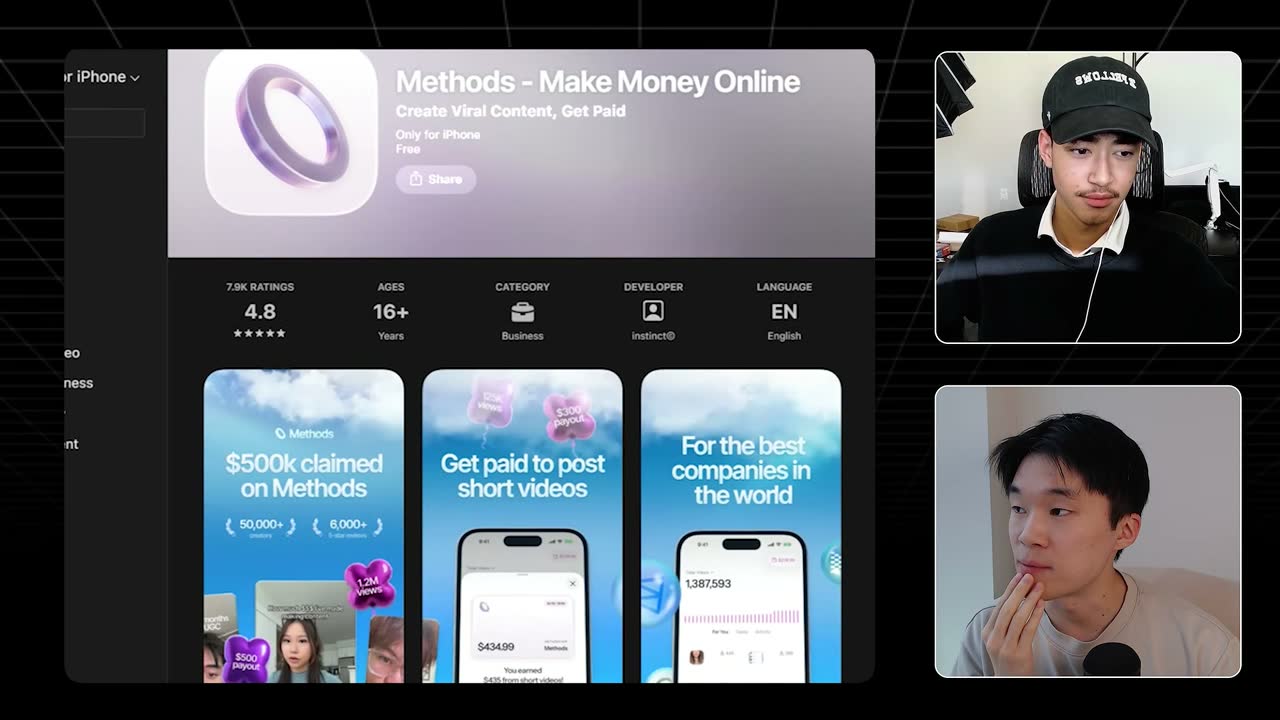
Methods app's App Store page: 4.8 rating from 7.9K reviews, "$500k claimed" by 50,000+ creators. Direct, character-led brand ads are replacing programmatic volume. In the US, one of eight characters introduces a direct advertiser's ad with a short custom script, such as Lily joking about laundry before a detergent ad. The 2026 goal is more direct volume and much less programmatic.
Scaling is slow because each advertiser needs the custom format explained.
4The trial paywall: clarity over persuasion
Give users clarity and confidence to buy instead of pushing harder. Duolingo's trial paywalls show a day-by-day timeline, such as a 7-day trial with a day-five notification, and state refund amounts when users switch plans. Pages that spell out the trial timeline won A/B tests.
This eases subscription aversion and fear of scams, especially outside the US. Tiwari warns that without trust you get poor conversion or complaints about unexpected charges. Quote: "Our goal is not to persuade users to try this. Our goal is to give them clarity and confidence to purchase."
"Try for $0.00" beat "Try for free" on the trial button. Button copy went from "Subscribe" to "Start my free trial" to "Try for free" to "Try for $0.00", which lifted both trial starts and trial-to-paid conversion. The graphs looked so green the team suspected a measurement error.
No size of uplift is given. It is one of the rarest CTA phrases in RevenueCat's paywall data, where "Continue" and "Subscribe" dominate. Eva of Solid Starts cites the big $0.00 button as showing how subtle the line on paywall tactics can be.
Letting users pick their reminder day added friction yet raised conversion. Duolingo normally reminds users about 2 days before a trial ends, then tested letting them choose the reminder day. The extra step drew attention to the reminder, raised confidence to start the trial, and lifted conversion.
Users felt safe waiting until day five or six to judge the value, and it may reduce day-zero cancellations. No conversion numbers were shared.
Free trials help even inside an already-free product. Kansu resisted trials for years because the app was free, but trials removed payment hesitation for interested, skeptical users, even when the first paid plan (no ads plus offline) needed no real trial experience.
Tiwari says premium benefits like unlimited energy or no ads only make sense once felt, so trials are the main lever for paid features. Skylight, by contrast, saw no lift from its own trial test.
Cutting the trial from 14 to 7 days doubled experimentation velocity. Duolingo ran 14-day trials until the end of 2024. Moving to 7 days halved the wait to read conversion experiments and, combined with allowing more trials per user, brought more conversions over time.
Losing tests get killed sooner, and the gain compounds over a quarter or year. Because the shorter trial and repeat trials were changed together, each one's share is unclear.
Upsells framed as onboarding questions beat standard upsells for new users. Instead of dropping a standard Super upsell into onboarding, Duolingo asked whether users want to learn with or without ads, or faster versus at their own pace, and positioned the offer as that choice. Opt-in rose significantly, one of last year's biggest wins.
Brand-new users are far more likely to convert, so their offers should fit where they are.
Framing a trial as keeping progress makes users start it. When hearts or energy run out, Duolingo positions the choice as losing progress unless the user continues, and users were much more likely to start a trial.
The screen still shows progress and offers paying gems as the alternative to starting the trial so the lesson can be finished.
Track day-zero cancellations as a read on trial intent. The share of users who cancel right after starting a trial signals intent, and once users cancel it is very hard to get them to un-cancel, so problems must be caught earlier.
The host adds that paid trials can give ad networks a cleaner signal than free trials that people switch off immediately.
Adapt trials to regional norms, like nominal paid trials in China. Almost no subscription service in China offers a zero-dollar trial; users expect a nominal fee around $1 or 99 cents, partly because auto-renewal is unfamiliar.
A paid trial also makes clear the product costs money, and similar models appear in parts of Europe. Duolingo is still working out how to serve these markets.
5Repeat trials and free tastes
Offer multiple trials because users are at different life stages. A user who did not grasp the benefits or was too busy the first time gets another chance, so over time they decide three or four times whether to buy. Combined with the 7-day trial, this produced net more conversions.
Apple allows an intro offer once per product, so workarounds are atypical and not easy. The cost of repeat trials is not discussed.
A no-strings 3-day free taste reaches hesitant users and paying subscribers. Duolingo gives a 3-day trial-like experience of Super or Max with no auto-conversion; users can convert during or at the end. Because Apple blocks a second free trial, it also upsells Super subscribers to Max, returning them to their original tier afterward.
It has been effective for both free-to-paid and paid-to-paid conversion. A taste can be a single feature, such as one isolated video call, which pushes users toward Max. No-card tastes are hard to explain because users expect an automatic charge.
Frame free tastes as an earned, time-limited reward. Copy says "you just earned this," states the three-day length, and uses timers for urgency. Duolingo moved the reward chest from the learning path to after a lesson because earning it there felt better.
Users must know a Max taste won't change what they are charged, or Super subscribers may cancel.
End a free taste plainly and make returning easy. A home drawer states that the benefits have ended and offers two options: continue, or explore and resubscribe.
Tiwari puts clarity that it ended ahead of loss-aversion copy.
6Streaks and the habit loop
- Full daily goal keeps streak
- High goals risked the habit
- Punished ambitious learners
- One lesson keeps streak
- Goals set high without risk
- Habit protected
Learners on 7+ day streaks rose over 40%
From Duolingo streak experiment
One lesson a day now keeps a streak alive, lifting 7+ day streaks 40%. Duolingo used to require users to hit their full daily goal to keep a streak, then decoupled the two so a single lesson preserves it. Learners on a 7+ day streak rose by over 40%.
The old rule punished ambitious learners who set high goals; decoupling let them aim high without risking the habit. The 7+ day share served as a concrete early-habit metric to compare variants.
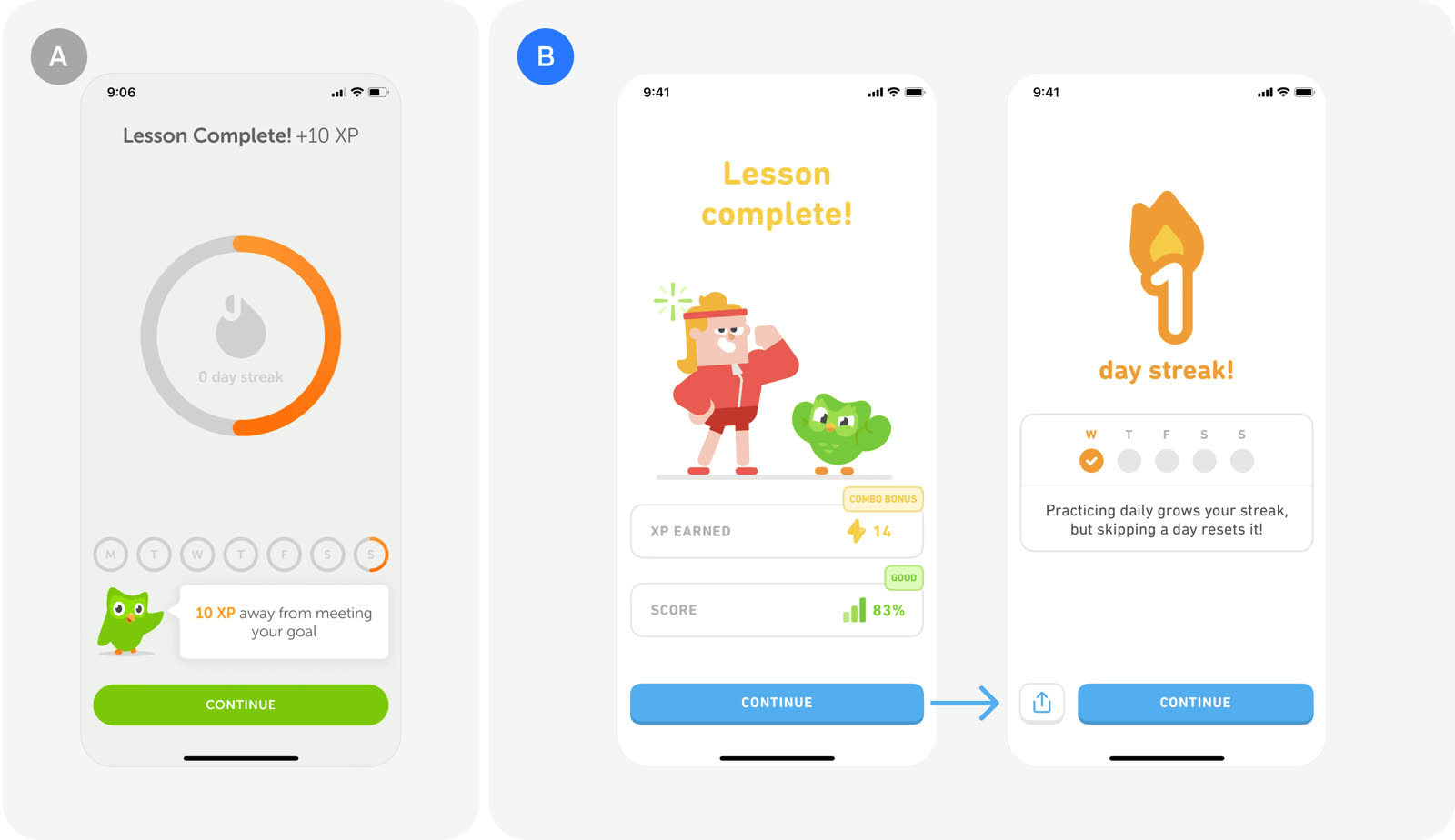
Version A and version B as Duolingo tested them. Gamification retains users by making them feel they are learning. Connor Zwick of Speak points to 700-day streaks from people who say they cannot speak the language, and Dris notes hundreds of millions of users though he knows no one who learned a language on it.
Dris's lesson: apps that feel like they work win. Speak instead bets that personal relevance and a relationship with the AI motivate better than streaks and dopamine loops.
BirdBrain tunes how many of 10 answers a learner gets right. The system adjusts difficulty to keep learners motivated, which a host compared to Purpose balancing tough love with support.
Its notifications are reverse-engineered and copied by other apps. A wrestling app team copied Duolingo's best notifications, sending at least one a day tied to past actions like beating a run record, plus "don't give up" messages to users who did not pay after onboarding.
They do not yet track which notifications drive clicks.
7AI features and Duolingo Max
Put AI usage in a higher tier to cover its compute costs. Duolingo had near-zero marginal cost per subscriber until Max placed AI features in a higher tier. Phil Carter recommends a basic plan with a taste of AI and a pro or max plan with full usage, as Duolingo Max, Perplexity, ChatGPT and others do.
Rik Haandrikman extends this to metered credits plus consumables, to "drop the floor and raise the ceiling." Max adds voice role plays with Lily.
Users asked for human tutors but were too scared to use them. Duolingo built an on-demand human tutor tier after years of requests, but no one used it despite heavy iteration. The later AI video call with Lily worked because it removed the fear of speaking to a person.
Kansu says video call with Lily has helped his own Spanish more than anything in nine years. Quote: "Do not take user feedback at face value."
AI is an accelerant for content and features, not a bolt-on chatbot. Duolingo uses AI mainly to produce content at higher quality and volume and to build features like conversation practice. Kansu says being able to teach a language is no threat unless it is also fun.
Explain My Answer was too costly at first due to LLM calls, then went free as costs fell and caching improved. Earlier personalization took hundreds of engineering hours.
Speaking practice lagged because speech models failed on accented learners. Early on, speech recognition had roughly an 80% error rate for strongly accented learners, so Duolingo and Rosetta Stone offered little speaking. Speak used that gap as its initial wedge.
Zwick sees Duolingo as complementary and its high stock price as validation of the market. Duolingo has since added speaking practice in Max.
Copying free-first breaks when AI token costs scale. Koby Conrad copied Duolingo's free-first approach, since it waited six or seven years to charge, but Sunflower's token costs reached hundreds of thousands of dollars and investors wanted revenue, so he added a monthly paywall.
Quote: "turns out investors want to see money."
8How Duolingo runs experiments
Big revenue tradeoffs go to senior leaders; teams decide small ones. Duolingo runs about 400 concurrent A/B tests and often weighs learning gains against revenue or DAU, with no single metric to settle it. Large strategic hits go to senior people, including the CEO, for sign-off.
Use 3 to 6 month holdouts for effects that shift over time. Long holdouts suit things like leaderboards that take 10 weeks to climb or push notifications whose novelty fades; a new notification can turn negative after 6 weeks.
Duolingo once ran a one-to-two-year ads holdout but now avoids year-long ones because teams forget them and bugs pollute the group.
9Math, music and chess inside one app
New subjects live in the main app, not separate apps. Math first launched as its own app on the assumption that math and language learners barely overlap. Duolingo folded it into the main app after finding users want several subjects and that growing a separate app is extremely expensive.
Math, music and chess now sit in the course switcher. Life360 and Simply cite this as a sign second apps rarely succeed. Quote: "why are we playing hard mode when we can play easy mode?"
Pick new areas by mobile fit, existing demand and internal champions. Math, music and chess can be taught in fun, bite-sized mobile lessons, already have big markets, and each had tenured builders eager to build it. Each took 6 to 12 months from idea to launch.
Coding was skipped as too hard on mobile and running as too offline.
10Product principles
Build for a general audience rather than personas. People learn languages for jobs, moving countries, heritage and more, so picking one persona cuts off the long tail. Duolingo asks new PMs to stop building persona maps.
Guide users with design, not text, because they don't read. On mobile, attention is split and users focus on roughly the core 30% of a screen.
Quote: "if you need to write a tutorial on what to do, you've already lost it."
The real competition is other screen time, so make learning fun. Churned users mostly go to Instagram, YouTube and other phone fun, not other education apps, so Duolingo invests heavily in fun to offset learning's extra effort.
Haandrikman adds that anyone can copy Duolingo's look, but its depth and community are hard to rebuild.
11The unhinged owl on social media
Repeated trending formats keep giving a famous brand fresh impressions. An article claimed Duolingo's numbers fell when it stopped its unhinged content. Each trending-format post is another chance to convert or bring a viewer back.
Adam Turaev notes the owl is wilder on social media than inside the app.
12Duolingo as a benchmark
Others measure retention and category size against Duolingo. Opal reports early retention on par with or better than Duolingo, which is cited as proof a category can hold winners making over $1B a year. Andrew Maguire puts its value at roughly $4B to $5B as one of consumer's few giant outcomes.
It is also named a compounding winner unlikely to shrink, an example of consumer expansion through gems and app colors, and, for ClassDojo's founders, the only other company living or dying by whether users benefit.

Decoupling streaks from daily goals: Duolingo's A/B test
Duolingo decoupled streaks from daily goals so one lesson a day keeps a streak alive, where before users had to hit their full goal. Learners on a 7+ day streak rose by over 40%, as the change eased pressure on ambitious learners.
One lesson a day now keeps a streak alive, lifting 7+ day streaks 40%. Duolingo used to require users to hit their full daily goal to keep a streak, then decoupled the two so a single lesson preserves it. Learners on a 7+ day streak rose by over 40%.
The old rule punished ambitious learners who set high goals; decoupling let them aim high without risking the habit. The 7+ day share served as a concrete early-habit metric to compare variants.
Version A and version B as Duolingo tested them.

The Counterintuitive Way To Nudge Users Into Free Trials – Anmol Tiwari, Duolingo
Cut its free trial from 14 days to 7 at the end of 2024, which doubled experimentation velocity and brought more conversions over time. It also uses repeat trials, a 3-day no-strings free taste, contextual onboarding upsells, and ML-driven ad personalization, all built on clarity and confidence to buy.
Duolingo's freemium playbook fits a huge funnel, not most apps. Freemium works for Duolingo because it teaches the basics of every language to a vast base of hobby learners and monetizes a slice. Phil Carter says hard paywalls convert 5x better and suit most apps; one client's freemium shift cut subscriber conversion by more than 50% and was pulled within weeks.
BoldVoice ignores basic learners and charges $150 to $200 a year to professionals whose alternative is a coach costing hundreds of dollars an hour; Praktika likewise targets serious career English. Anada Lakra warns against combining pieces of different apps' playbooks into a "mishmash strategy."
Repeated trending formats keep giving a famous brand fresh impressions. An article claimed Duolingo's numbers fell when it stopped its unhinged content. Each trending-format post is another chance to convert or bring a viewer back.
Adam Turaev notes the owl is wilder on social media than inside the app.
Why Your Free Users Are Your Real Growth Engine – Cem Kansu (Duolingo CPO)
About 10% of users subscribe and subscriptions bring in over 80% of revenue, while word of mouth from free users drives most growth. It runs about 400 concurrent tests, moved Practice Hub and Explain My Answer to free despite lost revenue, and added ads only after lessons. Explain My Answer started here because LLM costs were high. When costs fell, a test showed revenue dropped if it went free, and Duolingo moved it to free anyway. Math first launched as its own app on the assumption that math and language learners barely overlap. Duolingo later folded it into the main app, as users wanted several subjects in one place.

How Duolingo Built Duolingo Max
Grew from about 40 people and just over 1 million daily users to roughly 900 employees and a public listing. Every product change is A/B tested, even bug fixes, and every PM uses the app daily as a learner. Its moat is engagement, social features and learner session data, not content alone. Launched in May 2023 in a few countries and courses, and only took off about a year later after scaling and adding video call. Repositioning it from an AI tier to a conversation tier worked better, and it resonates most with English learners and serious learners. Video call with Lily drew far more response than roleplay, because calling her feels like calling a friend. The team is working on speaking at the learner's level and remembering past chats so she feels like a real friend. AI builds hundreds of episodes in a couple of days across many language pairs, work that would have taken years. The team would never have started it without AI.
Its notifications are reverse-engineered and copied by other apps. A wrestling app team copied Duolingo's best notifications, sending at least one a day tied to past actions like beating a run record, plus "don't give up" messages to users who did not pay after onboarding.
They do not yet track which notifications drive clicks.

Behind the product: Duolingo streaks | Jackson Shuttleworth (Group PM, Retention Team)
The streak is its biggest growth lever after the lessons, with over 9 million users on streaks of a year or longer and 600+ streak experiments in four years, about half of which lose. Wins include moving to a one-lesson streak, two starting freezes, Earn Back and a 23.5 hour reminder.
Duolingo's freemium playbook fits a huge funnel, not most apps. Freemium works for Duolingo because it teaches the basics of every language to a vast base of hobby learners and monetizes a slice. Phil Carter says hard paywalls convert 5x better and suit most apps; one client's freemium shift cut subscriber conversion by more than 50% and was pulled within weeks.
BoldVoice ignores basic learners and charges $150 to $200 a year to professionals whose alternative is a coach costing hundreds of dollars an hour; Praktika likewise targets serious career English. Anada Lakra warns against combining pieces of different apps' playbooks into a "mishmash strategy."
Scaling Duolingo, embracing failure, and insight into Latin America’s tech scene | Gina Gotthilf
Grew from 3 million to over 200 million users mostly through organic channels, with subscriptions and ads starting only around year three. Over 50% of its A/B tests failed, and its memeable passive-aggressive notifications became the brand voice.
"Try for $0.00" beat "Try for free" on the trial button. Button copy went from "Subscribe" to "Start my free trial" to "Try for free" to "Try for $0.00", which lifted both trial starts and trial-to-paid conversion. The graphs looked so green the team suspected a measurement error.
No size of uplift is given. It is one of the rarest CTA phrases in RevenueCat's paywall data, where "Continue" and "Subscribe" dominate. Eva of Solid Starts cites the big $0.00 button as showing how subtle the line on paywall tactics can be.

App Monetization: A Clever Way to Incorporate Mobile App Ads
Skips banners and shows a clean post-lesson interstitial saying 'This ad helps keep education free', with a go ad free premium link. It also offers a rewarded video ad before a lesson to refill health, which Young would move to after the lesson, and it appears to test an interstitial with a go ad free link against one with only a close button.
BirdBrain tunes how many of 10 answers a learner gets right. The system adjusts difficulty to keep learners motivated, which a host compared to Purpose balancing tough love with support.
How Praktika built a profitable $50M ARR AI business — Adam Turaev, Praktika
Adam praises its product and calls it in a league of its own, while Praktika targets serious career English instead of casual edutainment. Its owl is wilder on social media than inside the app.
Others measure retention and category size against Duolingo. Opal reports early retention on par with or better than Duolingo, which is cited as proof a category can hold winners making over $1B a year. Andrew Maguire puts its value at roughly $4B to $5B as one of consumer's few giant outcomes.
It is also named a compounding winner unlikely to shrink, an example of consumer expansion through gems and app colors, and, for ClassDojo's founders, the only other company living or dying by whether users benefit.
How Tolan 3X'd Subscriber Conversion after Shifting to Freemium
Serves classic mobile-game ads on its free tier, which Tolan mirrors in its own ad tests.
Others measure retention and category size against Duolingo. Opal reports early retention on par with or better than Duolingo, which is cited as proof a category can hold winners making over $1B a year. Andrew Maguire puts its value at roughly $4B to $5B as one of consumer's few giant outcomes.
It is also named a compounding winner unlikely to shrink, an example of consumer expansion through gems and app colors, and, for ClassDojo's founders, the only other company living or dying by whether users benefit.

Meet the ex-wrestler making $41k/mo with AI apps
The team reverse-engineered its best notifications and applied them to wrestling, sending behavior-tied reminders and don't-give-up messages.
New subjects live in the main app, not separate apps. Math first launched as its own app on the assumption that math and language learners barely overlap. Duolingo folded it into the main app after finding users want several subjects and that growing a separate app is extremely expensive.
Math, music and chess now sit in the course switcher. Life360 and Simply cite this as a sign second apps rarely succeed. Quote: "why are we playing hard mode when we can play easy mode?"
Why BoldVoice charged from day 1 and ignored the Duolingo freemium playbook — Anada Lakra
Its freemium playbook gives the product to a huge base of basic learners and monetizes a portion of them. BoldVoice argues that this fits Duolingo but not a high-intent professional audience, and that mixing playbooks creates a mishmash strategy.
Avoid the premium trap: paywalling free features works briefly, then stalls. Kansu says moving free features behind a paywall turns every metric green for about 6 months to a year, then stops working, and invites a rival to offer the same thing free within about two years.
Duolingo grew early because Rosetta Stone and similar rivals were paid and expensive. Its chief product officer coined the term "premium trap" for locking features to hit quarterly revenue. The claim rests on Kansu's judgment rather than published numbers.
New subjects live in the main app, not separate apps. Math first launched as its own app on the assumption that math and language learners barely overlap. Duolingo folded it into the main app after finding users want several subjects and that growing a separate app is extremely expensive.
Math, music and chess now sit in the course switcher. Life360 and Simply cite this as a sign second apps rarely succeed. Quote: "why are we playing hard mode when we can play easy mode?"
Make Ugly Ads to Grow Your App – Yuliya Lennox (Solid Starts)
It holds the top spot in Eva's category. Its big $0.00 call to action, from a public company, shows how subtle the line on paywall tactics can be.
Others measure retention and category size against Duolingo. Opal reports early retention on par with or better than Duolingo, which is cited as proof a category can hold winners making over $1B a year. Andrew Maguire puts its value at roughly $4B to $5B as one of consumer's few giant outcomes.
It is also named a compounding winner unlikely to shrink, an example of consumer expansion through gems and app colors, and, for ClassDojo's founders, the only other company living or dying by whether users benefit.
The Web2App Playbook: Scale Your App Without App Store Limits
Found that goal-commitment pages raise retention, which supports asking users to set goals before the paywall.
Duolingo's freemium playbook fits a huge funnel, not most apps. Freemium works for Duolingo because it teaches the basics of every language to a vast base of hobby learners and monetizes a slice. Phil Carter says hard paywalls convert 5x better and suit most apps; one client's freemium shift cut subscriber conversion by more than 50% and was pulled within weeks.
BoldVoice ignores basic learners and charges $150 to $200 a year to professionals whose alternative is a coach costing hundreds of dollars an hour; Praktika likewise targets serious career English. Anada Lakra warns against combining pieces of different apps' playbooks into a "mishmash strategy."
Put AI usage in a higher tier to cover its compute costs. Duolingo had near-zero marginal cost per subscriber until Max placed AI features in a higher tier. Phil Carter recommends a basic plan with a taste of AI and a pro or max plan with full usage, as Duolingo Max, Perplexity, ChatGPT and others do.
Rik Haandrikman extends this to metered credits plus consumables, to "drop the floor and raise the ceiling." Max adds voice role plays with Lily.
AI is an accelerant for content and features, not a bolt-on chatbot. Duolingo uses AI mainly to produce content at higher quality and volume and to build features like conversation practice. Kansu says being able to teach a language is no threat unless it is also fun.
Explain My Answer was too costly at first due to LLM calls, then went free as costs fell and caching improved. Earlier personalization took hundreds of engineering hours.
How Purpose Hit $1M ARR in 14 Days
Its BirdBrain system tunes how many of 10 answers a learner gets right to keep them motivated, which the host compared to Purpose balancing tough love with support.
Copying free-first breaks when AI token costs scale. Koby Conrad copied Duolingo's free-first approach, since it waited six or seven years to charge, but Sunflower's token costs reached hundreds of thousands of dollars and investors wanted revenue, so he added a monthly paywall.
Quote: "turns out investors want to see money."
The Bootstrapper's Path to $10M ARR Without Venture Capital – Andrew Maguire, Volo Ventures
It is worth roughly $4B to $5B, cited as evidence that consumer has produced few giant outcomes. That is still venture-backable but harder in 2026.
Put AI usage in a higher tier to cover its compute costs. Duolingo had near-zero marginal cost per subscriber until Max placed AI features in a higher tier. Phil Carter recommends a basic plan with a taste of AI and a pro or max plan with full usage, as Duolingo Max, Perplexity, ChatGPT and others do.
Rik Haandrikman extends this to metered credits plus consumables, to "drop the floor and raise the ceiling." Max adds voice role plays with Lily.
The real competition is other screen time, so make learning fun. Churned users mostly go to Instagram, YouTube and other phone fun, not other education apps, so Duolingo invests heavily in fun to offset learning's extra effort.
Haandrikman adds that anyone can copy Duolingo's look, but its depth and community are hard to rebuild.
How ClassDojo Built Network Effects to Reach 95% of US K-8 Schools
The only other company Sam and Liam saw thinking like them, living or dying by whether families and users benefit.
"Try for $0.00" beat "Try for free" on the trial button. Button copy went from "Subscribe" to "Start my free trial" to "Try for free" to "Try for $0.00", which lifted both trial starts and trial-to-paid conversion. The graphs looked so green the team suspected a measurement error.
No size of uplift is given. It is one of the rarest CTA phrases in RevenueCat's paywall data, where "Continue" and "Subscribe" dominate. Eva of Solid Starts cites the big $0.00 button as showing how subtle the line on paywall tactics can be.
Letting users pick their reminder day added friction yet raised conversion. Duolingo normally reminds users about 2 days before a trial ends, then tested letting them choose the reminder day. The extra step drew attention to the reminder, raised confidence to start the trial, and lifted conversion.
Users felt safe waiting until day five or six to judge the value, and it may reduce day-zero cancellations. No conversion numbers were shared.
Others measure retention and category size against Duolingo. Opal reports early retention on par with or better than Duolingo, which is cited as proof a category can hold winners making over $1B a year. Andrew Maguire puts its value at roughly $4B to $5B as one of consumer's few giant outcomes.
It is also named a compounding winner unlikely to shrink, an example of consumer expansion through gems and app colors, and, for ClassDojo's founders, the only other company living or dying by whether users benefit.
How Simply Finally Cracked Facebook Ads with Web Funnels – Yoav Sharon, Simply
Cited as an example of a company that pulled back from launching several separate learning apps, since portfolios rarely get economies of scale.
Machine learning chooses between paid ads and ads for Duolingo's own subscription. After each lesson a model picks a programmatic ad or an internal ad for Super, Max or the Duolingo English Test, optimizing LTV with likelihood to purchase as the objective, and backs off after someone sees the same Super ad three times.
It replaced fixed ratios of ads per tier, which Anmol Tiwari called "quite an inefficient way to operate," using signals like past taps on a plan and interest in video call. A bandit picks which Super creative shows to whom, and Tiwari says personalization has barely scratched the surface.
Methods app's App Store page: 4.8 rating from 7.9K reviews, "$500k claimed" by 50,000+ creators. Give users clarity and confidence to buy instead of pushing harder. Duolingo's trial paywalls show a day-by-day timeline, such as a 7-day trial with a day-five notification, and state refund amounts when users switch plans. Pages that spell out the trial timeline won A/B tests.
This eases subscription aversion and fear of scams, especially outside the US. Tiwari warns that without trust you get poor conversion or complaints about unexpected charges. Quote: "Our goal is not to persuade users to try this. Our goal is to give them clarity and confidence to purchase."
Letting users pick their reminder day added friction yet raised conversion. Duolingo normally reminds users about 2 days before a trial ends, then tested letting them choose the reminder day. The extra step drew attention to the reminder, raised confidence to start the trial, and lifted conversion.
Users felt safe waiting until day five or six to judge the value, and it may reduce day-zero cancellations. No conversion numbers were shared.
Free trials help even inside an already-free product. Kansu resisted trials for years because the app was free, but trials removed payment hesitation for interested, skeptical users, even when the first paid plan (no ads plus offline) needed no real trial experience.
Tiwari says premium benefits like unlimited energy or no ads only make sense once felt, so trials are the main lever for paid features. Skylight, by contrast, saw no lift from its own trial test.
Cutting the trial from 14 to 7 days doubled experimentation velocity. Duolingo ran 14-day trials until the end of 2024. Moving to 7 days halved the wait to read conversion experiments and, combined with allowing more trials per user, brought more conversions over time.
Losing tests get killed sooner, and the gain compounds over a quarter or year. Because the shorter trial and repeat trials were changed together, each one's share is unclear.
Upsells framed as onboarding questions beat standard upsells for new users. Instead of dropping a standard Super upsell into onboarding, Duolingo asked whether users want to learn with or without ads, or faster versus at their own pace, and positioned the offer as that choice. Opt-in rose significantly, one of last year's biggest wins.
Brand-new users are far more likely to convert, so their offers should fit where they are.
Framing a trial as keeping progress makes users start it. When hearts or energy run out, Duolingo positions the choice as losing progress unless the user continues, and users were much more likely to start a trial.
The screen still shows progress and offers paying gems as the alternative to starting the trial so the lesson can be finished.
Track day-zero cancellations as a read on trial intent. The share of users who cancel right after starting a trial signals intent, and once users cancel it is very hard to get them to un-cancel, so problems must be caught earlier.
The host adds that paid trials can give ad networks a cleaner signal than free trials that people switch off immediately.
Adapt trials to regional norms, like nominal paid trials in China. Almost no subscription service in China offers a zero-dollar trial; users expect a nominal fee around $1 or 99 cents, partly because auto-renewal is unfamiliar.
A paid trial also makes clear the product costs money, and similar models appear in parts of Europe. Duolingo is still working out how to serve these markets.
Offer multiple trials because users are at different life stages. A user who did not grasp the benefits or was too busy the first time gets another chance, so over time they decide three or four times whether to buy. Combined with the 7-day trial, this produced net more conversions.
Apple allows an intro offer once per product, so workarounds are atypical and not easy. The cost of repeat trials is not discussed.
A no-strings 3-day free taste reaches hesitant users and paying subscribers. Duolingo gives a 3-day trial-like experience of Super or Max with no auto-conversion; users can convert during or at the end. Because Apple blocks a second free trial, it also upsells Super subscribers to Max, returning them to their original tier afterward.
It has been effective for both free-to-paid and paid-to-paid conversion. A taste can be a single feature, such as one isolated video call, which pushes users toward Max. No-card tastes are hard to explain because users expect an automatic charge.
Frame free tastes as an earned, time-limited reward. Copy says "you just earned this," states the three-day length, and uses timers for urgency. Duolingo moved the reward chest from the learning path to after a lesson because earning it there felt better.
Users must know a Max taste won't change what they are charged, or Super subscribers may cancel.
End a free taste plainly and make returning easy. A home drawer states that the benefits have ended and offers two options: continue, or explore and resubscribe.
Tiwari puts clarity that it ended ahead of loss-aversion copy.
Protecting Freemium at 100M Users AND Driving $500M Revenue – Giordano Contestabile, Life360
Its chief product officer coined the "premium trap" for locking features to hit quarterly revenue. It reportedly folded a separate app back into the main app, a sign that second apps rarely succeed.
Gamification retains users by making them feel they are learning. Connor Zwick of Speak points to 700-day streaks from people who say they cannot speak the language, and Dris notes hundreds of millions of users though he knows no one who learned a language on it.
Dris's lesson: apps that feel like they work win. Speak instead bets that personal relevance and a relationship with the AI motivate better than streaks and dopamine loops.
Why Opal Stopped Chasing Revenue to Build a Billion-User App – Kenneth Schlenker
Used as a benchmark: Opal's early retention matches or beats it. It is also cited as proof that a category can hold winners, making over $1B a year.
Ads run only after a completed lesson, with dicey categories blocked. Duolingo shows ads after a lesson, never before or during, and retention stayed mostly neutral across ad tests. It blocks gambling, sketchy games and anything unsafe for young audiences or brands, even at a revenue cost.
The team dogfoods placements, since an app-open ad can look fine in metrics but feel awful. It started on AdMob, then added Facebook, Flurry and Unity, and asked networks to drop formats like ads with three exit buttons. Mojo's interviewer still cites the full-screen, unskippable post-lesson ad as aggressive monetization.
Dris Elamri's tweet announcing he left Cluely and hit $1.2M ARR seven days into stealth.
The AI Growth Playbook for Subscription Apps – Phil Carter, Elemental Growth
Skips the lecture and starts an immersive gamified lesson, but its earlier personalization took hundreds of engineering hours. Duolingo Max adds voice role plays with Lily, and it built a huge company on freemium.
Free trials help even inside an already-free product. Kansu resisted trials for years because the app was free, but trials removed payment hesitation for interested, skeptical users, even when the first paid plan (no ads plus offline) needed no real trial experience.
Tiwari says premium benefits like unlimited energy or no ads only make sense once felt, so trials are the main lever for paid features. Skylight, by contrast, saw no lift from its own trial test.
This Self-Improvement App Might Kill MasterClass: RiseGuide Review (2026)
Its data shows that asking users how much time they will commit increases retention. Streaks raise retention, but a broken long streak can lose the user for good.
Gamification retains users by making them feel they are learning. Connor Zwick of Speak points to 700-day streaks from people who say they cannot speak the language, and Dris notes hundreds of millions of users though he knows no one who learned a language on it.
Dris's lesson: apps that feel like they work win. Speak instead bets that personal relevance and a relationship with the AI motivate better than streaks and dopamine loops.
Speaking practice lagged because speech models failed on accented learners. Early on, speech recognition had roughly an 80% error rate for strongly accented learners, so Duolingo and Rosetta Stone offered little speaking. Speak used that gap as its initial wedge.
Zwick sees Duolingo as complementary and its high stock price as validation of the market. Duolingo has since added speaking practice in Max.
I speedran an ai app from 0 to $1m/yr in 10 months
Koby copied its free-first approach, since it waited six or seven years to charge. Sunflower's AI token costs reached hundreds of thousands of dollars, so it had to add a paywall. He wants a free, Duolingo-style version of Sunflower for hundreds of millions of people.
Repeated trending formats keep giving a famous brand fresh impressions. An article claimed Duolingo's numbers fell when it stopped its unhinged content. Each trending-format post is another chance to convert or bring a viewer back.
Adam Turaev notes the owl is wilder on social media than inside the app.
Insights from RevenueCat’s 2026 State of Subscription Apps Report
Anyone can copy how it looks, but its depth and community are hard to rebuild. It had near-zero marginal cost per subscriber until Duolingo Max put AI features in a higher tier.
Others measure retention and category size against Duolingo. Opal reports early retention on par with or better than Duolingo, which is cited as proof a category can hold winners making over $1B a year. Andrew Maguire puts its value at roughly $4B to $5B as one of consumer's few giant outcomes.
It is also named a compounding winner unlikely to shrink, an example of consumer expansion through gems and app colors, and, for ClassDojo's founders, the only other company living or dying by whether users benefit.
The Top 10% of Apps Grew 306%. Everyone Else? Barely Beat Inflation | SOSA 2026
Letting users pick their trial reminder day lifted conversion. Its chief product officer said a "try for $0" call to action beat "try for free". Named as a compounding winner unlikely to shrink.
Streak repair, sold for about $1 to $3, was the first purchase. Users cared enough about their streak that a good share would pay a dollar or two to repair a broken one, which proved Duolingo could monetize extras while keeping education free.
Luis von Ahn had publicly promised never to add ads, in-app purchases or subscriptions; Duolingo built all three, in that order, monetizing only the "bells and whistles." Margins plans the same model: free core features, with streak freezes, streak rescue and cosmetics paid.
Meet The 18y/o Who Solved UGC Marketing (100M Views in 2 Weeks)
Dris notes it has hundreds of millions of users even though he doesn't know anyone who learned a language on it. He uses it to show that apps that feel like they work win.
Free users are the growth engine, so free value stays strong. About 10% of users subscribe and subscriptions bring in over 80% of revenue, but word of mouth from free users drives most growth whether or not they ever pay. Duolingo moved Practice Hub and Explain My Answer from paid to free and accepted the revenue loss.
Explain My Answer started in the top paid tier because LLM costs were high. When costs fell, a test showed revenue dropped if it went free, and Duolingo moved it to free anyway. Quote from CPO Cem Kansu: "free users are our marketing engine."
Avoid the premium trap: paywalling free features works briefly, then stalls. Kansu says moving free features behind a paywall turns every metric green for about 6 months to a year, then stops working, and invites a rival to offer the same thing free within about two years.
Duolingo grew early because Rosetta Stone and similar rivals were paid and expensive. Its chief product officer coined the term "premium trap" for locking features to hit quarterly revenue. The claim rests on Kansu's judgment rather than published numbers.
The first business model, crowdsourced translation, failed on price and quality. Duolingo launched as a free website that sold learners' sentence translations to outlets like CNN and BuzzFeed. It earned a little, but learners translated poorly and rivals could always undercut on price.
Fixing quality pulled resources from teaching toward running a translation business. By 2016, when Kansu joined, the model was dropped and the company was searching for the next one.
Streak repair, sold for about $1 to $3, was the first purchase. Users cared enough about their streak that a good share would pay a dollar or two to repair a broken one, which proved Duolingo could monetize extras while keeping education free.
Luis von Ahn had publicly promised never to add ads, in-app purchases or subscriptions; Duolingo built all three, in that order, monetizing only the "bells and whistles." Margins plans the same model: free core features, with streak freezes, streak rescue and cosmetics paid.
Monetizing required investor pressure and a mission-driven culture shift. Around 2016 a Capital G board member told Luis the next round should be the last before a monetization plan, and Kansu's sole job became figuring out how to make money.
Many of the roughly 60 employees saw the company as almost a nonprofit. The message became that revenue funds the mission. Duolingo already had tens of millions of users when it started monetizing.
A janky one-month ad-free purchase proved demand before building a subscription. After reviews asked to pay to remove ads, Duolingo tested a one-time ad-free month at $3, $5 and $10. It sold far better than expected, leading to Duolingo Plus in 2017 with no ads, offline use and a "support the mission" line.
Early buyers were roughly half mission supporters and half people wanting no ads. Quote: "Even though we created the most bizarre package to sell, people want to buy this."
Unlimited hearts tied the subscription to real usage friction. Folding the hearts pacing mechanic into the subscription with unlimited hearts, plus custom practice, was a turning point that lifted both conversion and subscription retention.
Many users want new content rather than practicing old content, so removing the limit had real value.
Ads run only after a completed lesson, with dicey categories blocked. Duolingo shows ads after a lesson, never before or during, and retention stayed mostly neutral across ad tests. It blocks gambling, sketchy games and anything unsafe for young audiences or brands, even at a revenue cost.
The team dogfoods placements, since an app-open ad can look fine in metrics but feel awful. It started on AdMob, then added Facebook, Flurry and Unity, and asked networks to drop formats like ads with three exit buttons. Mojo's interviewer still cites the full-screen, unskippable post-lesson ad as aggressive monetization.
Dris Elamri's tweet announcing he left Cluely and hit $1.2M ARR seven days into stealth. Count complaints per million DAUs to put backlash in perspective. In 2016, while deciding whether to launch ads, Kansu found complaints about the missing Finnish course were 3x the complaints about ads.
Pair complaint counts with retention, app closes and review trends from A/B tests; retention was neutral to slightly down in most ad tests. Without this, every negative comment feels like the world is falling apart.
Roy Lee's tweet launching Cluely, "cheat on everything," with its cinematic demo video showing the AI overlay listening. Machine learning chooses between paid ads and ads for Duolingo's own subscription. After each lesson a model picks a programmatic ad or an internal ad for Super, Max or the Duolingo English Test, optimizing LTV with likelihood to purchase as the objective, and backs off after someone sees the same Super ad three times.
It replaced fixed ratios of ads per tier, which Anmol Tiwari called "quite an inefficient way to operate," using signals like past taps on a plan and interest in video call. A bandit picks which Super creative shows to whom, and Tiwari says personalization has barely scratched the surface.
Methods app's App Store page: 4.8 rating from 7.9K reviews, "$500k claimed" by 50,000+ creators. Direct, character-led brand ads are replacing programmatic volume. In the US, one of eight characters introduces a direct advertiser's ad with a short custom script, such as Lily joking about laundry before a detergent ad. The 2026 goal is more direct volume and much less programmatic.
Scaling is slow because each advertiser needs the custom format explained.
Give users clarity and confidence to buy instead of pushing harder. Duolingo's trial paywalls show a day-by-day timeline, such as a 7-day trial with a day-five notification, and state refund amounts when users switch plans. Pages that spell out the trial timeline won A/B tests.
This eases subscription aversion and fear of scams, especially outside the US. Tiwari warns that without trust you get poor conversion or complaints about unexpected charges. Quote: "Our goal is not to persuade users to try this. Our goal is to give them clarity and confidence to purchase."
"Try for $0.00" beat "Try for free" on the trial button. Button copy went from "Subscribe" to "Start my free trial" to "Try for free" to "Try for $0.00", which lifted both trial starts and trial-to-paid conversion. The graphs looked so green the team suspected a measurement error.
No size of uplift is given. It is one of the rarest CTA phrases in RevenueCat's paywall data, where "Continue" and "Subscribe" dominate. Eva of Solid Starts cites the big $0.00 button as showing how subtle the line on paywall tactics can be.
Free trials help even inside an already-free product. Kansu resisted trials for years because the app was free, but trials removed payment hesitation for interested, skeptical users, even when the first paid plan (no ads plus offline) needed no real trial experience.
Tiwari says premium benefits like unlimited energy or no ads only make sense once felt, so trials are the main lever for paid features. Skylight, by contrast, saw no lift from its own trial test.
Users asked for human tutors but were too scared to use them. Duolingo built an on-demand human tutor tier after years of requests, but no one used it despite heavy iteration. The later AI video call with Lily worked because it removed the fear of speaking to a person.
Kansu says video call with Lily has helped his own Spanish more than anything in nine years. Quote: "Do not take user feedback at face value."
AI is an accelerant for content and features, not a bolt-on chatbot. Duolingo uses AI mainly to produce content at higher quality and volume and to build features like conversation practice. Kansu says being able to teach a language is no threat unless it is also fun.
Explain My Answer was too costly at first due to LLM calls, then went free as costs fell and caching improved. Earlier personalization took hundreds of engineering hours.
Big revenue tradeoffs go to senior leaders; teams decide small ones. Duolingo runs about 400 concurrent A/B tests and often weighs learning gains against revenue or DAU, with no single metric to settle it. Large strategic hits go to senior people, including the CEO, for sign-off.
Use 3 to 6 month holdouts for effects that shift over time. Long holdouts suit things like leaderboards that take 10 weeks to climb or push notifications whose novelty fades; a new notification can turn negative after 6 weeks.
Duolingo once ran a one-to-two-year ads holdout but now avoids year-long ones because teams forget them and bugs pollute the group.
New subjects live in the main app, not separate apps. Math first launched as its own app on the assumption that math and language learners barely overlap. Duolingo folded it into the main app after finding users want several subjects and that growing a separate app is extremely expensive.
Math, music and chess now sit in the course switcher. Life360 and Simply cite this as a sign second apps rarely succeed. Quote: "why are we playing hard mode when we can play easy mode?"
Pick new areas by mobile fit, existing demand and internal champions. Math, music and chess can be taught in fun, bite-sized mobile lessons, already have big markets, and each had tenured builders eager to build it. Each took 6 to 12 months from idea to launch.
Coding was skipped as too hard on mobile and running as too offline.
Build for a general audience rather than personas. People learn languages for jobs, moving countries, heritage and more, so picking one persona cuts off the long tail. Duolingo asks new PMs to stop building persona maps.
Guide users with design, not text, because they don't read. On mobile, attention is split and users focus on roughly the core 30% of a screen.
Quote: "if you need to write a tutorial on what to do, you've already lost it."
The real competition is other screen time, so make learning fun. Churned users mostly go to Instagram, YouTube and other phone fun, not other education apps, so Duolingo invests heavily in fun to offset learning's extra effort.
Haandrikman adds that anyone can copy Duolingo's look, but its depth and community are hard to rebuild.
How Mojo Increased ARPU 60% In Just Five Months – Michal Parizek, Mojo
The interviewer cites its full-screen, unskippable ad after a lesson as an example of aggressive monetization, in a discussion of how a weak premium tier or stingy free tier affects user tolerance.
How Skylight Doubled Subscription Prices to $79 – Michael Segal & Mark Ungerer
Its free trial works because users feel the premium value before deciding, unlike Skylight's trial test, which showed no lift.
How Speak Built a $1B AI Language Learning App
Had little speaking early on because speech models had roughly an 80% error rate. Its 700-day streaks show strong retention from gamification, and Connor sees it as a complementary product whose high stock price validates the market. It has since added Max with speaking practice.
Meet The Guy Who Solved App Growth on TikTok
An article claims its numbers fell once it stopped its unhinged content, used as an example of why repeated trending formats keep giving a known brand fresh impressions.
The surprising advice from a founder who built 2 unicorns | Jason Cohen (WP Engine)
Shown as an example of consumer expansion, where gems and app colors give users many small ways to pay more.
How Margins Built a Viral Reading App
Offered as the model for Margins' monetization: free core features, with streak repair and other motivation tools sold later.
How Fitbod Uses AI to Hyperpersonalize Strength Workouts
Founded in 2011 and only began charging in 2017 with Duolingo Plus, a path the host says worked in an easier era of cheaper capital. Fitbod borrowed its weekly retention metric from Duolingo and A/B tests it.
How Opal Reached $10M ARR with 11 Employees
Held up as the model for making something hard easy through motivation, and as proof that self-improvement apps are easy to share. A Duolingo co-founder advised Kenneth to go freemium first, but Opal reversed that playbook with paid-first growth.
How Preply Built the World’s Largest Language Learning Marketplace
The host notes that debate over Duolingo's teaching quality misses a separate issue, which is staying motivated through a long, hard learning process.
How Best-In-Class Retention Propelled Flo to a $1B Valuation
It began with one use case and expanded later, a path similar to Flo's.
Finding hidden growth opportunities in your product | Albert Cheng (Duolingo, Grammarly, Chess.com)
Runs a rigid but fast experimentation process called the Green Machine. It grew sharing by improving moments users already screenshotted, which can 5x or 10x growth, and uses placement tests and friend push notifications for returning users.
How Noom Avoided PMF Collapse in the Wake of GLP-1s
Streak freezes and repairs made restarting easy after a vacation or missed weekend and lifted free-user retention. Duolingo later sold them as in-app purchases, which moved revenue too.
How onX Built a Portfolio of Apps to Grow ARR by 10x
Its huge addressable market lets it afford a large free user base, unlike narrower niche apps.
This AI Learning App Made $1.8M in Its First Year (Coursiv App)
Has reported that asking users how much time they will commit each day is an important number that affects retention. CP Young cites this as the reason every app should have that onboarding screen.
Easy Trick to Keep Users Coming Back to Your App
Its streaks are cited as the example of a loyalty loop that builds habits in the habit-forming phase.
How Chess.com Became the World’s Top Chess App
It once avoided paid ads and now spends very little on paid, country by country, such as TV commercials in Japan. Its model of a daily-active north star with retention as the hero driver is being borrowed by Chess.com.
How One AI Feature Supercharged Photoroom’s Growth
Cited as an example of showing value in onboarding, with a first lesson, points, a streak and a badge instead of explanations. Photoroom says it lacks Duolingo's or Canva's awareness, yet could afford dropping its watermark.
How Headspace Expanded from Meditation App to Wellness Platform
Cited alongside Quizlet as an example of showing learners their progress, a model for Headspace's score tracking in the app.
Insights from RevenueCat’s 2025 State of Subscription Apps Report
Its streak extensions are cited as an early non-gaming example of consumables that let heavy users spend more.
This Calorie Tracker App Makes $800,000 a Month (Cal AI)
Uses commitment steps in onboarding, such as choosing how fast you want to learn, and the speaker says the trick works.
How Ladder Nailed Product/Channel Fit on TikTok and Meta to Grow 2,000%
Ladder wanted a Duolingo-style product that keeps people motivated to return, and borrowed badges, streaks and friendly competition. Stewart lists it among his favorite apps.
Thinking beyond frameworks | Casey Winters (Pinterest, Eventbrite, Airbnb, Tinder, Reddit, Grubhub)
It has a data network effect because lessons improve as more people use it. It is one of the few consumer subscriptions with high annual retention, and it stayed small and scrappy for a long time.
More in Education
 Education
Headway
A book summary and self-growth app that sells subscriptions through a long web quiz funnel.
10 sources · 36 tips Education
Blinkist
A nonfiction book summary app that turns books into short audio and text reads.
16 sources · 17 tips Education
StudyFetch
An AI study platform that turns course materials into practice tests, flashcards and tutoring sessions.
4 sources · 31 tips Education
Coconote
An AI study app that records and transcribes lectures and creates notes, summaries and flashcards.
3 sources · 30 tips Education
Reforge
A company offering courses on product and growth, now also building AI products like Reforge Insights.
10 sources · 13 tips Education
Coursiv
An AI learning app that teaches beginners practical AI tools through short lessons and challenges.
2 sources · 17 tips Education
Unacademy
An Indian online learning platform offering courses for exam preparation and other subjects.
2 sources · 6 tips Education
ClassDojo
A classroom communication app connecting teachers, parents and kids, with optional paid extras and new learning products.
2 sources · 17 tips