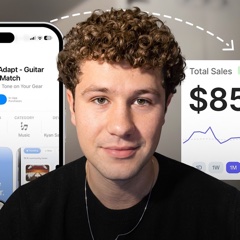
Kayen Santiago
Founder of Tone Adapt, a guitar tone matching app
Where to hear and read about Kayen Santiago1 episode or test

Kayen Santiago is the founder of Tone Adapt, a guitar tone matching app he built in 3 days that reached about $84K a month in October. The thing most worth learning from him is how to run a paid UGC creator program on proven formats, where one organic video also becomes an ad.
Literally just putting anything out there is always better than nothing.
He Went From Broke College Student to an $84K/Month App (Full Story)
Kayen Santiago: the story and the lessons
1How Kayen Santiago built Tone Adapt from his own videos
Santiago got into UGC by posting daily while broke. His computer science advice posts reached only 150 followers. Brands then offered paid UGC deals, which he took because he was broke, and he did UGC for about two months before launching the app.
The work put him in touch with founders running UGC programs at scale, who taught him how to go viral.
He built the first version in three days as a resume project. After about a year and a half of guitar, he found ChatGPT could match tones and no app did. Users enter their guitar, amp, pedals and a song, then get the original gear and settings for their own.
It was the first thing he ever built, which he calls "the most vibecoded piece of slop ever". He did no market research, since he could build it in a day.
His own videos took the app to $12K a month. He posted one to two videos a day and answered nearly every comment in the first month. His sixth video reached 604K views, and his first Tone Adapt TikTok got 282K views after four plain guitar-playing posts.
Many people quit after four posts. His own posting alone reached about $12K a month in a little over a month.
Three hired creators lifted it from $12K to about $40K. Once his own videos had found formats that worked, he hired three creators to post the exact same formats several times a day.
His first hired creator has only 1,500 followers, yet his videos got 585K and 250K views. About 10 creators now post one to three times a day, with some influencers and ads, and October reached about $84K to $85K.
He markets only the app, because it converts far better than the website. The website gets far more visits but a fraction of the paying subscribers. Since April he has not marketed the website at all.
A podcast co-guest, Joseph, put it down to the legitimacy of an App Store presence.
2Santiago's method for turning tutorials into product demos
He copied popular guitar tutorials and showed an app doing the work. He took the hook and placement of existing talking-head tone tutorials, but showed a product solving the problem instead of explaining it by hand.
The tutorial creators he studied were posting organic content and not monetizing it. In his words, he tried to "take that exact format and just show off a product that solves that issue".
His biggest videos open with the result, then run mostly demo. A talking hook states the result viewers want and the objections to existing solutions, then about 80% of the video is pure demo. Several talking videos on Instagram reached 1.4 to 1.6 million views.
The demo lands because the alternatives are costly and hard. Pro software needs extra hardware and a steep learning curve, and modeling amps with tone matching are expensive.
He pairs demos with songs everyone knows. One creator reuses the same two songs, Smells Like Teen Spirit and Everlong, because they always perform.
A loved song over a strong electric guitar adaptation is engaging without a clever hook. A familiar song can carry a video on its own.
Modest view counts are a good sign to him. An 18.8K video signals that some posts will reach 100K, though not every video hits.
He prefers captions in a Snapchat style, which feel more natural for an app than regular TikTok text, and has used them since launch.
3How Santiago runs his creator program
He gives creators a Notion brief of nine formats. Each format has three example videos, and creators are told to copy them as closely as possible so they have little to guess at.
His words: "there's three example videos of, you know, videos that they should try and copy literally as closely as possible."
Creators post drafts in a public Discord channel for feedback. They send each video before posting so he can review it, and everyone sees the notes. Each creator also has a private one-on-one channel with him.
This gives mass feedback without separate calls. He says the hard part of the whole program is managing people, doing outreach and building the program itself.
He pays a small base plus a low-threshold view bonus ladder. Base pay is $500 to $850 a month for about 30 videos, and some formats need 30 to 60. Bonuses run $50 at 50K views, $75 at 100K, $300 at 500K, $600 at 1M and $5,000 at 3M.
Tiers start at 50K because a winning ad often needs only 20K to 50K views. Many programs start bonuses at 100K for about $100, so a 50K video earns only the base. The $5,000 prize is a long shot meant to make creators really want to go viral.
He built a system that runs even without him. Most creator videos share a format, so little judgment is needed from him.
He calls UGC the first channel to build, exponential, while paid ads and influencers are "shots in the dark".
4How Santiago turns organic posts into winning ads
Creators upload every post to one shared Google Drive folder. He asks for every organic video, not only the hits, and downloads from the folder whenever he wants fresh ad creative. About 75% of his winning ads come straight from creators' posts.
One pool of content serves both organic and paid channels, so the same filmed videos earn on organic reach and then again as ads.
He tests a batch of creator videos once a week. He puts many new videos into one new ad set at $100 to $300 a day and lets Meta pick the winners, instead of putting $20 a day on a single video.
He skips formats that are dying on Meta and tests formats he hasn't run before. Running a big batch at once usually surfaces a couple of winners.
He tests low-view posts as ads before writing them off. One organic post with about 5,000 views performed as an ad for around two months.
He runs the videos without adapting them, and the more viral a post is, the better it usually performs as an ad. He judges by cost per acquisition alone and says he doesn't pay attention to CPM.
UGC earns higher margins than paid ads alone. Ads run about $15 to $20 per subscriber, and each subscriber brings back $30 to $50. Meta also needs a lot of spend before its algorithm learns the app.
He says the margin from ads never matches UGC.
5Santiago's onboarding: create the gap, then bridge it
He opens with personalization and an interactive mini demo. A welcome screen cites 200,000 guitarists, a few questions build a first sense of commitment, and users then pick a genre and song and search their gear.
The gear database holds over 4,000 guitars and 4,000 amps. Users reach the wow moment early.
The result screen shows the gap between the user's rig and the original. For an AC/DC song, it shows the original guitar, amp settings, cabinet and pedals. A diagram marks where the user's rig differs, and the app promises to fix it.
Joseph says many founders stop at problem and solution, and that showing the mechanism builds peak desire. In Santiago's words: "You create the gap and then you bridge the gap."
He would now drop the sign-in screen. Any sign-in screen costs at least 5% of users. He placed it just before the payoff, when users want the result badly enough to create an account.
He kept it only because the website back end relied on accounts for tracking, limits and plans, and the email campaigns use them too. Rebuilding the database for the app was too much work.
6How Santiago prices and designs paywalls
He found that higher prices earn more per user. A $35 year and $9 week plan converted 8.6% with 418 conversions. A $40 and $10 plan converted 7.6% with 365 yet earned more per user, and a $60 year plan dropped to about 5.6%.
The newest variant, $60 a year and $20 a month, converts lowest and earns the most per user. It sits in a new panel of paywalls, so results are early. The real prices are $39.99 a year and $9.99 a week.
A higher price makes ads profitable on day one. At $15 to $20 per subscriber, the cheap paywall struggles to return ad spend on day one. A $60 plan allows $20 to $25 per subscriber.
He launched at $60 a year, went cheaper to test, and is now going back up. Most people take the opposite route. He says return on ad spend rises with price.
He believes weekly plans at $6 to $7 pay back over time. At that price, renewal alerts stay under the point where people cancel on the spot. Most cancel, but renewers pay back over 6 to 12 months.
This is his view, and his best tested paywall used $9.99 a week. Joseph likens $6 to a weekly Starbucks run.
He uses a clean bottom sheet paywall with two plans. Social proof leads into a bottom sheet with an annual and a weekly plan. Bottom sheets usually ended up working a little better, so he stopped running full-screen versions.
He chose two plans because it looks cleaner than cramming plans onto one screen. Pricing, paywall and plan tests are always running.
He shows paid and organic users different paywalls. In Superwall, paid-ad traffic goes to paywalls with fewer free trials, which works better for him. Organic viewers see other paywalls, usually at lower prices and sometimes with trials.
Each audience converts best at different price points, with or without trials.
7Santiago's plan to build, scale and sell apps
He plans to sell Tone Adapt and repeat the process. His other apps bring in $5K to $15K a month, and he just launched a couple more. The goal is to scale each app to $50K to $100K a month, sell it for roughly $500K to $3M, then start the next.
None of the other apps matches Tone Adapt yet.
He sees the next year and a half to two years as the window. Building apps is easy, so the work is marketing, and marketing keeps getting easier. Information on how to scale an app is freely available.
He says scaling apps is as easy now as it will ever be.

He Went From Broke College Student to an $84K/Month App (Full Story)
Kayen Santiago explains how he runs a UGC program of about 10 creators, reuses their organic posts as Meta ads, and tests paywall pricing for Tone Adapt. The app was built in 3 days and went from his own videos to about $12K a month, then $40K with three creators, and about $84K to $85K a month in October.
Santiago got into UGC by posting daily while broke. His computer science advice posts reached only 150 followers. Brands then offered paid UGC deals, which he took because he was broke, and he did UGC for about two months before launching the app.
The work put him in touch with founders running UGC programs at scale, who taught him how to go viral.
He built the first version in three days as a resume project. After about a year and a half of guitar, he found ChatGPT could match tones and no app did. Users enter their guitar, amp, pedals and a song, then get the original gear and settings for their own.
It was the first thing he ever built, which he calls "the most vibecoded piece of slop ever". He did no market research, since he could build it in a day.
His own videos took the app to $12K a month. He posted one to two videos a day and answered nearly every comment in the first month. His sixth video reached 604K views, and his first Tone Adapt TikTok got 282K views after four plain guitar-playing posts.
Many people quit after four posts. His own posting alone reached about $12K a month in a little over a month.
Three hired creators lifted it from $12K to about $40K. Once his own videos had found formats that worked, he hired three creators to post the exact same formats several times a day.
His first hired creator has only 1,500 followers, yet his videos got 585K and 250K views. About 10 creators now post one to three times a day, with some influencers and ads, and October reached about $84K to $85K.
He markets only the app, because it converts far better than the website. The website gets far more visits but a fraction of the paying subscribers. Since April he has not marketed the website at all.
A podcast co-guest, Joseph, put it down to the legitimacy of an App Store presence.
He copied popular guitar tutorials and showed an app doing the work. He took the hook and placement of existing talking-head tone tutorials, but showed a product solving the problem instead of explaining it by hand.
The tutorial creators he studied were posting organic content and not monetizing it. In his words, he tried to "take that exact format and just show off a product that solves that issue".
His biggest videos open with the result, then run mostly demo. A talking hook states the result viewers want and the objections to existing solutions, then about 80% of the video is pure demo. Several talking videos on Instagram reached 1.4 to 1.6 million views.
The demo lands because the alternatives are costly and hard. Pro software needs extra hardware and a steep learning curve, and modeling amps with tone matching are expensive.
He pairs demos with songs everyone knows. One creator reuses the same two songs, Smells Like Teen Spirit and Everlong, because they always perform.
A loved song over a strong electric guitar adaptation is engaging without a clever hook. A familiar song can carry a video on its own.
Modest view counts are a good sign to him. An 18.8K video signals that some posts will reach 100K, though not every video hits.
He prefers captions in a Snapchat style, which feel more natural for an app than regular TikTok text, and has used them since launch.
He gives creators a Notion brief of nine formats. Each format has three example videos, and creators are told to copy them as closely as possible so they have little to guess at.
His words: "there's three example videos of, you know, videos that they should try and copy literally as closely as possible."
Creators post drafts in a public Discord channel for feedback. They send each video before posting so he can review it, and everyone sees the notes. Each creator also has a private one-on-one channel with him.
This gives mass feedback without separate calls. He says the hard part of the whole program is managing people, doing outreach and building the program itself.
He pays a small base plus a low-threshold view bonus ladder. Base pay is $500 to $850 a month for about 30 videos, and some formats need 30 to 60. Bonuses run $50 at 50K views, $75 at 100K, $300 at 500K, $600 at 1M and $5,000 at 3M.
Tiers start at 50K because a winning ad often needs only 20K to 50K views. Many programs start bonuses at 100K for about $100, so a 50K video earns only the base. The $5,000 prize is a long shot meant to make creators really want to go viral.
He built a system that runs even without him. Most creator videos share a format, so little judgment is needed from him.
He calls UGC the first channel to build, exponential, while paid ads and influencers are "shots in the dark".
Creators upload every post to one shared Google Drive folder. He asks for every organic video, not only the hits, and downloads from the folder whenever he wants fresh ad creative. About 75% of his winning ads come straight from creators' posts.
One pool of content serves both organic and paid channels, so the same filmed videos earn on organic reach and then again as ads.
He tests a batch of creator videos once a week. He puts many new videos into one new ad set at $100 to $300 a day and lets Meta pick the winners, instead of putting $20 a day on a single video.
He skips formats that are dying on Meta and tests formats he hasn't run before. Running a big batch at once usually surfaces a couple of winners.
He tests low-view posts as ads before writing them off. One organic post with about 5,000 views performed as an ad for around two months.
He runs the videos without adapting them, and the more viral a post is, the better it usually performs as an ad. He judges by cost per acquisition alone and says he doesn't pay attention to CPM.
UGC earns higher margins than paid ads alone. Ads run about $15 to $20 per subscriber, and each subscriber brings back $30 to $50. Meta also needs a lot of spend before its algorithm learns the app.
He says the margin from ads never matches UGC.
He opens with personalization and an interactive mini demo. A welcome screen cites 200,000 guitarists, a few questions build a first sense of commitment, and users then pick a genre and song and search their gear.
The gear database holds over 4,000 guitars and 4,000 amps. Users reach the wow moment early.
The result screen shows the gap between the user's rig and the original. For an AC/DC song, it shows the original guitar, amp settings, cabinet and pedals. A diagram marks where the user's rig differs, and the app promises to fix it.
Joseph says many founders stop at problem and solution, and that showing the mechanism builds peak desire. In Santiago's words: "You create the gap and then you bridge the gap."
He would now drop the sign-in screen. Any sign-in screen costs at least 5% of users. He placed it just before the payoff, when users want the result badly enough to create an account.
He kept it only because the website back end relied on accounts for tracking, limits and plans, and the email campaigns use them too. Rebuilding the database for the app was too much work.
He found that higher prices earn more per user. A $35 year and $9 week plan converted 8.6% with 418 conversions. A $40 and $10 plan converted 7.6% with 365 yet earned more per user, and a $60 year plan dropped to about 5.6%.
The newest variant, $60 a year and $20 a month, converts lowest and earns the most per user. It sits in a new panel of paywalls, so results are early. The real prices are $39.99 a year and $9.99 a week.
A higher price makes ads profitable on day one. At $15 to $20 per subscriber, the cheap paywall struggles to return ad spend on day one. A $60 plan allows $20 to $25 per subscriber.
He launched at $60 a year, went cheaper to test, and is now going back up. Most people take the opposite route. He says return on ad spend rises with price.
He believes weekly plans at $6 to $7 pay back over time. At that price, renewal alerts stay under the point where people cancel on the spot. Most cancel, but renewers pay back over 6 to 12 months.
This is his view, and his best tested paywall used $9.99 a week. Joseph likens $6 to a weekly Starbucks run.
He uses a clean bottom sheet paywall with two plans. Social proof leads into a bottom sheet with an annual and a weekly plan. Bottom sheets usually ended up working a little better, so he stopped running full-screen versions.
He chose two plans because it looks cleaner than cramming plans onto one screen. Pricing, paywall and plan tests are always running.
He shows paid and organic users different paywalls. In Superwall, paid-ad traffic goes to paywalls with fewer free trials, which works better for him. Organic viewers see other paywalls, usually at lower prices and sometimes with trials.
Each audience converts best at different price points, with or without trials.
He plans to sell Tone Adapt and repeat the process. His other apps bring in $5K to $15K a month, and he just launched a couple more. The goal is to scale each app to $50K to $100K a month, sell it for roughly $500K to $3M, then start the next.
None of the other apps matches Tone Adapt yet.
He sees the next year and a half to two years as the window. Building apps is easy, so the work is marketing, and marketing keeps getting easier. Information on how to scale an app is freely available.
He says scaling apps is as easy now as it will ever be.