Tone Adapt
An electric guitar app that matches a song's tone to the user's own guitar, amp and pedals.
Where Tone Adapt comes up1 episode or test

Tone Adapt, a guitar app that matches song tones to a user's gear, grew from $12K to about $84K a month in October. It got there by posting its own videos first, then using about 10 UGC creators posting one to three times a day, with 75% of winning ads coming from their organic posts. Raising the annual price from $35 to $60 cost about 3 points of conversion but nearly doubled revenue per subscriber.
From Kayen, Tone Adapt founder interview
What was said about Tone Adapt
1Growing to $84K a month with UGC creators
Kayen posted his own demo videos before hiring anyone. His first Tone Adapt TikTok got 282K views after four plain guitar-playing posts, and his sixth video reached 604K. His own posts alone took the app to about $12K a month in a little over a month.
He posted one to two videos a day, answered nearly every comment, and put his unpolished face on the main brand page, which built early trust. "Literally just putting anything out there is always better than nothing."
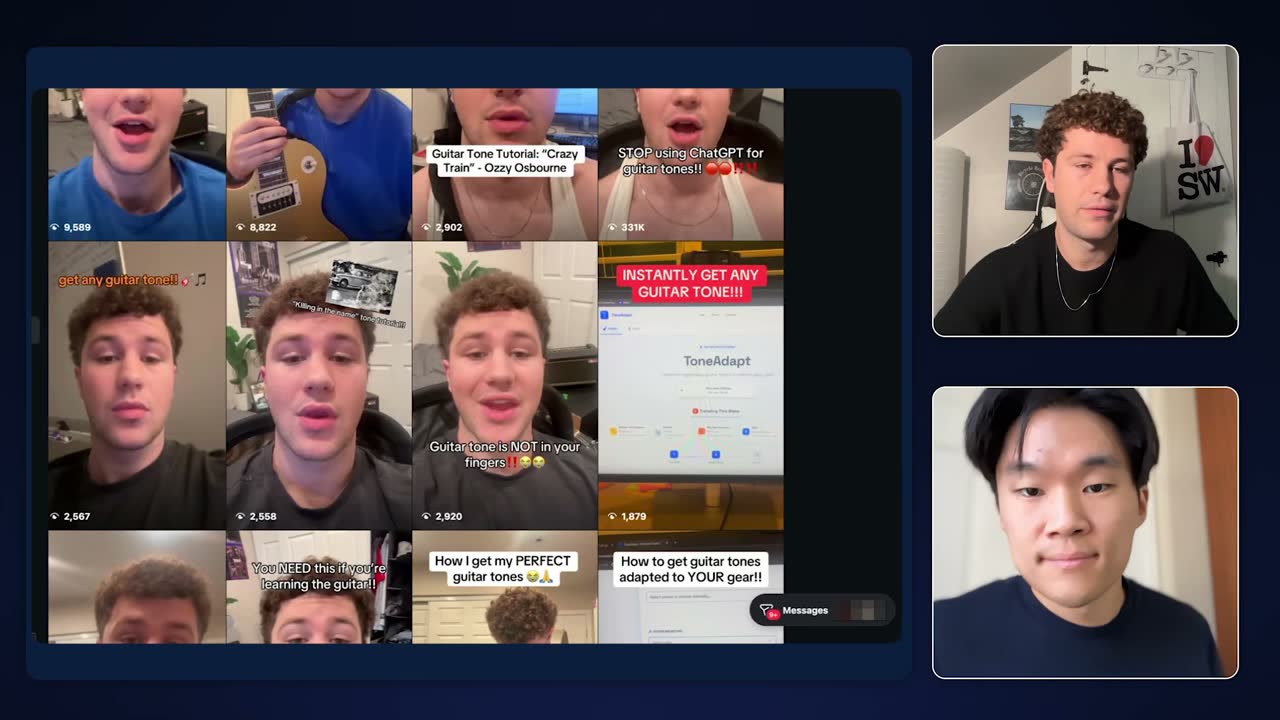
A UGC creator's video grid repeating ToneAdapt guitar-tone hooks; one hit 331K views. Copy popular tutorial formats, but show the product solving the problem. He took the hook and format of existing talking-head guitar tone tutorials and showed the app doing the work instead of explaining it by hand. The video opens with the result viewers want and the objections to existing options, then runs about 80% pure demo; several reached 1.4 to 1.6 million views on Instagram.
The demo lands because alternatives are costly and hard: pro software needs extra hardware and has a steep learning curve, and modeling amps with tone matching are expensive. The tutorial creators he studied were not monetizing, and he did no market research before building.
Once formats worked, hired creators to repeat them daily. Three creators posting his exact formats lifted revenue from about $12K to about $40K a month. About 10 creators now post one to three times a day, and October reached about $84K.
His first hired creator had only 1,500 followers, yet got videos of 585K and 250K views. Kayen says the hard part is managing people, doing outreach and building the program.
A format bank and public feedback channel leave creators little to guess. A Notion brief holds nine formats, each with three example videos creators should copy as closely as possible. Creators post drafts in a public Discord feedback channel before publishing, so everyone sees the notes.
Each creator also has a private one-on-one channel with him. This lets him review videos from about 10 creators without separate calls.
Creators get a base plus a low-threshold view bonus ladder. Pay is a $500 to $850 monthly base for about 30 videos, with some formats needing 30 to 60. Bonuses are $50 at 50K views, $75 at 100K, $300 at 500K, $600 at 1M and $5,000 at 3M.
A video costs about $20 while one hit can earn thousands. The small early tiers reward the 50K-view videos that often win as ads, and the 3M tier pushes creators to chase virality.
Familiar songs and authentic reactions keep videos performing. One creator reuses Smells Like Teen Spirit and Everlong because they always perform. Joseph says a loved song over a strong electric adaptation can work on familiarity alone, without a clever hook.
Reaction formats, such as Isaac's consistent 40K-view videos, feel authentic compared with the shocked-face hooks of two years earlier. Kayen uses Snapchat-style captions, which feel more natural for an app than regular TikTok text.
2Turning creator posts into winning ads
UGC earns far better margins than paid ads alone. Meta ads cost about $15 to $20 per subscriber, and each subscriber brings back $30 to $50. That margin never matches UGC.
Meta also needs a lot of spend before its algorithm learns the app.
Every organic post goes into one shared Drive folder for ad testing. Creators upload all posted videos, not just hits, to a shared Google Drive folder. About 75% of his winning ads come straight from these organic posts.
He never has to request footage, so organic creator spend also pays for ad creative.
Test a big batch of new videos once a week and let Meta pick. On a weekly testing day he puts many new creator videos into one new ad set at $100 to $300 a day, which usually surfaces a couple of winners.
He skips formats that are dying on Meta and tests formats he has not run before.
Low-view organic posts can still be strong ads. One organic post with about 5,000 views performed as an ad for around two months. He tests posts regardless of view count, though more viral posts usually do even better as ads.
He judges ads on CPA, not CPM.
3The onboarding flow: personalize, demo, then show the gap
Questions and an interactive mini demo deliver a wow moment early. A welcome screen cites 200,000 guitarists, a few questions build a first small commitment, then users pick a genre and song and search their own gear. The database holds over 4,000 guitars and 4,000 amps.
The gear search is the magic part, and because the demo is interactive users grasp how the app works right away, before sign-in and paywall.
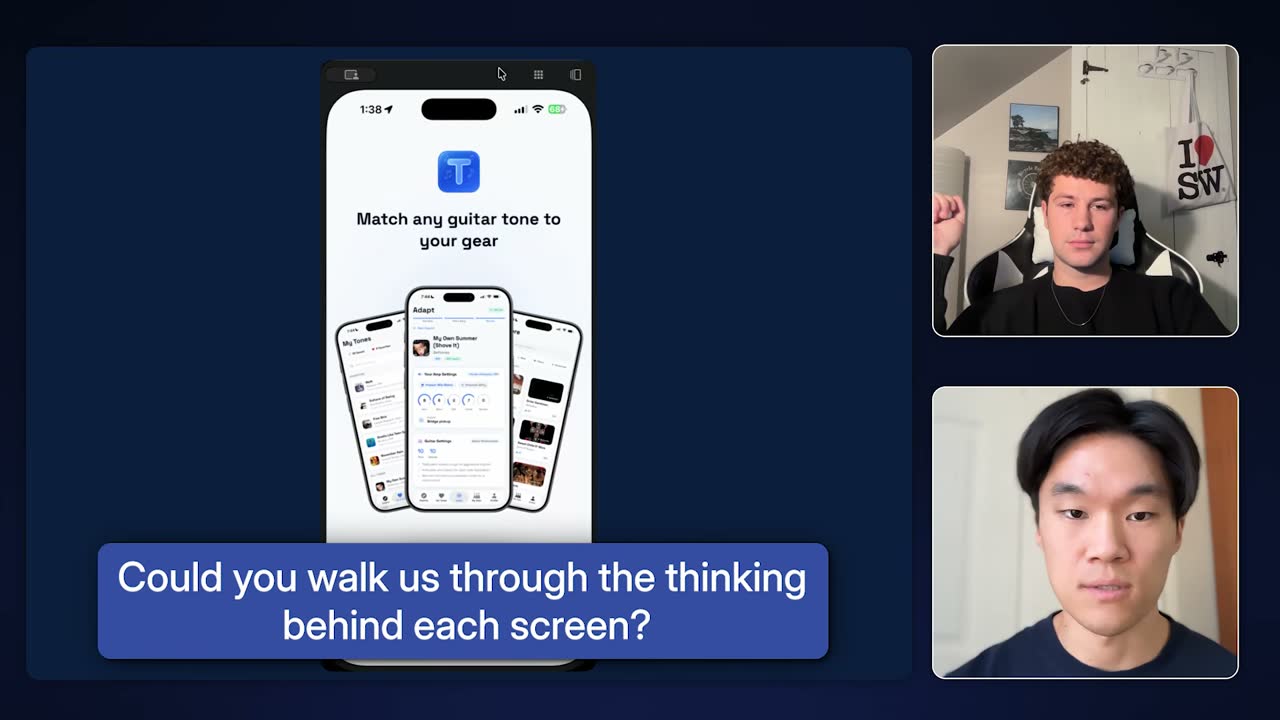
Tone Adapt's onboarding welcome screen pitches "Match any guitar tone to your gear" with app previews. Show the gap between the user's rig and the original, then bridge it. For an AC/DC song the result shows the original guitar, amp settings, cabinet and pedals, then a diagram marks where the user's rig differs and the app promises to fix it.
Joseph says many founders stop at problem and solution; showing the mechanism, the waveform gap, builds peak desire before the paywall. "You create the gap and then you bridge the gap."
A sign-in screen costs users, so Kayen would now drop it. He says any sign-in screen costs at least 5% of users. He placed it just before the payoff, after gear entry, when users want the result badly enough to make an account.
It exists only because the app grew out of a website whose back end relied on accounts for tracking, limits and plans. He says the small lift from email campaigns does not justify the drop-off.
4Paywall design and pricing tests
- Converted 8.6%
- 418 conversions
- Lower revenue per user
- Converted 7.6%
- 365 conversions
- Higher revenue per user
Pricier paywall won on revenue per user
From Kayen, Tone Adapt paywall tests
Higher prices won on revenue per user despite lower conversion. $35 a year and $9 a week converted 8.6% (418 conversions), while $40 and $10 with no trial converted 7.6% (365) but earned more per user. A $60 a year variant dropped to about 5.6% yet had higher revenue per user still.
He started at $60 a year, tested cheaper, and is testing higher again. Normal yearly prices run $40 to $50, and $60 has been the most consistent.
A $60 annual price makes paid ads profitable on day one. At $15 to $20 per subscriber, a $35 paywall makes day-one return hard; a $60 paywall lets CPA rise to $20 to $25 and still pay back on day one.
Joseph reads the numbers as about 3 points of conversion lost for nearly double the revenue per subscriber.
Paid and organic traffic see different paywalls. In Superwall, paid-ad users go to paywalls with fewer free trials, which works better for him. Organic viewers see other paywalls, usually with lower prices and sometimes trials.
"Users who come from paid ads and users who come from organic videos just always end up converting better at different price points on different pay walls."
Kayen favors weekly plans around $6 to $7. He believes $6 to $7 a week sits below the point where a renewal alert prompts instant cancellation, and the few who renew pay back over 6 to 12 months.
The gap from $10 to $6 is only $4 but feels big; Joseph likens $6 to a weekly Starbucks run. This is his view, and his tested paywalls used $9 and $10 weekly plans.
A clean two-plan bottom sheet beat full-screen paywalls. Social proof (300,000 guitarists, a five-star review, an "unlock my tones" button) leads into a bottom sheet with an annual and a weekly plan. It tended to convert a bit better, so he retired the full-screen versions.
He chose two plans because it looks cleaner than cramming plans onto one screen. Price, paywall and plan tests are always running.
5How Tone Adapt started, and why it became an app
Built in three days after spotting that ChatGPT could match tones. After about a year and a half of guitar, Kayen found ChatGPT could match tones and no app did, so he built Tone Adapt in three days as a resume project. Users enter their guitar, amp, pedals and a song and get the original gear and settings adapted to their own.
Daily posting had led him into paid UGC work for about two months, where founders running UGC programs taught him how to go viral. He calls the first version "the most vibecoded piece of slop ever"; it covers only electric guitar and suits beginners.
The mobile app converts far better than the website. The website gets far more visits but a fraction of the paying subscribers, so since the app launched in April he markets only the app.
Joseph attributes the gap to the legitimacy of being on the App Store. His first videos were screen recordings of the website before the app existed.
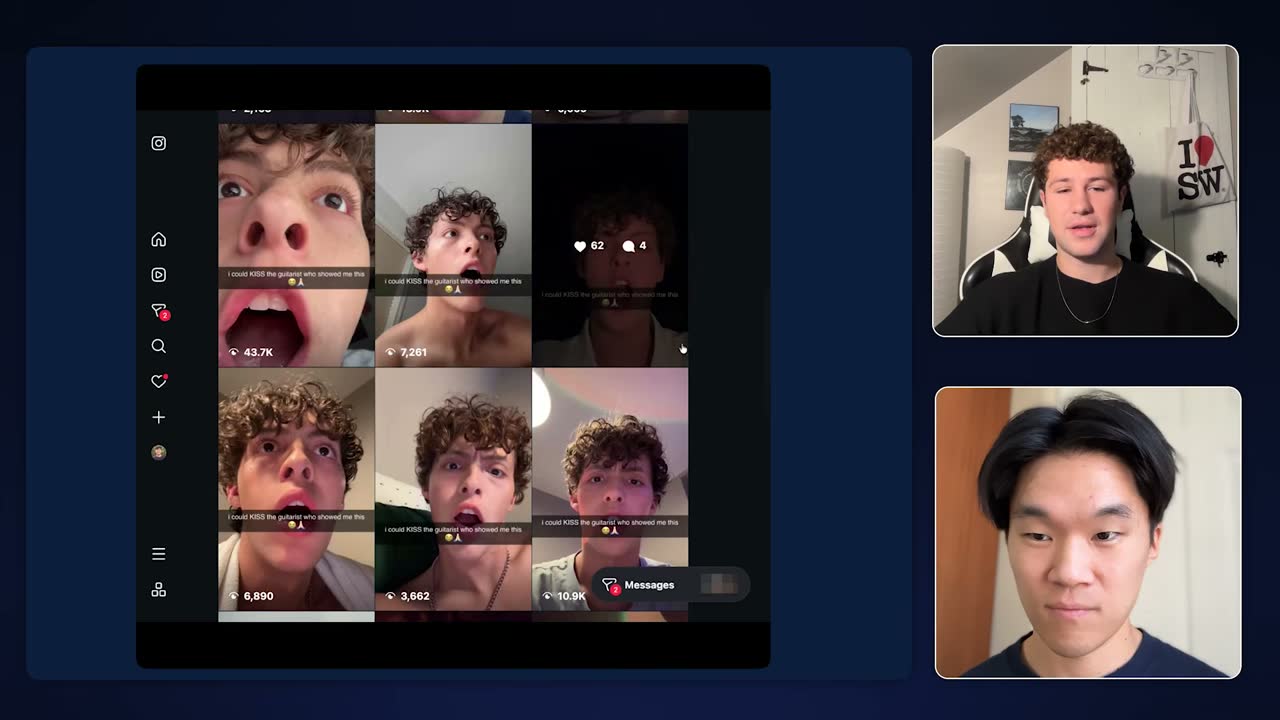
Isaac's Tone Adapt reels reuse one Snapchat-style caption hook, pulling 3.6K to 43.7K views.
He Went From Broke College Student to an $84K/Month App (Full Story)
Grew to about $84K a month in October, up from $12K with his own videos and $40K with three creators, using about 10 UGC creators posting one to three times a day. About 75% of winning ads come from creator posts, and a $60 annual paywall earned the most per user.
Kayen posted his own demo videos before hiring anyone. His first Tone Adapt TikTok got 282K views after four plain guitar-playing posts, and his sixth video reached 604K. His own posts alone took the app to about $12K a month in a little over a month.
He posted one to two videos a day, answered nearly every comment, and put his unpolished face on the main brand page, which built early trust. "Literally just putting anything out there is always better than nothing."
A UGC creator's video grid repeating ToneAdapt guitar-tone hooks; one hit 331K views. Copy popular tutorial formats, but show the product solving the problem. He took the hook and format of existing talking-head guitar tone tutorials and showed the app doing the work instead of explaining it by hand. The video opens with the result viewers want and the objections to existing options, then runs about 80% pure demo; several reached 1.4 to 1.6 million views on Instagram.
The demo lands because alternatives are costly and hard: pro software needs extra hardware and has a steep learning curve, and modeling amps with tone matching are expensive. The tutorial creators he studied were not monetizing, and he did no market research before building.
Once formats worked, hired creators to repeat them daily. Three creators posting his exact formats lifted revenue from about $12K to about $40K a month. About 10 creators now post one to three times a day, and October reached about $84K.
His first hired creator had only 1,500 followers, yet got videos of 585K and 250K views. Kayen says the hard part is managing people, doing outreach and building the program.
A format bank and public feedback channel leave creators little to guess. A Notion brief holds nine formats, each with three example videos creators should copy as closely as possible. Creators post drafts in a public Discord feedback channel before publishing, so everyone sees the notes.
Each creator also has a private one-on-one channel with him. This lets him review videos from about 10 creators without separate calls.
Creators get a base plus a low-threshold view bonus ladder. Pay is a $500 to $850 monthly base for about 30 videos, with some formats needing 30 to 60. Bonuses are $50 at 50K views, $75 at 100K, $300 at 500K, $600 at 1M and $5,000 at 3M.
A video costs about $20 while one hit can earn thousands. The small early tiers reward the 50K-view videos that often win as ads, and the 3M tier pushes creators to chase virality.
Familiar songs and authentic reactions keep videos performing. One creator reuses Smells Like Teen Spirit and Everlong because they always perform. Joseph says a loved song over a strong electric adaptation can work on familiarity alone, without a clever hook.
Reaction formats, such as Isaac's consistent 40K-view videos, feel authentic compared with the shocked-face hooks of two years earlier. Kayen uses Snapchat-style captions, which feel more natural for an app than regular TikTok text.
UGC earns far better margins than paid ads alone. Meta ads cost about $15 to $20 per subscriber, and each subscriber brings back $30 to $50. That margin never matches UGC.
Meta also needs a lot of spend before its algorithm learns the app.
Every organic post goes into one shared Drive folder for ad testing. Creators upload all posted videos, not just hits, to a shared Google Drive folder. About 75% of his winning ads come straight from these organic posts.
He never has to request footage, so organic creator spend also pays for ad creative.
Test a big batch of new videos once a week and let Meta pick. On a weekly testing day he puts many new creator videos into one new ad set at $100 to $300 a day, which usually surfaces a couple of winners.
He skips formats that are dying on Meta and tests formats he has not run before.
Low-view organic posts can still be strong ads. One organic post with about 5,000 views performed as an ad for around two months. He tests posts regardless of view count, though more viral posts usually do even better as ads.
He judges ads on CPA, not CPM.
Questions and an interactive mini demo deliver a wow moment early. A welcome screen cites 200,000 guitarists, a few questions build a first small commitment, then users pick a genre and song and search their own gear. The database holds over 4,000 guitars and 4,000 amps.
The gear search is the magic part, and because the demo is interactive users grasp how the app works right away, before sign-in and paywall.
Tone Adapt's onboarding welcome screen pitches "Match any guitar tone to your gear" with app previews. Show the gap between the user's rig and the original, then bridge it. For an AC/DC song the result shows the original guitar, amp settings, cabinet and pedals, then a diagram marks where the user's rig differs and the app promises to fix it.
Joseph says many founders stop at problem and solution; showing the mechanism, the waveform gap, builds peak desire before the paywall. "You create the gap and then you bridge the gap."
A sign-in screen costs users, so Kayen would now drop it. He says any sign-in screen costs at least 5% of users. He placed it just before the payoff, after gear entry, when users want the result badly enough to make an account.
It exists only because the app grew out of a website whose back end relied on accounts for tracking, limits and plans. He says the small lift from email campaigns does not justify the drop-off.
Higher prices won on revenue per user despite lower conversion. $35 a year and $9 a week converted 8.6% (418 conversions), while $40 and $10 with no trial converted 7.6% (365) but earned more per user. A $60 a year variant dropped to about 5.6% yet had higher revenue per user still.
He started at $60 a year, tested cheaper, and is testing higher again. Normal yearly prices run $40 to $50, and $60 has been the most consistent.
A $60 annual price makes paid ads profitable on day one. At $15 to $20 per subscriber, a $35 paywall makes day-one return hard; a $60 paywall lets CPA rise to $20 to $25 and still pay back on day one.
Joseph reads the numbers as about 3 points of conversion lost for nearly double the revenue per subscriber.
Paid and organic traffic see different paywalls. In Superwall, paid-ad users go to paywalls with fewer free trials, which works better for him. Organic viewers see other paywalls, usually with lower prices and sometimes trials.
"Users who come from paid ads and users who come from organic videos just always end up converting better at different price points on different pay walls."
Kayen favors weekly plans around $6 to $7. He believes $6 to $7 a week sits below the point where a renewal alert prompts instant cancellation, and the few who renew pay back over 6 to 12 months.
The gap from $10 to $6 is only $4 but feels big; Joseph likens $6 to a weekly Starbucks run. This is his view, and his tested paywalls used $9 and $10 weekly plans.
A clean two-plan bottom sheet beat full-screen paywalls. Social proof (300,000 guitarists, a five-star review, an "unlock my tones" button) leads into a bottom sheet with an annual and a weekly plan. It tended to convert a bit better, so he retired the full-screen versions.
He chose two plans because it looks cleaner than cramming plans onto one screen. Price, paywall and plan tests are always running.
Built in three days after spotting that ChatGPT could match tones. After about a year and a half of guitar, Kayen found ChatGPT could match tones and no app did, so he built Tone Adapt in three days as a resume project. Users enter their guitar, amp, pedals and a song and get the original gear and settings adapted to their own.
Daily posting had led him into paid UGC work for about two months, where founders running UGC programs taught him how to go viral. He calls the first version "the most vibecoded piece of slop ever"; it covers only electric guitar and suits beginners.
The mobile app converts far better than the website. The website gets far more visits but a fraction of the paying subscribers, so since the app launched in April he markets only the app.
Joseph attributes the gap to the legitimacy of being on the App Store. His first videos were screen recordings of the website before the app existed.
Isaac's Tone Adapt reels reuse one Snapchat-style caption hook, pulling 3.6K to 43.7K views.
More in Music & Audio
 Music & Audio
Spotify
A music, podcast and audiobook streaming app with a freemium model and personalized recommendations.



 30 sources · 61 tips
 Music & Audio
Suno
An AI music platform that turns text prompts into full songs with lyrics, vocals and instrumentation.
 8 sources · 24 tips
 Music & Audio
AJR
A pop band of three brothers known for vulnerable, goofy songs and theatrical live shows.
1 source · 20 tips Music & Audio
Anchor
A podcast creation and hosting app, later renamed Spotify for Podcasters.
1 source · 10 tips Music & Audio
Beats
A headphone and audio brand co-founded by Jimmy Iovine and Dr. Dre.
2 sources · 6 tipsBeats Music
A streaming service built from the MOG purchase that became Apple Music.
1 source · 2 tips Music & Audio
CD Baby
An online store and distributor that sells independent musicians' albums directly to fans.
1 source · 2 tipsPhonograph
Edison's device for recording and replaying the human voice.
 1 source · 2 tips