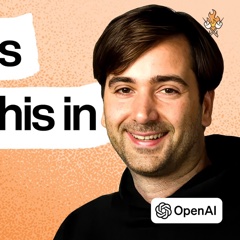
Tibo Sottiaux
Head of ChatGPT and Codex at OpenAI
Where to hear and read about Tibo Sottiaux1 episode or test

Tibo Sottiaux is Head of ChatGPT and Codex at OpenAI, a former engineer of 10 years who now builds an always-on personal agent called Dots. The thing most worth learning from him: design products for models and agents far better than today's, and keep them simple, safe and open to builders.
I myself even get fatigued with the model picker and the reasoning efforts. You kind of need a PhD in model pickers.
OpenAI’s Head of ChatGPT: We’re entering a new era of AI (again) | Tibo Sottiaux
Tibo Sottiaux: the story and the lessons
1How Tibo Sottiaux works with agents day to day
Sottiaux now writes almost no code by hand. He was an engineer for 10 years. Codex writes the code for his analysis of trends, the business and past launches, and much of the code for Dots.
Once a weekend he does a little LeetCode by hand as a "therapeutic moment".
He grows and shrinks his agent team with each model breakthrough. While pushing the frontier he builds larger teams of agents. When a better model arrives, one bigger agent can do it all, so he shrinks the team.
The bigger agent keeps everything in memory and learns. He calls the cycle expansion and shrinking.
Fast models and voice gave him back the flow of engineering. A breakthrough in ultrafast inference let him run fewer agents in parallel. He now does much of his work by dictation or by calling his agent, which he did not expect to feel better.
A 6-month-old ultrafast model costs roughly the same as Astra. He says he does not miss the old flow.
He spends half an hour a day on Twitter to learn from users. He posts when something comes to him, and one of his dots only monitors Twitter. People keep showing him uses he had not anticipated.
"I don't know how we would do it without the community."
2Sottiaux's vision for Dots, the always-on agent
He wants one agent that follows you across every device. One active intelligence should be reachable from any client or screen. It could join a meeting room and take notes, then be picked up by email or text.
The harness does not run on the machine, so one dot can connect to many devices. He calls the laptop a brick you carry.
Dots has no model picker and almost nothing to configure. The only thing to configure is which channels you talk through. Sottiaux says even he gets fatigued by reasoning effort, multi-agent and ultra options.
He wants to reach the "super essence of simplicity" as fast as possible, until the app almost disappears.
Codex and ChatGPT are being merged into one product. Users love the capability of work mode but sometimes want chat because it is faster and more pleasant. All of Codex's capabilities will eventually ship in ChatGPT, lifting the floor for about 1.2 billion users.
Dots launched with a single primary dot, then grows into a team. The primary dot is the one you text and the one that learns your preferences most deeply. Users will later add a second, third and fourth dot as a virtual team with roles.
Starting with one lets OpenAI see what people do and tune the system with the community. Launch went to Pro users first.
Specialist dots get their own hardware and extra guardrails. Dots that touch production systems get additional monitoring and run on their own hardware, some of them on Mac minis.
His own Dot warned him that ChatGPT production was down 5 minutes before the live demo. It offered to fix it and he said it was not there yet. Engineers fixed the outage, but the demo had already failed.
3How plugins and sign-in with ChatGPT pay builders
ChatGPT recommends plugins that people keep using. It surfaces plugins in conversations based on retention and quality. A strong plugin can reach a significant slice of the 1.2 billion users, and a weak one stops being recommended.
The test is whether a plugin adds utility and lets ChatGPT do something new. Getting people to write about you does not help.
Popular plugins and sign-in partners share in the revenue. When subscribers spend their usage through a plugin such as Notion or Figma, that company is paid. The same applies to products that use sign-in with ChatGPT.
Revenue sharing was not mentioned in the keynote. Sottiaux calls the open-ecosystem commitment an overlooked bet.
Sign-in with ChatGPT began as a handshake with open-source makers. Sottiaux talked with the creators of Pi and OpenCode last year. They agreed to use the sign-in and trusted each other not to do anything shady.
Its popularity turned it into a supported feature, now with 16 launch partners. He wants to grow it very quickly.
4What Sottiaux tells builders to design for
He says to imagine everything 10 times better in a year. When he looks at what people build, he often thinks they are not quite getting it. He wants builders to design for much better capability, cost and speed.
He expected today's capability in a year or two and revised his prior. He gives no data or timeline for the 10 times figure.
He expects agents to take most actions on the internet. When Notion shipped its MCP, agents sent a large amount of traffic that strained its systems and forced it to work out the economics.
Holding back an agent interface works for a while, but he calls it inevitable.
He names three things the market has not priced in. Cheaper and faster models, seamless integration of all modalities, and under-invested new experiences for humans.
For the last one he means experiences that truly benefit from older modalities, which he calls "absolutely delightful".
He wants agents to reduce noise, not add pressure. The promise is to let people spend attention where they choose, not "one more prompt per second".
A week offline on holiday makes him think more creatively, and he wonders whether fewer meetings would raise output.
5How Sottiaux's teams build, hire and learn from mistakes
Products start as unstructured bottom-up projects. The decisions API began as a Slack channel where four people hacked on a weekend, after the team saw Luna was a strong model. They added constraint sampling and shipped a new shape of the Responses API.
The channel then opened to everyone, and people added things like visual inputs.
A high quality bar decides what ships. Some things planned for DevDay were pulled and spaced out over the following weeks.
People take on roles to channel the bottom-up energy productively, and many of the builders are ex-founders.
He gives wide autonomy and expects fast fixes. Nothing runs through an "echelon of approvals", and Sottiaux can reset direction when it feels right, which keeps him close to the community.
He took production down on his third day at OpenAI and kept his job. He also caused a couple of outages in the early days of Codex.
He hires for taste, user focus and a drive to build. OpenAI has more than 120 ex-YC founders. Roles between design, engineering and product are blurring, and typing speed matters less than knowing what good looks like.
Younger people adopt AI first because they have no old way of working to unlearn, so hiring strategy changed.
He backs kind, collaborative learners, like new grad Ahmed Ibrahim. Ibrahim joined OpenAI as a new grad and now runs its compute fleet and applied work. Sottiaux trusts him with the most gnarly launches.
He solves important problems without putting himself first and uses the latest technology to learn at speeds Sottiaux has not seen before.
His admitted mistake: not steering teams toward simpler builds. Sottiaux says he should have pushed teams harder to build less complex things, and teams kept striving toward complexity.
Simplicity is now the direction of the products.
6Why Sottiaux says safety spending must keep pace with capability
OpenAI spends more compute on monitoring the main agent. A secondary system watches the primary agent to stop high-risk actions or interrupt it if it may be getting prompt injected.
Sottiaux says the majority of OpenAI's investment on the API stack goes into the safety stack.
OpenAI holds back capability until it feels hardened. It has not released the step up beyond Astra, and released a model near Astra's intelligence that is much more efficient. An Astra version reported in the news was not released, and he is proud of that.
Dots launched with Astra, OpenAI's safest, most aligned model, and more effort went into its security.
Scale makes safety an incentive, not only a duty. Products serve 1.2 billion people, including non-technical ones. He says "we don't gamble there" and is optimistic the problems get solved.

OpenAI’s Head of ChatGPT: We’re entering a new era of AI (again) | Tibo Sottiaux
Tibo Sottiaux explains how OpenAI is moving from chat and coding tools toward an always-on personal agent (Dots), and what that means for how products, plugins and teams should be built. He shares concrete practices on plugin discovery, bottoms-up shipping, agent-ready products and safety spending, drawn from a day when his team launched more than 20 products.
Sottiaux now writes almost no code by hand. He was an engineer for 10 years. Codex writes the code for his analysis of trends, the business and past launches, and much of the code for Dots.
Once a weekend he does a little LeetCode by hand as a "therapeutic moment".
He grows and shrinks his agent team with each model breakthrough. While pushing the frontier he builds larger teams of agents. When a better model arrives, one bigger agent can do it all, so he shrinks the team.
The bigger agent keeps everything in memory and learns. He calls the cycle expansion and shrinking.
Fast models and voice gave him back the flow of engineering. A breakthrough in ultrafast inference let him run fewer agents in parallel. He now does much of his work by dictation or by calling his agent, which he did not expect to feel better.
A 6-month-old ultrafast model costs roughly the same as Astra. He says he does not miss the old flow.
He spends half an hour a day on Twitter to learn from users. He posts when something comes to him, and one of his dots only monitors Twitter. People keep showing him uses he had not anticipated.
"I don't know how we would do it without the community."
He wants one agent that follows you across every device. One active intelligence should be reachable from any client or screen. It could join a meeting room and take notes, then be picked up by email or text.
The harness does not run on the machine, so one dot can connect to many devices. He calls the laptop a brick you carry.
Dots has no model picker and almost nothing to configure. The only thing to configure is which channels you talk through. Sottiaux says even he gets fatigued by reasoning effort, multi-agent and ultra options.
He wants to reach the "super essence of simplicity" as fast as possible, until the app almost disappears.
Codex and ChatGPT are being merged into one product. Users love the capability of work mode but sometimes want chat because it is faster and more pleasant. All of Codex's capabilities will eventually ship in ChatGPT, lifting the floor for about 1.2 billion users.
Dots launched with a single primary dot, then grows into a team. The primary dot is the one you text and the one that learns your preferences most deeply. Users will later add a second, third and fourth dot as a virtual team with roles.
Starting with one lets OpenAI see what people do and tune the system with the community. Launch went to Pro users first.
Specialist dots get their own hardware and extra guardrails. Dots that touch production systems get additional monitoring and run on their own hardware, some of them on Mac minis.
His own Dot warned him that ChatGPT production was down 5 minutes before the live demo. It offered to fix it and he said it was not there yet. Engineers fixed the outage, but the demo had already failed.
ChatGPT recommends plugins that people keep using. It surfaces plugins in conversations based on retention and quality. A strong plugin can reach a significant slice of the 1.2 billion users, and a weak one stops being recommended.
The test is whether a plugin adds utility and lets ChatGPT do something new. Getting people to write about you does not help.
Popular plugins and sign-in partners share in the revenue. When subscribers spend their usage through a plugin such as Notion or Figma, that company is paid. The same applies to products that use sign-in with ChatGPT.
Revenue sharing was not mentioned in the keynote. Sottiaux calls the open-ecosystem commitment an overlooked bet.
Sign-in with ChatGPT began as a handshake with open-source makers. Sottiaux talked with the creators of Pi and OpenCode last year. They agreed to use the sign-in and trusted each other not to do anything shady.
Its popularity turned it into a supported feature, now with 16 launch partners. He wants to grow it very quickly.
He says to imagine everything 10 times better in a year. When he looks at what people build, he often thinks they are not quite getting it. He wants builders to design for much better capability, cost and speed.
He expected today's capability in a year or two and revised his prior. He gives no data or timeline for the 10 times figure.
He expects agents to take most actions on the internet. When Notion shipped its MCP, agents sent a large amount of traffic that strained its systems and forced it to work out the economics.
Holding back an agent interface works for a while, but he calls it inevitable.
He names three things the market has not priced in. Cheaper and faster models, seamless integration of all modalities, and under-invested new experiences for humans.
For the last one he means experiences that truly benefit from older modalities, which he calls "absolutely delightful".
He wants agents to reduce noise, not add pressure. The promise is to let people spend attention where they choose, not "one more prompt per second".
A week offline on holiday makes him think more creatively, and he wonders whether fewer meetings would raise output.
Products start as unstructured bottom-up projects. The decisions API began as a Slack channel where four people hacked on a weekend, after the team saw Luna was a strong model. They added constraint sampling and shipped a new shape of the Responses API.
The channel then opened to everyone, and people added things like visual inputs.
A high quality bar decides what ships. Some things planned for DevDay were pulled and spaced out over the following weeks.
People take on roles to channel the bottom-up energy productively, and many of the builders are ex-founders.
He gives wide autonomy and expects fast fixes. Nothing runs through an "echelon of approvals", and Sottiaux can reset direction when it feels right, which keeps him close to the community.
He took production down on his third day at OpenAI and kept his job. He also caused a couple of outages in the early days of Codex.
He hires for taste, user focus and a drive to build. OpenAI has more than 120 ex-YC founders. Roles between design, engineering and product are blurring, and typing speed matters less than knowing what good looks like.
Younger people adopt AI first because they have no old way of working to unlearn, so hiring strategy changed.
He backs kind, collaborative learners, like new grad Ahmed Ibrahim. Ibrahim joined OpenAI as a new grad and now runs its compute fleet and applied work. Sottiaux trusts him with the most gnarly launches.
He solves important problems without putting himself first and uses the latest technology to learn at speeds Sottiaux has not seen before.
His admitted mistake: not steering teams toward simpler builds. Sottiaux says he should have pushed teams harder to build less complex things, and teams kept striving toward complexity.
Simplicity is now the direction of the products.
OpenAI spends more compute on monitoring the main agent. A secondary system watches the primary agent to stop high-risk actions or interrupt it if it may be getting prompt injected.
Sottiaux says the majority of OpenAI's investment on the API stack goes into the safety stack.
OpenAI holds back capability until it feels hardened. It has not released the step up beyond Astra, and released a model near Astra's intelligence that is much more efficient. An Astra version reported in the news was not released, and he is proud of that.
Dots launched with Astra, OpenAI's safest, most aligned model, and more effort went into its security.
Scale makes safety an incentive, not only a duty. Products serve 1.2 billion people, including non-technical ones. He says "we don't gamble there" and is optimistic the problems get solved.
More from OpenAI
 Guest
Kevin Weil
Chief Product Officer at OpenAI, former head of product at Instagram and Twitter
 OpenAI2 sources · 34 tips
 Guest
Tara Seshan
Product lead for ChatGPT Work and Codex at OpenAI; ex-Stripe, Watershed, Sutter Hill EIR
OpenAI2 sources · 33 tips Guest
Alexander Embiricos
Product lead for Codex at OpenAI
OpenAI1 source · 18 tips Guest
Andrew Ambrosino
Product and engineering lead for the Codex desktop app at OpenAI
OpenAI1 source · 18 tips Guest
Ian Silber
Head of product design at OpenAI (ChatGPT, Codex); formerly Artifact and eight years at Instagram
OpenAI1 source · 16 tips Guest
Krithika Shankarraman
Executive in Residence at Thrive Capital; first marketing hire at OpenAI and Stripe, former marketing lead at Retool
OpenAI1 source · 19 tips