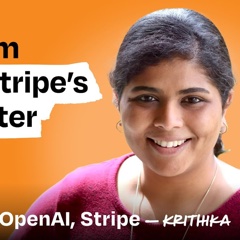
Krithika Shankarraman
Executive in Residence at Thrive Capital; first marketing hire at OpenAI and Stripe, former marketing lead at Retool
Where to hear and read about Krithika Shankarraman1 episode or test

Krithika Shankarraman is a marketer who was the first marketing hire at OpenAI and Stripe, led marketing at Retool, and now supports founders at Thrive Capital. The thing most worth learning from her is to diagnose your own funnel problem and deliberately take a different path from competitors, instead of copying anyone's playbook.
You have to spend the hours and the time to really understand your customer, and there is no replacement for that.
Growth tactics from OpenAI and Stripe’s first marketer | Krithika Shankarraman
Krithika Shankarraman: the story and the lessons
1Krithika Shankarraman's path as the first marketer
She has built marketing from nothing at several famous companies. She was first marketing hire and VP of marketing at OpenAI, and first marketing hire at Stripe, where she was the only marketer for about three years. She was also an early marketing leader at Retool and Dropbox, and did marketing for Android at Google.
Founders most want to copy these companies, which is why they come to her asking how they did it.
At Thrive Capital she works as a marketing partner to the whole portfolio. The work can mean interim CMO, pressure testing growth targets, or checking a landing page. Companies range from one not yet incorporated to Databricks, Stripe and OpenAI, across consumer, healthcare, defense, B2B SaaS and AI.
She also helps portfolio founders hire early marketing leaders, and Thrive has built internal engineering tools that surface context and competitive landscape for each company.
When founders ask her for the playbook, she tells them there is none. She argues that jumping between 30-minute calls cannot make you a meaningful partner, so she goes deep with each founder. Founders come for something new, not for her past experience.
2Why Shankarraman says copied playbooks fail, and her DATE framework
Copying another company's marketing ignores the context that produced it. Each company's wins came from its own context, competition and timing. Copying the outputs of Stripe, Retool or OpenAI skips the inputs that led to those strategies.
She uses four steps: Diagnose, Analyze, take a different Track, Experiment. Diagnose the real problem, study competitors for a baseline and gaps, deliberately go a different way, then test small, scale what works and discard what does not.
She also borrows ideas from domains far outside her own. In her words, "you have to intentionally take a different path than what everyone else is doing".
She treats competitor analysis as a baseline, not a blueprint. Fixating on competitors leads to local maxima instead of breakthroughs, though studying them still reveals gaps and niches to take.
Experiments only work if failed work gets thrown away. Sunk cost bias is strongest when a team has poured heart and soul into a piece of content. Teams need psychological safety to fail, and should double down once something works.
She avoids competing on being cheaper, especially in AI. Models get cheaper and more capable, so a low price is not durable. Differentiation through novelty, customer values and a strong product experience matched by marketing lasts longer.
"Being cheaper is a race to the bottom."
3How Shankarraman built marketing at Stripe
Stripe's founders were its first real marketers, and she had to unlearn. John and Patrick were developers, so they knew how to reach developers authentically. She had to unlearn much of what she knew from Google and Dropbox.
She stayed almost eight and a half years, and was the only marketer for about three. She does not recommend that.
She taught Stripe that a launch is not done at code complete. When she joined, shipped features sat in a secret Hackpad backlog nobody had announced. The first job was clearing it and changing the culture so a launch means reaching the customer.
Usage and engagement replaced the binary of launched or not as the north star. "Your launch isn't complete if you're just code complete."
She reran her marketing diagnosis every three to six months during hypergrowth. Marketing's purpose changed in epochs: clearing the backlog, wider launches and developer relations, guiding customers through a multi-product platform, then sales and international goals.
She hired T-shaped people who could flex with those shifts, not deep specialists.
Support questions became a ranked backlog of landing pages. New hires did a support rotation, and the company spent about 20% of its time talking to users and non-users. Recurring questions, such as whether Stripe handles subscriptions or payouts, became educational pages in customers' own language.
This fits developer products, where the funnel is often a self-directed education. Her engineering background makes her ask what developer is clicking on paid ads.
For Stripe Connect she wrote a reverse RFP instead of copying consultants. Connect's real competition was marketplaces becoming payment facilitators (PayFacs) themselves, with consultants using legacy jargon. Stripe wrote a secret playbook on becoming a PayFac that ended with: if this feels onerous, use Stripe Connect.
It captured the legacy search terms without Stripe calling itself a PayFac. Becoming a PayFac consultancy would have left Connect nowhere near its current run rate.
4How Shankarraman rebuilt marketing at Retool
Retool needed outbound because awareness lagged its product market fit. Stripe and OpenAI had latent demand at the door. At Retool, marketing sat between the company and revenue, and product market fit with enterprises and developers was strong but few people knew about it.
She describes it as stepping outside the house to introduce yourself to the neighborhood.
She judged channels by pipeline and revenue, not clicks or impressions. Measuring signups for self-serve and leads, pipeline and revenue for B2B showed paid social did little. The team built new engines instead of scaling it.
She called clicks, views and impressions "bullshit numbers". The team tested webinars, sales dinners and event formats and scaled only the winners.
She let real enterprise customers tell Retool's story. Competitors ran content and events, so Retool doubled down on customer marketing and storytelling. Its enterprise customers were paying and expanding.
"No other company could replicate the kind of customers that Retool had in its bench."
She opened self-hosted Retool to self-serve and tested it first. Self-hosting had been gated behind sales. Demand came from small customers in regulated industries or with PII. Pipeline seen by sales dropped considerably, but sales moved to larger customers and higher ACV deals.
She said the trade-off was hard enough that only experimentation made it possible. She compares gating value behind a sales call to the SSO tax.
5What Shankarraman did at OpenAI
Enterprise demand arrived at OpenAI with no demand generation at all. Turning on the contact sales form for ChatGPT Enterprise, one of her first launches, raised lead volume 40x overnight.
She coded a Python script with ChatGPT as the first lead scoring model, and it stayed in production "longer than I'd care to admit".
She marketed use cases because awareness was never the problem. Everyone knew ChatGPT, but people did not know what to use it for or what it replaced. Marketing's job became creating a use case epiphany.
The goal was people thinking "I had no idea ChatGPT can do that."
She ran product and product marketing as a three-legged race. Marketing is not a handoff at the end of the conveyor belt. Early customer insight gives the language customers use, which she calls a cheat code for messaging and positioning.
Creativity on differentiation should happen in lockstep with product management.
She found OpenAI's mission lived day to day, with intense scrutiny. Products and go-to-market strategies were pressure tested with rigor she called bar none. Being at the eye of the storm raised the stakes on everything.
OpenAI had been a research lab for almost a decade, and ChatGPT launched about a year before she joined.
6How Shankarraman decides what marketing to hire and do
She checks what happens once prospects are in the room. Strong close rates point to product market fit, so more top of funnel helps. Many questions about competitors and price point to a leaky bottom, which needs product marketing first.
"Hiring a demand generator may be the worst thing that you can do" for a leaky funnel.
She hires marketing only after a spark of product market fit. Marketing adds fuel to a fire that must already be burning. Pick product marketing if features ship faster than customers can follow, demand generation for a sales-driven journey, or brand and community.
She separates capital M marketing from lowercase m marketing. Capital M is the team's function, artifacts and engines. Lowercase m is what the company stands for, shaped by product, sales (ICP and decision makers) and the founder's storyline.
She wants modern marketers comb-shaped, not T-shaped. A comb has depth in several areas. Modern leaders must be analytical, close to data science and tied to revenue goals, because marketing in a silo is no longer possible.
She calls the ideal a chameleon CMO who goes deep in different domains as the diagnosis requires.
7Shankarraman on process, brand and loyalty
She reviews marketing work at the 20% and 80% marks. A transparent forum open to marketing and product reviews strategy at 20%: goal, audience, approach. It returns at 80% while substantive changes are still possible.
A 99% review is a rubber stamp. Good process lets a new hire perform like a veteran in week two, and watching reviews teaches people by osmosis.
She treats brand as every customer touchpoint, not just marketing assets. Brand includes product experience, support tickets and recruiting. A consistent brand makes a fast company faster, and treating speed and brand as separate silos optimizes the wrong thing.
At Stripe, trust gave a new billing service goodwill from day one. At OpenAI, the team sometimes paused to improve quality and safety despite the race to market.
She says loyalty comes from reality beating expectations over time. Labs trade blows on evals weekly, but users care about delight. A small positive gap between expectation and reality builds loyalty, and a negative gap detracts from the brand.
8Shankarraman on AI pricing, taste and tools
She says there is no pricing playbook for AI yet. Value may sit in seats, hours saved or new things people can do, and paying for agents has no standard unit of completion. She tests pricing in the market to build conviction.
She expects "a Wild, Wild West" before any model feels as internalized as seat-based or usage-based pricing.
She bets taste and craft will separate companies as AI floods the market. Anyone can generate content, so winners show real understanding of product and customer, with AI augmenting them. Taste grows through exposure hours, and Thrive keeps a share channel of things that resonated.
She uses AI to speed up work already underway. Thrive's internal tools let one person go deep on dozens of companies each week by surfacing institutional knowledge. She advises fixing a company's own operational efficiency with AI before adding it to the product.
She tells early-career marketers to use AI tools and still learn fundamentals, since skipping the tools is a disadvantage.
9Shankarraman's mistake with Stripe Relay and her view on expectations
Stripe Relay flopped because the market was not ready. Launched in 2014 with a lot of fanfare, it was meant to let e-commerce companies tap social commerce through buy buttons. It never produced the expected revenue.
The team had not done enough user research on whether people wanted it, what alternatives they had, or whether they would adopt a net new tool over one plugged into systems like inventory management.
She manages unhappiness by setting expectations, not chasing the right answer. Her motto is that the gap between expectations and reality drives unhappiness, and expectations are easier to change. She sets them with customers in external marketing and with stakeholders and her team.
That includes explaining trade-offs and why decisions were made.
She picks a company on three things: people, product and potential. This work-life blend came from Claire Hughes Johnson, Stripe's COO. People should push your thinking and be worth your hours, and you should want to put the product in more hands.
Potential covers the company and also your discipline's impact on its path. She says she can't market just any product.

Growth tactics from OpenAI and Stripe’s first marketer | Krithika Shankarraman
Marketing playbooks copied from other companies usually fail, so this episode teaches a four-step diagnostic (DATE) for finding the right marketing move, with examples from OpenAI, Stripe and Retool. The proof: ChatGPT Enterprise lead volume rose 40x overnight, and Retool and Stripe won by zigging where competitors zagged.
She has built marketing from nothing at several famous companies. She was first marketing hire and VP of marketing at OpenAI, and first marketing hire at Stripe, where she was the only marketer for about three years. She was also an early marketing leader at Retool and Dropbox, and did marketing for Android at Google.
Founders most want to copy these companies, which is why they come to her asking how they did it.
At Thrive Capital she works as a marketing partner to the whole portfolio. The work can mean interim CMO, pressure testing growth targets, or checking a landing page. Companies range from one not yet incorporated to Databricks, Stripe and OpenAI, across consumer, healthcare, defense, B2B SaaS and AI.
She also helps portfolio founders hire early marketing leaders, and Thrive has built internal engineering tools that surface context and competitive landscape for each company.
When founders ask her for the playbook, she tells them there is none. She argues that jumping between 30-minute calls cannot make you a meaningful partner, so she goes deep with each founder. Founders come for something new, not for her past experience.
Copying another company's marketing ignores the context that produced it. Each company's wins came from its own context, competition and timing. Copying the outputs of Stripe, Retool or OpenAI skips the inputs that led to those strategies.
She uses four steps: Diagnose, Analyze, take a different Track, Experiment. Diagnose the real problem, study competitors for a baseline and gaps, deliberately go a different way, then test small, scale what works and discard what does not.
She also borrows ideas from domains far outside her own. In her words, "you have to intentionally take a different path than what everyone else is doing".
She treats competitor analysis as a baseline, not a blueprint. Fixating on competitors leads to local maxima instead of breakthroughs, though studying them still reveals gaps and niches to take.
Experiments only work if failed work gets thrown away. Sunk cost bias is strongest when a team has poured heart and soul into a piece of content. Teams need psychological safety to fail, and should double down once something works.
She avoids competing on being cheaper, especially in AI. Models get cheaper and more capable, so a low price is not durable. Differentiation through novelty, customer values and a strong product experience matched by marketing lasts longer.
"Being cheaper is a race to the bottom."
Stripe's founders were its first real marketers, and she had to unlearn. John and Patrick were developers, so they knew how to reach developers authentically. She had to unlearn much of what she knew from Google and Dropbox.
She stayed almost eight and a half years, and was the only marketer for about three. She does not recommend that.
She taught Stripe that a launch is not done at code complete. When she joined, shipped features sat in a secret Hackpad backlog nobody had announced. The first job was clearing it and changing the culture so a launch means reaching the customer.
Usage and engagement replaced the binary of launched or not as the north star. "Your launch isn't complete if you're just code complete."
She reran her marketing diagnosis every three to six months during hypergrowth. Marketing's purpose changed in epochs: clearing the backlog, wider launches and developer relations, guiding customers through a multi-product platform, then sales and international goals.
She hired T-shaped people who could flex with those shifts, not deep specialists.
Support questions became a ranked backlog of landing pages. New hires did a support rotation, and the company spent about 20% of its time talking to users and non-users. Recurring questions, such as whether Stripe handles subscriptions or payouts, became educational pages in customers' own language.
This fits developer products, where the funnel is often a self-directed education. Her engineering background makes her ask what developer is clicking on paid ads.
For Stripe Connect she wrote a reverse RFP instead of copying consultants. Connect's real competition was marketplaces becoming payment facilitators (PayFacs) themselves, with consultants using legacy jargon. Stripe wrote a secret playbook on becoming a PayFac that ended with: if this feels onerous, use Stripe Connect.
It captured the legacy search terms without Stripe calling itself a PayFac. Becoming a PayFac consultancy would have left Connect nowhere near its current run rate.
Retool needed outbound because awareness lagged its product market fit. Stripe and OpenAI had latent demand at the door. At Retool, marketing sat between the company and revenue, and product market fit with enterprises and developers was strong but few people knew about it.
She describes it as stepping outside the house to introduce yourself to the neighborhood.
She judged channels by pipeline and revenue, not clicks or impressions. Measuring signups for self-serve and leads, pipeline and revenue for B2B showed paid social did little. The team built new engines instead of scaling it.
She called clicks, views and impressions "bullshit numbers". The team tested webinars, sales dinners and event formats and scaled only the winners.
She let real enterprise customers tell Retool's story. Competitors ran content and events, so Retool doubled down on customer marketing and storytelling. Its enterprise customers were paying and expanding.
"No other company could replicate the kind of customers that Retool had in its bench."
She opened self-hosted Retool to self-serve and tested it first. Self-hosting had been gated behind sales. Demand came from small customers in regulated industries or with PII. Pipeline seen by sales dropped considerably, but sales moved to larger customers and higher ACV deals.
She said the trade-off was hard enough that only experimentation made it possible. She compares gating value behind a sales call to the SSO tax.
Enterprise demand arrived at OpenAI with no demand generation at all. Turning on the contact sales form for ChatGPT Enterprise, one of her first launches, raised lead volume 40x overnight.
She coded a Python script with ChatGPT as the first lead scoring model, and it stayed in production "longer than I'd care to admit".
She marketed use cases because awareness was never the problem. Everyone knew ChatGPT, but people did not know what to use it for or what it replaced. Marketing's job became creating a use case epiphany.
The goal was people thinking "I had no idea ChatGPT can do that."
She ran product and product marketing as a three-legged race. Marketing is not a handoff at the end of the conveyor belt. Early customer insight gives the language customers use, which she calls a cheat code for messaging and positioning.
Creativity on differentiation should happen in lockstep with product management.
She found OpenAI's mission lived day to day, with intense scrutiny. Products and go-to-market strategies were pressure tested with rigor she called bar none. Being at the eye of the storm raised the stakes on everything.
OpenAI had been a research lab for almost a decade, and ChatGPT launched about a year before she joined.
She checks what happens once prospects are in the room. Strong close rates point to product market fit, so more top of funnel helps. Many questions about competitors and price point to a leaky bottom, which needs product marketing first.
"Hiring a demand generator may be the worst thing that you can do" for a leaky funnel.
She hires marketing only after a spark of product market fit. Marketing adds fuel to a fire that must already be burning. Pick product marketing if features ship faster than customers can follow, demand generation for a sales-driven journey, or brand and community.
She separates capital M marketing from lowercase m marketing. Capital M is the team's function, artifacts and engines. Lowercase m is what the company stands for, shaped by product, sales (ICP and decision makers) and the founder's storyline.
She wants modern marketers comb-shaped, not T-shaped. A comb has depth in several areas. Modern leaders must be analytical, close to data science and tied to revenue goals, because marketing in a silo is no longer possible.
She calls the ideal a chameleon CMO who goes deep in different domains as the diagnosis requires.
She reviews marketing work at the 20% and 80% marks. A transparent forum open to marketing and product reviews strategy at 20%: goal, audience, approach. It returns at 80% while substantive changes are still possible.
A 99% review is a rubber stamp. Good process lets a new hire perform like a veteran in week two, and watching reviews teaches people by osmosis.
She treats brand as every customer touchpoint, not just marketing assets. Brand includes product experience, support tickets and recruiting. A consistent brand makes a fast company faster, and treating speed and brand as separate silos optimizes the wrong thing.
At Stripe, trust gave a new billing service goodwill from day one. At OpenAI, the team sometimes paused to improve quality and safety despite the race to market.
She says loyalty comes from reality beating expectations over time. Labs trade blows on evals weekly, but users care about delight. A small positive gap between expectation and reality builds loyalty, and a negative gap detracts from the brand.
She says there is no pricing playbook for AI yet. Value may sit in seats, hours saved or new things people can do, and paying for agents has no standard unit of completion. She tests pricing in the market to build conviction.
She expects "a Wild, Wild West" before any model feels as internalized as seat-based or usage-based pricing.
She bets taste and craft will separate companies as AI floods the market. Anyone can generate content, so winners show real understanding of product and customer, with AI augmenting them. Taste grows through exposure hours, and Thrive keeps a share channel of things that resonated.
She uses AI to speed up work already underway. Thrive's internal tools let one person go deep on dozens of companies each week by surfacing institutional knowledge. She advises fixing a company's own operational efficiency with AI before adding it to the product.
She tells early-career marketers to use AI tools and still learn fundamentals, since skipping the tools is a disadvantage.
Stripe Relay flopped because the market was not ready. Launched in 2014 with a lot of fanfare, it was meant to let e-commerce companies tap social commerce through buy buttons. It never produced the expected revenue.
The team had not done enough user research on whether people wanted it, what alternatives they had, or whether they would adopt a net new tool over one plugged into systems like inventory management.
She manages unhappiness by setting expectations, not chasing the right answer. Her motto is that the gap between expectations and reality drives unhappiness, and expectations are easier to change. She sets them with customers in external marketing and with stakeholders and her team.
That includes explaining trade-offs and why decisions were made.
She picks a company on three things: people, product and potential. This work-life blend came from Claire Hughes Johnson, Stripe's COO. People should push your thinking and be worth your hours, and you should want to put the product in more hands.
Potential covers the company and also your discipline's impact on its path. She says she can't market just any product.
More from OpenAI
 Guest
Kevin Weil
Chief Product Officer at OpenAI, former head of product at Instagram and Twitter
 OpenAI2 sources · 34 tips
 Guest
Tara Seshan
Product lead for ChatGPT Work and Codex at OpenAI; ex-Stripe, Watershed, Sutter Hill EIR
OpenAI2 sources · 33 tips Guest
Alexander Embiricos
Product lead for Codex at OpenAI
OpenAI1 source · 18 tips Guest
Andrew Ambrosino
Product and engineering lead for the Codex desktop app at OpenAI
OpenAI1 source · 18 tips Guest
Ian Silber
Head of product design at OpenAI (ChatGPT, Codex); formerly Artifact and eight years at Instagram
OpenAI1 source · 16 tips Guest
Logan Kilpatrick
Head of developer relations at OpenAI
OpenAI1 source · 17 tips