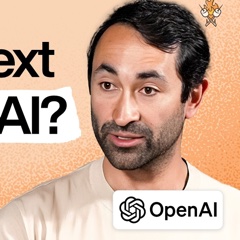
Alexander Embiricos
Product lead for Codex at OpenAI
Where to hear and read about Alexander Embiricos1 episode or test

Alexander Embiricos is the product lead for Codex at OpenAI, after five years running his own startup and a stint as a PM at Dropbox. The thing most worth learning from him is that as building gets cheap, the limit moves to human prompting and review, so the job is to make agents validate their own work.
I think a current underappreciated limiting factor is like literally human typing speed or human multitasking speed on like writing prompts.
Inside OpenAI: 2026 is the year of agents, AI’s biggest bottleneck, and why compute isn’t the issue
Alexander Embiricos: the story and the lessons
1Alexander Embiricos: from startup founder to running Codex
Embiricos came to OpenAI after a startup and Dropbox. He spent five years at his own startup and was a PM at Dropbox before joining OpenAI. At the startup the open question was when to commit to an idea and when to pivot.
At Dropbox and at his startup the job was to point the ship in one direction, then accelerate.
OpenAI's scale made him far more ruthless with his time. Codex grew 10x in a matter of months and well beyond since. He says that sets a new bar for any product he works on next.
The impact needed to do a good job is so high that he has to protect his time much harder than before.
He runs Codex bottoms up and learns by trying. Nobody knows which capabilities will arrive or land with users, so the org learns empirically. Teams reason well about a year or more out and about the next weeks, but not the stretch in between.
He was surprised by the drive and autonomy of individuals, and says very few companies have the talent to copy this model as is.
His startup made kind and candid a single value. The founders were often nice but delayed hard conversations, so they were not candid. They reframed candor as an act of kindness, in both doing it and how they framed it.
Six months after each reminder they found they had still not been candid enough.
2How Embiricos grew Codex
Codex took off when it met engineers in the IDE and terminal. The first cloud version had its own computer and was hard to set up, like a teammate you can only message asynchronously. Starting in an IDE extension or terminal gave a quick feedback loop, and usage is up 20x since the GPT-5 launch in August.
The local loop configures the agent as a byproduct, so delegation comes later. In his words: "first you need to land with users in a way that's much more intuitive and like trivial to get value from."
Model, API and harness are built together by one team. Product and research iterate as one team, and the model is trained for one opinionated harness of plain shell plus sandbox. Compaction, which lets runs go 24 hours past the context window, needed changes in all three layers.
Codex is now the most served coding model in the API, at many trillions of tokens a week.
He discounts internal dogfooding because OpenAI staff are far ahead. OpenAI staff train reasoning models all day, so they prompt up front, run work in parallel and return later. The wider market wanted a simpler synchronous experience.
The cloud product greatly accelerated OpenAI itself. The team keeps dogfooding but now weighs how different audiences use the product.
GPT-5.1 Codex Max shifted the team from model to agent. It shipped the Wednesday before the interview and is roughly 30% faster than GPT-5.1 Codex on a given task, and smarter at higher reasoning levels.
The team's thinking moved from training the best model to asking what an agent is overall.
3How Embiricos reads user signal
He checks early retention and signs up as a new user. A tool for power users pulls a team toward features deep in the journey. He counters by watching D7 retention and signing up from scratch, keeping several ChatGPT Pro accounts at about $200 a month each for it.
"The feeling of being a user and the early retention stats are still like super important for us."
He trusts Reddit over Twitter for complaints. A coding agent breaks in specific behaviors, so a few team members are constantly on Reddit and Twitter. r/codex is a key place they watch.
Twitter is hypier and more one-to-one. Of Reddit he says: "Reddit is a little more negative, but real actually."
He judges progress by user feedback as well as benchmarks. The product goal is a tool that makes clear what the human should do next. The aim is to accelerate people maximally, not leave them unsure of their role.
4Embiricos on how coding agents should work
He says to build any agent as a coding agent. Pointing and clicking is slow and unpredictable, while code is composable and importable. Scripts an agent writes often should be stored so teammates can reuse them.
Teams also need configurable context, such as a different crash-analysis prompt for each sub-team. "If you want to build any agent, maybe you should be building a coding agent."
He wants Codex to help without being asked. People could use help thousands of times a day but prompt only tens. Today Codex is like a smart intern who refuses to read Slack and does not check Datadog or Sentry unless asked.
He treats the proactive teammate as a one-year horizon and a plausible contention, not a plan.
He designs for in-context help, not constant notifications. A thousand push notifications a day would be unbearable. Autocomplete is the model: wrong ideas cost little and right ones speed you up.
This is part of why OpenAI built the Atlas browser, which gives control over what the AI sees. He cites Tesla's self-driving as a master class in mixed-initiative software that keeps the human in control.
He shrinks review by showing the easiest output first. Reviewing agent code is the least fun part for engineers. In Codex web the image preview of the result appears before the diff.
"You shouldn't be reviewing the code unless first you've seen the image." He pairs this with a code review feature that builds confidence.
He gets agents to fix why they cannot verify their work. An Atlas engineer asked Codex, in a loop, why it could not verify its work and to fix that. Atlas work that took two to three engineers two to three weeks now takes one engineer about one week.
Humans configure the agent with build previews, tests and integration harnesses, and its reach grows stage by stage.
He has users write a verifiable plan.md before long runs. People collaborate with the agent on a markdown plan, then let it go. If the plan has verifiable steps, the agent works much longer, including overnight and 24 hours.
He doubts spec-driven development will win because many people dislike writing specs.
5What Codex changed inside OpenAI
Two or three engineers shipped Sora Android in 28 days. It reached employees in 18 days and the public in 28, and became the number one app in the App Store. Engineers had Codex read the iOS app, write plans of work, then implement them.
Codex is strongest when another version exists to compare against. He won't call it easy mode, since iOS had already settled the underlying APIs and systems.
Designers prototype by vibe coding instead of meeting. Designers keep a vibe coded side prototype of the Codex app. A liked idea becomes a PR, sometimes finished by an engineer.
One designer vibe coded an animation editor, built the Codex coin animation in it, and checked the result into the repo.
Cheap code now gets written even if it never ships. Given a pile of data, Codex builds an interactive data viewer that used to be too annoying to bother with. PMs, data scientists and designers all do this.
One person can do more, so handoffs disappear. Embiricos cites Scott Belsky's idea of compressing the talent stack. A PM can ask Codex questions and prototype instead of writing a spec.
He was already a technically leaning PM who dogfoods tools built for engineers.
6Embiricos's advice for builders
He says to understand one customer's problems deeply. With building faster, customer insight matters most. A founder with a network of customers underserved by AI tools is set, while someone good at building websites with no target customer has a harder time.
Execution and distribution still matter. He thinks hard building may have been a temporary phase that hid how much customer insight counts.
He tells people to test Codex on their hardest real task. Pick a hard bug with an unknown cause and keep it to one question. A new unicorn business won't work yet.
Treat it like a new teammate: have it understand the codebase, plan, then implement bit by bit, in parallel.
He expects productivity hockey sticks to start with new startups. Early adopters should see them starting next year. New startups can pick stacks where agents are self-sufficient, while a company like SAP with complex systems will take years.
The blocker is humans prompting and manually reviewing all the work, so systems must be rebuilt for agents to be useful by default.
He values doers, systems thinkers and people at the frontier. When hiring early-career people he asks how productive they are with the latest tools. Typing fast or recalling algorithms matters less.
Agents are weaker at the frontier of a field, which pushes you to speed up your own workflow.
He hires technical people who already have a view on agents. The Codex team is hiring engineers and salespeople, and Embiricos is looking for a product person. His test is what a software engineer's life looks like if you joined and did great work for six months.
Needing a long time to think it over is the filter. Candidates need not agree with the team, only be passionate about the topic.

Inside OpenAI: 2026 is the year of agents, AI’s biggest bottleneck, and why compute isn’t the issue
The episode explains how OpenAI built Codex into a coding agent that is becoming a software engineering teammate, and what product choices drove its growth. Codex grew 20x since August, serves trillions of tokens a week, and helped a few engineers ship the Sora Android app in 28 days.
Embiricos came to OpenAI after a startup and Dropbox. He spent five years at his own startup and was a PM at Dropbox before joining OpenAI. At the startup the open question was when to commit to an idea and when to pivot.
At Dropbox and at his startup the job was to point the ship in one direction, then accelerate.
OpenAI's scale made him far more ruthless with his time. Codex grew 10x in a matter of months and well beyond since. He says that sets a new bar for any product he works on next.
The impact needed to do a good job is so high that he has to protect his time much harder than before.
He runs Codex bottoms up and learns by trying. Nobody knows which capabilities will arrive or land with users, so the org learns empirically. Teams reason well about a year or more out and about the next weeks, but not the stretch in between.
He was surprised by the drive and autonomy of individuals, and says very few companies have the talent to copy this model as is.
His startup made kind and candid a single value. The founders were often nice but delayed hard conversations, so they were not candid. They reframed candor as an act of kindness, in both doing it and how they framed it.
Six months after each reminder they found they had still not been candid enough.
Codex took off when it met engineers in the IDE and terminal. The first cloud version had its own computer and was hard to set up, like a teammate you can only message asynchronously. Starting in an IDE extension or terminal gave a quick feedback loop, and usage is up 20x since the GPT-5 launch in August.
The local loop configures the agent as a byproduct, so delegation comes later. In his words: "first you need to land with users in a way that's much more intuitive and like trivial to get value from."
Model, API and harness are built together by one team. Product and research iterate as one team, and the model is trained for one opinionated harness of plain shell plus sandbox. Compaction, which lets runs go 24 hours past the context window, needed changes in all three layers.
Codex is now the most served coding model in the API, at many trillions of tokens a week.
He discounts internal dogfooding because OpenAI staff are far ahead. OpenAI staff train reasoning models all day, so they prompt up front, run work in parallel and return later. The wider market wanted a simpler synchronous experience.
The cloud product greatly accelerated OpenAI itself. The team keeps dogfooding but now weighs how different audiences use the product.
GPT-5.1 Codex Max shifted the team from model to agent. It shipped the Wednesday before the interview and is roughly 30% faster than GPT-5.1 Codex on a given task, and smarter at higher reasoning levels.
The team's thinking moved from training the best model to asking what an agent is overall.
He checks early retention and signs up as a new user. A tool for power users pulls a team toward features deep in the journey. He counters by watching D7 retention and signing up from scratch, keeping several ChatGPT Pro accounts at about $200 a month each for it.
"The feeling of being a user and the early retention stats are still like super important for us."
He trusts Reddit over Twitter for complaints. A coding agent breaks in specific behaviors, so a few team members are constantly on Reddit and Twitter. r/codex is a key place they watch.
Twitter is hypier and more one-to-one. Of Reddit he says: "Reddit is a little more negative, but real actually."
He judges progress by user feedback as well as benchmarks. The product goal is a tool that makes clear what the human should do next. The aim is to accelerate people maximally, not leave them unsure of their role.
He says to build any agent as a coding agent. Pointing and clicking is slow and unpredictable, while code is composable and importable. Scripts an agent writes often should be stored so teammates can reuse them.
Teams also need configurable context, such as a different crash-analysis prompt for each sub-team. "If you want to build any agent, maybe you should be building a coding agent."
He wants Codex to help without being asked. People could use help thousands of times a day but prompt only tens. Today Codex is like a smart intern who refuses to read Slack and does not check Datadog or Sentry unless asked.
He treats the proactive teammate as a one-year horizon and a plausible contention, not a plan.
He designs for in-context help, not constant notifications. A thousand push notifications a day would be unbearable. Autocomplete is the model: wrong ideas cost little and right ones speed you up.
This is part of why OpenAI built the Atlas browser, which gives control over what the AI sees. He cites Tesla's self-driving as a master class in mixed-initiative software that keeps the human in control.
He shrinks review by showing the easiest output first. Reviewing agent code is the least fun part for engineers. In Codex web the image preview of the result appears before the diff.
"You shouldn't be reviewing the code unless first you've seen the image." He pairs this with a code review feature that builds confidence.
He gets agents to fix why they cannot verify their work. An Atlas engineer asked Codex, in a loop, why it could not verify its work and to fix that. Atlas work that took two to three engineers two to three weeks now takes one engineer about one week.
Humans configure the agent with build previews, tests and integration harnesses, and its reach grows stage by stage.
He has users write a verifiable plan.md before long runs. People collaborate with the agent on a markdown plan, then let it go. If the plan has verifiable steps, the agent works much longer, including overnight and 24 hours.
He doubts spec-driven development will win because many people dislike writing specs.
Two or three engineers shipped Sora Android in 28 days. It reached employees in 18 days and the public in 28, and became the number one app in the App Store. Engineers had Codex read the iOS app, write plans of work, then implement them.
Codex is strongest when another version exists to compare against. He won't call it easy mode, since iOS had already settled the underlying APIs and systems.
Designers prototype by vibe coding instead of meeting. Designers keep a vibe coded side prototype of the Codex app. A liked idea becomes a PR, sometimes finished by an engineer.
One designer vibe coded an animation editor, built the Codex coin animation in it, and checked the result into the repo.
Cheap code now gets written even if it never ships. Given a pile of data, Codex builds an interactive data viewer that used to be too annoying to bother with. PMs, data scientists and designers all do this.
One person can do more, so handoffs disappear. Embiricos cites Scott Belsky's idea of compressing the talent stack. A PM can ask Codex questions and prototype instead of writing a spec.
He was already a technically leaning PM who dogfoods tools built for engineers.
He says to understand one customer's problems deeply. With building faster, customer insight matters most. A founder with a network of customers underserved by AI tools is set, while someone good at building websites with no target customer has a harder time.
Execution and distribution still matter. He thinks hard building may have been a temporary phase that hid how much customer insight counts.
He tells people to test Codex on their hardest real task. Pick a hard bug with an unknown cause and keep it to one question. A new unicorn business won't work yet.
Treat it like a new teammate: have it understand the codebase, plan, then implement bit by bit, in parallel.
He expects productivity hockey sticks to start with new startups. Early adopters should see them starting next year. New startups can pick stacks where agents are self-sufficient, while a company like SAP with complex systems will take years.
The blocker is humans prompting and manually reviewing all the work, so systems must be rebuilt for agents to be useful by default.
He values doers, systems thinkers and people at the frontier. When hiring early-career people he asks how productive they are with the latest tools. Typing fast or recalling algorithms matters less.
Agents are weaker at the frontier of a field, which pushes you to speed up your own workflow.
He hires technical people who already have a view on agents. The Codex team is hiring engineers and salespeople, and Embiricos is looking for a product person. His test is what a software engineer's life looks like if you joined and did great work for six months.
Needing a long time to think it over is the filter. Candidates need not agree with the team, only be passionate about the topic.
More from OpenAI
 Guest
Kevin Weil
Chief Product Officer at OpenAI, former head of product at Instagram and Twitter
 OpenAI2 sources · 34 tips
 Guest
Tara Seshan
Product lead for ChatGPT Work and Codex at OpenAI; ex-Stripe, Watershed, Sutter Hill EIR
OpenAI2 sources · 33 tips Guest
Andrew Ambrosino
Product and engineering lead for the Codex desktop app at OpenAI
OpenAI1 source · 18 tips Guest
Ian Silber
Head of product design at OpenAI (ChatGPT, Codex); formerly Artifact and eight years at Instagram
OpenAI1 source · 16 tips Guest
Krithika Shankarraman
Executive in Residence at Thrive Capital; first marketing hire at OpenAI and Stripe, former marketing lead at Retool
OpenAI1 source · 19 tips Guest
Logan Kilpatrick
Head of developer relations at OpenAI
OpenAI1 source · 17 tips