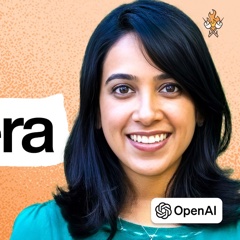
Tara Seshan
Product lead for ChatGPT Work and Codex at OpenAI; ex-Stripe, Watershed, Sutter Hill EIR
Where to hear and read about Tara Seshan2 episodes and tests

 Lenny's PodcastStop planning for 2027: how OpenAI builds product 90 days at a time | Tara Sesha and Nan Yu (OpenAI)
 Lenny's PodcastAI’s third era: the rise of persistent AI coworkers | Tara Seshan (OpenAI’s product lead)
Tara Seshan leads product for ChatGPT Work and Codex at OpenAI, after six years at Stripe, product leadership at Watershed, her own startup and a stint at Sutter Hill. The thing most worth learning from her is to define one sharp hypothesis, test it with real users fast, and build for models two to three months out.
You fail if you build for where the models are now. You fail if you build for where you think the models will be in a year.
AI’s third era: the rise of persistent AI coworkers | Tara Seshan (OpenAI’s product lead)
Tara Seshan: the story and the lessons
1Tara Seshan's path from Stripe to OpenAI
Seshan joined Stripe as one of its first five product managers. She spent six years there, then led product at Watershed, was a founder, and later was an EIR at Sutter Hill before joining OpenAI.
Stripe shaped her habits: everything was polished and every enum name was weighed. Its writing culture let her briefs go viral internally, and she used them to start product areas and propose big changes.
A Thiel Fellowship was an inflection point for her ambition. The fellowship gives $100,000 to skip college and takes 20 people a year. Her batch was filmed for CNBC.
Someone told her she needn't stay on her path, and she credits mentors who raised her ambition. Fellows she mentions include Dylan Field and Ari Weinstein, who leads computer use at OpenAI.
Sutter Hill convinced her that building a huge company is not luck. The firm keeps a near-empty website yet incubates companies like Snowflake. Mike Spiser's repeated successes convinced her a roadmap exists.
She went there because her career is about finding product-market fit as many times as possible. She also credits its recruiting, helped by an internal tool called Reticle that maps contacts and their ten best people.
She now tests positioning before she builds the product. Her Sutter Hill lesson is to pitch 100 people and refine the narrative of why the idea is transformative. Only then commit to a product shape.
She used to dismiss product marketing as glue between functions. She now sees it can decide a company's outcome, since it combines deep technology understanding with the enterprise sales process.
At OpenAI she found founder-like ownership and no secret strategy vault. Every team owns its area like a founder, and she expected a 'payments bible' equivalent and found none. Much of what OpenAI thinks soon becomes public product.
She leads product for Codex and ChatGPT Work, with Andrew Ambrosino as her engineering manager. She says she isn't in any 'secret room' with a master plan.
2Why Seshan builds two to three months ahead of the models
Seshan aims products at where models will be in two to three months. Building only for today gets you left behind, and betting a year or more out is almost always wrong. She calls both failure modes equally wrong.
The forecast is not a gut feeling. Tight contact with research tells her which capabilities the team is pushing, such as coding or writing, so models are not entirely a black box to her.
She keeps a personal doc of her own failed predictions. The doc lists things she predicted incorrectly and reminds her how poor long-range predictions are.
She leaves room in the product for the model to improve. Her working picture is that models will get far better, so model capability is the center of the product. She asks how to make the design right for the model in two to three months.
She says product constructs should get out of the model's way. She calls Kevin Weil's line that this is the worst the models will ever be a cliché, but 'absurd and true'.
She sets planning cadence by how fast the market moves. Stripe's payments market behaves much as before, so you can model bull, base and bear cases months out. OpenAI's business cannot be modeled that way, so its horizon is 60 to 90 days.
She jokes that Stripe PMs still have to do annual planning. The point is to understand the pace of the market you are in.
3How Seshan moved from polish to shipping fast
She replaced Stripe-style long reasoning docs with a sharp hypothesis and fast test. At Stripe she wrote plans like a 'PhD thesis'. At OpenAI she names the one most important thing to test and gets it in front of users as fast as possible.
The shift felt jarring and she worried she wasn't doing her due diligence. Any grand strategy beyond the core question is irrelevant to her.
Seshan ships imperfect features because nothing beats watching real users. The agent mode toggle shipped as an admitted imperfect solution so over a billion ChatGPT users could get an agentic harness without disrupting developer workflows.
She says 'nothing compares to like the actual empirical evidence of seeing users try it, use it, and then iterating from there'.
She says done is better than perfect when a product is transformative. Polish used to matter more because timing made little difference to outcomes. Now getting a transformative product to users quickly wins.
The ChatGPT Work launch drew comments about confusion and the team iterated quickly. Her rule is to listen to the right signals, ideally before launch.
She uses internal dogfooding as a quality bar before wide release. The team ships internally and checks whether it retains, whether people find it delightful, and whether it unlocks a new use of the models. There is no fixed number.
Weak internal uptake is a signal not to ship. The bar also asks that the feature fit the models and get out of their way.
Seshan ships the frontier to enterprises even when it breaks their habits. Enterprises were using ChatGPT only for questions and answers while the agent revolution was happening. OpenAI shipped agents anyway, or customers might have turned to alternatives.
Her line is 'do what your users need, not what your users say they need', which she says applies more than ever.
She keeps users on side by telling a coherent story. The agent toggle is a stepping stone toward no toggle, expected to go away within a year.
She says users accept turns and deprecations when they can follow the story and see what is happening behind the scenes.
4How Seshan designs agents people can follow and trust
She insists an agent must finish the last mile. An agent that gets 99% of the way and then fails is worse than one that never started, because it is an unfulfilled promise.
Computer use is the fallback when plugins or MCPs are missing. It may be slower and cost more tokens, but it will do the job. Capabilities are layered so a second layer finishes what the first could not.
Seshan treats platform capabilities as layers, not native versus third party. She frames it as a range: native features, first and third party plugins, then computer use. The team exposes hooks so developers can build cohesive, composable experiences.
Everything serves the user getting the task done. An example is a meetings plugin that pulls meeting data, with computer use covering a missing plugin interface.
She decides single versus many agents by working through edge cases. The answer depends on the use case: how memory is segmented, such as per private Slack channel, and whether the agent uses the user's credentials or a universal service account.
People can't manage 40 agents any more than 40 direct reports, so they bundle them under a chief of staff agent. She says users should easily understand which identity and data the agent is using.
She wants agent behavior to be predictable. With semi-autonomous agents, a settings menu or popup no longer excuses surprising behavior. At any point a user should be able to predict what a feature will probably do.
Users also need to understand privacy and how their data is used.
For knowledge work she wants process and citations shown, not just output. Code can be checked against tests, but a finished deck claiming a number like 90% success cannot be judged from the result alone. ChatGPT Work shows in-progress work and citations.
She treats the open question of whether the coding thread is the right surface for knowledge work as unsettled.
Her north star is that users never choose between modes. A user types a task and the system picks the harness and model. Work mode is Codex underneath with the coding interface removed, and corporate finance uses it for complex financial models.
Harnesses are 'crazy concepts' for a billion consumers, so complexity has to be hidden. She also wants agents to become multiplayer, with people steering together and syncing at intervals.
5Seshan on working with research and staying near users
She brings research user sessions and evals. She reads sample sessions to see where the model failed and why, then shows that a given prompt and skills reach the outcome and asks research to post-train it in.
Research was entirely new to her at OpenAI. She says learning to write good evals is the most important thing, and good user data earns research's trust to iterate.
Seshan stays directly reachable and asks follow-up questions. Feedback on agent products is subtle, such as a bad tone, so she asks about what it said and the context.
She says good feedback often comes only on the second or third follow-up question.
She invests far more in onboarding to close the capability overhang. Models can do much more than people use, so the limit is how much users can absorb. She says the initial experience must make clear what the product offers.
Many engineers dislike working on onboarding, and she still treats it as driving success. A related bet is products that drive themselves to solve the empty input box.
She adds relentless iteration to user empathy and systems thinking. The classic PM skills still apply, and she adds trying things again and again and accepting a lot of pain.
Learning from feedback loops always mattered, but the clock speed has risen sharply.
Seshan is bullish on voice as a default interface. Voice changed how she works and cut the tech support she gives family. It also made onboarding OpenAI's people team onto a new product far easier.
She says it is an intuitive interface for so many people, and models are getting faster at it.
6How Seshan thinks about ambition, roles and the PM job
She sees the PM job as finding the key question and testing it. The core loop is to ask what decides whether the product works, test it, read results and rerun. It needs three inputs: users, the market and the technology.
Running execution on time and writing docs and presentations are the trappings that have fallen away. EMs, engineers, data scientists and designers have moved to the same loop.
Seshan says ambition is now the bottleneck, so she pushes others to raise it. Because AI widens what one person can do, a PM can ask for a faster timeline, a bigger first version or a 10x scale.
She says 'Elevating others ambitions or reminding them of what's possible here is a huge part of the product management role.'
She asks 'Is this maximally accelerated?' and 'Are you mainlining it yet?'. She and Andrew Ambrosino use these OpenAI memes with the team, alongside a push for ambitious scope. 'Mainlining' means using the product all day to get your work done.
She likens mainlining to a new dogfooding. The Codex desktop team already worked this way before outside attention caught up.
She wants one accountable owner for the outcome, whatever the role. Role boundaries blur, as they did at Stripe, but someone must be the DRI for whether users want the product and find it high quality.
She loves PM craft and asks whether fluid teamwork costs her polish in it. Her answer: 'I truly don't have an answer.'
She argues humans keep value as owners, authors and teammates. The person still owns the end product, especially in regulated industries. What to build and how it feels is a question of taste and opinion.
She compares software to filmmaking, not real estate, because money alone doesn't make it good. She attributes the line to one of the Collisons.
7Seshan's habits for writing, thinking and building with AI
She writes to think herself and automates writing that only reports. Models draft status updates, launch plans and summaries. She starts and finishes thinking pieces herself and uses AI mid-way for research, data and pushback.
She says 'Writing is reporting I happily automate. But writing is thinking is something I never will automate.' This is her main guard against atrophying her thinking.
Seshan shows mocks and test results instead of long docs. A long doc no longer signals real thought, since one is easy to produce without it. She leads with mocks, prototypes and A/B results.
She still writes hundreds of docs, but now for herself.
She takes a doc to 70% and lets others get it to 100%. A former manager taught her to bring a rough draft to the people she needs. She repeats it with each next person, and her briefs get strong by being attacked early.
She says 'very few great people want to interact with like a perfectly polished finished idea.'
She preps as long as readers or attendees will spend. Before asking people to read a doc, she spends at least their collective reading time writing it. Meetings follow the same rule.
This keeps her own thinking sharp.
She builds shareable sites instead of docs and slide decks. She asks Codex or Work for a site for anything, such as a team game or a backpacking route tracking elevation and food. Sites have a database, can auto-update, and can be public, team-only or private.
She sees it as a more dynamic surface for presenting than a slide deck. She also uses /visualize in Codex to turn raw usage data into a story.
Stop planning for 2027: how OpenAI builds product 90 days at a time | Tara Sesha and Nan Yu (OpenAI)
OpenAI's product leaders explain how they build AI products when models change every few months: ship imperfect features fast, aim 2 to 3 months ahead, and finish the last mile of a task. The payoff is a practical set of rules for working with research, designing agents people can follow, and staying close to users.
Seshan joined Stripe as one of its first five product managers. She spent six years there, then led product at Watershed, was a founder, and later was an EIR at Sutter Hill before joining OpenAI.
Stripe shaped her habits: everything was polished and every enum name was weighed. Its writing culture let her briefs go viral internally, and she used them to start product areas and propose big changes.
Seshan aims products at where models will be in two to three months. Building only for today gets you left behind, and betting a year or more out is almost always wrong. She calls both failure modes equally wrong.
The forecast is not a gut feeling. Tight contact with research tells her which capabilities the team is pushing, such as coding or writing, so models are not entirely a black box to her.
She keeps a personal doc of her own failed predictions. The doc lists things she predicted incorrectly and reminds her how poor long-range predictions are.
She sets planning cadence by how fast the market moves. Stripe's payments market behaves much as before, so you can model bull, base and bear cases months out. OpenAI's business cannot be modeled that way, so its horizon is 60 to 90 days.
She jokes that Stripe PMs still have to do annual planning. The point is to understand the pace of the market you are in.
Seshan ships imperfect features because nothing beats watching real users. The agent mode toggle shipped as an admitted imperfect solution so over a billion ChatGPT users could get an agentic harness without disrupting developer workflows.
She says 'nothing compares to like the actual empirical evidence of seeing users try it, use it, and then iterating from there'.
She uses internal dogfooding as a quality bar before wide release. The team ships internally and checks whether it retains, whether people find it delightful, and whether it unlocks a new use of the models. There is no fixed number.
Weak internal uptake is a signal not to ship. The bar also asks that the feature fit the models and get out of their way.
Seshan ships the frontier to enterprises even when it breaks their habits. Enterprises were using ChatGPT only for questions and answers while the agent revolution was happening. OpenAI shipped agents anyway, or customers might have turned to alternatives.
Her line is 'do what your users need, not what your users say they need', which she says applies more than ever.
She keeps users on side by telling a coherent story. The agent toggle is a stepping stone toward no toggle, expected to go away within a year.
She says users accept turns and deprecations when they can follow the story and see what is happening behind the scenes.
She insists an agent must finish the last mile. An agent that gets 99% of the way and then fails is worse than one that never started, because it is an unfulfilled promise.
Computer use is the fallback when plugins or MCPs are missing. It may be slower and cost more tokens, but it will do the job. Capabilities are layered so a second layer finishes what the first could not.
Seshan treats platform capabilities as layers, not native versus third party. She frames it as a range: native features, first and third party plugins, then computer use. The team exposes hooks so developers can build cohesive, composable experiences.
Everything serves the user getting the task done. An example is a meetings plugin that pulls meeting data, with computer use covering a missing plugin interface.
She decides single versus many agents by working through edge cases. The answer depends on the use case: how memory is segmented, such as per private Slack channel, and whether the agent uses the user's credentials or a universal service account.
People can't manage 40 agents any more than 40 direct reports, so they bundle them under a chief of staff agent. She says users should easily understand which identity and data the agent is using.
She wants agent behavior to be predictable. With semi-autonomous agents, a settings menu or popup no longer excuses surprising behavior. At any point a user should be able to predict what a feature will probably do.
Users also need to understand privacy and how their data is used.
She brings research user sessions and evals. She reads sample sessions to see where the model failed and why, then shows that a given prompt and skills reach the outcome and asks research to post-train it in.
Research was entirely new to her at OpenAI. She says learning to write good evals is the most important thing, and good user data earns research's trust to iterate.
Seshan stays directly reachable and asks follow-up questions. Feedback on agent products is subtle, such as a bad tone, so she asks about what it said and the context.
She says good feedback often comes only on the second or third follow-up question.
She invests far more in onboarding to close the capability overhang. Models can do much more than people use, so the limit is how much users can absorb. She says the initial experience must make clear what the product offers.
Many engineers dislike working on onboarding, and she still treats it as driving success. A related bet is products that drive themselves to solve the empty input box.
She adds relentless iteration to user empathy and systems thinking. The classic PM skills still apply, and she adds trying things again and again and accepting a lot of pain.
Learning from feedback loops always mattered, but the clock speed has risen sharply.
Seshan is bullish on voice as a default interface. Voice changed how she works and cut the tech support she gives family. It also made onboarding OpenAI's people team onto a new product far easier.
She says it is an intuitive interface for so many people, and models are getting faster at it.
AI’s third era: the rise of persistent AI coworkers | Tara Seshan (OpenAI’s product lead)
Product building at a frontier lab rewards fast empirical testing, ambition and human steering over long strategy docs, with agents moving from chat to persistent coworkers. Tara explains how OpenAI builds for models two to three months out and how she keeps her own thinking sharp while using AI heavily.
Seshan joined Stripe as one of its first five product managers. She spent six years there, then led product at Watershed, was a founder, and later was an EIR at Sutter Hill before joining OpenAI.
Stripe shaped her habits: everything was polished and every enum name was weighed. Its writing culture let her briefs go viral internally, and she used them to start product areas and propose big changes.
A Thiel Fellowship was an inflection point for her ambition. The fellowship gives $100,000 to skip college and takes 20 people a year. Her batch was filmed for CNBC.
Someone told her she needn't stay on her path, and she credits mentors who raised her ambition. Fellows she mentions include Dylan Field and Ari Weinstein, who leads computer use at OpenAI.
Sutter Hill convinced her that building a huge company is not luck. The firm keeps a near-empty website yet incubates companies like Snowflake. Mike Spiser's repeated successes convinced her a roadmap exists.
She went there because her career is about finding product-market fit as many times as possible. She also credits its recruiting, helped by an internal tool called Reticle that maps contacts and their ten best people.
She now tests positioning before she builds the product. Her Sutter Hill lesson is to pitch 100 people and refine the narrative of why the idea is transformative. Only then commit to a product shape.
She used to dismiss product marketing as glue between functions. She now sees it can decide a company's outcome, since it combines deep technology understanding with the enterprise sales process.
At OpenAI she found founder-like ownership and no secret strategy vault. Every team owns its area like a founder, and she expected a 'payments bible' equivalent and found none. Much of what OpenAI thinks soon becomes public product.
She leads product for Codex and ChatGPT Work, with Andrew Ambrosino as her engineering manager. She says she isn't in any 'secret room' with a master plan.
Seshan aims products at where models will be in two to three months. Building only for today gets you left behind, and betting a year or more out is almost always wrong. She calls both failure modes equally wrong.
The forecast is not a gut feeling. Tight contact with research tells her which capabilities the team is pushing, such as coding or writing, so models are not entirely a black box to her.
She leaves room in the product for the model to improve. Her working picture is that models will get far better, so model capability is the center of the product. She asks how to make the design right for the model in two to three months.
She says product constructs should get out of the model's way. She calls Kevin Weil's line that this is the worst the models will ever be a cliché, but 'absurd and true'.
She replaced Stripe-style long reasoning docs with a sharp hypothesis and fast test. At Stripe she wrote plans like a 'PhD thesis'. At OpenAI she names the one most important thing to test and gets it in front of users as fast as possible.
The shift felt jarring and she worried she wasn't doing her due diligence. Any grand strategy beyond the core question is irrelevant to her.
She says done is better than perfect when a product is transformative. Polish used to matter more because timing made little difference to outcomes. Now getting a transformative product to users quickly wins.
The ChatGPT Work launch drew comments about confusion and the team iterated quickly. Her rule is to listen to the right signals, ideally before launch.
For knowledge work she wants process and citations shown, not just output. Code can be checked against tests, but a finished deck claiming a number like 90% success cannot be judged from the result alone. ChatGPT Work shows in-progress work and citations.
She treats the open question of whether the coding thread is the right surface for knowledge work as unsettled.
Her north star is that users never choose between modes. A user types a task and the system picks the harness and model. Work mode is Codex underneath with the coding interface removed, and corporate finance uses it for complex financial models.
Harnesses are 'crazy concepts' for a billion consumers, so complexity has to be hidden. She also wants agents to become multiplayer, with people steering together and syncing at intervals.
She sees the PM job as finding the key question and testing it. The core loop is to ask what decides whether the product works, test it, read results and rerun. It needs three inputs: users, the market and the technology.
Running execution on time and writing docs and presentations are the trappings that have fallen away. EMs, engineers, data scientists and designers have moved to the same loop.
Seshan says ambition is now the bottleneck, so she pushes others to raise it. Because AI widens what one person can do, a PM can ask for a faster timeline, a bigger first version or a 10x scale.
She says 'Elevating others ambitions or reminding them of what's possible here is a huge part of the product management role.'
She asks 'Is this maximally accelerated?' and 'Are you mainlining it yet?'. She and Andrew Ambrosino use these OpenAI memes with the team, alongside a push for ambitious scope. 'Mainlining' means using the product all day to get your work done.
She likens mainlining to a new dogfooding. The Codex desktop team already worked this way before outside attention caught up.
She wants one accountable owner for the outcome, whatever the role. Role boundaries blur, as they did at Stripe, but someone must be the DRI for whether users want the product and find it high quality.
She loves PM craft and asks whether fluid teamwork costs her polish in it. Her answer: 'I truly don't have an answer.'
She argues humans keep value as owners, authors and teammates. The person still owns the end product, especially in regulated industries. What to build and how it feels is a question of taste and opinion.
She compares software to filmmaking, not real estate, because money alone doesn't make it good. She attributes the line to one of the Collisons.
She writes to think herself and automates writing that only reports. Models draft status updates, launch plans and summaries. She starts and finishes thinking pieces herself and uses AI mid-way for research, data and pushback.
She says 'Writing is reporting I happily automate. But writing is thinking is something I never will automate.' This is her main guard against atrophying her thinking.
Seshan shows mocks and test results instead of long docs. A long doc no longer signals real thought, since one is easy to produce without it. She leads with mocks, prototypes and A/B results.
She still writes hundreds of docs, but now for herself.
She takes a doc to 70% and lets others get it to 100%. A former manager taught her to bring a rough draft to the people she needs. She repeats it with each next person, and her briefs get strong by being attacked early.
She says 'very few great people want to interact with like a perfectly polished finished idea.'
She preps as long as readers or attendees will spend. Before asking people to read a doc, she spends at least their collective reading time writing it. Meetings follow the same rule.
This keeps her own thinking sharp.
She builds shareable sites instead of docs and slide decks. She asks Codex or Work for a site for anything, such as a team game or a backpacking route tracking elevation and food. Sites have a database, can auto-update, and can be public, team-only or private.
She sees it as a more dynamic surface for presenting than a slide deck. She also uses /visualize in Codex to turn raw usage data into a story.
More from OpenAI
 Guest
Kevin Weil
Chief Product Officer at OpenAI, former head of product at Instagram and Twitter
 OpenAI2 sources · 34 tips
 Guest
Alexander Embiricos
Product lead for Codex at OpenAI
OpenAI1 source · 18 tips Guest
Andrew Ambrosino
Product and engineering lead for the Codex desktop app at OpenAI
OpenAI1 source · 18 tips Guest
Ian Silber
Head of product design at OpenAI (ChatGPT, Codex); formerly Artifact and eight years at Instagram
OpenAI1 source · 16 tips Guest
Krithika Shankarraman
Executive in Residence at Thrive Capital; first marketing hire at OpenAI and Stripe, former marketing lead at Retool
OpenAI1 source · 19 tips Guest
Logan Kilpatrick
Head of developer relations at OpenAI
OpenAI1 source · 17 tips