Ian Silber
Head of product design at OpenAI (ChatGPT, Codex); formerly Artifact and eight years at Instagram
Where to hear and read about Ian Silber1 episode or test
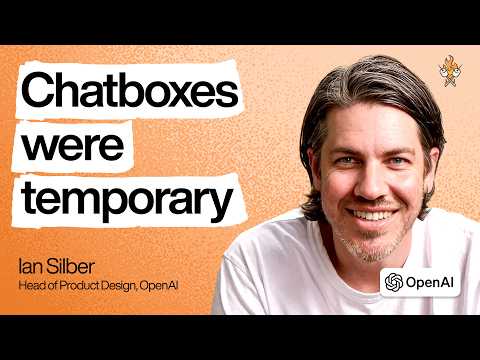
Ian Silber is head of product design at OpenAI, leading design for ChatGPT and Codex after eight years at Instagram and a stint at Artifact. The lesson most worth taking from him is to polish only what is durable, move fast on the rest, and let human judgment about users and point of view be your edge.
What is my point of view? Who am I building this for and why?
Chatbots are not the final interface: OpenAI’s Head of Design on what’s next | Ian Silber
Ian Silber: the story and the lessons
1Ian Silber's path from Instagram to OpenAI
Silber has led design for OpenAI's biggest products for three years. He leads design for ChatGPT, Codex and OpenAI's product experience. Before that he spent eight years at Instagram, then worked at Artifact, the news app from Instagram's founders.
Three years at OpenAI is, in his words, a lifetime in AI time.
He learned design as a teenager by viewing page source. He picked up the web by viewing the source of pages and using tools like Dreamweaver.
He says a beginner today can learn faster and be far more expressive, which shapes his view that anyone can now become a designer.
Stepping into OpenAI left him intimidated and feeling bad at the job. He interviewed soon after GPT-4 came out. He used the tools but felt he lacked a true understanding of them, and he had never managed at a scale growing this fast.
He felt he was failing every day, unsure how to build a team or hire. He says he still has much to learn.
Silber has seen three company cultures from the inside. Groupon had a comedy writing team and a brand-led product. Instagram was design-led under Kevin Systrom. OpenAI is a research lab with Sam Altman's different style.
He treats each culture as fixed: you won't change a founder-driven culture, so you help round it out. Instagram's slower pace suited most of its stages but would not work at OpenAI's current stage.
2How Silber decides what to polish and what to ship fast
Silber spends heavy design effort only where the technology won't change soon. The technology can shift within a month, so a new capability, lower latency or smarter model can make an interaction or setting obsolete. He says to harden something only once it won't change tomorrow.
He admits that knowing what is durable is hard.
Some ChatGPT features get heavy iteration, others ship in hours. The ChatGPT composer changes daily: the team tries 100 things, throws out 99 and ships one. Some work goes from idea to ship in about 4 hours.
Codex and the super app move faster and are built in public for instant feedback. Polished features get A/B tests and user research.
Features about personal life get the full design treatment first. Making ChatGPT feel at home in personal life gets whiteboards, Figma, prototypes and dogfooding before shipping.
His first design question is whether to design anything at all. He tells his designers to do less. An existing component may already do the job, or the feature may only need to extend one that exists.
Designers must think beyond their own project so the product feels like one cohesive thing the model can reason about. Speed is why this matters so much now.
Silber builds composable primitives rather than one-off experiences. OpenAI is building toward a superintelligence with many capabilities, so it needs underlying building blocks that stack on each other. He cites Notion's early composable blocks as a model.
This keeps the product feeling simple and lets the model combine the pieces. Siloed, one-off experiences are the thing to avoid.
3How Silber designs ChatGPT for a billion users
ChatGPT serves a far wider spread of users than Instagram did. Instagram had billions of users but a simple product with a few ways to use it. ChatGPT users range from someone planning tonight's recipe to someone automating a farm in Japan, and from free daily use to people paying hundreds of dollars.
Designers need empathy for every type of user, which adds complexity and makes the work fun.
Silber tests advanced features with enthusiasts before simplifying for everyone. Most people get only a sliver of the value, which OpenAI calls the capability overhang. The risk is putting something confusing in front of a billion users.
The desktop app and Codex test ideas early with people who care. "We can experiment early with the people that really care."
He treats the blank chat box as an open design problem. One empty input has to become many tools: one person arrives for image generation, another for a PowerPoint. He calls it uncharted territory.
The team keeps two users in mind: a novice who needs to see the value, and a daily user who needs the interface out of the way.
The interface should adapt to who the user is. OpenAI ships tap-through follow-up questions and writing blocks that hold an email or letter in an editable block. Image generation gets its own tools.
The aims are to help people express intent without being perfect prompt engineers, and to teach them what the model can help with at all.
His goal is one universal input that decides how to respond. The input should know whether to answer fast, chat, or go off and do work, with model and speed options kept for those who want them.
Next steps are proactive suggestions from calendar and Slack, richer voice input and visual output, and reusable workflows instead of starting from zero each task. He calls proactivity the biggest untapped part of the experience.
4How Silber hires and structures a design team
Silber hires for curiosity and prototyping, not an AI background. OpenAI looks for aptitude at learning how AI works and using it in the design process, plus building tools that let more people use it.
Prototyping has become more accessible, so it usually stands out in interviews. He also looks for a point of view on where the tools are going, and for strategic and systems thinking.
He builds a team of complementary strengths, not clones. He wants the right ratio of generalists, plus visual designers, a brand team, prototypers, strategic product thinkers and people obsessed with the cutting edge.
No single designer checks every box. He calls this a luxury of a larger team but believes it holds at a startup too, where he might pick the best generalists.
He keeps distinct PM, design and engineering roles even as they blur. Roles were always blurry, and ladders mostly help big companies organize people. At scale a strong PM still rallies teams and sharpens the problem, and an engineer keeps the output sound.
He frames roles as hats needed to build great software, with people moving between them more fluidly.
5Why Silber says designers still have an edge
He calls this the best time in history to be a designer. An idea becomes a working version in minutes, so reach grows and the human work of understanding users matters more. At OpenAI, designers are empowered to package an early research concept into something people want.
He has seen startups run about one designer to fifteen engineers.
Silber thinks AI is a strong designer but not the best at any craft. He says AI is already good at product design and open to anyone, but doubts it leads in visual design, information hierarchy, typography or interaction design.
He won't predict where it goes, since three years brought huge change.
Humans keep the edge where there is no precedent to learn from. Watching real people use a product, inventing new paradigms and holding a point of view are hard to replace. He points to the iPhone's multi-touch and Snapchat's flipped way of communicating.
Voice with AI and agents that carry out tasks have little precedent either. Designers should hone their answer to who they are building for and why.
His claim comes from inside OpenAI and lacks outside evidence. He offers no data that design hiring is rising, and he and Lenny both note the expected surge in designers has not appeared yet.
Designers' output is not growing like engineers' 10x, though he says they can do a lot more.
6Silber's working habits and what his mistakes taught him
He throws ideas into an agent early to find a new way of working. He puts an idea straight into Codex or Claude to think it through and prototype it. He types late-night ideas into ChatGPT Cowork, which runs in the cloud, and brings the artifact to the team.
He says it may not be the exact right way to work, but those who adapt are doing well. He also hands busywork to AI, like summarizing Slack and prepping for meetings.
He retries AI tools on every new model release. His coding agents kept hitting hiccups on paternity leave late last year. A month later Codex dropped and it just works.
Voice mode and computer use barely worked when he joined, and now OpenAI uses both to build software. "What was totally broken yesterday now actually just kind of works."
He tells anxious designers to aim at the outcome, not the process. He treats designer anxiety as a rational response, then advises exploring, prototyping more and rethinking tooling.
The job is great products people love, not processes or token maxing, and the designer remains the person steering. "We're not here to token max or something like that."
IGTV flopped at Instagram, and Reels came from dropping its assumptions. IGTV baked in wrong assumptions and held onto some constraints. The team changed those assumptions and redid it as Reels, which became very successful.
He says what matters is how you react and keep listening to users, not what you shipped once.
He beat imposter feelings by talking to peers and a mentor. For a long time he felt bad at managing a fast-growing team. Friends who led large design teams felt exactly the same.
A mentor or an impartial buddy outside the situation helped him most. "The problems that I had were not unique."

Chatbots are not the final interface: OpenAI’s Head of Design on what’s next | Ian Silber
Ian Silber explains how OpenAI designs ChatGPT and Codex when the technology changes monthly: pick which features to polish, design for a huge spread of users, and stay curious and adaptable. He argues designers are more empowered than ever, with human judgment about user needs, invention and point of view as the lasting edge.
Silber has led design for OpenAI's biggest products for three years. He leads design for ChatGPT, Codex and OpenAI's product experience. Before that he spent eight years at Instagram, then worked at Artifact, the news app from Instagram's founders.
Three years at OpenAI is, in his words, a lifetime in AI time.
He learned design as a teenager by viewing page source. He picked up the web by viewing the source of pages and using tools like Dreamweaver.
He says a beginner today can learn faster and be far more expressive, which shapes his view that anyone can now become a designer.
Stepping into OpenAI left him intimidated and feeling bad at the job. He interviewed soon after GPT-4 came out. He used the tools but felt he lacked a true understanding of them, and he had never managed at a scale growing this fast.
He felt he was failing every day, unsure how to build a team or hire. He says he still has much to learn.
Silber has seen three company cultures from the inside. Groupon had a comedy writing team and a brand-led product. Instagram was design-led under Kevin Systrom. OpenAI is a research lab with Sam Altman's different style.
He treats each culture as fixed: you won't change a founder-driven culture, so you help round it out. Instagram's slower pace suited most of its stages but would not work at OpenAI's current stage.
Silber spends heavy design effort only where the technology won't change soon. The technology can shift within a month, so a new capability, lower latency or smarter model can make an interaction or setting obsolete. He says to harden something only once it won't change tomorrow.
He admits that knowing what is durable is hard.
Some ChatGPT features get heavy iteration, others ship in hours. The ChatGPT composer changes daily: the team tries 100 things, throws out 99 and ships one. Some work goes from idea to ship in about 4 hours.
Codex and the super app move faster and are built in public for instant feedback. Polished features get A/B tests and user research.
Features about personal life get the full design treatment first. Making ChatGPT feel at home in personal life gets whiteboards, Figma, prototypes and dogfooding before shipping.
His first design question is whether to design anything at all. He tells his designers to do less. An existing component may already do the job, or the feature may only need to extend one that exists.
Designers must think beyond their own project so the product feels like one cohesive thing the model can reason about. Speed is why this matters so much now.
Silber builds composable primitives rather than one-off experiences. OpenAI is building toward a superintelligence with many capabilities, so it needs underlying building blocks that stack on each other. He cites Notion's early composable blocks as a model.
This keeps the product feeling simple and lets the model combine the pieces. Siloed, one-off experiences are the thing to avoid.
ChatGPT serves a far wider spread of users than Instagram did. Instagram had billions of users but a simple product with a few ways to use it. ChatGPT users range from someone planning tonight's recipe to someone automating a farm in Japan, and from free daily use to people paying hundreds of dollars.
Designers need empathy for every type of user, which adds complexity and makes the work fun.
Silber tests advanced features with enthusiasts before simplifying for everyone. Most people get only a sliver of the value, which OpenAI calls the capability overhang. The risk is putting something confusing in front of a billion users.
The desktop app and Codex test ideas early with people who care. "We can experiment early with the people that really care."
He treats the blank chat box as an open design problem. One empty input has to become many tools: one person arrives for image generation, another for a PowerPoint. He calls it uncharted territory.
The team keeps two users in mind: a novice who needs to see the value, and a daily user who needs the interface out of the way.
The interface should adapt to who the user is. OpenAI ships tap-through follow-up questions and writing blocks that hold an email or letter in an editable block. Image generation gets its own tools.
The aims are to help people express intent without being perfect prompt engineers, and to teach them what the model can help with at all.
His goal is one universal input that decides how to respond. The input should know whether to answer fast, chat, or go off and do work, with model and speed options kept for those who want them.
Next steps are proactive suggestions from calendar and Slack, richer voice input and visual output, and reusable workflows instead of starting from zero each task. He calls proactivity the biggest untapped part of the experience.
Silber hires for curiosity and prototyping, not an AI background. OpenAI looks for aptitude at learning how AI works and using it in the design process, plus building tools that let more people use it.
Prototyping has become more accessible, so it usually stands out in interviews. He also looks for a point of view on where the tools are going, and for strategic and systems thinking.
He builds a team of complementary strengths, not clones. He wants the right ratio of generalists, plus visual designers, a brand team, prototypers, strategic product thinkers and people obsessed with the cutting edge.
No single designer checks every box. He calls this a luxury of a larger team but believes it holds at a startup too, where he might pick the best generalists.
He keeps distinct PM, design and engineering roles even as they blur. Roles were always blurry, and ladders mostly help big companies organize people. At scale a strong PM still rallies teams and sharpens the problem, and an engineer keeps the output sound.
He frames roles as hats needed to build great software, with people moving between them more fluidly.
He calls this the best time in history to be a designer. An idea becomes a working version in minutes, so reach grows and the human work of understanding users matters more. At OpenAI, designers are empowered to package an early research concept into something people want.
He has seen startups run about one designer to fifteen engineers.
Silber thinks AI is a strong designer but not the best at any craft. He says AI is already good at product design and open to anyone, but doubts it leads in visual design, information hierarchy, typography or interaction design.
He won't predict where it goes, since three years brought huge change.
Humans keep the edge where there is no precedent to learn from. Watching real people use a product, inventing new paradigms and holding a point of view are hard to replace. He points to the iPhone's multi-touch and Snapchat's flipped way of communicating.
Voice with AI and agents that carry out tasks have little precedent either. Designers should hone their answer to who they are building for and why.
His claim comes from inside OpenAI and lacks outside evidence. He offers no data that design hiring is rising, and he and Lenny both note the expected surge in designers has not appeared yet.
Designers' output is not growing like engineers' 10x, though he says they can do a lot more.
He throws ideas into an agent early to find a new way of working. He puts an idea straight into Codex or Claude to think it through and prototype it. He types late-night ideas into ChatGPT Cowork, which runs in the cloud, and brings the artifact to the team.
He says it may not be the exact right way to work, but those who adapt are doing well. He also hands busywork to AI, like summarizing Slack and prepping for meetings.
He retries AI tools on every new model release. His coding agents kept hitting hiccups on paternity leave late last year. A month later Codex dropped and it just works.
Voice mode and computer use barely worked when he joined, and now OpenAI uses both to build software. "What was totally broken yesterday now actually just kind of works."
He tells anxious designers to aim at the outcome, not the process. He treats designer anxiety as a rational response, then advises exploring, prototyping more and rethinking tooling.
The job is great products people love, not processes or token maxing, and the designer remains the person steering. "We're not here to token max or something like that."
IGTV flopped at Instagram, and Reels came from dropping its assumptions. IGTV baked in wrong assumptions and held onto some constraints. The team changed those assumptions and redid it as Reels, which became very successful.
He says what matters is how you react and keep listening to users, not what you shipped once.
He beat imposter feelings by talking to peers and a mentor. For a long time he felt bad at managing a fast-growing team. Friends who led large design teams felt exactly the same.
A mentor or an impartial buddy outside the situation helped him most. "The problems that I had were not unique."
More from OpenAI
 Guest
Kevin Weil
Chief Product Officer at OpenAI, former head of product at Instagram and Twitter
 OpenAI2 sources · 34 tips
 Guest
Tara Seshan
Product lead for ChatGPT Work and Codex at OpenAI; ex-Stripe, Watershed, Sutter Hill EIR
OpenAI2 sources · 33 tips Guest
Alexander Embiricos
Product lead for Codex at OpenAI
OpenAI1 source · 18 tips Guest
Andrew Ambrosino
Product and engineering lead for the Codex desktop app at OpenAI
OpenAI1 source · 18 tips Guest
Krithika Shankarraman
Executive in Residence at Thrive Capital; first marketing hire at OpenAI and Stripe, former marketing lead at Retool
OpenAI1 source · 19 tips Guest
Logan Kilpatrick
Head of developer relations at OpenAI
OpenAI1 source · 17 tips