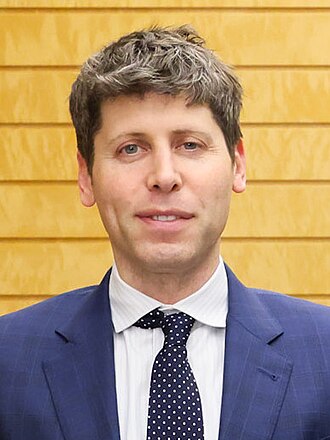
Sam Altman
CEO and co-founder of OpenAI, former startup investor and Y Combinator president
Where to hear and read about Sam Altman1 episode or test

Sam Altman is the co-founder and CEO of OpenAI, who came to the job after a failed first startup and about ten years at Y Combinator watching thousands of companies. The most useful lesson from him is focus under constraint: make non-consensus bets where a win is huge, then cut even good products to feed the one that matters.
Sacrificing the good ideas to go after the great ideas is kind of the hardest lesson for any entrepreneur or business to learn.
Sam Altman on Building OpenAI & Betting on the Impossible
Sam Altman: the story and the lessons
1Sam Altman's path from AI-obsessed kid to OpenAI
Altman loved AI as a kid because it seemed impossible. He spent Friday nights on his computer reading sci-fi, joined a school robots club and went to college to study AI.
Most computer nerds found AI exciting but out of reach; his reaction was "Let's try." He says the more impossible something seemed, the more it intrigued him.
A college AI lab showed him nothing worked, so he turned to startups. After a summer in an AI lab he drifted into startups, which he calls no detour since they proved useful later.
His first company as a founder did not work out well, so he does not see himself as a founder turned investor turned founder.
Years as an investor gave him a library of crux decisions. An operator faces few crux moments in a career; an investor at YC watched them all day across thousands of companies.
He draws on that pattern matching for high-stakes strategy shifts and messy executive firings at OpenAI. Having done both, he finds running a company much harder than investing, and plans to work on OpenAI for the rest of his career.
He credits Y Combinator with making OpenAI possible at all. YC's philosophy of iterative deployment, technical people in charge and betting on young, ambitious people shaped how OpenAI ships and does research.
YC also gave founders leverage and let young technical founders raise large sums without a proven resume. Run the clock from 2004 to 2016 without those changes and he doubts OpenAI could have existed.
OpenAI's first day had no plan and the energy collapsed. About 11 or 12 people met at Greg Brockman's apartment in early January 2016, fetched a whiteboard, and realized nobody knew what to do.
They did what they knew: wrote papers and tested ideas until they found a rhythm for making and judging research bets. His main memory of the early days is trying and failing to raise money.
OpenAI ran four and a half years with no product or customers. Lacking customer signal, the team tried to "simulate end users" with a public leaderboard during the Dota 2 work and demos for eminent people researchers wanted to impress.
Fake deadlines did not work. Advice from Alan Kay and other research veterans only partly fit, since Bell Labs and Xerox PARC had profit machines behind them and OpenAI had none. The sentiment neuron paper led to GPT-1, and the scaling laws gave confidence to scale.
Peter Thiel talked him into going all in on ChatGPT. About two months after launch, growth looked unstable and staff wanted to pursue five or six other directions; Thiel called anything else "an obvious mistake."
ChatGPT had no feeds, network effects or lock-in, but Thiel argued it was the first thing in 20 years to look like the Google text box. OpenAI went super hard on it, and it reached about a billion users in under four years.
2How Sam Altman picks bets and focuses OpenAI
Altman runs research like an investor running a power law. In investing the best bet outperforms all the others combined, and he says AI research works the same way.
His rule is that high-risk bets are fine as long as success would be hugely valuable. In 2015 thousands of founders built photo sharing apps while only DeepMind and one or two others chased AGI, and a professor had called deep learning the most guaranteed way to have a bad career.
He backs people with unpopular convictions, not a thin veneer of difference. He avoids founders pitching a slight variation on the last thousand pitches and looks for non-standard, high-energy people who stand by unpopular views.
They may be wrong, but if right, they are really right. He thinks a lone "monk researcher" still has some chance of upsetting the big labs, though only two or three people starting labs today are doing something truly new.
Altman spends most of his time on models and compute, not product. He looks for "the high-leverage difficult problem that will continue the exponential" and believes the rest follows if models and compute are right.
Compute mixes chips, fabs, racks, power, finance, policy and supply chain, problems that suit him. He calls the buildout probably already or soon the most expensive infrastructure project in history.
He killed Sora and the Atlas browser to free compute and people. Sora used a lot of compute and mattered less than Codex, where the compute went; Atlas, which he called the best browser, freed talent for higher priorities.
The test was what matters most with limited compute, people and resources: general intelligence for knowledge work, and eventually science. He admits entrepreneurs, himself included, are terrible at cutting good ideas.
OpenAI is meant to be a platform, not a builder of everything. ChatGPT and Codex were merged into one interface, alongside one API, with the aim of the best AI at every point on the cost and performance curve.
He says OpenAI should not compete with its customers or "subsume the entire economy," and aims instead for 100 million new businesses and 8 billion people using it.
He thinks AI's missing piece is a product idea, not technology. He compares now to smartphones before the iPhone, when he owned a Palm Treo and the missing thing was product ideas more than multi-touch.
He admits he still works the way he did for 20 years despite having Codex. He sees context, not raw intelligence, as the limit, and wants an agent that reads the internal Slack, customer stories and papers he cannot.
3Sam Altman on AI safety, power and adoption
Altman argues shipping imperfect AI early is how it gets safe. The startup method of shipping, getting real feedback and seeing what breaks makes products both good and safe; he models it on aviation's accident reporting and public postmortems.
The early doom predictions were wrong, so he says they should be updated, though he expects safety to get harder as models pass the smartest people. "I don't think you're going to solve it by disconnecting yourself from reality."
He names loss of control and concentrated power as the two risks. Both are anti-human, and he calls the pitch of cheap abundance in exchange for autonomy a terrible one.
The risks are a little in tension, and he says fear of AI often becomes cover for grabbing power. His fix for both is keeping people deeply in control of the future.
He blames AI builders for much of the public's fear. The field talked of a 25% chance of destroying the world and half of jobs vanishing while racing ahead, and skipped why personal freedom matters.
He expects the biggest boom in small business formation ever and says OpenAI has not talked about it or built for it enough: "no excuse, we should be doing more."
Altman was wrong on how fast AI would disrupt software. After GPT-4 in 2023 he expected much faster disruption; people kept buying from the same companies, as they kept going to Blockbuster after Netflix.
He now sees that inertia as positive because it makes the transition smoother, and expects human connection and work built on people liking people to gain value.
4How Sam Altman learns and thinks through hard problems
He learns more from what worked than from what failed. Failure taught generic lessons like grit, since most things fail for many reasons; what worked at YC and OpenAI was more useful.
He says he should have applied those success lessons more, though he still advises learning from both.
He thinks the lessons that work are unglamorous and need repeating. His list: talk to users more, ship earlier, get more feedback, hold a higher hiring bar.
Paul Graham taught founders to ship an embarrassing first version, and Altman never asked him about launching ChatGPT because he knew the answer.
Graham and Thiel are his partners for non-obvious problems. He picks them because they are the two people whose next word he can predict the least.
Often their input is one specific thing to do, which then seems obvious and correct.
He wrote letters to his son to see events honestly. He began by telling his first son about his day while rocking him to sleep, then wrote it down on Sundays, about eight letters in all.
Writing to a child left no room to hide, and if something felt bad, the letter pushed him to act differently the next week.

Sam Altman on Building OpenAI & Betting on the Impossible
Sam Altman explains how OpenAI was built on non-consensus bets, a platform strategy and a willingness to kill good ideas to protect compute for great ones. The decision to ship ChatGPT early and double down on it, against Silicon Valley wisdom, shows how iterative deployment and focus shaped the company.
Altman loved AI as a kid because it seemed impossible. He spent Friday nights on his computer reading sci-fi, joined a school robots club and went to college to study AI.
Most computer nerds found AI exciting but out of reach; his reaction was "Let's try." He says the more impossible something seemed, the more it intrigued him.
A college AI lab showed him nothing worked, so he turned to startups. After a summer in an AI lab he drifted into startups, which he calls no detour since they proved useful later.
His first company as a founder did not work out well, so he does not see himself as a founder turned investor turned founder.
Years as an investor gave him a library of crux decisions. An operator faces few crux moments in a career; an investor at YC watched them all day across thousands of companies.
He draws on that pattern matching for high-stakes strategy shifts and messy executive firings at OpenAI. Having done both, he finds running a company much harder than investing, and plans to work on OpenAI for the rest of his career.
He credits Y Combinator with making OpenAI possible at all. YC's philosophy of iterative deployment, technical people in charge and betting on young, ambitious people shaped how OpenAI ships and does research.
YC also gave founders leverage and let young technical founders raise large sums without a proven resume. Run the clock from 2004 to 2016 without those changes and he doubts OpenAI could have existed.
OpenAI's first day had no plan and the energy collapsed. About 11 or 12 people met at Greg Brockman's apartment in early January 2016, fetched a whiteboard, and realized nobody knew what to do.
They did what they knew: wrote papers and tested ideas until they found a rhythm for making and judging research bets. His main memory of the early days is trying and failing to raise money.
OpenAI ran four and a half years with no product or customers. Lacking customer signal, the team tried to "simulate end users" with a public leaderboard during the Dota 2 work and demos for eminent people researchers wanted to impress.
Fake deadlines did not work. Advice from Alan Kay and other research veterans only partly fit, since Bell Labs and Xerox PARC had profit machines behind them and OpenAI had none. The sentiment neuron paper led to GPT-1, and the scaling laws gave confidence to scale.
Peter Thiel talked him into going all in on ChatGPT. About two months after launch, growth looked unstable and staff wanted to pursue five or six other directions; Thiel called anything else "an obvious mistake."
ChatGPT had no feeds, network effects or lock-in, but Thiel argued it was the first thing in 20 years to look like the Google text box. OpenAI went super hard on it, and it reached about a billion users in under four years.
Altman runs research like an investor running a power law. In investing the best bet outperforms all the others combined, and he says AI research works the same way.
His rule is that high-risk bets are fine as long as success would be hugely valuable. In 2015 thousands of founders built photo sharing apps while only DeepMind and one or two others chased AGI, and a professor had called deep learning the most guaranteed way to have a bad career.
He backs people with unpopular convictions, not a thin veneer of difference. He avoids founders pitching a slight variation on the last thousand pitches and looks for non-standard, high-energy people who stand by unpopular views.
They may be wrong, but if right, they are really right. He thinks a lone "monk researcher" still has some chance of upsetting the big labs, though only two or three people starting labs today are doing something truly new.
Altman spends most of his time on models and compute, not product. He looks for "the high-leverage difficult problem that will continue the exponential" and believes the rest follows if models and compute are right.
Compute mixes chips, fabs, racks, power, finance, policy and supply chain, problems that suit him. He calls the buildout probably already or soon the most expensive infrastructure project in history.
He killed Sora and the Atlas browser to free compute and people. Sora used a lot of compute and mattered less than Codex, where the compute went; Atlas, which he called the best browser, freed talent for higher priorities.
The test was what matters most with limited compute, people and resources: general intelligence for knowledge work, and eventually science. He admits entrepreneurs, himself included, are terrible at cutting good ideas.
OpenAI is meant to be a platform, not a builder of everything. ChatGPT and Codex were merged into one interface, alongside one API, with the aim of the best AI at every point on the cost and performance curve.
He says OpenAI should not compete with its customers or "subsume the entire economy," and aims instead for 100 million new businesses and 8 billion people using it.
He thinks AI's missing piece is a product idea, not technology. He compares now to smartphones before the iPhone, when he owned a Palm Treo and the missing thing was product ideas more than multi-touch.
He admits he still works the way he did for 20 years despite having Codex. He sees context, not raw intelligence, as the limit, and wants an agent that reads the internal Slack, customer stories and papers he cannot.
Altman argues shipping imperfect AI early is how it gets safe. The startup method of shipping, getting real feedback and seeing what breaks makes products both good and safe; he models it on aviation's accident reporting and public postmortems.
The early doom predictions were wrong, so he says they should be updated, though he expects safety to get harder as models pass the smartest people. "I don't think you're going to solve it by disconnecting yourself from reality."
He names loss of control and concentrated power as the two risks. Both are anti-human, and he calls the pitch of cheap abundance in exchange for autonomy a terrible one.
The risks are a little in tension, and he says fear of AI often becomes cover for grabbing power. His fix for both is keeping people deeply in control of the future.
He blames AI builders for much of the public's fear. The field talked of a 25% chance of destroying the world and half of jobs vanishing while racing ahead, and skipped why personal freedom matters.
He expects the biggest boom in small business formation ever and says OpenAI has not talked about it or built for it enough: "no excuse, we should be doing more."
Altman was wrong on how fast AI would disrupt software. After GPT-4 in 2023 he expected much faster disruption; people kept buying from the same companies, as they kept going to Blockbuster after Netflix.
He now sees that inertia as positive because it makes the transition smoother, and expects human connection and work built on people liking people to gain value.
He learns more from what worked than from what failed. Failure taught generic lessons like grit, since most things fail for many reasons; what worked at YC and OpenAI was more useful.
He says he should have applied those success lessons more, though he still advises learning from both.
He thinks the lessons that work are unglamorous and need repeating. His list: talk to users more, ship earlier, get more feedback, hold a higher hiring bar.
Paul Graham taught founders to ship an embarrassing first version, and Altman never asked him about launching ChatGPT because he knew the answer.
Graham and Thiel are his partners for non-obvious problems. He picks them because they are the two people whose next word he can predict the least.
Often their input is one specific thing to do, which then seems obvious and correct.
He wrote letters to his son to see events honestly. He began by telling his first son about his day while rocking him to sleep, then wrote it down on Sundays, about eight letters in all.
Writing to a child left no room to hide, and if something felt bad, the letter pushed him to act differently the next week.
More from OpenAI
 Guest
Kevin Weil
Chief Product Officer at OpenAI, former head of product at Instagram and Twitter
 OpenAI
 2 sources · 34 tips
 Guest
Tara Seshan
Product lead for ChatGPT Work and Codex at OpenAI; ex-Stripe, Watershed, Sutter Hill EIR
OpenAI2 sources · 33 tips Guest
Alexander Embiricos
Product lead for Codex at OpenAI
OpenAI1 source · 18 tips Guest
Andrew Ambrosino
Product and engineering lead for the Codex desktop app at OpenAI
OpenAI1 source · 18 tips Guest
Ian Silber
Head of product design at OpenAI (ChatGPT, Codex); formerly Artifact and eight years at Instagram
OpenAI1 source · 16 tips Guest
Krithika Shankarraman
Executive in Residence at Thrive Capital; first marketing hire at OpenAI and Stripe, former marketing lead at Retool
OpenAI1 source · 19 tips