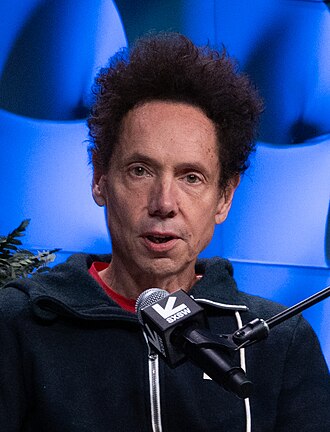
Malcolm Gladwell
Author of The Tipping Point and Outliers, staff writer at The New Yorker
Where to hear and read about Malcolm Gladwell1 episode or test

Malcolm Gladwell is the author of The Tipping Point, Outliers and David and Goliath, and a staff writer at The New Yorker. The thing most worth learning from him is to record many open-ended conversations with specific people, with no agenda, until the real story shows up.
other people have stories. Go and find out what they are.
The Most Useful Hour You'll Ever Spend on Storytelling (Malcolm Gladwell Interview)
Malcolm Gladwell: the story and the lessons
1How Gladwell finds a story: long interviews with no agenda
Gladwell meets a subject every three weeks and talks with no agenda. He proposes two-hour sessions and ends up with 15 to 25 hours of tape. The habit began with his Paul Simon project, where each session turned up things he did not know to ask about.
He has used the method four or five times since. His pitch is simply: "Let's just get together once every 3 weeks and talk for two hours."
.
An ICU doctor revealed the point of the project in hour 12. Gladwell only learned why he was doing the project when the doctor said he was the single defense expert against 50 for the prosecution. The defense won.
A shorter interview would likely never have reached it.
Gladwell interviews the person with the most specific detail, not the most important one. A cardiac surgeon describing a four centimeter incision and six centimeters of depth gave him what he calls a 99th percentile interview. Gladwell supplies the big context himself and wants granularity from the subject.
The surgeon's comparison of minimally invasive surgery to a move from singles tennis to soccer revealed what he cared about. "You want the person who can bring the most specificity to the topic."
Gladwell builds obligations into his life that force his curiosity outward. He hosts the Smart Talks podcast for IBM, which puts him among clients and industries he would never otherwise meet. He does not know a season's subjects in advance, so he has to look everywhere.
He calls this compulsion essential to his practice.
Gladwell tells beginners to stop inventing stories and go find them. He says new writers freeze because they think the burden of coming up with a story is on them. His answer is that other people already have stories.
His imagined writing class would start with students recording 45 minutes with a parent and turning the transcript into a short article.
2How Gladwell shapes a story around one emotional moment
Gladwell organized the whole Alabama murders podcast around one line. A woman who tried to save a man on death row described learning he had been executed: "I do what I always do. I lit a candle and said a small prayer." The line shows she had lost cases before.
Hearing it on tape, he knew the story had to be built around it, and he accepted thousands of words of run-up. He trusted that listeners who got there would feel what he felt.
Gladwell earned the emotional moment through repeated meetings and trust. The woman told the story around hour 15 of their time together, after rapport had built up. He did not get it on first contact.
His words: "I had earned that moment from her."
Gladwell would rather have a satisfying character than a neat ending. He says an open ending works if the reader has a real encounter with a character. Much science writing follows a person chasing a mystery who ends up only a little closer.
He gave a first-time novelist with gifted characterization the same advice: she needs little plot. He says elaborate plots often cover for writers who cannot do character or mood.
Gladwell cuts the extra twists and uses one ending. Four twists at the end of a thriller tell him the writer lost confidence. He will quit a 400-page thriller at page 395 over it.
The same goes for studio voiceovers added to patch a film. "You have to have faith in your story if you're going to tell it properly."
3How Gladwell keeps readers from leaving
Gladwell assumes the reader will quit and keeps a mystery open. His newspaper background taught him that readers leave before the piece ends. So he works hard on the opening and rations information so the reader needs the answer.
He likes spy and mystery novels because they play the same game, titrating information and twists.
Gladwell adds one specific detail so the reader pictures a person. His favorite joke, by Demetri Martin, adds one word to a restaurant sign about employees washing their hands: "especially Earl." You instantly imagine Earl.
He says specificity makes you interesting even if you are no smarter or better informed.
Gladwell paces a story like a distance runner. He calls pacing a controlled release of effort. Readers notice when a writer is anxious, frontloads too much or holds back for no reason, and they leave.
He points to Jakob Ingebrigtsen losing the Olympic 1500 meters by about half a second of misjudged pace. Runners knew he was doomed from the first split.
Gladwell gives readers a big why, but now tolerates more ambiguity. He says people are theory poor, so a framing idea gives them a place to file facts. Blink opens by stating its premise outright, a newspaper habit.
He overdid it early on, giving everything a fun name. As his confidence grew, he began to wait longer before delivering the payoff.
4What Gladwell changed his mind about, and his working habits
Gladwell regrets backing broken windows in The Tipping Point. He committed to the theory in his 30s, when the New York crime drop was only in its fourth year. He now calls it dumb.
His lesson: "The penalties associated with premature conclusions are just so large." You end up defending a position you took too early.
Gladwell turns down stories that lack intrinsic interest. He does not trust himself to rescue a dull topic. He contrasts himself with Michael Lewis, who can make baseball analytics gripping through character.
He notes that Moneyball took many failed drafts and a heavy re-edit to become a film.
Gladwell thinks in audio and uses real interview tape in audiobooks. Audiobooks changed how he writes: The American Way of Killing has screenplay-like blocks of quoted speech. For nonfiction audiobooks he plays the actual recordings rather than having someone read quotes.
Some of his audiobooks have outsold print, Talking to Strangers among them.
Gladwell learns his daily writing chunk and stops when returns diminish. He knows he is done for the day when he hits steep diminishing returns. Getting back into a piece takes a couple of days, and it makes sense again by day three.
Most of his days go to reporting and logistics, so writing itself is relatively rare. His first magazine article took six months, and today it would take a week.

The Most Useful Hour You'll Ever Spend on Storytelling (Malcolm Gladwell Interview)
Malcolm Gladwell explains that good nonfiction runs on specific detail, a reader you assume will leave, and a story shaped around its emotional crux. The technique worth hearing is his habit of recording many open-ended interviews with no agenda until the real story shows up, often around hour 12.
Gladwell meets a subject every three weeks and talks with no agenda. He proposes two-hour sessions and ends up with 15 to 25 hours of tape. The habit began with his Paul Simon project, where each session turned up things he did not know to ask about.
He has used the method four or five times since. His pitch is simply: "Let's just get together once every 3 weeks and talk for two hours."
An ICU doctor revealed the point of the project in hour 12. Gladwell only learned why he was doing the project when the doctor said he was the single defense expert against 50 for the prosecution. The defense won.
A shorter interview would likely never have reached it.
Gladwell interviews the person with the most specific detail, not the most important one. A cardiac surgeon describing a four centimeter incision and six centimeters of depth gave him what he calls a 99th percentile interview. Gladwell supplies the big context himself and wants granularity from the subject.
The surgeon's comparison of minimally invasive surgery to a move from singles tennis to soccer revealed what he cared about. "You want the person who can bring the most specificity to the topic."
Gladwell builds obligations into his life that force his curiosity outward. He hosts the Smart Talks podcast for IBM, which puts him among clients and industries he would never otherwise meet. He does not know a season's subjects in advance, so he has to look everywhere.
He calls this compulsion essential to his practice.
Gladwell tells beginners to stop inventing stories and go find them. He says new writers freeze because they think the burden of coming up with a story is on them. His answer is that other people already have stories.
His imagined writing class would start with students recording 45 minutes with a parent and turning the transcript into a short article.
Gladwell organized the whole Alabama murders podcast around one line. A woman who tried to save a man on death row described learning he had been executed: "I do what I always do. I lit a candle and said a small prayer." The line shows she had lost cases before.
Hearing it on tape, he knew the story had to be built around it, and he accepted thousands of words of run-up. He trusted that listeners who got there would feel what he felt.
Gladwell earned the emotional moment through repeated meetings and trust. The woman told the story around hour 15 of their time together, after rapport had built up. He did not get it on first contact.
His words: "I had earned that moment from her."
Gladwell would rather have a satisfying character than a neat ending. He says an open ending works if the reader has a real encounter with a character. Much science writing follows a person chasing a mystery who ends up only a little closer.
He gave a first-time novelist with gifted characterization the same advice: she needs little plot. He says elaborate plots often cover for writers who cannot do character or mood.
Gladwell cuts the extra twists and uses one ending. Four twists at the end of a thriller tell him the writer lost confidence. He will quit a 400-page thriller at page 395 over it.
The same goes for studio voiceovers added to patch a film. "You have to have faith in your story if you're going to tell it properly."
Gladwell assumes the reader will quit and keeps a mystery open. His newspaper background taught him that readers leave before the piece ends. So he works hard on the opening and rations information so the reader needs the answer.
He likes spy and mystery novels because they play the same game, titrating information and twists.
Gladwell adds one specific detail so the reader pictures a person. His favorite joke, by Demetri Martin, adds one word to a restaurant sign about employees washing their hands: "especially Earl." You instantly imagine Earl.
He says specificity makes you interesting even if you are no smarter or better informed.
Gladwell paces a story like a distance runner. He calls pacing a controlled release of effort. Readers notice when a writer is anxious, frontloads too much or holds back for no reason, and they leave.
He points to Jakob Ingebrigtsen losing the Olympic 1500 meters by about half a second of misjudged pace. Runners knew he was doomed from the first split.
Gladwell gives readers a big why, but now tolerates more ambiguity. He says people are theory poor, so a framing idea gives them a place to file facts. Blink opens by stating its premise outright, a newspaper habit.
He overdid it early on, giving everything a fun name. As his confidence grew, he began to wait longer before delivering the payoff.
Gladwell regrets backing broken windows in The Tipping Point. He committed to the theory in his 30s, when the New York crime drop was only in its fourth year. He now calls it dumb.
His lesson: "The penalties associated with premature conclusions are just so large." You end up defending a position you took too early.
Gladwell turns down stories that lack intrinsic interest. He does not trust himself to rescue a dull topic. He contrasts himself with Michael Lewis, who can make baseball analytics gripping through character.
He notes that Moneyball took many failed drafts and a heavy re-edit to become a film.
Gladwell thinks in audio and uses real interview tape in audiobooks. Audiobooks changed how he writes: The American Way of Killing has screenplay-like blocks of quoted speech. For nonfiction audiobooks he plays the actual recordings rather than having someone read quotes.
Some of his audiobooks have outsold print, Talking to Strangers among them.
Gladwell learns his daily writing chunk and stops when returns diminish. He knows he is done for the day when he hits steep diminishing returns. Getting back into a piece takes a couple of days, and it makes sense again by day three.
Most of his days go to reporting and logistics, so writing itself is relatively rare. His first magazine article took six months, and today it would take a week.