0:00Malcolm Gladwell's on the show today who's one of the most influential non-fiction writers in the 21st century. You know him from books like Outliers, The Tipping Point, David and Goliath, his essays and the New Yorker. And I said, Malcolm, I want to learn one thing from you. I want to learn how you tell a story like you do. What is it that you do to find the facts, find the narrative, do your research, and just weave it all together into this story that's compelling, that brings me through, that changes my worldview, that's easy to remember. I want to know how you do all that. And if you want to learn to tell a great story, well, you're in the right spot. Here's my conversation with Malcolm Gladwell.
How are puzzles similar to writing
0:380:38Where I want to start is the connection between writing and puzzles. In what way for you is writing like constructing a puzzle? In what way is it different? That's the pleasure of it. It's assembling pieces. Some pieces come from you. Some pieces you collect. Some pieces you had in the back of your head for a while. and you have to kind of arrange them in your mind on the page or uh when I'm deep in writing I have very often had this sensation that when I get up and go outside I don't know where I am and I've thought about this a lot and I think it's because the I am using exactly the same part of my brain for writing as I do to make sense of my uh of of direction, right? The same thing you in order to know where you're going, you have to have visualized in your mind a series of steps that lead to some and when I I've so kind of exhausted that particular module of my brain in writing that when I go outside
1:41and have to do it again even in a more trivial way, I can't do it. It takes me like two minutes and then suddenly I realize where I am. >> On that point, do you feel like let's follow the sense of direction analogy. Do you feel like there's a certain amount of time each day, a certain amount of consistency that you need in your writing to maintain that sense of direction, that kind of spatial awareness of where you are in the piece and holding all the information in your head? Well, unfortunately, very little of my life is given over to writing, much less than I would have thought. Most of my day days are spent either reporting or arranging to report.
2:18logistics consume an enormous amount of and the kind of background stuff. So, writing is not rare but relatively rare. Um, but when I'm in the middle of it, I do notice like an I'm in the middle of a little writing chunk right now. And I do notice how quickly you get into the takes a couple days, but by day three, it's all starting to kind of make sense again to you use that muscle again. Like some fiction writers write every day. I I've always been fascinated by what that would feel like because I've never done that.
2:53>> That consistency. >> Yeah. Except when I was a newspaper writer, but that's a different kind of writing. >> I've heard you say most writers overestimate how much writing they can get done in one day. >> So there is an element of consistency, right? >> Yeah. I think the you know that notion that neurological notion of chunking um you I think you have you come to an understanding of what your chunk is. So and as you get it you know in in classic chunking the expert is someone whose chunk is larger than everybody else. So, you know, the great basketball point guard, his chunk is the whole um court simultaneously, everyone on the court all at once. He can look at it and make sense of the whole thing. The kid, this the eight-year-old playing basketball, his chunk is the guy in front of him, right? So I do think that as a writer you come to understand what your chunk is and how much how much
3:55information can I make sense of in a given period. I very clearly I always know when I'm done for the day is without um and where I'm into steep diminishing returns because I realize oh I've I've exceeded my maximum by the moment. Did that maximum increase over the course of your career like a runner or >> it's a little bit bigger than it was? I think uh the problem is that you know we have way more distractions than we than we had when I started writing. But I do think my levels of self-discipline have probably I'm certainly a lot more efficient than I was um when I started out. When I started out I was quite a slow ride. I remember I worked for 6 months on my first magazine article. I was 21 or 20 years old, but um I wasn't working on it every day, but it took a long time to kind of get it out today. I would have done that in a week. Talk to
Why specificity matters more than knowledge
4:554:56me about this idea of looking for people who are closer to the front lines. Like I think the way you put it was it was almost people who are five levels down in an organization. I've always been fascinated in storytelling by specificity. And so if you think about when I think about what makes somebody interesting or funny, it is almost always that they have a particular talent for bringing spec specificity to what they're articulating. Um, my favorite joke of I think about this joke every single day.
5:31the the comic Dmitri Martin has this joke which I think is the greatest joke of all time. The setup was he was thinking of phrases that have their meaning altered by the addition of the minimum number of words. Right? So that's his setup because he's obsessed with language and his one of his the best of his examples was when you go into the bathroom in a restaurant and it says employees must wash hands before returning to work. So the words he added to that are employees must wash hands before returning to work especially Earl [laughter] which is the greatest I think it's one of the greatest literary jokes of all time and it's it's great because immediately you imagine who Earl is right in an instant you know Earl and you you and also the suddenly the notion of staying in that restaurant becomes impossible like you can't you have to leave right you can't [laughter] stay it's so good and that I' I've thought of
6:27that joke so often because it's like and I realize what makes people when I respond to somebody or friends of mine who I find interesting. It's because there is they bring that level of specificity to their conversation and it's that specificity is not you don't you're not specific or use specifics when you're smarter than anyone else or even necessarily more informed than anyone else. It's just if you're more interesting than anyone else, right?
6:56It's the thing that makes you interesting. And all kinds of people bring part of what makes eavesdropping a conversation so much fun is how much specificity there is. You have no context, right? Or women are actually in my experience better at this than men. There's a far more spec for reason. Now that I am married and have children, I understand why women have more specificity because they need to have more specificity. But that the reason why do you listen? You have no there's no reason. Nothing that is being said is of any relevance to you, but you listen because you're attracted to the specificity of it. And then she called me and this is what she said, right?
7:36You're like riveted by that. And um I remember once doing an interview with one of the guys from um Vampire Weekend. It was two hours and at least half of the interview he was talking about one line in a song. It was everything he wanted. He was using this incredibly specific bit of music and lyrics to kind of talk about his entire not intentionally, he just happened to want to focus on that that day and we just Rick especially just kept on proddding him to get more and more and more and more and more. It was fantastic. So the thing about people who are when you're thinking about who to interview, you don't want the most important person doesn't help you. You want the person who can bring the most specificity to the topic. If you're thinking of non-fiction writing as a balance between you and your and the material, the easiest thing for you to do and many ways is the best thing for you to do is
8:33the context you set up. And then what you want from your subjects is the is the granularity. And there's way more that's surprising. And like I did a I interviewed this uh cardiac surgeon the other day, John Puscus, who is one of the pioneers of what's called minimally invasive cardiac surgery. Huge deal in that world. He's this Canadian guy. And this is sort of important because he there's a certain kind of uh old school um Canadian who's very proper, very kind of English, but also very kind of plain spoken. It's a weird the combination of that kind of there usually I know it's funny. I've met this type so many times in my life.
9:21They I know where they live. They live in a certain neighborhood in Toronto called Rosedale. There's something a little bit early 20th century about them. They wear proper shoes. They have a very precise way of speaking and but there's also a kind of earthiness to them. Anyway, he was he grew up in a mining town in Northern Ontario, but he's that guy. He now is a fancy surgeon at Emory and the interview is it was one of those interviews where like it was a 99th percentile interview and there's a moment in it where he's describing the problem. So cardiac surgery, bypass surgery is I cut open your I cut down your sternum. I pry open your ribs. The heart is in front of me. I hook it up to an external machine and then I sew on an artery, right, that I've gotten from somewhere. He was the pioneer, one of the pioneers of what's called minimally invasive, where you don't cut open the chest. You make a little tiny
10:15incision and you insert a camera and you use little thin long instruments and sometimes a robot and you sew it all. You don't stop the heart at all. You just sew it all. The cavity is this narrow deep thing. And so he there's a moment where he's describing why that's different. And it's it is he uses there's no context. He's he's not talking about, you know, the broader struggle to get surgeons to move. He's not talking about the long-term implication of he's talking about what it means to look through an incision that's four centimeters long and you know whatever 6 centimeters deep with this and he goes on and it's like poetry. It's like and every in violation you think normally when you that that it works against you if there's too many numbers, right?
11:06Because the reader or the listener is troubled. He uses a number in every sentence, but so artfully and beautifully that it kind of it kind of builds symphonically and you're like you're he's like everything's in centimeters, too, which is just lovely that it's in centimeters, right? Because of course that's the way he's going to think as a surgeon, right? So it's the four centimeters and the 8 centimeters and then if I you if I move my hand you know half a centimeter it it disrupts my neighbor my you know my neighbor on the operating table's hand and he's talking about how they have to kind of collaborate and then he goes what we're playing you know it's not we've gone from playing singles tennis and now we're playing soccer >> and what's lovely at that point is after listening to him you're like you know this guy plays a lot of tennis and you realize that he's chosen that because he's it's emotionally important to him.
11:59Tennis is emotionally meaningful to him. And he's saying I had, you know, I had to give up this thing I loved. I play soccer. He just can't stop play soccer. It's like a patrician Canadian. He's never been near a soccer field in his life. He plays tennis at his cottage in Lake Muscoa. That's what he does, right? But um [clears throat] anyway, everything about that was great because he he wasn't addressing the larger stuff. I could do that. He was like giving me the kind of bird's eye view.
How Malcolm wrote his new book
12:2812:28>> I want to talk about specificity with your new book because immediately I was talking to my aunt this morning. She said, "Hey, what's Malcolm working on?" I said, "Book about gun violence." And immediately when I started talking about it, I was like, "Okay, here's what the right is going to say. Here's what the left's going to say." And all of a sudden, we start talking about abstractions and ideologies. So my question for you here is as you investigate a topic like that, how do you use specificity to find some semblance of truth that is like under all the abstractions that we're stuck thinking in?
12:58>> Yeah. So there was some deliberate narrative choices in writing that book to do this that very thing. One is there's that chapter where I talk about that surgeon Eddie Cornwall talking about the hardest case of his life. You know Eddie is the guy who's treated more gunshot wounds than probably anyone else. I don't want to say history, but it's quite possible than anyone else in history. And he's this he is a patrician African-American from Washington DC who's a very particular type who's a third generation surgeon.
13:31And I you I love that story. It's a great story. First of all, his story about how he saves his kid who should otherwise have died of gun violence. and he had comes to this really bizarre unusual interpretation of why he managed to save the kid's life because the kid I won't go into it but because the kid happened to have been hit in the scrotum with a bullet which he comes to understand is the key to unlocking why the kid survives and the reason that story is so important in the context of that book is that he takes you physicians take us a long way from ideology it's one of the few professions that is uninfected by all of these kind of hardened partisan lines. And so the more I can spend time in the head of a physician, the more I forget that politics messes up our understanding of things. By the end, I hope you're so transported that you've forgotten you had an ideological position. And also
14:31he's his perspective is so different from yours, which is he just sees the fruits of violence. He's not one charged in stopping it or he isn't getting involved in policy debates. He just they show up in his ER and he you know the only thing there was a moment in that story where he says two kids come into the hospital. They were both injured because they both shot each other. And the first thing he has to do is to make sure that the families aren't in the waiting room together because they'll continue the fight.
15:08Right? That's the only moment where he has to step outside of is possible and understand because he understands that what he sees day in day out day out is is the outcome of grievances, disputes, arguments, not nothing. It's not like any grand conspiratorial violence. It's there just beefs. And so he has to he knows he has the two families potentially meeting in the waiting room and he has to send the other case the lesser case to another hospital to make sure they don't meet in the so you get a little glimpse and then you're just but then you're down in his point of view.
15:43This episode is sponsored by Alpha School. When you think of school, what comes to mind? For me, it was lectures, homework, being stuck at a desk. And the worst part is that it doesn't even work. 54% of Americans read below a sixth grade level. That's over half of Americans. We need something new. And that's why I'm excited to have Alpha School as the flagship sponsor of How I Write. At Alpha, you go to school, you get all your academics done in only 2 hours per day, so that then you can spend the rest of the time learning life skills like running a business, writing a musical, giving a TEDex talk. You know, the kind of things that make you a capable and well-rounded person. And it's working. They have the academics figured [music] out. Alpha classes test in the top 1% nationally and more than 90% of students say they love school.
16:33Now, I used to live in Austin where Alpha School started and I was consistently blown away by what was happening [music] there. I personally mentored a bunch of the kids and what stuck out to me is how much their team believes in the potential of kids. Alpha's approach and the success it's already having is why it's the most talked about K through2 school in the world [music] right now. and also where I want to send my kids to school one day. So, if you want to learn more, visit go.alpha.school how I write.
Stop readers from leaving
17:0217:03As you're writing stories, thinking through the pacing, thinking through the reveal of information, what is it that you're focused on? I'm an old newspaper man. So, I'm news. If you're a newspaper person, you're aware that your reader will leave you, right? You have a sense of fatalism about that. They'll leave you before it's over. So you you're constantly in a state of anxiety about keeping them for as long as you can. And that means, you know, spending a lot of time on the beginning obviously, but also like keeping certain kind of mysteries alive so so that the person can't leave, right? They're kind of trapped because they need to know the answer. It's why I like mysteries in spine novels so much because that's the game they're playing as well, right? It's the titration of um of information and of uh twists and all those kinds of things to keep you in involved. What would you take from Lee
18:04Child? Well, Lee Child is all about specificity. He's a king of specificity. Although you could argue that genre wise, Day of the Jackal is the most important book of genre because Day of the Jackal is really a kind of how-to book. The whole book is consumed with the details of how the Jackal uh goes about plotting and executing the assassination of a major political figure. Right? It's in it's it's like no one had really ever done that before as far as I understand.
18:39It's like it's not a how-to, but it's it's really close to a how-to, but it took such pleasure. It luxuriated in the details. Here's the weapon. Here's how you take it apart. Here's how you put it back together. It gave you this minute-by-minute examination of this guy's day. He's moving across Paris, France. He's he has this much time. He meets this woman. He picks her up. She takes him home. He has to kill her in the morning. You know this kind of like logistical lens. That's the genius of it.
19:11>> You never thought about the mechanics of beating up four men in a bar. You know the cartoon version that you see in a TV show, but it's not explained to you and it's a trick. You know it's a trick. He writes it in such a way that you begin to believe that it's actually possible if you know what you're doing. And tell
What he learned from John le Carré
19:2819:29me about Jean Lar and the idea of disordered stories >> is really important because it affects the way that you appreciate the story. So the those are disordered narratives. They are you're getting information in a not in logical order but in an incomplete order. and he eventually is going to fill in all of those because, you know, there's a narratively there's a lot of kind of circling back and filling in holes as you get deeper and deeper into the book or a lot of uh uh you're learning a lot of facts in the wrong order, not in uh right, that's what engages your interest. And one of the reasons that he's able to sustain that is because he's so masterful in creating a mood. Um so you really feel you don't feel like you're smiling or that smile is a friend of yours, but you do feel like as he's charging through the rain on some gloomy London night with his raincoat and his whatever, you actually
20:29feel like you're walking next to him. Like you I always feel like I've rarely read someone who so completely puts me in that world. >> Is it like a arm on the shoulder sitting on the couch with you or is it something else? I feel I kind of know without having any firsthand experience with our world. I feel I know it that kind of it's in some of his earlier books his ability to capture the kind of um uh the dreiness of postwar London life is so spectacular. But my point is that because he can do that it permits him he gets all kinds of liberties. He is allowed all kinds of liberties in other areas. I was talk I have a friend of mine who was writing a a non non-writer writing her first novel and she's incredibly startlingly gifted and I was talking to her because her gift is for characterization and for her writing is like they're paragraphs that if I showed them to you you'd be like oh my god like jewelbox
21:32paragraph and she asked me to respond to her manuscript and I said you have to understand that because that part of your writing is so good you don't need We don't need a long, complicated, engrossing plot. We don't need that. We're happy. We're meeting these characters. We're in love with the language. Just give us enough plot that we have a, you know, another kind of part of our brain is activated. But people do elaborate plots when they haven't when they haven't mastered the other stuff, right? They're just covering up for the fact they can't write or they or their car their characters are cardboard. Right? If you can do car character like Lucari can and if you can do mood then you can you can like meander along with these kind of these wonderfully elusive plots.
22:24Is the point here that it really helps to have a keen awareness of what the specificity of what your gift really is and lean into that not kind of try to do everything. >> Yeah, I am very very very late to any kind of artistic appreciation. But we moved into a new apartment uh in the city and I had to buy art for the first time in my life. And I I I bought this one painter. I put the painting in our bedroom and I'm stunned every time I look at it by the difference between its figurative meaning and the mood it elicits.
23:06So, it's a woman on a bed. You don't see her face and the bed is unmade and it's ginormous this painting. It's like 4 by six. And if you actually look at it up really up close, it's not like it's an incredible feat of portraiture. It's not like But the mood it evokes is so overwhelming. It just like it's moving. It's complicated. It's like I've seen it now a hundred times. I never It has not lost any of its appeal to me. I'm just in awe of that. I was like, "Oh my god." Like that's wow. I feel that way about some writers. They can just do they can do that thing so well that everything else becomes less important.
What he learned from Michael Lewis
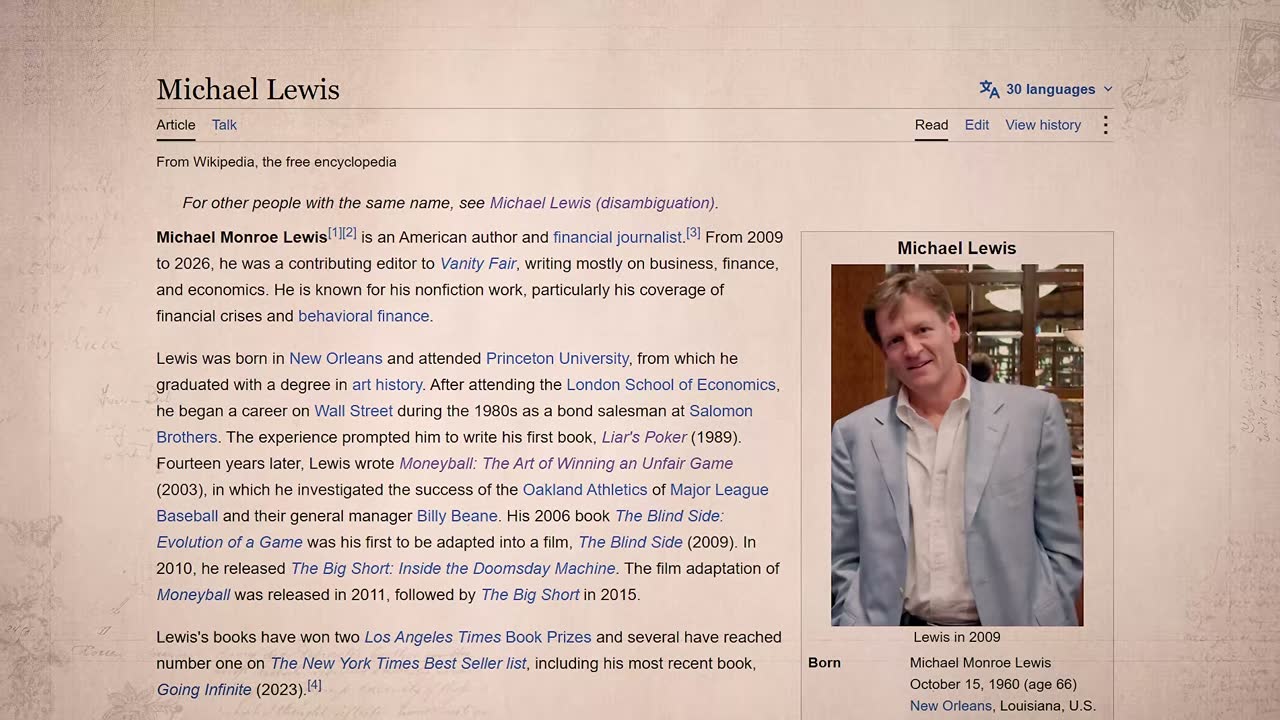
23:5823:58>> Do you do you know what the genesis was for the style that you developed of starting with the story and then having that story unfold? Where did that come from? Because if I look at it culturally, I think it goes back to you. >> So very early in my life, I I I sort of fell in love with Michael Lewis's writing. And I always thought that Michael Lewis among others and Janet Malcolm will be another example of this are writers who do something that I cannot do that they can inhabit a character and and sustain your interest as they go deeper and deeper into that character.
24:33Michael does it. They do it in very different ways, but Michael Michael can go and hang out with somebody and he could just bring that person to life and he allows that person to present themselves on their own terms. um which is a beautiful generous thing he does and that's why we we're so drawn to his writing because there is this incredible like I say generosity to it. He gives a warm reading of their world because he's chosen him because he has warm feelings towards them but there's not there's very little of Michael. It's like a kind of um I once writing something about Michael and I said that I was dis I was distinguishing Michael Lewis and Bob Woodward and they're totally different for Watergate.
25:17You don't want Michael Lewis because Michael remember Nixon's secretary was Rosemary Woods. And I said that if Michael was doing trying to break the Watergate story, he would never get past Rose Rosemary Woods. He he'd spend his whole time. He'd fall in love with her. He'd tell her whole story. He would it would go on. It would be a completely different story. It would not be about Watergate, right? He would like find his own little The thing about the Woodward thing is Woodward finds the real important story and like gathers an enormous amount of information in service of that. Michael, he blends the car, you know, he fall in love with the character and like give you that bring that character to life in a lovely way.
25:55Um, I can't do that. I don't know how to I could never write an entire book about one person. I try actually tried. So my long answer to your question, why do I tell stories that way? Because I don't think I can tell stories in a conventional way. >> How much stock do you place in kind of in kind of the intrinsic entertainingness of a subject? So give an example. Michael Lewis finds Billy Bean who's taking sports analytics, applying it to baseball, and it's numbers, numbers, and more numbers. If I look at that, I'm like, interesting story, not going to be a riveting narrative. He found a way to do it. Is that a skill that he has or do stories carry this kind of intrinsic entertainingness?
26:41In his case, it's a skill he has. I will turn down a story if I don't think it has intrinsic interestingness. I mean, the story of how they got turned into a movie is so many people tried and failed. They went through draft after draft. The film was filmed and then it had to be massively re-edited. for the exact reason you just stated. The story is not intrinsically interesting. Michael made it interesting. Right. I don't have faith that I can make something that lacks some fundamental crucial narrative element into a good story.
You should engineer your curiosity
27:1527:15When we were talking earlier, you talked about the increase in discipline over the course of your career and your just ability to kind of sit down and be more efficient. So we take that on this side. But also in preparing for this I was like the level of curiosity that you have the number of subjects that you've explored is just so vast and in order to get there you have to place a lot of weight on your what's in the periphery of your vision.
27:40>> Mhm. >> And so how do you crank up crank down your peripheral awareness? >> Well that's changed over the years. One of the things I do now is I very deliberately try and do things professionally that get me exposed to. So I do a podcast with IBM called uh Smart Talks at IBM which is basically me interviewing or telling stories about some of their clients. Now it sounds one response would be why would you do that? I actually think it's essential to my practice because uh it's not a world I would otherwise have any exposure to try I try and build into my life things that compel my curiosity in certain directions. The podcast is the same thing. I have a certain amount of episodes I have to do.
28:32I don't know at the beginning of the season what they are and so I am compelled to look everywhere. That's a very very useful kind of compulsion that I have built into my life. And >> what are you doing as you're looking? Is it like find the story, find the interesting, find the oneliner? What is the ah I got it. Like what enters your mind right before you say ah I got it. I think I found the thing. It's funny because I've started to do this thing recently in the last couple of years where I find someone and without any agenda whatsoever, I say, "Let's meet for as long as we want. Let's just get together once every 3 weeks and talk for two hours and I gather 15, 20, 25 hours of tape." And I I was inspired to do this because of the Paul Simon thing.
29:21Because with Paul Simon, I went to him and said, "I'd love to do something on you." And he was like, "Sure." And then I thought I would I'd meet with him twice and at the end of every meeting, he would always say, "When are we meeting again?" He was just enjoying it and I was enjoying it. I didn't know where it was headed. And each time I interviewed him, we interviewed, me and my friend Bruce did it, we found out more stuff that we didn't know we were going to find out. And so I began to make that part of my kind of intentional practice. I've done this now four or five times. The one I'm doing now, I figured out why I was doing it probably in hour 12.
30:02Uh it was a I was talk it's a guy who's an ICU doctor and I really literally had no I had used him on another story. Thought he was interesting guy. Proposed that we just talk. Had no had zero feeling about where I was going to head. In hour 12, he tells me about he testified in a lawsuit in a murder case. I like, "Oh, tell me about that." And he goes, "The prosecution called 50 expert witnesses. The defense called one. I was that one witness and we won." I was like, "Oh, [laughter] there we are.
30:45Oh, yeah. >> That's it. >> That's it, baby. That's it. And it turned out, wow, was that it is all I have to say cuz then I just went back and like, okay, I know what I want now.
Why memory is underrated
30:5930:59>> In your conversations with Paul Simon, you have a line that really stuck out to me. You say, I've always thought that memory is under theorized in the creative process. >> Talk to about that. It dates back to this thing that I first learned about was somebody was interviewing Larry Bird, basketball player. In the course of the interview, they asked Larry Bird about a game he'd been involved in like 15 years before, and he reconstructs the game in insane detail. And then I learned that actually lots of guys can do this. Bill Russell, you know, in being interviewed remembered, he was in his 80s at the time, reconstructed in exceedingly precise, accurate detail uh the circumstances of a game he played as a as a kid in college. And I begin to think, oh, so this must be constituent of these people at the top that their their memories are serving some essential function in their and you can think of
32:02some of the obvious ones if you're a basketball player or it goes back to chunking. It's how you increase the size of your chunk that the your memory is serving as a kind of uh archive of patterns. So you have so many patterns in your head that there's nothing you can use them. you're f even when you seem to be in unfamiliar territory, you're in familiar territory, which if you're a basketball player or a golfer was incredibly useful. But I also began to wonder that with Paul Simon, his memory for the music of his youth, I mean, he was his late 70s when we talked and he would have insanely incredibly precise memories of the Bside of a 45 that he played when he heard when he was 11 years old. and and I realized, oh, you know, that must be a key part of uh particularly of how he is able to remain so creative for so long that um he's drawing from this. He can draw effortlessly and precisely from an
33:08enormous archive which gives him, you know, it's it's he's his own walking LLM, right? he just has infinite resources um in terms of of summoning um facts and riffs and idea musical ideas. Um and I don't like I said I don't think maybe I haven't looked hard enough but I've seen surprisingly little um theorizing about that because it seems to be really important. We've talked a
Give readers a big why
33:3733:38lot about specificity and obviously that's a big part of your writing. But then there's the other side which is like general observations, broad points and how do you think about the balance, the interplay, the harmony between the two of those? I think that you have an obligation if you do my kind of writing to give people kind of tools to organize their experience. Um, so you and also things are much more powerful if I give you a kind of overarching why or overarching kind of um that's a way of it's not just a way of making sense of the world. It's a way of also of retaining the information.
34:22So if you're if you're nervous about your viewer abandoning, your listener or or reader abandoning you, then I think you try harder to give them something to hold on to a a place to file the information you're giving them. I that other part that kind of like explain that sort of super structure is a kind of crucial part of ensuring you're heard. Um and um so I've I've kind of I don't do it as much as I used to. I think I I think I over I overused some of that. I got very cute with the things I would call, you know, I'd always come up with fun names for things and got a little out of hand. But um but I think the impulse was correct, which is that um you do want to organize experience for people because people are theory poor, you know.
35:08>> Yeah, I caught this example from Blink and I was thinking what is this? I feel like you're setting the premise. Maybe I'm right, maybe I'm wrong. I'm curious to hear how you think about it, but you're right. We live in a world that assumes that the quality of a decision is directly related to the time and effort that went into making it. We believe that we are always better in gathering as much information as possible. We really only trust conscious decision-making. But there are moments, particularly in times of stress, when haste does not make waste, when our snap judgments and first impressions can offer a much better means of making sense of the world. The first task of blink is to convince you of a simple fact. Decisions made very quickly can be every bit as good as decisions made cautiously and deliberately.
35:49>> Yeah. >> It's like setting the premise. Here's where we're going to go. Talk to me about that. I was You're what you're reading in that is echoes of my newspaper past. That's very You wouldn't do that in a newspaper in a not exact way, but the intention is very newspapery. Here's where I'm going. you know, I'm I'm gonna I'm going to be as clear and as um uh and organized as possible in the way I'm going to tell this story so you can, you know, get out of here quickly and go on to reading other parts of the paper. Like it's very that kind of there's a certain kind of lurking behind that um is a kind of is is this is the anxiety of the writer's anxiety of being abandoned. Um, I don't, uh, as I've gotten further and further away from newspapers, I've lost a little bit of that. As I'm older, I I tolerate a lot more ambiguity in my writing. So, that's there's not a lot of toleration of ambiguity in it. Now, the
36:55way you're talking there reminds me of comedians. The comedians when they come on the show, they talk a lot about their nervousness, their anxiety about the lack of a laugh. And a lot of them say, "It's taken me years to get to a point where I can go 30 seconds without a laugh, a minute without a laugh, so I can get into deeper stuff in my comedy." Yeah. It's funny that so many I'm obsessed with uh Bill Cosby and so many of those comedians he is there's a whole group of them for he is the >> gold standard. He's the one who and a lot of it is that the amount of self-confidence he had on stage was astonishing, right? His ability to delay and he's sitting on the stage. He's not standing.
37:39See, remember he's sitting on a stool. You know, there's something there's a a rhythm to what he was doing which ran so counter to the kind of anxiety that you're talking about. And that's why so many comics were drawn to him. They're like, "Oh, I don't have to be this kind of nervously pursuing the laughs, you know, look at Bill. Bill, you know, Bill has his own problems, obviously, but uh you know, look at him." And that that revolutionizes comedy, right? The the chill comedian, you know, wow, what a kind of what a kind of oxymoron.
How to make readers cry
38:1538:15>> It feels like we're a little bit overindexed on humor relative to other things. And I was thinking about why. And we live in a very fast culture. It's very quick. It's kind of warp speed. And the thing about comedy is you can get comedy fast. You can't get other virtues fast. And maybe that's why we're so indexed to comedy. And this always gets me in trouble with comedians who I admire tremendously. But getting someone to laugh is just way easier than getting them to cry. I mean, it's not even close. Much of laughter is like cheap and kind of you know sometimes it's meaningful but other times a lot of times it's not. It's just kind of like a side effect of the way people process unusual bit of information. Tears on the other hand now that's a serious business.
39:05>> There's a moment in um what I think the best podcast I've ever done was came out last year and it was called the Alabama murders. It all builds to a moment in the eighth episode. This woman who we've gotten to know was the protector of this guy on death row in Alabama and tries to save his life and we learned that she's failed. And she's describing the moment when she learns he's been executed. And we've been building towards this for seven episodes. So that's three hours.
39:42And I don't think there's any way to listen to that and not cry in that moment. And part of the reason that was powerful because to going back I was saying earlier, she's one of those people I sat with for hours and hours and hours and I got she told that story in maybe hour 15 of our gettogethers. So I had I had earned that moment from her. It wasn't like she just came out with it. We had established a level of rapport and trust over repeated meetings as we finally got to the emotional core of this. And she describes sitting in her home in Brooklyn and she gets a call from death row in Alabama >> saying that Kenny is his name Kenny was going and she says and I'll never forget this is such an incred this is the thing that makes you cry. She says I said what did you do when you heard and she said I do what I always do. I lit a candle and said a small prayer. It's that you realize oh this is not her first case.
40:39She has tried to save the lives of many people on death row before and she always fails like and then you're like we've just been with her with one case for and now you suddenly learn at the emotional crux she's this is not a one-off. >> I do what I always do. >> I do what I always do and it's like to this day I hear that I just like that's insane. I could and I remember when I I was a wreck when she was saying that because I'd been with her for like 12 hours and I realized listening to the tape that I needed to organize the story around that moment even and the organization meant three hours of runup thousands and thousands of words of getting there because I knew if I got you there then you were then you understood what I was doing talking to
What audio formats mean to him
41:2941:30you. really feel what audio did for your for you as a storyteller. I mean, I I I can feel it and I understand it now. like obviously doing so much writing early on and then the podcast and what how podcasts and music and sound can deliver information and hit all these emotional frequencies that I think are harder to hit in the world of writing. >> Yeah. I I love audio so much. Uh it's so I think it's because so much I think I process I don't think I'm alone like many people I process so much information orally particularly powerful information when I think of my mother I think of her voice she's very distinctive voice I always say to friends who never I describe my mother and I always say, "I wish you could meet her." And by which I mean, I don't mean that you need to see her to understand her. Are you going to hear her? Are writers undervaluing audio books? Oh, massively.
42:46We don't. The idea that you like, we do all our audio books using real tape. So, if I interview you in the course of the book, then I use that tape for the interview. It's like an audio documentary. It's like an extended podcast. The idea that anyone would ever do a non-fiction audio book any other way is madness to me. Why? Why bother? Why are you reading the quote from somebody? It's audio. Play me the tape. Let's hear them. Like, what are you doing? In the audio book for American Way of Killing, I have a friend, uh, Drew Hulcom, who's a singer in Nashville. Really, really, really, really interesting guy. And I called him up. I sent him the book and I said, "Read the book and uh if there's if there's any music of yours that suits, I want to use the music." And >> Oh, cool.
43:40>> So, he this reads the book and he was back. He said, "Yeah, there's a song I wrote called Troubles." And I think it works. And so, I said, "Okay." And then I looked it up and listened to it and I was in tears. I was like, "Oh my god." So now the book begins with him singing Troubles. He does in two and a half minutes what I couldn't do in the book which is he set the mood. It's going back to what Bleed Child says he can do.
44:07using that song at the beginning like, "Oh, okay. I'm in it now." Cuz the song is all about a Drew's taking his kid to school and he hears about a mass shooting at a school and he take drops his kid off and goes home and writes this song and that emotional that was a space he's in and it's this kind of lament, but I don't I don't want to I don't want to do that. I don't want to I don't want to have to do that. That's it's wrong. like why at the moment when I'm dropping my kids off am I hearing about 25 kids killed in you know Texas or something and that it's exactly the emotional register I wanted in the book and it was there in the song like why would I do the audio book if I without that song like it's crazy I would have paid him don't tell him this he gave it to me for free I would have paid him an infinite amount of money for the rest of that song it's like name your price Drew dude I need it I can't do without it so how
45:06do you produce your audio books like is your thinking through okay my book comes out September 29th you finish the book when and how is your process different to produce that only in the sense that I'm uh collecting all my tape as I go along and when I'm writing you'll notice in American way of killing in the print version when I have large groups of text it's like a screenplay there's a lot more quoted chunks of quoted speech in it. It's influenced by the fact that I'm thinking about it as a bit of audio as I'm writing it.
45:41>> So really the audiobook begins. >> Audiobooks have definitely changed the way I write books. In some of my books, I've sold more audio books than print books. >> I think of talking to strangers as an audio book. >> Yeah, that one sold way more, which is very unusual.
Leave room for uncertainty
45:5745:57>> Tell me about this quote. It's a mistake to make up your mind too soon. from everything from everyday interactions. If you just delay your conclusion in an interaction, you're so much better off. You're talking to someone, they seem distant and hostile. Your normal reaction is to take on bridge. Just delay it. And what you find out invariably is, you know, something terrible has happened in our life. It's got nothing to do with you. The penalties associated with premature conclusions are just so large and you just get you just invariably end up being defensive and protecting some thing that in the back of your mind. And I did that in with tipping point. I fell in love with broken windows. I mean, how many times have I regretted that? It's just dumb.
46:44Why are you in year four of the New York City crime turnaround? I I backed a horse. In retrospect, I was an idiot. Why would you do that? You're four. I was in my 30s. I had plenty of time to wait, right? How do you think about neatness in terms of storytelling? Kind of the meandering, the on one hand, it's like a good story has like it's it's it's clean, it's neat, it's simple. On the other hand, the world is so messy, it's all over the place. And if you're just like it's messy and all over the place, you're like, "Well, thanks David, but that didn't help me at all."
47:23And how do you think about the balance between those two things? >> You can satisfy the demand for neatness with your characters if it's not there in a story. So like going back to the example I gave of my friend who wrote that book where the characterization and the language is so beautiful and my point was you don't need to the plot doesn't have to be. >> It's the same way. If you want to tell a story with an indetermined ending, just make sure that I have a satisfying encounter with a character because the character characters have it's possible to land somewhere with people, right? um in a meaningful way.
47:59You're not necessarily resolving all their ambiguities or complexities, but you can give people a if I've given you a sense of who that character is, then you're fine with uh uh with with uncertainties in the kind of broader narrative. Um you know, a lot of science writing is that it is I meet someone who's trying to unravel a mystery and by the end we haven't unraveled the mystery. Maybe we got a little closer. Get there. Maybe still some. But if I'm if the character is compelling, I'm fine with that. Yeah.
Pace your story like a runner
48:3748:37You've obviously studied so many musicians and I think of basketball. We talked about Larry Bird, talked about Bill Russell. How much have you thought about your own career as like an athlete or musician? that kind of intensity, that discipline, that persistence of improvement, all of that >> a little bit in the sense that I'm a a runner. Running is all about I'm a distance runner. Distance running is all about the controlled release of effort.
49:12Um that you're titrating. It's a exercise in titration. Very very sophisticated physical titration. and you're in mile one. You can run a lot faster than you're capable of, but you deliberately don't because you want to be around for mile 10. Yakabing loses the 1500 meters in the last Olympics because he miscalculates by literally half a second about how he titrates his energy over the first two laps and he knows it. So he goes out in his first lap and he sees the split and he knows he's doomed, right? He's leading at that point. He's the greatest distance 50 runner in the world.
50:01He's trained for this moment. He goes out and those of us who are runners saw that split and they were like, "Oh, we all knew it." Like it's like and so the whole the race suddenly becomes incredibly fascinating. He's managing the consequences of his misjudgment. He failed to titrate his energy as exactly as and the margin of error is as tiny to the untrained eye like he's fine still leaning looks relaxed or strutting away but we all know reckoning is coming. How does that apply for you as a writer?
50:31I've thought about that as a kind of useful lesson for thinking about what it means to like tell a story that's satisfying. I think people are much more sophisticated in how they consume narratives than than we realize. they're um you know people shut off when it ceases to engage them and one of the things they're picking up on is that pace. If your pace is wrong, if you're if they feel like you're anxious or you're frontloading too much or you're holding too much back for reasons that aren't justifiable, they get frustrated. Um I'm an extreme example of this. I will actually, you know, read a 400page thriller and I will stop reading on page 395 if I think if they violated those rules.
51:25>> Okay, that's insane. Really >> done that so many times. I'm like >> I'm like I'm done with you. I cannot believe you just [laughter] did that. What are you doing? Just walk away in disgust. >> If I get 395 pages, I'm making it to the end. I could I have a stack of books which I've read almost to their end but then stopped because they I just get just I'm just so pissed off. What are your other reading pet peeves? Well, I just like in thrillers I hate the multiple endings. I think you got one shot. You don't need four twists. If you have four twists at the end of a thriller, you're a bad thriller writer. You just lost confidence. that moment you can sense when the writers lost confidence in their material. Movie makers you this is even more >> absolutely >> or the or the editor or the studio chief you can see where they lost confidence and you're just all of the air goes out of the room at that point you just want
52:20to leave you're like you guys don't believe in the story why should I >> Yep. >> Right. And they when they do that thing with the tacked on endings and they're like I I if you can't find a way out of the problem that you've established for ourselves what are you doing? Why did you even start? Sometimes you're watching a movie and you're like, "Ah, the studio watched it and someone high up thought there was a hole in the story and you can tell because like the register of the writing is different or something like that and they plopped it into the script and you hear it and sometimes it's a voice over like it's the narrator doing it and you'll be in the movie and you'll be like, "There it is. Come on." They got nervous and like you got to trust you have to have faith in your story if you're going to tell it properly.
Say more with fewer words
53:0253:02What did you learn from songwriters? Has songwriting the lessons from there come into your work? Just the economy of um expression. It's the same reason on a more extreme level why I'm so fascinated with ads because the economy is extreme in that instance. I've got 30 seconds or I have a minute and like the idea that you could do something meaningful in that time is just to my mind fantastic. Like the constraints are um there's a Heineken ad that I love so much that I tracked down the guy who did it and just interviewed him for no reason. I never used the tape. It's the end of the night. They're all tipsy. They're at a bar. They're taking a cab home as they should and they all start singing along in a sort of slightly tipsy but kind of fantastic man banner and then halfway through the grumpy cab driver turns it up and joins in. That's the ad.
54:00So good. It's so good. It's It's a minute and it's fant it just summons so many things are happening that make that warm your heart, right? It makes you want to go out and get a hineken. It's like they had fun. It's two girls in a guy. It's not sex is not complicated. They just had good, honest fun. They're taking a cab home, which they should. They're singing in public, which we all want an excuse to do, and they converted the cab driver, like six, five things. Yeah. What I love about comedy and what I love about songwriting is if it works, it works. So there's that song by the Black Eyed Peace. Monday, Tuesday, Wednesday, and Thursday, Friday, Saturday, Saturday, and Sunday. All they did was say the names of the days in a week. And yet it just works. I love that song. I got a feeling. And I just really love the idea that if people like it, then it's good.
55:03It's I I was thinking of there's another great days of the week song um from the 80s. The chorus is isn't it something something? Thursdays I'm in love. Do >> you know Friday I'm in love. >> Friday I'm in love. [laughter] It's great. Yes. When they work they work forever. Last question. If you go
Malcolm's writing advice for beginner writers
55:2455:26to a high school, you go to a college or let's put it like this, you're given the ability, the opportunity to basically teach a semester class on writing to do what you've done. What do you tell them? How do you structure the curriculum? What are the core lessons that you're trying to give them? >> I've thought about this. Uh it's all about asking questions. Everything begins with your ability to ask questions and to understand what the point of a question is to understand where a question comes from. To understand what's to appreciate what's interesting in someone to to be generous in that process to understand that it's about them, not you. It's just everything flows. I would just do endless versions of question asking. I would have I would have the kids go home and I would have them interview their parents and bring the transcripts back into the class and we would go through the transcripts. I'd have them write
56:20articles that were just versions of transcripts and understand that writing an article about someone or something is simply a version of the interview, right? It's the interviews everything and then you're just filling in the blanks. It's fine if I'm dealing with a 14-year-old that it begins with someone else giving you something. It's not that I think kids think the burden is on them and that's why they're so inhibited when it comes to writing. I don't know what story to tell. You we're not asking you to tell a story. That's the last thing I want. No, other people have stories. Go and find out what they are. go and why does so many people when you ask people about their parents after their parents have passed, every single person I've ever talked to about this said, "Oh yeah, I never talked to them about that. I wish I had."
57:13Get to class, sit down with your parents, take out your phone, just record, have them do 45 minutes, run it through an AI trans transcript thing, come back with a transcript tomorrow, and let's make a little article about your parents and where they came from. That's where we That's day one. And then we just build from there, right? And then the last class is I bring in someone who has a secret. Class has to figure out the secret. I'm not telling you anything else. And they sit in the middle of the row and we just we see if we get there.
57:48>> I would love to take that class. Malcolm Gladwell, thank you very much. It was great to meet you. That >> was really fun. David, thank you.
 Caddie
 How I Write · The whole library, and ask it anything