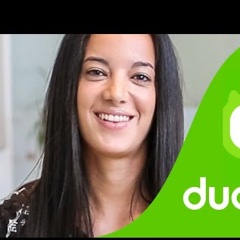
Natalia Castillejo
Director of Product, leads monetization at Duolingo
Where to hear and read about Natalia Castillejo1 episode or test

Natalia Castillejo is Director of Product at Duolingo, where she grew from the second PM hired in 2015 to leading monetization and the launch of Duolingo Max. The thing most worth learning from her is to start AI features from a known user gap, then sell the outcome learners want (conversation practice) rather than the technology.
The hardest part about learning a language is actually keeping yourself motivated over a very long period of time, because language learning takes years.
How Duolingo Built Duolingo Max
Natalia Castillejo: the story and the lessons
1Natalia Castillejo's path from first PMs to Duolingo's monetization lead
Castillejo was Duolingo's second PM hire and grew with the company. She joined in 2015, when about 40 people shared one floor in Pittsburgh and the app had barely over 1 million daily users. Today Duolingo has about 900 employees, is publicly traded and also teaches math and music.
She rose from intern to director. Spanish is her native language, and learning English showed her how a language changes opportunities, which is why the mission drew her.
She started on the English Test, then spent most of her time on core learning. Her core work covered the home screen, course redesigns and faster content creation. Video call began in her learning team and later became the hero feature of Max.
Her background was zero-to-one learning features, where success relies on proxy metrics for A/B tests.
She moved to monetization as video call launched, so she saw both stages. The move began when she covered a pillar lead on parental leave. The roles were later swapped for good, so leads see other parts of the company.
She watched video call go from zero to one, then get monetized.
A decade at one company makes her teams faster and her decisions better. She can predict how colleagues will react and how they like to work. She also remembers past ideas and what went wrong, so a retry avoids the same mistake.
Her favorite part of Duolingo is working with people she has known for 10 years.
2How Castillejo's team built Duolingo's AI features from known learner gaps
Duolingo started from gaps it already knew, not from the AI technology. Learning science, interviews and surveys had shown learners wanted personalized feedback on mistakes and free-form conversation. When ChatGPT access arrived in late 2022, the team asked which features it had always wanted but could not build.
Earlier non-AI versions failed: feedback was not specific enough and conversations were too structured. These gaps became Explain My Answer, Roleplay and Video Call. Her warning: "starting with the user need like what is it that users want rather than kind of starting with personalization or starting with AI."
Starting from technology risks features too sophisticated for what users want. Duolingo had learned this before: building around a technology first did not work well. Better models mean better conversations, but the user need leads.
The first Explain My Answer failed because it took too much effort. It began as a chatbot, a Duo coach, where learners had to type specific questions. The team replaced it with a direct explanation of what the learner got wrong, and A/B tested whether usage rose.
Learners just want to know why an answer was wrong, and the app already has their answer, so no interaction is needed.
Every change is A/B tested, and daily use adds a final check. Even bug fixes run as A/B tests, to measure the bug's impact and to learn. Each test ends with a report on hypotheses, results, learnings and next steps.
Every PM uses the app daily as a learner, so each forms an opinion as a user. UX research is added on top.
3How Duolingo Max took off, and the pivot to a conversation tier
Max launched in May 2023 but needed a year of work to take off. The launch had only Explain My Answer and Roleplay, in a few countries and courses. Scaling to more countries and courses began the following year.
Her team spent a non-trivial amount of time improving the features and making them scalable. The bigger impact came from better features, wider reach and video call together.
Video call was the turning point, because learners responded to it far more than roleplay. Adding video call to Max had a huge effect on monetization, even though Roleplay and Explain My Answer were already in the tier. The team saw it in the data.
Both target speaking, but calling Lily feels like calling a friend, while roleplay feels like a generic conversation such as preparing for a trip to Brazil.
Selling Max as a conversation tier worked better than selling it as an AI tier. Max began as "we have AI, let's create a tier around that." Pivoting away from the AI brand toward conversation was the big unlock, and Max ads now focus on speaking and video call.
Rebranding both tiers earlier had not landed.
Unclear differences between Super and Max held sales back. Learners could not tell what Super offered versus Max, so the team invested heavily in clearer tier differentiation. Many learners still miss that Max includes every Super benefit.
Deciding which learners should see Max ads and which should see Super ads is still open.
Max fits serious learners with real stakes, not casual ones. English learners studying for jobs and careers react most positively. Casual users who practice now and then may find Super enough.
Higher stakes, such as career outcomes and earning potential, make the higher price easier to justify.
4What Castillejo learned running monetization at Duolingo
Monetization gives clearer goals and faster learning cycles than core learning work. Experiments are judged mainly on subscription bookings and ad revenue, with long-term effects considered. Engagement and learning act as guardrails.
Teams can point to the dashboard instead of spending time on alignment. Teams carry quarterly goals, while learning work was more of a zigzag.
Small copy changes on calls to action can lift bookings a lot. Because of this, a large part of the monetization roadmap goes to small optimizations. Learning features rarely show that kind of effect from micro changes.
5Where Castillejo sees AI taking Duolingo next
She wants Lily to match the learner's level and remember past chats. Lily should use words and grammar a learner can understand, which she does fairly well now but not yet where the team wants. Memory is the second gap: asking about a story from last week or a favorite hobby would make Lily feel like a real friend.
Lily remembers to some extent today, but it does not quite feel like talking to a human.
She treats motivation as a bigger problem than teaching. Language learning takes years, so keeping people motivated is the hardest part. The goal is that learners talk to Lily because they want to, not only to learn.
Streaks, badges and leaderboards already motivate, and a character who knows you adds another layer.
AI makes features possible that were too costly to build before. AI builds hundreds of Duolingo Radio episodes, two-minute listening sessions, in a couple of days. Many language pairs, such as Spanish from English or Spanish from Portuguese, multiply the work.
The team would never have started Radio without AI, because the same volume would have taken years.
She sees Duolingo's moat in engagement, social features and learner data. Other companies can use the same AI, but Duolingo is expert at getting learners to come back every day. Friends, leaderboards and family plans add social pull.
She agrees the AI products are improved using millions of learners, a data advantage other apps lack.
She pushes PMs to use AI on experiment history, specs and prototypes. The team wants a bot that scans over a decade of A/B test reports and links relevant past tests to a new pitch. PMs already use GPT daily for Slack and specs.
One PM with only a designer built a real app prototype in Replit, skipping the limits of Figma and the need for an engineer.
She wants engaging content for harder subjects like calculus. She says calculus needs sitting down at a screen, not a quick session on the subway. She hopes cheaper content creation lifts education in physics, calculus and biology, where material is now dry.

How Duolingo Built Duolingo Max
Duolingo's product leader explains how it built AI features (Explain My Answer, Roleplay, Video Call) from known learning gaps and packaged them as Duolingo Max. Max only took off after video calls launched and the pitch moved from 'AI tier' to 'conversation tier'.
Castillejo was Duolingo's second PM hire and grew with the company. She joined in 2015, when about 40 people shared one floor in Pittsburgh and the app had barely over 1 million daily users. Today Duolingo has about 900 employees, is publicly traded and also teaches math and music.
She rose from intern to director. Spanish is her native language, and learning English showed her how a language changes opportunities, which is why the mission drew her.
She started on the English Test, then spent most of her time on core learning. Her core work covered the home screen, course redesigns and faster content creation. Video call began in her learning team and later became the hero feature of Max.
Her background was zero-to-one learning features, where success relies on proxy metrics for A/B tests.
She moved to monetization as video call launched, so she saw both stages. The move began when she covered a pillar lead on parental leave. The roles were later swapped for good, so leads see other parts of the company.
She watched video call go from zero to one, then get monetized.
A decade at one company makes her teams faster and her decisions better. She can predict how colleagues will react and how they like to work. She also remembers past ideas and what went wrong, so a retry avoids the same mistake.
Her favorite part of Duolingo is working with people she has known for 10 years.
Duolingo started from gaps it already knew, not from the AI technology. Learning science, interviews and surveys had shown learners wanted personalized feedback on mistakes and free-form conversation. When ChatGPT access arrived in late 2022, the team asked which features it had always wanted but could not build.
Earlier non-AI versions failed: feedback was not specific enough and conversations were too structured. These gaps became Explain My Answer, Roleplay and Video Call. Her warning: "starting with the user need like what is it that users want rather than kind of starting with personalization or starting with AI."
Starting from technology risks features too sophisticated for what users want. Duolingo had learned this before: building around a technology first did not work well. Better models mean better conversations, but the user need leads.
The first Explain My Answer failed because it took too much effort. It began as a chatbot, a Duo coach, where learners had to type specific questions. The team replaced it with a direct explanation of what the learner got wrong, and A/B tested whether usage rose.
Learners just want to know why an answer was wrong, and the app already has their answer, so no interaction is needed.
Every change is A/B tested, and daily use adds a final check. Even bug fixes run as A/B tests, to measure the bug's impact and to learn. Each test ends with a report on hypotheses, results, learnings and next steps.
Every PM uses the app daily as a learner, so each forms an opinion as a user. UX research is added on top.
Max launched in May 2023 but needed a year of work to take off. The launch had only Explain My Answer and Roleplay, in a few countries and courses. Scaling to more countries and courses began the following year.
Her team spent a non-trivial amount of time improving the features and making them scalable. The bigger impact came from better features, wider reach and video call together.
Video call was the turning point, because learners responded to it far more than roleplay. Adding video call to Max had a huge effect on monetization, even though Roleplay and Explain My Answer were already in the tier. The team saw it in the data.
Both target speaking, but calling Lily feels like calling a friend, while roleplay feels like a generic conversation such as preparing for a trip to Brazil.
Selling Max as a conversation tier worked better than selling it as an AI tier. Max began as "we have AI, let's create a tier around that." Pivoting away from the AI brand toward conversation was the big unlock, and Max ads now focus on speaking and video call.
Rebranding both tiers earlier had not landed.
Unclear differences between Super and Max held sales back. Learners could not tell what Super offered versus Max, so the team invested heavily in clearer tier differentiation. Many learners still miss that Max includes every Super benefit.
Deciding which learners should see Max ads and which should see Super ads is still open.
Max fits serious learners with real stakes, not casual ones. English learners studying for jobs and careers react most positively. Casual users who practice now and then may find Super enough.
Higher stakes, such as career outcomes and earning potential, make the higher price easier to justify.
Monetization gives clearer goals and faster learning cycles than core learning work. Experiments are judged mainly on subscription bookings and ad revenue, with long-term effects considered. Engagement and learning act as guardrails.
Teams can point to the dashboard instead of spending time on alignment. Teams carry quarterly goals, while learning work was more of a zigzag.
Small copy changes on calls to action can lift bookings a lot. Because of this, a large part of the monetization roadmap goes to small optimizations. Learning features rarely show that kind of effect from micro changes.
She wants Lily to match the learner's level and remember past chats. Lily should use words and grammar a learner can understand, which she does fairly well now but not yet where the team wants. Memory is the second gap: asking about a story from last week or a favorite hobby would make Lily feel like a real friend.
Lily remembers to some extent today, but it does not quite feel like talking to a human.
She treats motivation as a bigger problem than teaching. Language learning takes years, so keeping people motivated is the hardest part. The goal is that learners talk to Lily because they want to, not only to learn.
Streaks, badges and leaderboards already motivate, and a character who knows you adds another layer.
AI makes features possible that were too costly to build before. AI builds hundreds of Duolingo Radio episodes, two-minute listening sessions, in a couple of days. Many language pairs, such as Spanish from English or Spanish from Portuguese, multiply the work.
The team would never have started Radio without AI, because the same volume would have taken years.
She sees Duolingo's moat in engagement, social features and learner data. Other companies can use the same AI, but Duolingo is expert at getting learners to come back every day. Friends, leaderboards and family plans add social pull.
She agrees the AI products are improved using millions of learners, a data advantage other apps lack.
She pushes PMs to use AI on experiment history, specs and prototypes. The team wants a bot that scans over a decade of A/B test reports and links relevant past tests to a new pitch. PMs already use GPT daily for Slack and specs.
One PM with only a designer built a real app prototype in Replit, skipping the limits of Figma and the need for an engineer.
She wants engaging content for harder subjects like calculus. She says calculus needs sitting down at a screen, not a quick session on the subway. She hopes cheaper content creation lifts education in physics, calculus and biology, where material is now dry.
More from Duolingo
 Guest
Anmol Tiwari
Director of Product at Duolingo
 Duolingo
 1 source · 15 tips
 Guest
Cem Kansu
Chief Product Officer at Duolingo
Duolingo1 source · 19 tips Guest
Gina Gotthilf
Co-founder and COO of Latitud, former head of growth and marketing at Duolingo
Duolingo 1 source · 18 tips
 Guest
Jackson Shuttleworth
Group Product Manager leading the retention team at Duolingo
Duolingo1 source · 21 tips