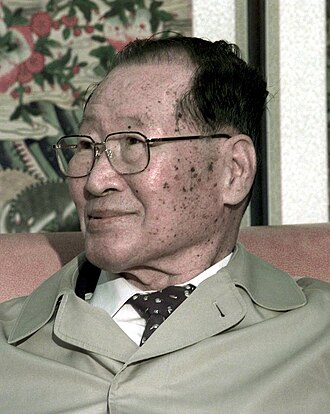
Chung Ju-yung
Founder of Hyundai
Where to hear and read about Chung Ju-yung1 episode or test

Chung Ju-yung was a starving farmer's son with six years of schooling who built Hyundai through rice, auto repair, construction and shipbuilding and became the richest person in Korea. The lesson most worth taking from him is that he treated time as the one capital everyone gets equally, planned heavily, then moved faster than everyone else and refused to accept 'impossible' until he had actually tried.
Do it until nothing more can be done. Give it your all until the very end.
The Most Inspiring Autobiography I've Ever Read: Born of This Land: Chung Ju yung
Chung Ju-yung: the story and the lessons
1Chung Ju-yung's childhood of hunger and four escapes
Chung grew up so poor his family ate tree bark after harsh winters. Farm work never repaid the effort. Human waste was the main fertilizer, so children went home to relieve themselves rather than waste it, and his parents' arguments were always about food.
From age 10 he worked beside his father in the scorching sun without complaining, and a short rest in the shade felt like heaven to him.
He had six years of schooling and made up for it by reading. He spent three years at a Confucian village school and three at elementary school. He argued that missing schooling does not mean missing wisdom.
He took from books the idea that finding meaning in daily life matters more than finding it in a whole life.
His silent father taught him endurance by example. His father had only a healthy body and a diligent character, never took a day off, and said three or four words in a full day of working together. Chung called him 'the progenitor of my body and soul' and his greatest mentor.
Chung later copied the way his father cleared rocks and built his house from scratch when he started businesses.
Chung ran away four times before leaving the farm for good at 19. His father begged him to stay, warning that the eldest son was the pillar of the family and that a sixth-grade farm boy would end up with the family begging in the streets. Chung reasoned that any job done as hard as farming would pay more.
Writing in his 80s, he still got a lump in his throat recalling his weeping father. Years later in Seoul his father stayed awake until Chung came home, which Chung called unspoken love.
2From rice delivery boy to garage owner, and the losses in between
Chung gave a rice delivery job full effort and owned the shop at 24. He arrived first, swept the entrance and delivered rice by bicycle with full energy. Four years after running away, the owner sold him the shop, and he renamed it 'number one in Seoul'.
He waited three years to write his father, afraid of being fetched home. By then he earned 20 bags of rice a year, and his father replied, 'My son, it seems like you made it.'
He took any work and judged each job by whether it fed him. Before the rice shop he moved goods, worked on another farm for housing, hauled stone and lumber, and ran errands for a factory.
His creed: 'Half measures, compromises, cutting corners, or being realistic, do not exist in my world.'
War and fire wiped out his businesses, and he rebuilt each time. The colonial government requisitioned his rice shop after two years, a fire destroyed his first garage, and in 1941 Japan forced his repair shop into a merger that left him unemployed at 29 with a household of 20.
He called the merger 'a merger in name only', really a hostile takeover. It was the only time he was ever officially unemployed.
Pleading every morning won him a second loan and police tolerance. After the fire he begged his moneylender for another chance and got more credit. His new garage was unlicensed, so he visited the police section chief's home every morning for a month until the chief gave up.
The chief said, 'how can I detain someone who comes to plead at my door every single morning?'
Bed bugs convinced him persistence beats any barrier. Laborers in his bunk house put water pots under the table legs, which worked for a day or two. Then the bugs climbed the walls and dropped from the ceiling.
He concluded, 'I'm no bed bug. I'm a man,' and later described his life as a series of giving all he had until nothing more could be done.
3How Chung moved into construction and survived the Korean War
Chung moved into construction because the same effort paid far more. Delivering bids, he saw construction firms earn up to 10 million won per contract against his 300,000 to 400,000 won per repair job. He decided the gap was scale, not effort.
His partners refused, saying they did not know construction. He went ahead, having worked construction sites as a laborer. 'For the same amount of effort, why not go for the real big bucks?'
He improvised to serve the US Army through scarcity. His Hyundai Motor Service Center replaced engines at the US Army Ordnance Depot, welded two 1.5 ton trucks into one 2.5 ton truck, and converted gasoline cars to run on charcoal or carbide.
Trusting the government in 1950 cost him almost everything. His brother-in-law urged him to buy rice before the invasion. Chung assumed the army would hold and fled Seoul with only the clothes on his back, returning to a stripped house and factory.
He admitted, 'I naively placed that much faith in the government.' He went straight back to US Army work, including remodeling the Seoul National University College of Liberal Arts and Sciences.
He moved his whole workforce into his Busan home and ate with them. When Chinese forces entered Seoul in January 1951, he built quarters in his front yard and cooked on borrowed pots for everyone down to the lowest technicians. Hyundai Engineering and Construction came out with a near monopoly on US 8th Army construction.
'We all ate together. We did whatever was needed to get the job done.'
4How Chung Ju-yung built a shipyard before he had built a ship
The shipyard began as an idea the size of a grain of rice. Chung nurtured small ideas until he could picture a finished project. He pictured the world's largest shipyard in the early 1960s without ever having built a boat.
The mental picture came before the money, the buyers or the technology.
After mockery abroad, Chung gave up for the first time, and Park refused it. Japanese and American firms mocked Korea's primitive technology. Chung told President Park it could not be done, and Park said, 'You only tried once and you're telling me you can't do it,' and told him to get on the next plane.
Park also ordered officials to cut off Chung's proposals. Chung left treating the shipyard as a solemn duty, moved by Park's passion for the country.
He presold ships from a nonexistent yard to win the loan. His pitch: buy our ships, and I'll get a loan, build a shipyard and deliver. A Greek buyer, Levanos, ordered two ships with a 1.4 billion won down payment, which Chung showed the bank as proof.
'I just need to find somebody crazier than me to say yes.' Daniel Ludwig used the same move, taking an oil hauling contract to a bank to fund his first tanker.
Doubt made him more stubborn. 'The more people say I can't do it, the more determined I am to prove them wrong.' He returned with a loan and two purchase orders, and Park ordered groundbreaking preparations.
5Chung Ju-yung's rules on time and speed
Chung treated time as capital given equally to everyone. His motto was 'shorten the time'. He made a plan, jumped in headfirst and finished faster than others, and said his life was defined by time rather than age.
'When others are hesitating, I have already begun working.' In his mid-80s he was still fully engulfed in work.
His speed looked reckless but rested on heavy planning. Rivals called him 'the bulldozer', an upstart who dug first and thought later. He said he spent enormous time analyzing every detail before any project.
'If I hadn't first sat down and planned everything out, the Hyundai group of today could never have existed.'
He called wasting time or money a sin. He called doing just enough to get by the most foolish way to live, and noted that great people of every kind achieved their feats in one lifetime through diligent use of time.
He saw himself first as a builder and cited the Confucian view that true knowledge comes only from direct experience.
A poor man, he said, must work 10 to 20 times harder. Korea had no resources to catch up with advanced nations, only its people's determination. He called his own approach 'bold bordering on reckless'.
6Why Chung Ju-yung refused to accept 'impossible'
His reply to 'impossible' was 'Did you try?'. He was told a cheap highway, a shipyard and moving heavy underwater equipment by barge were all impossible, and he did each one.
He held that if you cannot find a method, you did not think hard enough.
He saw fixed common sense as a limit on creativity. He believed a method always appears if you search hard enough, and that a strong will to succeed releases people's collective energy.
He left no room for even 1 percent doubt. Each time he started a business he said success is 90 percent determination and 10 percent confidence. Critics called him reckless at every move.
'If you doubt yourself, then you will only be able to accomplish as much as your doubts let you.'
7How Chung Ju-yung ran Hyundai and stayed a laborer
Chung gave workers short deadlines and drove them hard. He told workers to finish tasks by the next morning, trained and examined them rigorously, and admitted growling and hurting feelings.
'You just can't build a company with intelligence alone. It takes a will to act.' His son's first memory is creditors breaking the floor with an axe, the debt that made Chung a hard-driving boss.
He built every business from scratch and never bought one. Buying a struggling firm cheap meant using its owners' misfortune as a stepping stone, since they had worked as hard as he had. Hyundai never took over another company.
'If I want to be in a particular business, I will start it myself.'
He rejected an executive elevator and a carpet to protect frugality. The company motto was diligence, frugality, affection. He turned down a separate executive elevator on the spot and called a carpet laid for him at a site nonsense.
'I began as a laborer. I still see myself as a laborer. I just happen to have a little money now.' And: 'After luxury comes corruption.'
Credibility, he said, grows like a tree. He believed trust is built slowly, through work done over time.
8Chung Ju-yung on diligence and positive thinking
Diligence was the first thing Chung recommended. One diligent day brings a good night's sleep, a month improves your life, a lifetime earns recognition. He claimed the diligent live 100 times more productively than the lazy.
'I don't trust anyone who is lazy.' He worked because he enjoyed the act of working.
He treated positive thinking as the base of problem solving. He never saw himself as underprivileged, so he never complained, even staring hungry at market rice cakes. He never regretted leaving the farm with no education or contacts.
'I was born with the ability to accentuate the positive rather than the negative.' He admitted hard times when all he could do was clench his teeth.
He found meaning day by day, and called 90 percent of life joyful. He believed 'life is but a sequence of days', so meaning must be found in daily work. Near the end he said 90 percent of his life had been full of joy and meaning.
In 1997 he wrote to tell the young that everyone has an equal chance, given strong conviction and concentrated effort.

The Most Inspiring Autobiography I've Ever Read: Born of This Land: Chung Ju yung
Chung Ju-yung rose from a starving farmer's son with a sixth grade education to build Hyundai through rice, auto repair, construction and shipbuilding, treating time as the one capital everyone gets equally. He planned obsessively, then moved faster than everyone else and refused to quit when told it was impossible, which is why he could build a shipyard before he had ever built a ship.
Chung grew up so poor his family ate tree bark after harsh winters. Farm work never repaid the effort. Human waste was the main fertilizer, so children went home to relieve themselves rather than waste it, and his parents' arguments were always about food.
From age 10 he worked beside his father in the scorching sun without complaining, and a short rest in the shade felt like heaven to him.
He had six years of schooling and made up for it by reading. He spent three years at a Confucian village school and three at elementary school. He argued that missing schooling does not mean missing wisdom.
He took from books the idea that finding meaning in daily life matters more than finding it in a whole life.
His silent father taught him endurance by example. His father had only a healthy body and a diligent character, never took a day off, and said three or four words in a full day of working together. Chung called him 'the progenitor of my body and soul' and his greatest mentor.
Chung later copied the way his father cleared rocks and built his house from scratch when he started businesses.
Chung ran away four times before leaving the farm for good at 19. His father begged him to stay, warning that the eldest son was the pillar of the family and that a sixth-grade farm boy would end up with the family begging in the streets. Chung reasoned that any job done as hard as farming would pay more.
Writing in his 80s, he still got a lump in his throat recalling his weeping father. Years later in Seoul his father stayed awake until Chung came home, which Chung called unspoken love.
Chung gave a rice delivery job full effort and owned the shop at 24. He arrived first, swept the entrance and delivered rice by bicycle with full energy. Four years after running away, the owner sold him the shop, and he renamed it 'number one in Seoul'.
He waited three years to write his father, afraid of being fetched home. By then he earned 20 bags of rice a year, and his father replied, 'My son, it seems like you made it.'
He took any work and judged each job by whether it fed him. Before the rice shop he moved goods, worked on another farm for housing, hauled stone and lumber, and ran errands for a factory.
His creed: 'Half measures, compromises, cutting corners, or being realistic, do not exist in my world.'
War and fire wiped out his businesses, and he rebuilt each time. The colonial government requisitioned his rice shop after two years, a fire destroyed his first garage, and in 1941 Japan forced his repair shop into a merger that left him unemployed at 29 with a household of 20.
He called the merger 'a merger in name only', really a hostile takeover. It was the only time he was ever officially unemployed.
Pleading every morning won him a second loan and police tolerance. After the fire he begged his moneylender for another chance and got more credit. His new garage was unlicensed, so he visited the police section chief's home every morning for a month until the chief gave up.
The chief said, 'how can I detain someone who comes to plead at my door every single morning?'
Bed bugs convinced him persistence beats any barrier. Laborers in his bunk house put water pots under the table legs, which worked for a day or two. Then the bugs climbed the walls and dropped from the ceiling.
He concluded, 'I'm no bed bug. I'm a man,' and later described his life as a series of giving all he had until nothing more could be done.
Chung moved into construction because the same effort paid far more. Delivering bids, he saw construction firms earn up to 10 million won per contract against his 300,000 to 400,000 won per repair job. He decided the gap was scale, not effort.
His partners refused, saying they did not know construction. He went ahead, having worked construction sites as a laborer. 'For the same amount of effort, why not go for the real big bucks?'
He improvised to serve the US Army through scarcity. His Hyundai Motor Service Center replaced engines at the US Army Ordnance Depot, welded two 1.5 ton trucks into one 2.5 ton truck, and converted gasoline cars to run on charcoal or carbide.
Trusting the government in 1950 cost him almost everything. His brother-in-law urged him to buy rice before the invasion. Chung assumed the army would hold and fled Seoul with only the clothes on his back, returning to a stripped house and factory.
He admitted, 'I naively placed that much faith in the government.' He went straight back to US Army work, including remodeling the Seoul National University College of Liberal Arts and Sciences.
He moved his whole workforce into his Busan home and ate with them. When Chinese forces entered Seoul in January 1951, he built quarters in his front yard and cooked on borrowed pots for everyone down to the lowest technicians. Hyundai Engineering and Construction came out with a near monopoly on US 8th Army construction.
'We all ate together. We did whatever was needed to get the job done.'
The shipyard began as an idea the size of a grain of rice. Chung nurtured small ideas until he could picture a finished project. He pictured the world's largest shipyard in the early 1960s without ever having built a boat.
The mental picture came before the money, the buyers or the technology.
After mockery abroad, Chung gave up for the first time, and Park refused it. Japanese and American firms mocked Korea's primitive technology. Chung told President Park it could not be done, and Park said, 'You only tried once and you're telling me you can't do it,' and told him to get on the next plane.
Park also ordered officials to cut off Chung's proposals. Chung left treating the shipyard as a solemn duty, moved by Park's passion for the country.
He presold ships from a nonexistent yard to win the loan. His pitch: buy our ships, and I'll get a loan, build a shipyard and deliver. A Greek buyer, Levanos, ordered two ships with a 1.4 billion won down payment, which Chung showed the bank as proof.
'I just need to find somebody crazier than me to say yes.' Daniel Ludwig used the same move, taking an oil hauling contract to a bank to fund his first tanker.
Doubt made him more stubborn. 'The more people say I can't do it, the more determined I am to prove them wrong.' He returned with a loan and two purchase orders, and Park ordered groundbreaking preparations.
Chung treated time as capital given equally to everyone. His motto was 'shorten the time'. He made a plan, jumped in headfirst and finished faster than others, and said his life was defined by time rather than age.
'When others are hesitating, I have already begun working.' In his mid-80s he was still fully engulfed in work.
His speed looked reckless but rested on heavy planning. Rivals called him 'the bulldozer', an upstart who dug first and thought later. He said he spent enormous time analyzing every detail before any project.
'If I hadn't first sat down and planned everything out, the Hyundai group of today could never have existed.'
He called wasting time or money a sin. He called doing just enough to get by the most foolish way to live, and noted that great people of every kind achieved their feats in one lifetime through diligent use of time.
He saw himself first as a builder and cited the Confucian view that true knowledge comes only from direct experience.
A poor man, he said, must work 10 to 20 times harder. Korea had no resources to catch up with advanced nations, only its people's determination. He called his own approach 'bold bordering on reckless'.
His reply to 'impossible' was 'Did you try?'. He was told a cheap highway, a shipyard and moving heavy underwater equipment by barge were all impossible, and he did each one.
He held that if you cannot find a method, you did not think hard enough.
He saw fixed common sense as a limit on creativity. He believed a method always appears if you search hard enough, and that a strong will to succeed releases people's collective energy.
He left no room for even 1 percent doubt. Each time he started a business he said success is 90 percent determination and 10 percent confidence. Critics called him reckless at every move.
'If you doubt yourself, then you will only be able to accomplish as much as your doubts let you.'
Chung gave workers short deadlines and drove them hard. He told workers to finish tasks by the next morning, trained and examined them rigorously, and admitted growling and hurting feelings.
'You just can't build a company with intelligence alone. It takes a will to act.' His son's first memory is creditors breaking the floor with an axe, the debt that made Chung a hard-driving boss.
He built every business from scratch and never bought one. Buying a struggling firm cheap meant using its owners' misfortune as a stepping stone, since they had worked as hard as he had. Hyundai never took over another company.
'If I want to be in a particular business, I will start it myself.'
He rejected an executive elevator and a carpet to protect frugality. The company motto was diligence, frugality, affection. He turned down a separate executive elevator on the spot and called a carpet laid for him at a site nonsense.
'I began as a laborer. I still see myself as a laborer. I just happen to have a little money now.' And: 'After luxury comes corruption.'
Credibility, he said, grows like a tree. He believed trust is built slowly, through work done over time.
Diligence was the first thing Chung recommended. One diligent day brings a good night's sleep, a month improves your life, a lifetime earns recognition. He claimed the diligent live 100 times more productively than the lazy.
'I don't trust anyone who is lazy.' He worked because he enjoyed the act of working.
He treated positive thinking as the base of problem solving. He never saw himself as underprivileged, so he never complained, even staring hungry at market rice cakes. He never regretted leaving the farm with no education or contacts.
'I was born with the ability to accentuate the positive rather than the negative.' He admitted hard times when all he could do was clench his teeth.
He found meaning day by day, and called 90 percent of life joyful. He believed 'life is but a sequence of days', so meaning must be found in daily work. Near the end he said 90 percent of his life had been full of joy and meaning.
In 1997 he wrote to tell the young that everyone has an equal chance, given strong conviction and concentrated effort.