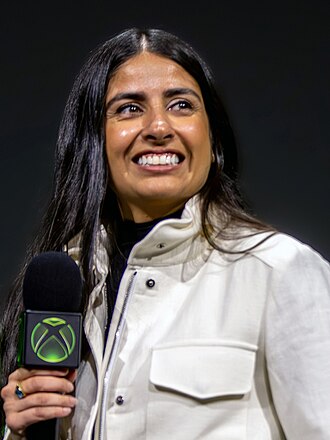
Asha Sharma
Chief Vice President of Product, Microsoft AI platform; former COO at Instacart and VP Product at Meta
Where to hear and read about Asha Sharma1 episode or test

Asha Sharma is chief vice president of product for Microsoft's AI platform, and earlier was COO at Instacart and ran Messenger at Meta. The thing most worth learning from her is to treat an AI product as a learning loop of data, rewards and tuning, and to organize the team around that loop rather than around functions.
living organisms that just get better with the more interactions that happen. And in many ways, I think this is the new IP of every single company.
How 80,000 companies build with AI: Products as organisms and the death of org charts | Asha Sharma
Asha Sharma: the story and the lessons
1Who Asha Sharma is and what drives her
Sharma sees what works across thousands of AI builders. She is chief vice president of product for Microsoft's AI platform, covering infrastructure, foundation models and agent toolchains. She also leads applied engineering, responsible AI and growth for the core AI division.
Her view comes from customers: more than 15,000 have built agents on Azure, and the agents number in the millions.
She came to AI through consumer and marketplace operating roles. Before Microsoft she was COO at Instacart and ran Messenger at Meta. She was employee 7 at Porch.
She joined Microsoft just after OpenAI's large models landed, then watched proprietary, open and frontier models multiply.
Health and society motivate her platform work. She builds the platform so people can use AI on hundred-year problems. Her mother has cancer, and she now thinks a cure may come in her lifetime.
She cites a London hospital using AI to match eggs and sperm, and Stanford, a platform customer, using AI for tumor reviews. She also worries about falling birth rates.
Sharma credits Satya Nadella with showing that optimism renews. She says Microsoft has had reason to fail for 50 years, yet Nadella renews everyone's dedication through energy and clarity, daily, in a fiercely competitive talent market.
She doesn't know if it is innate or worked at. She sees it as part of the culture, next to the growth mindset.
She stays close to customers and optimizes for option value. She joined the Home Depot board this year, drawn to its inverted pyramid where associates sit at the top and the traditional HQ is support. Her motto moved from minimizing regret to maximizing option value.
She is a second-degree taekwondo black belt and says the real value is mental clarity, courage and seeing things through, which she applies to making product.
2Sharma's view of AI products as living organisms
She says AI products stop being artifacts and become organisms. Once models can call tools and act, a product is no longer a shipped object with a ship date and a dashboard. It becomes a system that improves with every interaction.
She calls them "products that think and live and learn" and says the team's metabolism is the KPI: how fast it ingests data, digests the reward model and produces an outcome.
Sharma runs a full loop of reward design, rollout and A/B testing. Teams design a reward model, roll it out, A/B test it rigorously and pick the use case where it matters most. That generates data to learn from.
She has never seen it be a single loop for a product. It usually runs as several parallel tracks, like assembly lines.
She prefers tuning an existing model to building a new one. Building a foundation model needs huge compute and scarce science talent. Post-training an off-the-shelf model toward price, performance or quality gives more leverage and control over taste.
She cites Nathan Lambert's finding that pre-training capex stops making economic sense past 30 billion parameters, and says about 50% of developers already fine-tune. Training data can be your own, bought or synthetic, though she says your own is best.
Microsoft's Dragon team lifted acceptance with expert-annotated data. Dragon, the physician product, compared synthetic fine-tuning against feeding the model 600,000 expert-annotated patient and physician interactions. Acceptance rose from roughly 30 to 60 percent, depending on the run, to about 83 percent.
A small cross-functional group did it, not a large organization.
She favors a model system over one model for everything. Different tasks suit different models, such as Sonnet 4 for some and GPT-5 for others, and latency tolerance and thinking time change the fit.
She separates a model system from an ensemble, which is multiple models tuned and deployed independently. She admits the terms are invented on the fly because the data points are few. Her line: "I'm much more in the like model system rather than one model to rule them all".
3How Sharma organizes teams around the loop
Sharma replaces functional lanes with full-stack builders. An average launch has about 10 steps across 5 to 7 functions and 6 to 7 layers, roughly 500 touch points. That is too slow when hundreds of models and technologies appear each week.
Full-stack builders who own the whole loop raise velocity and throughput, and she sees it even in 50-year-old enterprises. Her rule: "it's all about the loop not the lane". She agrees a PM must level up on design or engineering.
She expects org charts to become work charts. As agents push the marginal cost of good output toward zero, demand for output grows and agents scale to meet it. Teams become sets of agents with a goal, with fewer layers and tasks routed automatically.
Humans still decide where AI is applied. She calls this speculation.
Agent oversight uses the same loop as product improvement. Reviewing thousands of agents depends on fine-tuning, self-healing, observability and strong evals.
She says systems that manage devices, policies and group access for billions of people already exist, so little needs reinventing.
Microsoft plans in seasons, not six-month semesters. A season is set by a secular change in the industry or among customers and can last three to twelve months. Past seasons were early GPT prototyping, then reasoning models, and now agents.
Each season fixes the customer problems, what winning looks like and a north star metric. Below it sit loose quarterly OKRs and four to six week squad goals. The question she asks is "what season are we in?"
She leaves slack in plans for the unplanned and for the slope. Capacity is kept free for unplanned issues and for investment needed to disrupt your own platform thinking.
She expects plans to change often in an AI platform business and says to be open about it. "We try to leave slack in the system not just for the unplanned but for the slope".
She still wants human judgment in strategy, even as strategy docs fade. She says the most consequential products needed creativity, judgment and vision, not just logical inputs. Docs will fade into applications and artifacts in the productivity suite.
She points to Webvan failing where Instacart worked, and says an organization built for AI needs a different alignment mechanism than a doc.
4Sharma's advice for companies adopting AI
She sees winners moving through three phases of AI use. First everyone becomes AI fluent with a copilot in daily work. Then they apply AI to an existing process, and only then use it to lift growth such as LTV, retention or new categories.
One example is cutting fraud resolution from 15 days to 10. The steps are to map the process, apply AI and then see the effect on the P&L. Fluency removes the fear of AI.
Sharma says most companies fail by doing AI for AI's sake. They launch many projects with no blueprint of how the stack works, and no measurement, observability or evals end to end. They treat AI as a side bet rather than a real investment.
Her answer is to set up measurement, observability and evals first.
She tells builders to use a swappable platform and build for the slope. With about 70,000 enterprise AI tools launched in a year, picking one tool per outcome is risky. A platform layer lets you swap models and tools so you are not beholden to any one technology.
In her words, "you have to actually build for the slope instead of the snapshot of where you are".
She says winning platforms invest in invisible fundamentals. At Porch, the matching engine for 6 million professionals, 1,300 service types and 37,000 zip codes drove lead quality and the first $500 million valuation. WhatsApp won on reach, speed and end-to-end privacy, not stickers or dark mode.
For AI platforms the equivalents are data residency, availability, reliability, tool selection and knowledge retrieval. A German hospital can fine-tune only if its data never leaves the region. She calls the tuning work "the game of inches".
She wants products built for composability and agent readability. Databases moved from desktop tools to SQL and cloud from consoles to Terraform, and text streams connect better with LLMs. Makers spend too much time on UI and too little on how a product composes and how an agent reads it.
Chat will matter but is not enough, and documents stay useful as composable artifacts. She says to bring AI to where users already are.
Sharma names memory and long-running tool loops as missing agent pieces. Microsoft is focused on alignment, accountability, observability and evals first, then memory and tool-calling loops that run longer tasks.
The bet is on building blocks that give agents endurance. She says the next season could arrive in 3 or 13 months.

How 80,000 companies build with AI: Products as organisms and the death of org charts | Asha Sharma
Asha Sharma explains how AI products are shifting from static artifacts to learning loops, and how teams, planning and org structure need to change with them. She draws on Microsoft's view of 15,000 customers building agents, including a physician-note product that went from a 30 to 60 percent acceptance rate to 83 percent after expert-annotated fine-tuning.
Sharma sees what works across thousands of AI builders. She is chief vice president of product for Microsoft's AI platform, covering infrastructure, foundation models and agent toolchains. She also leads applied engineering, responsible AI and growth for the core AI division.
Her view comes from customers: more than 15,000 have built agents on Azure, and the agents number in the millions.
She came to AI through consumer and marketplace operating roles. Before Microsoft she was COO at Instacart and ran Messenger at Meta. She was employee 7 at Porch.
She joined Microsoft just after OpenAI's large models landed, then watched proprietary, open and frontier models multiply.
Health and society motivate her platform work. She builds the platform so people can use AI on hundred-year problems. Her mother has cancer, and she now thinks a cure may come in her lifetime.
She cites a London hospital using AI to match eggs and sperm, and Stanford, a platform customer, using AI for tumor reviews. She also worries about falling birth rates.
Sharma credits Satya Nadella with showing that optimism renews. She says Microsoft has had reason to fail for 50 years, yet Nadella renews everyone's dedication through energy and clarity, daily, in a fiercely competitive talent market.
She doesn't know if it is innate or worked at. She sees it as part of the culture, next to the growth mindset.
She stays close to customers and optimizes for option value. She joined the Home Depot board this year, drawn to its inverted pyramid where associates sit at the top and the traditional HQ is support. Her motto moved from minimizing regret to maximizing option value.
She is a second-degree taekwondo black belt and says the real value is mental clarity, courage and seeing things through, which she applies to making product.
She says AI products stop being artifacts and become organisms. Once models can call tools and act, a product is no longer a shipped object with a ship date and a dashboard. It becomes a system that improves with every interaction.
She calls them "products that think and live and learn" and says the team's metabolism is the KPI: how fast it ingests data, digests the reward model and produces an outcome.
Sharma runs a full loop of reward design, rollout and A/B testing. Teams design a reward model, roll it out, A/B test it rigorously and pick the use case where it matters most. That generates data to learn from.
She has never seen it be a single loop for a product. It usually runs as several parallel tracks, like assembly lines.
She prefers tuning an existing model to building a new one. Building a foundation model needs huge compute and scarce science talent. Post-training an off-the-shelf model toward price, performance or quality gives more leverage and control over taste.
She cites Nathan Lambert's finding that pre-training capex stops making economic sense past 30 billion parameters, and says about 50% of developers already fine-tune. Training data can be your own, bought or synthetic, though she says your own is best.
Microsoft's Dragon team lifted acceptance with expert-annotated data. Dragon, the physician product, compared synthetic fine-tuning against feeding the model 600,000 expert-annotated patient and physician interactions. Acceptance rose from roughly 30 to 60 percent, depending on the run, to about 83 percent.
A small cross-functional group did it, not a large organization.
She favors a model system over one model for everything. Different tasks suit different models, such as Sonnet 4 for some and GPT-5 for others, and latency tolerance and thinking time change the fit.
She separates a model system from an ensemble, which is multiple models tuned and deployed independently. She admits the terms are invented on the fly because the data points are few. Her line: "I'm much more in the like model system rather than one model to rule them all".
Sharma replaces functional lanes with full-stack builders. An average launch has about 10 steps across 5 to 7 functions and 6 to 7 layers, roughly 500 touch points. That is too slow when hundreds of models and technologies appear each week.
Full-stack builders who own the whole loop raise velocity and throughput, and she sees it even in 50-year-old enterprises. Her rule: "it's all about the loop not the lane". She agrees a PM must level up on design or engineering.
She expects org charts to become work charts. As agents push the marginal cost of good output toward zero, demand for output grows and agents scale to meet it. Teams become sets of agents with a goal, with fewer layers and tasks routed automatically.
Humans still decide where AI is applied. She calls this speculation.
Agent oversight uses the same loop as product improvement. Reviewing thousands of agents depends on fine-tuning, self-healing, observability and strong evals.
She says systems that manage devices, policies and group access for billions of people already exist, so little needs reinventing.
Microsoft plans in seasons, not six-month semesters. A season is set by a secular change in the industry or among customers and can last three to twelve months. Past seasons were early GPT prototyping, then reasoning models, and now agents.
Each season fixes the customer problems, what winning looks like and a north star metric. Below it sit loose quarterly OKRs and four to six week squad goals. The question she asks is "what season are we in?"
She leaves slack in plans for the unplanned and for the slope. Capacity is kept free for unplanned issues and for investment needed to disrupt your own platform thinking.
She expects plans to change often in an AI platform business and says to be open about it. "We try to leave slack in the system not just for the unplanned but for the slope".
She still wants human judgment in strategy, even as strategy docs fade. She says the most consequential products needed creativity, judgment and vision, not just logical inputs. Docs will fade into applications and artifacts in the productivity suite.
She points to Webvan failing where Instacart worked, and says an organization built for AI needs a different alignment mechanism than a doc.
She sees winners moving through three phases of AI use. First everyone becomes AI fluent with a copilot in daily work. Then they apply AI to an existing process, and only then use it to lift growth such as LTV, retention or new categories.
One example is cutting fraud resolution from 15 days to 10. The steps are to map the process, apply AI and then see the effect on the P&L. Fluency removes the fear of AI.
Sharma says most companies fail by doing AI for AI's sake. They launch many projects with no blueprint of how the stack works, and no measurement, observability or evals end to end. They treat AI as a side bet rather than a real investment.
Her answer is to set up measurement, observability and evals first.
She tells builders to use a swappable platform and build for the slope. With about 70,000 enterprise AI tools launched in a year, picking one tool per outcome is risky. A platform layer lets you swap models and tools so you are not beholden to any one technology.
In her words, "you have to actually build for the slope instead of the snapshot of where you are".
She says winning platforms invest in invisible fundamentals. At Porch, the matching engine for 6 million professionals, 1,300 service types and 37,000 zip codes drove lead quality and the first $500 million valuation. WhatsApp won on reach, speed and end-to-end privacy, not stickers or dark mode.
For AI platforms the equivalents are data residency, availability, reliability, tool selection and knowledge retrieval. A German hospital can fine-tune only if its data never leaves the region. She calls the tuning work "the game of inches".
She wants products built for composability and agent readability. Databases moved from desktop tools to SQL and cloud from consoles to Terraform, and text streams connect better with LLMs. Makers spend too much time on UI and too little on how a product composes and how an agent reads it.
Chat will matter but is not enough, and documents stay useful as composable artifacts. She says to bring AI to where users already are.
Sharma names memory and long-running tool loops as missing agent pieces. Microsoft is focused on alignment, accountability, observability and evals first, then memory and tool-calling loops that run longer tasks.
The bet is on building blocks that give agents endurance. She says the next season could arrive in 3 or 13 months.
More from Microsoft
 Founder story
Bill Gates
Co-founder of Microsoft
 Microsoft

 2 sources · 37 tips
 Guest
Aparna Chennapragada
Chief Product Officer of Experiences and Devices at Microsoft; formerly CPO at Robinhood and VP at Google
Microsoft1 source · 17 tips Founder story
Steve Ballmer
CEO and leaders of Microsoft from the browser wars through the Ballmer years (1995 to 2014)
Microsoft1 source · 20 tips