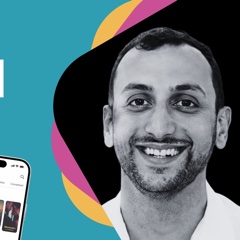
Ali Albazaz
Founder and CEO of Inkitt
Where to hear and read about Ali Albazaz1 episode or test

Ali Albazaz is the founder and CEO of Inkitt, which runs the Galatea, CandyJar and Ironblood subscription apps at around $130 million in annualized revenue. The thing most worth learning from him is to own the customer relationship and prove every story, ad and feature in its cheapest form before betting more on it.
I think what we've learned honestly is there is nothing like a bad idea. You just need to test it and sometimes things work that you didn't see coming.
How Inkitt took on Kindle and tested its way to $130M a year
Ali Albazaz: the story and the lessons
1How Ali Albazaz took Inkitt from Amazon to its own apps
Albazaz saw Amazon owning the buyer as Inkitt's biggest growth block. Inkitt sold ebooks through Kindle, but Amazon never shared customer emails, so Inkitt could not sell part two or three of a book. Kindle sales stalled near $40,000 a month.
As a software engineer he framed it as lifetime value, which needs a direct relationship, and wrote a paper to the team naming the gap. Effectively every buyer was a one-time customer, which he describes as 100% churn.
He launched the first app as a slideshow of text screenshots. The app was built in 3 to 4 days, used RevenueCat for subscriptions, and was tested with about $20 a day in ads. Revenue reached almost $1M a month by about June 2019.
The RevenueCat account was created in July 2018, and about six months of heavy experimentation came before growth took off. The first sign was an ad that led to a $10 purchase, so the team doubled down on that funnel.
Going direct looked crazy in 2017, and he did it anyway. Kindle dominated then, and critics asked why anyone would come to an app for a book. The Kindle sales had proven the demand, and the app removed Amazon's limits.
He kept the same rule in later apps, owning the relationship rather than distributing through a Netflix-style partner.
A Kleiner Perkins Series A turned a long shot into a company. Inkitt first raised about $2 to $3 million from European investors with a team of 10 to 12 in Berlin. After Galatea took off he raised a Series A from Kleiner Perkins, with NEA and Khosla also investing, and moved to San Francisco.
Before that it was "spaghetti at the wall" and a "Disney of the 21st century" dream that felt delusional. Kleiner's biggest meeting room is named the Amazon room, which made the goal feel real.
Ten years of compounding left Inkitt ready for new technology. Inkitt now runs Galatea, CandyJar and Ironblood, with over a million paid subscribers and growth that is accelerating at around $130M a year.
He credits luck and building blocks that worked out. His view is that "the longer you can compound, the good things can happen if you're ready to take advantage of them."
2How Albazaz picks stories and builds the creator side of Inkitt
Albazaz replaces one editor's opinion with thousands of readers' behavior. Inkitt tests every story with free readers and tracks whether they finish it, read it overnight, share it and bring friends. Reviews, ratings and comments do not count.
He calls a traditional publisher's single editor an "N-of-1" and wants an "N-of-1,000". Over two million stories sit on Inkitt, started by human writers and now often AI assisted.
About 45% of stories moved to Galatea passed $100,000 in sales. About 16% passed $1M. He says this beats the average publisher by "40X or 60X" as a benchmark.
He says Inkitt has had no flop of its own, because stories are validated before more money goes in.
Each format is a gate a story must pass before more investment. Stories are found on Inkitt, get a little more investment as Galatea ebooks, and the strongest become microdramas, then movies and games.
His summary: "The possibilities are limitless, but it's all about early validation."
He recruited the first authors by hand, then ran writing contests. Albazaz messaged about the first 300 authors on fanfiction.net and uploaded their stories himself, once setting a 4 AM alarm in Germany to help an author in Australia. Contests with a deadline, criteria, a jury and a prize then became the flywheel.
Inkitt reached a million signed up users with $0 in marketing.
Graduated authors share in every later format, and the writing app stays free. Authors who graduate sign a deal that includes ebook, audiobook, movie and microdrama sales, and they can cancel anytime if Inkitt underperforms. The Inkitt app has no ads and no margin, and revenue starts only after graduation.
One author wrote at 21 on her father's Android phone in India and bought her grandparents a house. Author subscriptions pass 100% to the author, and AI audiobooks and the Movie Creator are passed through at provider cost.
3How Albazaz tests everything
Inkitt runs about 30 significant A/B tests a month on monetization. The tests cover plan types such as weekly, monthly and quarterly, paywall position, pricing and paywall frequency.
They also test whether to show the paywall on first open or only after the aha moment.
He tests about 3,000 new ad creatives a week. Music, the first second and the hook cannot be predicted, so Inkitt produces creatives in volume and lets results decide.
Learnings from ad tests carry over into content and scripts.
Galatea tests the story text itself. Inkitt sells books chapter by chapter and runs hundreds of monthly tests that move the paywall and rewrite cliffhangers and openings.
Text is cheap to change, so it is the right format for this kind of testing, and winning patterns are reused in later formats.
He uses industry data and platform calls to find what to test next. RevenueCat's annual study shows which subscription types work and what churn should be, so gaps point to tests. He also asks Apple and Google, in their regular calls with larger apps, what they see and what Inkitt hasn't tested.
He doesn't know the revenue threshold for getting the monthly call, and says the platforms usually have good ideas too.
He runs a no bad ideas culture across product, content and ads. Content, marketing and product each run their own testing engine, and he calls it a company ethos of testing everything.
He says finding a real differentiator can take about 50 swings. One investor joked that Inkitt will A/B test theme park roller coasters by which makes people scream more.
4How Albazaz moved Inkitt into microdramas and AI movies
He tested microdramas with one PM, one engineer and 30 days. Production companies shot two movies at about $100,000 each from stories that had already earned over $1M as books. The test only had to show that ad users would spend more than the ads cost.
In 2023 only Inkitt and ReelShort competed in the US, and he says those first films wouldn't perform today. Galatea cross-promotion helped, but paid user acquisition was the main boost.
A rival's ads showed Inkitt's stories already fit vertical drama. A team member's Instagram feed showed ReelShort selling romance-heavy vertical dramas. Sensor Tower put ReelShort at roughly $2M to $3M a month.
The first app was named Galatea TV, as a graduation from Galatea. ReelShort was incubated by China's COL Group.
He engineers each short episode to end on a reason to pay. Films are cut into 60 to 90 second chunks, each needing a cliffhanger, and chunks unlock for about 50 cents. The subscription paywall usually comes after about 10 minutes of build-up and then a huge moment.
The thought he wants in the viewer's head is "Oh, I'm going to pay 50 cents to continue." He says all of this needs to be engineered.
He fed ad hooks and cliffhanger results into CandyJar scripts. Inkitt already knew which ad hooks worked and which Galatea cliffhangers converted, and carried that into CandyJar scripts along with good actors.
CandyJar is now slightly bigger than Galatea, about three years in, with growth fastest in the last 12 months.
He pays for celebrities where they drive installs and uses AI elsewhere. CandyJar works with seven or eight bigger celebrities, and Joseph Purcell signed to make movies only with Inkitt, with a movie almost every month.
Without a celebrity attached, AI production is usually the better choice. He hopes to announce a very big celebrity within two weeks.
He built Inkitt's own AI movie agent and hired producers to run it. The Movie Creator is built on Seedance, Claude Code, Eleven Labs and Nano Banana. A 30-person team of video producers uses it, and Inkitt is hiring four more producers a week.
The agent keeps characters consistent, picks the lens and checks the acting. He says AI is creating jobs at Inkitt, with the most open roles on the video side.
His standard is AI video so good viewers do not notice or care. He says 20 to 25% of viewers do not notice the AI today and expects most viewers within six months.
He points to the writers, directors, sound designers and colorists behind each film and posts behind-the-scenes material. His aim: "let's try to make it so good that nobody notices it's AI."

How Inkitt took on Kindle and tested its way to $130M a year
Inkitt's founder explains how owning the customer relationship, testing everything, and validating stories in cheap formats before spending more built a portfolio of reading and video subscription apps. The company is now at around $130 million in annualized revenue, with growth accelerating.
Albazaz saw Amazon owning the buyer as Inkitt's biggest growth block. Inkitt sold ebooks through Kindle, but Amazon never shared customer emails, so Inkitt could not sell part two or three of a book. Kindle sales stalled near $40,000 a month.
As a software engineer he framed it as lifetime value, which needs a direct relationship, and wrote a paper to the team naming the gap. Effectively every buyer was a one-time customer, which he describes as 100% churn.
He launched the first app as a slideshow of text screenshots. The app was built in 3 to 4 days, used RevenueCat for subscriptions, and was tested with about $20 a day in ads. Revenue reached almost $1M a month by about June 2019.
The RevenueCat account was created in July 2018, and about six months of heavy experimentation came before growth took off. The first sign was an ad that led to a $10 purchase, so the team doubled down on that funnel.
Going direct looked crazy in 2017, and he did it anyway. Kindle dominated then, and critics asked why anyone would come to an app for a book. The Kindle sales had proven the demand, and the app removed Amazon's limits.
He kept the same rule in later apps, owning the relationship rather than distributing through a Netflix-style partner.
A Kleiner Perkins Series A turned a long shot into a company. Inkitt first raised about $2 to $3 million from European investors with a team of 10 to 12 in Berlin. After Galatea took off he raised a Series A from Kleiner Perkins, with NEA and Khosla also investing, and moved to San Francisco.
Before that it was "spaghetti at the wall" and a "Disney of the 21st century" dream that felt delusional. Kleiner's biggest meeting room is named the Amazon room, which made the goal feel real.
Ten years of compounding left Inkitt ready for new technology. Inkitt now runs Galatea, CandyJar and Ironblood, with over a million paid subscribers and growth that is accelerating at around $130M a year.
He credits luck and building blocks that worked out. His view is that "the longer you can compound, the good things can happen if you're ready to take advantage of them."
Albazaz replaces one editor's opinion with thousands of readers' behavior. Inkitt tests every story with free readers and tracks whether they finish it, read it overnight, share it and bring friends. Reviews, ratings and comments do not count.
He calls a traditional publisher's single editor an "N-of-1" and wants an "N-of-1,000". Over two million stories sit on Inkitt, started by human writers and now often AI assisted.
About 45% of stories moved to Galatea passed $100,000 in sales. About 16% passed $1M. He says this beats the average publisher by "40X or 60X" as a benchmark.
He says Inkitt has had no flop of its own, because stories are validated before more money goes in.
Each format is a gate a story must pass before more investment. Stories are found on Inkitt, get a little more investment as Galatea ebooks, and the strongest become microdramas, then movies and games.
His summary: "The possibilities are limitless, but it's all about early validation."
He recruited the first authors by hand, then ran writing contests. Albazaz messaged about the first 300 authors on fanfiction.net and uploaded their stories himself, once setting a 4 AM alarm in Germany to help an author in Australia. Contests with a deadline, criteria, a jury and a prize then became the flywheel.
Inkitt reached a million signed up users with $0 in marketing.
Graduated authors share in every later format, and the writing app stays free. Authors who graduate sign a deal that includes ebook, audiobook, movie and microdrama sales, and they can cancel anytime if Inkitt underperforms. The Inkitt app has no ads and no margin, and revenue starts only after graduation.
One author wrote at 21 on her father's Android phone in India and bought her grandparents a house. Author subscriptions pass 100% to the author, and AI audiobooks and the Movie Creator are passed through at provider cost.
Inkitt runs about 30 significant A/B tests a month on monetization. The tests cover plan types such as weekly, monthly and quarterly, paywall position, pricing and paywall frequency.
They also test whether to show the paywall on first open or only after the aha moment.
He tests about 3,000 new ad creatives a week. Music, the first second and the hook cannot be predicted, so Inkitt produces creatives in volume and lets results decide.
Learnings from ad tests carry over into content and scripts.
Galatea tests the story text itself. Inkitt sells books chapter by chapter and runs hundreds of monthly tests that move the paywall and rewrite cliffhangers and openings.
Text is cheap to change, so it is the right format for this kind of testing, and winning patterns are reused in later formats.
He uses industry data and platform calls to find what to test next. RevenueCat's annual study shows which subscription types work and what churn should be, so gaps point to tests. He also asks Apple and Google, in their regular calls with larger apps, what they see and what Inkitt hasn't tested.
He doesn't know the revenue threshold for getting the monthly call, and says the platforms usually have good ideas too.
He runs a no bad ideas culture across product, content and ads. Content, marketing and product each run their own testing engine, and he calls it a company ethos of testing everything.
He says finding a real differentiator can take about 50 swings. One investor joked that Inkitt will A/B test theme park roller coasters by which makes people scream more.
He tested microdramas with one PM, one engineer and 30 days. Production companies shot two movies at about $100,000 each from stories that had already earned over $1M as books. The test only had to show that ad users would spend more than the ads cost.
In 2023 only Inkitt and ReelShort competed in the US, and he says those first films wouldn't perform today. Galatea cross-promotion helped, but paid user acquisition was the main boost.
A rival's ads showed Inkitt's stories already fit vertical drama. A team member's Instagram feed showed ReelShort selling romance-heavy vertical dramas. Sensor Tower put ReelShort at roughly $2M to $3M a month.
The first app was named Galatea TV, as a graduation from Galatea. ReelShort was incubated by China's COL Group.
He engineers each short episode to end on a reason to pay. Films are cut into 60 to 90 second chunks, each needing a cliffhanger, and chunks unlock for about 50 cents. The subscription paywall usually comes after about 10 minutes of build-up and then a huge moment.
The thought he wants in the viewer's head is "Oh, I'm going to pay 50 cents to continue." He says all of this needs to be engineered.
He fed ad hooks and cliffhanger results into CandyJar scripts. Inkitt already knew which ad hooks worked and which Galatea cliffhangers converted, and carried that into CandyJar scripts along with good actors.
CandyJar is now slightly bigger than Galatea, about three years in, with growth fastest in the last 12 months.
He pays for celebrities where they drive installs and uses AI elsewhere. CandyJar works with seven or eight bigger celebrities, and Joseph Purcell signed to make movies only with Inkitt, with a movie almost every month.
Without a celebrity attached, AI production is usually the better choice. He hopes to announce a very big celebrity within two weeks.
He built Inkitt's own AI movie agent and hired producers to run it. The Movie Creator is built on Seedance, Claude Code, Eleven Labs and Nano Banana. A 30-person team of video producers uses it, and Inkitt is hiring four more producers a week.
The agent keeps characters consistent, picks the lens and checks the acting. He says AI is creating jobs at Inkitt, with the most open roles on the video side.
His standard is AI video so good viewers do not notice or care. He says 20 to 25% of viewers do not notice the AI today and expects most viewers within six months.
He points to the writers, directors, sound designers and colorists behind each film and posts behind-the-scenes material. His aim: "let's try to make it so good that nobody notices it's AI."