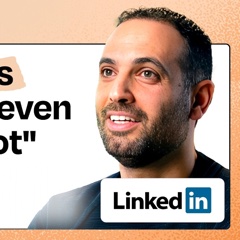
Tomer Cohen
Chief Product Officer at LinkedIn
Where to hear and read about Tomer Cohen2 episodes and tests

 Lenny's PodcastWhy AI is disrupting traditional product management | Tomer Cohen (LinkedIn CPO)
 Lenny's PodcastHow LinkedIn became interesting: The inside story | Tomer Cohen (CPO at LinkedIn)
Tomer Cohen is Chief Product Officer at LinkedIn, who rose from building its mobile app to running the feed turnaround, its AI-first shift, and now its Full Stack Builder model. The thing most worth learning from him is to set a huge goal, make everyone clear on it, and own the technology and culture changes yourself instead of delegating them.
We might be wrong, but we are not confused.
How LinkedIn became interesting: The inside story | Tomer Cohen (CPO at LinkedIn)
Tomer Cohen: the story and the lessons
1Tomer Cohen's path from Israel to LinkedIn CPO
Cohen chose hard roles early and moved to the US in 2008. Before LinkedIn he picked the toughest engineering role, the best company and the best army unit. He came from Israel in 2008 for graduate school, where he asked what mattered to him and where he could make a dent.
He says that in Israel arguing is a love language, and in the US he had to learn that "I don't exactly understand" often masks disagreement.
He started a company on a student visa before ever joining LinkedIn. He founded it with heavy school debt, which he calls not a very intelligent decision economically. He first heard of LinkedIn at a 2008 Stanford talk where Reid Hoffman described professional communities online.
He joined a few years after starting his own company.
Cohen never applied to LinkedIn; he pitched how mobile should be built. He told Deep Nishar how mobile should be built, and Nishar asked him to build it. LinkedIn was desktop-first then and mobile was seen as noise.
He later saw the same pattern with the feed and with ads.
He rose from senior PM to CPO by following conviction and impact. He moved through senior PM, group PM, director, VP and CPO. He stopped chasing the most in-demand roles and picked work where he held strong conviction and could make a dent.
Offered an exciting project at the edge or a grindy one at the core, he picks the core. As CPO he runs product development, design, business development, content creation and customer operations.
Cohen judges people by what they built, not titles or logos. In interviews he asks what they built, what they learned and how well it did. He compares a product resume to a musician's albums.
He leaves LinkedIn after 14 years, proud and eager for new problems. He says he has a bias for change and for going where he can learn the most. Much of what he learned came from tough situations, hard calls and late nights.
His motto is "becoming is better than being", and each year he asks how much he grew between version Tomer 2025 and version Tomer 2026.
2How Cohen turned around the LinkedIn feed
Cohen asked for the feed role because nobody else wanted it. The feed began as an activity feed of job changes and new connections, then drifted into a promotional feed. There was no feed team or PM, so he asked for the role and assembled a team.
He says he had strong conviction about what he could do with it.
He gave the feed a purpose and said what it was not. It would no longer be a springboard for other products, a traffic jumpstart or an upsell feed. It became knowledge exchange between people who matter to each other professionally.
"It's really about people that matter talking about things that I care about professionally."
He sized the goal from LinkedIn's potential, not its numbers. He wanted millions, not tens of millions, of people coming to the feed daily, which made no sense against the numbers then. He asked how many professionals exist and how many would want a place to share and engage.
He pictures a mountain where the peak is sharp, base camp is known, and the middle can stay blurry.
Cohen carved out 2 million members to prove the new feed. Testing on everyone made the company nervous, because every team depended on the feed for traffic and any swing set off escalations. The randomized 2 million cohort changed behavior clearly within months.
The proof changed the internal argument from how to slice the pie to how to grow it. He says a full company-wide shift would need a CEO who accepts no company growth for two years. Otherwise, carve out first and extend later.
He measured the feed by downstream engagement, not visits. The feed is the landing page, so raw counts include bystanders. The team set targets on active, engaged and high-value engagement, and covered both creation and consumption.
Moving the AI objective from click-through to downstream conversations drew spammers, and the team then spent a lot of time removing bad activity.
Turnaround products are harder than new ones, in Cohen's view. He calls them minus-one-to-one products. Entrenched flows, processes and metrics have to change from the inside, as with the feed and LinkedIn Pages.
3How Cohen made LinkedIn AI first
Cohen says the product leader must steer AI, not delegate it. He compares AI to the engine of the car and the pedals at the back of a river raft that steer. The AI team on the feed was strong but pointed another way, because it was doing what it had been told.
He merged it into one AI-first team, since in a marketplace satisfying the other side brings people back.
He expects product leaders to write the algorithm's objective on a board. That includes the features, the parameters the model learns on, and the investment in data collection and fine-tuning. From about 2016 he spent most of his resources here.
He notes that infrastructure can be a bigger lever than another button, yet few PMs talk about it.
He made every PM complete an AI Academy in 2020. It was modeled on the mobile-first shift in 2014. Strong AI practitioners on the product side taught others and spread expertise in waves.
In fall 2022 he told teams to drop roadmaps and return to the problem. He asked how the new LLM technology could solve their objectives better, not what cool thing to build. This began months before ChatGPT's public debut in March 2023.
"Let go of what you've built, let go of your roadmap, go back to the drawing board with what are you trying to solve for."
He let teams diverge for weeks, then converged on about five bets. Teams duplicated ideas while nobody had a playbook, and prompt engineering became an internal playbook. Capacity and cost limits then forced a pick of four or five bets, which he reviewed weekly.
LinkedIn learned ahead of the market and shared it with OpenAI and Microsoft.
Cohen says AI-first leaders control ingredients, not the whole experience. He compares it to a chef who now hands over ingredients and guidelines. AI is not deterministic, so safety guards and responsible AI are essential.
"You don't control the experience anymore, you control the ingredients."
He sees AI as the matchmaker between creators and the right readers. A professor who posted daily for about a year and a half got speaking offers worth roughly half his annual university salary. He was also invited to advise prime ministers on investment strategy.
4Cohen's rules for clarity, goals and conviction
Cohen puts clarity above being right. "We might be wrong, but we are not confused" came from a founder whose failing company still had people hedging in different directions. It is so ingrained at LinkedIn that colleagues name it first among his Tomerisms.
Clarity has two halves, clarity of thought and clarity of execution. In a confused system, only luck can save you.
He wants principles with teeth that name a trade-off. "We should build a simple product" is useless, since nobody wants a complicated one. Stating what you will sacrifice is the strong opinion he wants to hear.
His product reviews start with a precise problem. "A video product" is too vague. He wants to know which video, for which audience, with what unique criteria.
With a sharp problem you can see the road and the base camp.
He checks whether a colleague disagrees or misunderstands. A mentor's test: if you misunderstand, keep going until you can restate the other view. If you disagree, stop and say so.
"Are you disagreeing or misunderstanding?"
A priority only counts once it shows up in staffing. Cohen found leaders who called one initiative their top priority while most engineers worked on a migration and top talent sat on moonshots.
"You have to make sure that what you're sharing as a priority is actually manifested in your resourcing."
He sets goals big and then tries to beat them. He says he doesn't understand teams that underplay a goal to over-deliver. Sharing the destination makes building more exciting and draws people in.
At LinkedIn's potential, one billion members is actually pretty small. He notes Airbnb's Brian Chesky also pushes goals ten times larger than expected.
He leads with beliefs, then tries to prove them with evidence. He chose mobile, the feed and ads on conviction about where each could go, even when the company saw them as noise. He admits a more pessimistic person might suit some roles better.
"I tend to lead with beliefs versus evidence."
5The Full Stack Builder model at LinkedIn
Cohen says layered specialist process became too slow for AI-speed change. Research grew to 10 to 15 sources, plus separate design, privacy and security reviews, until one small feature needed multiple teams and sprints. Design alone split into interaction, animation, content and research.
Each step has a valid reason to exist, but the sum is bloat. He says the model was already broken and the pace of change exposed it.
One full-stack builder takes an idea to market with AI. Humans keep vision, empathy, communication, creativity and, above all, judgment. Cohen is working hard to automate everything else.
He defines judgment as high-quality decisions in complex, ambiguous situations. He does not think AI is yet great at next-level creativity.
He assembles small pods and reassembles them each quarter. Pods flex across engineering, design, product and even BD. Cohen compares them to Navy SEAL teams, cross-trained and built around the mission.
Early pods show gains in velocity, focus and nimbleness.
LinkedIn replaced its APM program with an associate builder program. The APM program ends this year, and an Associate Product Builder program starts in January, teaching code, design and PM. Full-stack builder is now a formal title with its own career ladder.
The training is meant to be reused to upskill the rest of the company.
Cohen measures the benefit as experiment volume times quality over time. Benefit is experiment volume multiplied by quality, divided by time from idea to launch. So far PMs, designers and engineers save hours a week.
A maintenance agent and a QA agent are close to handling 50% of failed builds.
He expects some people to stay specialists. System builders empower the full-stack builders, and specialists remain, though far fewer are needed than before.
"Some people do not want to be full stack builders. And that's completely okay."
6How LinkedIn built its custom AI agents under Cohen
Off-the-shelf tools never worked on LinkedIn's code, so the platform was rebuilt. LinkedIn built composable UI components with server-side support so AI can reason over its platform. It worked in alpha mode with vendors such as Copilot, Cursor, Windsurf and Figma to fit its stack.
"You can't just go and bring a third-party tool and have it work on the LinkedIn stack. In fact, that's one of our biggest learnings, it never works."
Each area's head of craft owns a narrow specialist agent. The head of trust built the trust agent, and growth, research, analyst, maintenance and QA agents followed. Builders run a spec through them for critique before building.
Run on an old Open to Work spec, the trust agent surfaced issues the team had caught and holes they missed until later. The research agent shifted a team toward other integrations on a marketing spec.
Cohen found that curated golden examples beat the whole knowledge base. Giving an agent access to the whole drive made it hallucinate, since it could not weigh importance or link original specs to outcomes. The fix was specific context and a cleaned set of gold examples.
He compares it to weeks of hand-sorting good from bad professional posts when rebuilding the feed over 10 years ago.
The first agents took four to five months, mostly data work. Setup began at the end of last year. The dedicated build took a couple of months, and most of it was gathering and cleaning data.
Heavy customization on enterprise tools produced the biggest gain. The knowledge agents run on Copilot Enterprise and ChatGPT Enterprise, with an orchestrator letting the trust and growth agents go back and forth. Users may later see only a front end such as the product jam engine.
Agents stay narrow so they can be graded.
Idea-to-design is where he is now investing. Coding agents came first. Idea-to-design is where much of the work's quality comes from, and it got little investment before this program.
7How Cohen drives adoption of new ways of working
He puts most of his effort into culture, not tools. Platform and tools are the entry ticket. Only the cutting-edge 5% adopt new tools on their own, so the rest need incentives, examples and changed expectations.
"It's not enough to give them the tools to use it. You have to build incentives programs the motivation, the examples to how you do it."
Hiring and performance reviews now reward AI agency. Cohen's direct reports went first, with 360 reviews where designers rated PMs. The criteria were announced to everyone for the next bi-annual cycle.
People were glad to know how they would be rated and eager to show examples.
Visible wins spread the change better than directives. A head of partnerships built the developer portal connectors himself. A user researcher became a growth PM in a role that had sat empty for a while, and the story was shared company-wide.
All-hands celebrate wins and several were devoted to how to use the tools.
He runs the rollout as pods that must give feedback. A core team builds the track across R&D, and designer, PM and engineer pods get access in return for feedback. On the semantic people and job search team, PMs built their own dashboards and designers began pushing PRs.
He treats the internal tools like a product with early adopters.
Top performers adopt the tools first, so he recruits them. Contrary to the idea that AI levels everyone up, the heaviest users are top talent, who spend time on feedback and want to scale the tools.
Whether AI lifts average people or makes the best even better is still open, and so far it looks like the latter.
He tells people not to wait for a reorg to start. Designers pushed PRs and PMs built dashboards before general availability. Mindset matters more than title, so the formal title rollout stays slow to avoid diluting it.
"If you're looking for a formal re-org or declaration to start building differently, you're waiting too long."
He asks for ambition about the goal and patience about the investment. A startup can build in a week from scratch, but a large organization cannot. Skip the platform and the effort fails, and skip customizing and you get vanilla agents.
He calls expecting 2x productivity in a week the wrong yardstick.
8What Cohen would redo and what is still hard
His main regret was running a core team out of sight. He worked closely with a small team while the organization kept asking what was going on. He now says to get the wider org using early tools or at least aware of them.
He advises over-communicating the vision and progress, and sharing KPIs or OKRs with teams. "In retrospect we could have done a lot more in the flow to just show them."
Tool sprawl resisted his plan to converge on a few. Teams gravitated to different design tools such as Figma, Subframe and Magic Patterns, depending on function and prior know-how.
He expects no winner-take-all, because the user's starting point decides which tool feels simple.
Early payoff is modest and uneven. Quality looks better, but only early adopters are iterating so far. Legacy information, code, knowledge and designs make the investment large.
He expects broader use and clearer top-line numbers in about 6 months.
Why AI is disrupting traditional product management | Tomer Cohen (LinkedIn CPO)
LinkedIn is replacing the traditional PM, design and engineering split with a Full Stack Builder model built on three pillars: a re-architected platform, custom internal agents, and culture. The episode shows how to build customized agents, curate their data, and drive adoption through incentives, pilots and performance reviews.
He started a company on a student visa before ever joining LinkedIn. He founded it with heavy school debt, which he calls not a very intelligent decision economically. He first heard of LinkedIn at a 2008 Stanford talk where Reid Hoffman described professional communities online.
He joined a few years after starting his own company.
He leaves LinkedIn after 14 years, proud and eager for new problems. He says he has a bias for change and for going where he can learn the most. Much of what he learned came from tough situations, hard calls and late nights.
His motto is "becoming is better than being", and each year he asks how much he grew between version Tomer 2025 and version Tomer 2026.
Cohen says layered specialist process became too slow for AI-speed change. Research grew to 10 to 15 sources, plus separate design, privacy and security reviews, until one small feature needed multiple teams and sprints. Design alone split into interaction, animation, content and research.
Each step has a valid reason to exist, but the sum is bloat. He says the model was already broken and the pace of change exposed it.
One full-stack builder takes an idea to market with AI. Humans keep vision, empathy, communication, creativity and, above all, judgment. Cohen is working hard to automate everything else.
He defines judgment as high-quality decisions in complex, ambiguous situations. He does not think AI is yet great at next-level creativity.
He assembles small pods and reassembles them each quarter. Pods flex across engineering, design, product and even BD. Cohen compares them to Navy SEAL teams, cross-trained and built around the mission.
Early pods show gains in velocity, focus and nimbleness.
LinkedIn replaced its APM program with an associate builder program. The APM program ends this year, and an Associate Product Builder program starts in January, teaching code, design and PM. Full-stack builder is now a formal title with its own career ladder.
The training is meant to be reused to upskill the rest of the company.
Cohen measures the benefit as experiment volume times quality over time. Benefit is experiment volume multiplied by quality, divided by time from idea to launch. So far PMs, designers and engineers save hours a week.
A maintenance agent and a QA agent are close to handling 50% of failed builds.
He expects some people to stay specialists. System builders empower the full-stack builders, and specialists remain, though far fewer are needed than before.
"Some people do not want to be full stack builders. And that's completely okay."
Off-the-shelf tools never worked on LinkedIn's code, so the platform was rebuilt. LinkedIn built composable UI components with server-side support so AI can reason over its platform. It worked in alpha mode with vendors such as Copilot, Cursor, Windsurf and Figma to fit its stack.
"You can't just go and bring a third-party tool and have it work on the LinkedIn stack. In fact, that's one of our biggest learnings, it never works."
Each area's head of craft owns a narrow specialist agent. The head of trust built the trust agent, and growth, research, analyst, maintenance and QA agents followed. Builders run a spec through them for critique before building.
Run on an old Open to Work spec, the trust agent surfaced issues the team had caught and holes they missed until later. The research agent shifted a team toward other integrations on a marketing spec.
Cohen found that curated golden examples beat the whole knowledge base. Giving an agent access to the whole drive made it hallucinate, since it could not weigh importance or link original specs to outcomes. The fix was specific context and a cleaned set of gold examples.
He compares it to weeks of hand-sorting good from bad professional posts when rebuilding the feed over 10 years ago.
The first agents took four to five months, mostly data work. Setup began at the end of last year. The dedicated build took a couple of months, and most of it was gathering and cleaning data.
Heavy customization on enterprise tools produced the biggest gain. The knowledge agents run on Copilot Enterprise and ChatGPT Enterprise, with an orchestrator letting the trust and growth agents go back and forth. Users may later see only a front end such as the product jam engine.
Agents stay narrow so they can be graded.
Idea-to-design is where he is now investing. Coding agents came first. Idea-to-design is where much of the work's quality comes from, and it got little investment before this program.
He puts most of his effort into culture, not tools. Platform and tools are the entry ticket. Only the cutting-edge 5% adopt new tools on their own, so the rest need incentives, examples and changed expectations.
"It's not enough to give them the tools to use it. You have to build incentives programs the motivation, the examples to how you do it."
Hiring and performance reviews now reward AI agency. Cohen's direct reports went first, with 360 reviews where designers rated PMs. The criteria were announced to everyone for the next bi-annual cycle.
People were glad to know how they would be rated and eager to show examples.
Visible wins spread the change better than directives. A head of partnerships built the developer portal connectors himself. A user researcher became a growth PM in a role that had sat empty for a while, and the story was shared company-wide.
All-hands celebrate wins and several were devoted to how to use the tools.
He runs the rollout as pods that must give feedback. A core team builds the track across R&D, and designer, PM and engineer pods get access in return for feedback. On the semantic people and job search team, PMs built their own dashboards and designers began pushing PRs.
He treats the internal tools like a product with early adopters.
Top performers adopt the tools first, so he recruits them. Contrary to the idea that AI levels everyone up, the heaviest users are top talent, who spend time on feedback and want to scale the tools.
Whether AI lifts average people or makes the best even better is still open, and so far it looks like the latter.
He tells people not to wait for a reorg to start. Designers pushed PRs and PMs built dashboards before general availability. Mindset matters more than title, so the formal title rollout stays slow to avoid diluting it.
"If you're looking for a formal re-org or declaration to start building differently, you're waiting too long."
He asks for ambition about the goal and patience about the investment. A startup can build in a week from scratch, but a large organization cannot. Skip the platform and the effort fails, and skip customizing and you get vanilla agents.
He calls expecting 2x productivity in a week the wrong yardstick.
His main regret was running a core team out of sight. He worked closely with a small team while the organization kept asking what was going on. He now says to get the wider org using early tools or at least aware of them.
He advises over-communicating the vision and progress, and sharing KPIs or OKRs with teams. "In retrospect we could have done a lot more in the flow to just show them."
Tool sprawl resisted his plan to converge on a few. Teams gravitated to different design tools such as Figma, Subframe and Magic Patterns, depending on function and prior know-how.
He expects no winner-take-all, because the user's starting point decides which tool feels simple.
Early payoff is modest and uneven. Quality looks better, but only early adopters are iterating so far. Legacy information, code, knowledge and designs make the investment large.
He expects broader use and clearer top-line numbers in about 6 months.
How LinkedIn became interesting: The inside story | Tomer Cohen (CPO at LinkedIn)
Tomer Cohen explains how LinkedIn rebuilt its feed from a promotional activity stream into a place people check daily, and how he pushed the company to an AI first mindset years before AI was hot. The episode is worth hearing for the concrete moves: a 2 million member carve-out to prove a turnaround, a roadmap reset for LLMs, and clarity rules that keep teams aligned.
Cohen chose hard roles early and moved to the US in 2008. Before LinkedIn he picked the toughest engineering role, the best company and the best army unit. He came from Israel in 2008 for graduate school, where he asked what mattered to him and where he could make a dent.
He says that in Israel arguing is a love language, and in the US he had to learn that "I don't exactly understand" often masks disagreement.
He started a company on a student visa before ever joining LinkedIn. He founded it with heavy school debt, which he calls not a very intelligent decision economically. He first heard of LinkedIn at a 2008 Stanford talk where Reid Hoffman described professional communities online.
He joined a few years after starting his own company.
Cohen never applied to LinkedIn; he pitched how mobile should be built. He told Deep Nishar how mobile should be built, and Nishar asked him to build it. LinkedIn was desktop-first then and mobile was seen as noise.
He later saw the same pattern with the feed and with ads.
He rose from senior PM to CPO by following conviction and impact. He moved through senior PM, group PM, director, VP and CPO. He stopped chasing the most in-demand roles and picked work where he held strong conviction and could make a dent.
Offered an exciting project at the edge or a grindy one at the core, he picks the core. As CPO he runs product development, design, business development, content creation and customer operations.
Cohen judges people by what they built, not titles or logos. In interviews he asks what they built, what they learned and how well it did. He compares a product resume to a musician's albums.
Cohen asked for the feed role because nobody else wanted it. The feed began as an activity feed of job changes and new connections, then drifted into a promotional feed. There was no feed team or PM, so he asked for the role and assembled a team.
He says he had strong conviction about what he could do with it.
He gave the feed a purpose and said what it was not. It would no longer be a springboard for other products, a traffic jumpstart or an upsell feed. It became knowledge exchange between people who matter to each other professionally.
"It's really about people that matter talking about things that I care about professionally."
He sized the goal from LinkedIn's potential, not its numbers. He wanted millions, not tens of millions, of people coming to the feed daily, which made no sense against the numbers then. He asked how many professionals exist and how many would want a place to share and engage.
He pictures a mountain where the peak is sharp, base camp is known, and the middle can stay blurry.
Cohen carved out 2 million members to prove the new feed. Testing on everyone made the company nervous, because every team depended on the feed for traffic and any swing set off escalations. The randomized 2 million cohort changed behavior clearly within months.
The proof changed the internal argument from how to slice the pie to how to grow it. He says a full company-wide shift would need a CEO who accepts no company growth for two years. Otherwise, carve out first and extend later.
He measured the feed by downstream engagement, not visits. The feed is the landing page, so raw counts include bystanders. The team set targets on active, engaged and high-value engagement, and covered both creation and consumption.
Moving the AI objective from click-through to downstream conversations drew spammers, and the team then spent a lot of time removing bad activity.
Turnaround products are harder than new ones, in Cohen's view. He calls them minus-one-to-one products. Entrenched flows, processes and metrics have to change from the inside, as with the feed and LinkedIn Pages.
Cohen says the product leader must steer AI, not delegate it. He compares AI to the engine of the car and the pedals at the back of a river raft that steer. The AI team on the feed was strong but pointed another way, because it was doing what it had been told.
He merged it into one AI-first team, since in a marketplace satisfying the other side brings people back.
He expects product leaders to write the algorithm's objective on a board. That includes the features, the parameters the model learns on, and the investment in data collection and fine-tuning. From about 2016 he spent most of his resources here.
He notes that infrastructure can be a bigger lever than another button, yet few PMs talk about it.
He made every PM complete an AI Academy in 2020. It was modeled on the mobile-first shift in 2014. Strong AI practitioners on the product side taught others and spread expertise in waves.
In fall 2022 he told teams to drop roadmaps and return to the problem. He asked how the new LLM technology could solve their objectives better, not what cool thing to build. This began months before ChatGPT's public debut in March 2023.
"Let go of what you've built, let go of your roadmap, go back to the drawing board with what are you trying to solve for."
He let teams diverge for weeks, then converged on about five bets. Teams duplicated ideas while nobody had a playbook, and prompt engineering became an internal playbook. Capacity and cost limits then forced a pick of four or five bets, which he reviewed weekly.
LinkedIn learned ahead of the market and shared it with OpenAI and Microsoft.
Cohen says AI-first leaders control ingredients, not the whole experience. He compares it to a chef who now hands over ingredients and guidelines. AI is not deterministic, so safety guards and responsible AI are essential.
"You don't control the experience anymore, you control the ingredients."
He sees AI as the matchmaker between creators and the right readers. A professor who posted daily for about a year and a half got speaking offers worth roughly half his annual university salary. He was also invited to advise prime ministers on investment strategy.
Cohen puts clarity above being right. "We might be wrong, but we are not confused" came from a founder whose failing company still had people hedging in different directions. It is so ingrained at LinkedIn that colleagues name it first among his Tomerisms.
Clarity has two halves, clarity of thought and clarity of execution. In a confused system, only luck can save you.
He wants principles with teeth that name a trade-off. "We should build a simple product" is useless, since nobody wants a complicated one. Stating what you will sacrifice is the strong opinion he wants to hear.
His product reviews start with a precise problem. "A video product" is too vague. He wants to know which video, for which audience, with what unique criteria.
With a sharp problem you can see the road and the base camp.
He checks whether a colleague disagrees or misunderstands. A mentor's test: if you misunderstand, keep going until you can restate the other view. If you disagree, stop and say so.
"Are you disagreeing or misunderstanding?"
A priority only counts once it shows up in staffing. Cohen found leaders who called one initiative their top priority while most engineers worked on a migration and top talent sat on moonshots.
"You have to make sure that what you're sharing as a priority is actually manifested in your resourcing."
He sets goals big and then tries to beat them. He says he doesn't understand teams that underplay a goal to over-deliver. Sharing the destination makes building more exciting and draws people in.
At LinkedIn's potential, one billion members is actually pretty small. He notes Airbnb's Brian Chesky also pushes goals ten times larger than expected.
He leads with beliefs, then tries to prove them with evidence. He chose mobile, the feed and ads on conviction about where each could go, even when the company saw them as noise. He admits a more pessimistic person might suit some roles better.
"I tend to lead with beliefs versus evidence."
 LinkedIn