Hari Srinivasan
VP of Product, LinkedIn Talent Solutions (Recruiter, Jobs, Learning)
Where to hear and read about Hari Srinivasan1 episode or test

Hari Srinivasan is VP of Product for LinkedIn Talent Solutions, running hiring, jobs and learning products for LinkedIn's biggest business. The thing most worth learning from him is how one North Star plus fast decision rules keeps a tangle of marketplaces moving, which helped push skills-first hiring to about 47% of recruiters.
as long as you keep that North Star ahead of you, you're going to be just fine.
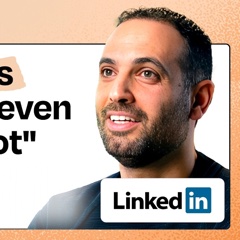
LinkedIn’s product evolution and the art of building complex systems | Hari Srinivasan (LinkedIn)
Hari Srinivasan: the story and the lessons
1Who Hari Srinivasan is and how he found his footing at LinkedIn
Srinivasan runs every LinkedIn product for getting a job or learning a skill. He has been at LinkedIn for 8 and a half years and is VP of product for talent solutions. His team covers all hiring and learning products.
The work is two marketplaces, hiring and learning, built to run as one ecosystem. Teams are organized around seekers and hirers on one side, and learners and instructors on the other.
His first LinkedIn product review failed because he borrowed other people's advice. He joined through a small acquisition of his own company and had never been a PM, so he stitched together the advice he had been given. Jeff, then head of product and CEO, kindly said it made no sense.
He drove home and told his wife he might be fired. Jeff just asked him to come back, about four or five weeks later. His rule for the second try was to do something he believed in, and the profile pitch rebuilt around connecting people to opportunity went very well.
Earlier, he worked on the Ford Escape hybrid, which set his bar for products. It was the first US hybrid SUV, and people drove hundreds of miles to see it.
He says that success set a bar for what he hopes his products can do.
2How Srinivasan runs a tangle of marketplaces
Every decision is tested against one North Star: connecting people to economic opportunity. A profile could serve identity in many ways, so the first question is which intent to unlock, such as sharing a podcast or landing a job. Once that is clear, the choice gets simpler across feed, hiring, marketing and premium.
Jeff and Ryan repeated it so consistently that it became the company's DNA, and the culture has a "pretty high immune system" against people who ignore it. Each marketplace picks its own outputs, such as hires made and people who learned a skill, measured by time spent.
Members come first when two sides compete for priority. Connecting people to opportunity always involves two parties, so the company needs clarity on whose needs lead.
That focus builds trust first, and it settles who gets access to data and how decisions are made. The North Star is the company mission and is not on the list of values.
He traces second, third and even fourth order effects of every change. A change like open to work alters how recruiters, employers and members behave on the other side, so each effect has to be traced and measured.
He contrasts this with his children's book, which was finished once it was out. A LinkedIn change never ends that cleanly.
He puts a single name on every decision using RAPID. RAPID lists who Recommends, who must Agree, who gives Input and who Decides. He says the most important part is one name on the decision line.
His personal norms are that a decision should be reachable within an hour, though it doesn't always work that way, and that after three emails you pick up the phone. After 20 minutes on the phone, you go to the decision maker.
A five-day clock forces stuck escalations up a level. If someone cannot escalate and solve an issue within five days, it becomes the next level up's problem.
Srinivasan calls RAPID and the five-day rule fuse-like limits that break ties and keep the ecosystem running.
He refreshes his team's process every quarter or two so it does not harden. Planning now uses red and orange priorities: leaders name the big rocks first and teams plan from there, instead of only bottom up. Product reviews are being cut from an hour to 15 minutes.
Long-lived review processes get institutionalized and fill up with long documents. The 15 minute format is an experiment, and he does not yet know if it will work.
He hires and promotes people who can simplify complex systems. His interview question is the most complex thing a candidate ever built. He looks for whether they gravitated to something really hard and whether they can simplify it.
Good answers explain how they modeled it, what the levers were and how cause and effect worked, even when non-linear. Failing is fine if they understand why they could not crack it. In promotions LinkedIn also asks how well someone works across teams, and built telemetry to see it.
3How LinkedIn moved hiring from titles to skills
Skills-first hiring began as a fix for a mismatched labor market in 2020. In March 2020, customer service could not hire enough while hospitality laid people off. Hospitality workers have about 70% of the skills customer service needs, but title searches hid them.
Recruiters can instead search for abilities like negotiation and de-escalation, and the rest can be trained. Srinivasan calls skills-based hiring one of the biggest changes nobody is talking about.
About 47% of recruiters now explicitly search by skills. LinkedIn did not decree this shift. It heard the demand from members and adapted.
The same pattern produced collections and filters for values-based search. He says nothing would click if hirers or seekers did not care.
He keeps a pulse on what members want and moves it through the system fast. A change only works when members want it and the system can amplify it.
Lenny notes that LinkedIn's size means it can change how hiring happens in the world.
Open to work lost its stigma step by step, and the internal version follows. It began as a hidden recruiter-only signal, then became a public feed post, then the photo frame launched around COVID. Open to internal work has just launched, letting employees tell an internal recruiter they may want a next role.
Srinivasan sees even more stigma here because of worry about telling a manager. He expects employee-driven moves to follow the same path over 5 to 10 years.
The feed improved by getting clearer on what members want. Surveys show people want relationships inside their network and knowledge, advice and real perspectives outside it. LinkedIn's goal did not change, but its understanding sharpened.
He cannot name a single biggest change, since machine learning gains compound. He says it is nowhere near time to declare victory, and new gen AI prompts invite members to share their own perspective.
4Srinivasan's advice for job seekers and product managers
He tells job seekers to attach evidence to each skill. Against each skill on a job post you can add work products and recommendations. A recruiter can hover over a skill, see the evidence and use it to recommend you to the hiring manager.
This matters most for people who lack the matching title. LinkedIn sees some correlation between demonstrated skills and getting the role.
He says to signal intent early, even when no role is open. Recruiters look for skills and intent. Open to work can name specific job types, and you can mark interest in a company page before any role exists.
Open to work has a high signal to noise ratio, while company interest commitments are still early. His advice is to be open about it and tell the companies you want.
In a down market, he points to relationships and industry experience. Tech hiring is down about 50% year over year, and PM hiring trends slightly below software engineering. He says relationships are the first thing to build.
He suggests targeting roles where your background substitutes for missing functional experience, such as automotive for an automotive tech PM role. Senior roles are usually recruited rather than applied for.
Great PMs live on the edges of a skills triangle. The three corners are a Spielberg-type creator, a data scientist and a general manager. He has never seen a great PM in the center.
He urges people to find where they fit and not to over-correct for their gaps.
He says PMs should teach and learn through real cases, not frameworks alone. LinkedIn's internal bootcamp began after a survey where PMs said they lacked the skills for their jobs. Frameworks were not enough, so the curriculum added real cases, including failures.
The bootcamp was later filmed as a public course. Topics include the bar for validating an idea, ranking ideas against an acute, widespread pain point, and thinking in loops.
He keeps building on the side so his builder muscle does not atrophy. He tells PMs to own their product and say where they want to drive it. His projects include a bedtime-story book written with his oldest child that has about half a million readers.
He also made the board game Parallel Universe, which Stanford design professors use, and honey-sweetened gummy bears with about 40% of the sugar of candy like Twizzlers. He keeps these separate from business.

LinkedIn’s product evolution and the art of building complex systems | Hari Srinivasan (LinkedIn)
Hari Srinivasan explains how LinkedIn runs a tangled set of marketplaces around one North Star, and how that shapes skills-first hiring, decision rules, and PM career advice. The result worth hearing: about 47% of recruiters now explicitly search by skills, a shift that began as a COVID-era fix for mismatched labor markets.
Srinivasan runs every LinkedIn product for getting a job or learning a skill. He has been at LinkedIn for 8 and a half years and is VP of product for talent solutions. His team covers all hiring and learning products.
The work is two marketplaces, hiring and learning, built to run as one ecosystem. Teams are organized around seekers and hirers on one side, and learners and instructors on the other.
His first LinkedIn product review failed because he borrowed other people's advice. He joined through a small acquisition of his own company and had never been a PM, so he stitched together the advice he had been given. Jeff, then head of product and CEO, kindly said it made no sense.
He drove home and told his wife he might be fired. Jeff just asked him to come back, about four or five weeks later. His rule for the second try was to do something he believed in, and the profile pitch rebuilt around connecting people to opportunity went very well.
Earlier, he worked on the Ford Escape hybrid, which set his bar for products. It was the first US hybrid SUV, and people drove hundreds of miles to see it.
He says that success set a bar for what he hopes his products can do.
Every decision is tested against one North Star: connecting people to economic opportunity. A profile could serve identity in many ways, so the first question is which intent to unlock, such as sharing a podcast or landing a job. Once that is clear, the choice gets simpler across feed, hiring, marketing and premium.
Jeff and Ryan repeated it so consistently that it became the company's DNA, and the culture has a "pretty high immune system" against people who ignore it. Each marketplace picks its own outputs, such as hires made and people who learned a skill, measured by time spent.
Members come first when two sides compete for priority. Connecting people to opportunity always involves two parties, so the company needs clarity on whose needs lead.
That focus builds trust first, and it settles who gets access to data and how decisions are made. The North Star is the company mission and is not on the list of values.
He traces second, third and even fourth order effects of every change. A change like open to work alters how recruiters, employers and members behave on the other side, so each effect has to be traced and measured.
He contrasts this with his children's book, which was finished once it was out. A LinkedIn change never ends that cleanly.
He puts a single name on every decision using RAPID. RAPID lists who Recommends, who must Agree, who gives Input and who Decides. He says the most important part is one name on the decision line.
His personal norms are that a decision should be reachable within an hour, though it doesn't always work that way, and that after three emails you pick up the phone. After 20 minutes on the phone, you go to the decision maker.
A five-day clock forces stuck escalations up a level. If someone cannot escalate and solve an issue within five days, it becomes the next level up's problem.
Srinivasan calls RAPID and the five-day rule fuse-like limits that break ties and keep the ecosystem running.
He refreshes his team's process every quarter or two so it does not harden. Planning now uses red and orange priorities: leaders name the big rocks first and teams plan from there, instead of only bottom up. Product reviews are being cut from an hour to 15 minutes.
Long-lived review processes get institutionalized and fill up with long documents. The 15 minute format is an experiment, and he does not yet know if it will work.
He hires and promotes people who can simplify complex systems. His interview question is the most complex thing a candidate ever built. He looks for whether they gravitated to something really hard and whether they can simplify it.
Good answers explain how they modeled it, what the levers were and how cause and effect worked, even when non-linear. Failing is fine if they understand why they could not crack it. In promotions LinkedIn also asks how well someone works across teams, and built telemetry to see it.
Skills-first hiring began as a fix for a mismatched labor market in 2020. In March 2020, customer service could not hire enough while hospitality laid people off. Hospitality workers have about 70% of the skills customer service needs, but title searches hid them.
Recruiters can instead search for abilities like negotiation and de-escalation, and the rest can be trained. Srinivasan calls skills-based hiring one of the biggest changes nobody is talking about.
About 47% of recruiters now explicitly search by skills. LinkedIn did not decree this shift. It heard the demand from members and adapted.
The same pattern produced collections and filters for values-based search. He says nothing would click if hirers or seekers did not care.
He keeps a pulse on what members want and moves it through the system fast. A change only works when members want it and the system can amplify it.
Lenny notes that LinkedIn's size means it can change how hiring happens in the world.
Open to work lost its stigma step by step, and the internal version follows. It began as a hidden recruiter-only signal, then became a public feed post, then the photo frame launched around COVID. Open to internal work has just launched, letting employees tell an internal recruiter they may want a next role.
Srinivasan sees even more stigma here because of worry about telling a manager. He expects employee-driven moves to follow the same path over 5 to 10 years.
The feed improved by getting clearer on what members want. Surveys show people want relationships inside their network and knowledge, advice and real perspectives outside it. LinkedIn's goal did not change, but its understanding sharpened.
He cannot name a single biggest change, since machine learning gains compound. He says it is nowhere near time to declare victory, and new gen AI prompts invite members to share their own perspective.
He tells job seekers to attach evidence to each skill. Against each skill on a job post you can add work products and recommendations. A recruiter can hover over a skill, see the evidence and use it to recommend you to the hiring manager.
This matters most for people who lack the matching title. LinkedIn sees some correlation between demonstrated skills and getting the role.
He says to signal intent early, even when no role is open. Recruiters look for skills and intent. Open to work can name specific job types, and you can mark interest in a company page before any role exists.
Open to work has a high signal to noise ratio, while company interest commitments are still early. His advice is to be open about it and tell the companies you want.
In a down market, he points to relationships and industry experience. Tech hiring is down about 50% year over year, and PM hiring trends slightly below software engineering. He says relationships are the first thing to build.
He suggests targeting roles where your background substitutes for missing functional experience, such as automotive for an automotive tech PM role. Senior roles are usually recruited rather than applied for.
Great PMs live on the edges of a skills triangle. The three corners are a Spielberg-type creator, a data scientist and a general manager. He has never seen a great PM in the center.
He urges people to find where they fit and not to over-correct for their gaps.
He says PMs should teach and learn through real cases, not frameworks alone. LinkedIn's internal bootcamp began after a survey where PMs said they lacked the skills for their jobs. Frameworks were not enough, so the curriculum added real cases, including failures.
The bootcamp was later filmed as a public course. Topics include the bar for validating an idea, ranking ideas against an acute, widespread pain point, and thinking in loops.
He keeps building on the side so his builder muscle does not atrophy. He tells PMs to own their product and say where they want to drive it. His projects include a bedtime-story book written with his oldest child that has about half a million readers.
He also made the board game Parallel Universe, which Stanford design professors use, and honey-sweetened gummy bears with about 40% of the sugar of candy like Twizzlers. He keeps these separate from business.
 LinkedIn