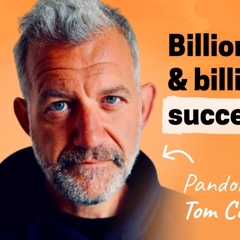
Tom Conrad
CEO of Zero, board member at Sonos, former VP Product at Snap, CTO of Pandora, CPO at Quibi
Where to hear and read about Tom Conrad1 episode or test

Tom Conrad is CEO of Zero and a product and engineering leader who worked at Apple, Pandora, Snap and Quibi, and who sits on the Sonos board. The most useful thing to learn from him is that a company is an equation of investment and returns, so check the math before you iterate on the product.
Oh, companies are equations.
Billion dollar failures, and billion dollar success | Tom Conrad (Quibi, Pandora, Pets.com, Zero)
Tom Conrad: the story and the lessons
1Tom Conrad's path from Apple to Zero
Conrad aimed at Apple from age 15 and got in with a mailed letter. Growing up in Columbus, Ohio, his heroes were the roughly 20 people whose signatures were inside the Mac case. Apple recruited at the University of Michigan, so he mailed a real letter and landed an internship.
He drove to California in his dad's Pontiac and worked on QuickDraw GX. On his last day he told Finder manager Ron Lichty he wanted to join in 10 months. In May Ron called, with a hiring slot expiring the next day, and Conrad started in summer 1992 without an interview.
A 2am placeholder animation of his outlived four rewrites of the Finder. He needed a cue that a folder was about to open, so he wrote code that blinked it five times, planning to hand it to a designer. It shipped as written, was dropped in the Mac OS X Finder rewrite, and was re-implemented with the same five blinks after people complained.
iOS folders later inherited the blink. His spring-loaded folders idea shipped four years after he wrote it. He draws the lesson that shortcuts taken to be cleaned up later can last 30 years.
Apple left him wide but shallow, and Berkeley Systems made him deep. Apple rewarded contributions across engineering, design and marketing, and he left after four years feeling "six miles wide and a centimeter deep." As technical director on You Don't Know Jack at Berkeley Systems, his one job was shipping good software on time.
Feedback outside that lane would not help his career, which forced depth, and he says that is when he became a real engineer. New versions of the game still sell nearly 30 years later.
At Snap he executed Evan Spiegel's vision, and it taught him to swing bigger. Snap hired him after one morning of interviews, with an offer at 1 p.m. in a manila envelope. He asked for another week to meet more leaders and check that the flattery wasn't hiding red flags. He worked as Evan's right hand for about two years.
He calls Evan brilliant and kind, with very high standards, but found the job exhausting and less soul satisfying than he wanted. It was nothing like the latitude Joe Kennedy gave him at Pandora.
Whitman and Katzenberg took seven months to talk him into Quibi. He left Snap in December 2018 after about 25 years in software, thinking he had lost the passion. He kept declining lunches until Meg Whitman said her tech and product leaders had both left after about six weeks and asked for two days a week as a favor.
His wife urged him to try it. He predicted two days would creep to six and was right. Building a team and product from scratch made him fall in love with the work again.
2How Conrad built Pandora's growth and what it missed
A chance meeting at Coachella led Conrad to Pandora. A high school friend introduced him to Tim Westergren of Savage Beast, which had 7 or 8 employees. He first declined the VP of engineering job because the business was B2B2C, and they called back, impressed that he had run engineering at Pets.com.
Within 90 days a new CEO, Joe Kennedy, arrived with the 1-Click Personal Radio idea and gave Conrad the keys. They worked together for 10 years.
Everyone at Pandora answered user email personally, and it drove word of mouth. support@pandora.com forwarded to the whole company, and whoever saw a request first replied. There were no macros, no FAQ links and no rules on what to say.
Users heard from the founder, the CEO or the engineer who wrote the feature. Pandora grew from 0 to 80 million users and from 10 to 3,000 employees without paid acquisition. "We thought one of our superpowers as a young company was that we could just engage with our audience as real human beings."
Pandora bet on radio while rivals chased owned music, and read the future wrong. Radio advertising was a $30 billion category against $8 billion of recorded music, and listeners spent about 10 times more minutes on radio. Conrad now says all music was always going to be streamed from the cloud.
Pandora stayed on its statutory license while the labels wanted Spotify-style direct deals. It moved to direct deals too late, and Spotify took the lead.
Pandora started in a cold investor climate and could not fund big risks. Lawsuits, label relationships and a lack of big exits kept investors wary. The biggest exit then was Yahoo buying Musicmatch for about $400 million.
Spotify arrived six or seven years later to far more optimism, with Pandora at $8 billion and Netflix at $100 billion as comparisons. Pandora's public investors were still figuring it out, so it lacked capital for big swings.
3Why Quibi failed, in Conrad's account
Quibi's content plan was sized for about $2 billion but looked like $6 to $10 billion. The team made 70 shows in 18 months, more than all the major broadcast networks combined in a year. The library still had to be far bigger to get people to subscribe and stay.
About a third of content spend went to daily network-style shows made the day of or day before airing, so there was no back catalog. Betting $10 billion on the format was "more than anyone could stomach."
Its model required a top 10 app ranking from day one, forever. Hollywood marketing people saw the numbers as small, since 20 million people see Shrek on opening night. Even Uber, with unlimited money for paid acquisition, is not reliably a top 10 download.
Conrad says he should have argued harder that this was very unlikely. It was improbable rather than impossible, which made it hard to argue against. Quibi also launched two weeks into Covid.
Quibi's cost structure left no time to grind the funnel. Millions downloaded the app and retention was a decent industry starting point, but not a record. Conrad expected a year or two of funnel work, as any startup would do.
With about a billion dollars a year going into content, the math pulled the team back to fundamentals almost at once. "In a world where you have to spend a billion dollars a year of making content, you just can't afford to not be a hit."
Conrad thinks Quibi's idea may still come, with a different product. A Hollywood show shot vertical is now launching on Reels and TikTok, and purpose-built mobile video looks a lot like TikTok.
He says Quibi missed much of the innovation in its initial product definition.
4What Pets.com taught Conrad about overfunding
Three pet sites each raised over $50 million and fought a spending arms race. Each assumed the market was zero-sum, so when one bought national TV ads, all did. Pets.com went from nothing to a public company to shut down in 19 months.
"Having an excess of investment can be its own albatross." He adds that the team made mistakes too.
Conrad calls pet e-commerce an early business, not a stupid one. Chewy is worth $9 billion today, and PetSmart bought it for $3 billion, then the biggest e-commerce acquisition. Conrad says Chewy executed well for a decade and grew brick by brick.
Shipping dog food could not work in 2000, when 80% of the connected country was on dial up.
Pets.com liquidated early and returned cash instead of going bankrupt. It needed more investment to reach profitability, and market conditions meant it could not raise more. Leadership shut down and returned the remaining balance to investors, which no public company had done before.
Winding down early beat spending every last penny on a fruitless attempt to salvage it.
5How Conrad runs Zero
A health scare made Zero personal, and he wanted to shape a culture. Eight months into the pandemic he was 50 to 60 pounds overweight, with cholesterol in the red zone. He used Zero, gave founder Mike Maser product feedback, and Mike then moved to executive chair and sought a CEO.
After Snap and Quibi, he had spent five years inside founders' cultures and wanted to set one himself, on something weightier than media. Zero has 27 people and kept double-digit growth coming out of the pandemic.
Conrad models the whole business before optimizing any one screen. He first optimized leaf nodes like install to registered and registered to trial. He then built a spreadsheet pulling in business intelligence data and raw subscription transactions, and tests scenarios by changing variables.
He calls it a bit embarrassing to realize at 53 that companies are equations. He is now Zero's full-time FP&A person, and the model shows which variables carry the most leverage.
Zero grows by raising the value of each user, not buying users. While competitors raised huge rounds for paid acquisition in 2021 and 2022, Zero optimized the value of its organic traffic. It has over 1 million monthly users, over 100,000 paying, and no paid acquisition.
He and Mike remembered 2000 and 2008 and went the other way, which was out of fashion then. 75% of users lose weight, with 5 to 10% of body weight gone in the first 60 days, which drives word of mouth.
6Conrad's rules for choosing work and people
He picks jobs for the product and the people, not the outcome. His satisfaction did not track audience size or financial return. It tracked whether he loved what was being built and the people he built it with.
Quibi and Pets.com were rewarding, and the big successes were not always the most satisfying. His advice: find something you love with people you find amazing.
Conrad trusts his gut about people and wishes he had earlier. Each time he joined a team with different values or working style, he knew early and told himself a story to ignore it.
He compares it to sitting next to a stranger at dinner, where you leave knowing how it went. A senior hire spends more time with the team than most candidates do, so pay attention to how you feel.
He thinks many talented people should join a team instead of founding. Many raise a $2 million seed and build a company that goes nowhere. They could do better on a team with a winning equation and a right-sized market.
He has never been a founder and says he is biased. He rejects the label "you're like a founder" because at Pandora and Zero a team, momentum and money already existed.
He values steady output over performative long hours. At 23 he wrote code from 4 p.m. to 3 a.m. and was celebrated, while a teammate who arrived at 8:30 and left each evening contributed more. At Pandora he rewarded people who did the work and went home to other things.
He still works nights and weekends because he loves it, and allows for the 22-year-old who wants to work through the night.
Conrad uses ikigai to explain why he doesn't burn out. He has always had all four parts: what he loves, what he is good at, what the world needs and what pays. Even his weekend fun is learning After Effects.
He warns that having three of the four is a trap, because it feels close enough to settle for.
7How Conrad leads, decides and hires
He knows the details as CEO but holds back on dictating results. Nine out of 10 times, someone who hears a CEO's passing thought starts working on it. Coda's flag tags (FYI, suggestion, do this, die on this hill) help only partly.
He stays deep in the product, the business and the processes. "Nine out of 10 times, that person is going to go and start working on that thing."
He sets how hands-on a CEO should be by company size. At Apple before Steve Jobs returned, brilliant people talked themselves out of every imperfect solution. Jobs ended the voting and made the call.
His joke: Apple was the only place where a vote of a thousand to one was a tie. In a small org of mission-driven people, he thinks a light touch works better.
Snap showed him what strong investor backing makes possible. Evan Spiegel's financial support let him buy technology he thought was game changing and build speculative features a normal roadmap would have pruned. Many bets paid off.
Pandora was not set up for that, and Conrad was not temperamentally inclined to big swings. He now takes bigger ones.
He interviews with "tell me about a time" and asks about a great day. Nearly every question starts with "Tell me about a time in your career when...". He avoids asking candidates to solve his own business problems, which creates an imbalance.
Near the end he asks what they did on a really great day at work. It shows what naturally rewards them and where they will be best used.

Billion dollar failures, and billion dollar success | Tom Conrad (Quibi, Pandora, Pets.com, Zero)
Tom Conrad draws on Pets.com and Quibi failures and on Pandora, Snap and Zero successes to show why a company is an equation of investment and returns, and why product craft alone cannot fix a broken one. He took Pandora from zero to 80 million users with no paid acquisition and now runs Zero, a subscription app with over 100,000 paying users that also grows without paid acquisition.
Conrad aimed at Apple from age 15 and got in with a mailed letter. Growing up in Columbus, Ohio, his heroes were the roughly 20 people whose signatures were inside the Mac case. Apple recruited at the University of Michigan, so he mailed a real letter and landed an internship.
He drove to California in his dad's Pontiac and worked on QuickDraw GX. On his last day he told Finder manager Ron Lichty he wanted to join in 10 months. In May Ron called, with a hiring slot expiring the next day, and Conrad started in summer 1992 without an interview.
A 2am placeholder animation of his outlived four rewrites of the Finder. He needed a cue that a folder was about to open, so he wrote code that blinked it five times, planning to hand it to a designer. It shipped as written, was dropped in the Mac OS X Finder rewrite, and was re-implemented with the same five blinks after people complained.
iOS folders later inherited the blink. His spring-loaded folders idea shipped four years after he wrote it. He draws the lesson that shortcuts taken to be cleaned up later can last 30 years.
Apple left him wide but shallow, and Berkeley Systems made him deep. Apple rewarded contributions across engineering, design and marketing, and he left after four years feeling "six miles wide and a centimeter deep." As technical director on You Don't Know Jack at Berkeley Systems, his one job was shipping good software on time.
Feedback outside that lane would not help his career, which forced depth, and he says that is when he became a real engineer. New versions of the game still sell nearly 30 years later.
At Snap he executed Evan Spiegel's vision, and it taught him to swing bigger. Snap hired him after one morning of interviews, with an offer at 1 p.m. in a manila envelope. He asked for another week to meet more leaders and check that the flattery wasn't hiding red flags. He worked as Evan's right hand for about two years.
He calls Evan brilliant and kind, with very high standards, but found the job exhausting and less soul satisfying than he wanted. It was nothing like the latitude Joe Kennedy gave him at Pandora.
Whitman and Katzenberg took seven months to talk him into Quibi. He left Snap in December 2018 after about 25 years in software, thinking he had lost the passion. He kept declining lunches until Meg Whitman said her tech and product leaders had both left after about six weeks and asked for two days a week as a favor.
His wife urged him to try it. He predicted two days would creep to six and was right. Building a team and product from scratch made him fall in love with the work again.
A chance meeting at Coachella led Conrad to Pandora. A high school friend introduced him to Tim Westergren of Savage Beast, which had 7 or 8 employees. He first declined the VP of engineering job because the business was B2B2C, and they called back, impressed that he had run engineering at Pets.com.
Within 90 days a new CEO, Joe Kennedy, arrived with the 1-Click Personal Radio idea and gave Conrad the keys. They worked together for 10 years.
Everyone at Pandora answered user email personally, and it drove word of mouth. support@pandora.com forwarded to the whole company, and whoever saw a request first replied. There were no macros, no FAQ links and no rules on what to say.
Users heard from the founder, the CEO or the engineer who wrote the feature. Pandora grew from 0 to 80 million users and from 10 to 3,000 employees without paid acquisition. "We thought one of our superpowers as a young company was that we could just engage with our audience as real human beings."
Pandora bet on radio while rivals chased owned music, and read the future wrong. Radio advertising was a $30 billion category against $8 billion of recorded music, and listeners spent about 10 times more minutes on radio. Conrad now says all music was always going to be streamed from the cloud.
Pandora stayed on its statutory license while the labels wanted Spotify-style direct deals. It moved to direct deals too late, and Spotify took the lead.
Pandora started in a cold investor climate and could not fund big risks. Lawsuits, label relationships and a lack of big exits kept investors wary. The biggest exit then was Yahoo buying Musicmatch for about $400 million.
Spotify arrived six or seven years later to far more optimism, with Pandora at $8 billion and Netflix at $100 billion as comparisons. Pandora's public investors were still figuring it out, so it lacked capital for big swings.
Quibi's content plan was sized for about $2 billion but looked like $6 to $10 billion. The team made 70 shows in 18 months, more than all the major broadcast networks combined in a year. The library still had to be far bigger to get people to subscribe and stay.
About a third of content spend went to daily network-style shows made the day of or day before airing, so there was no back catalog. Betting $10 billion on the format was "more than anyone could stomach."
Its model required a top 10 app ranking from day one, forever. Hollywood marketing people saw the numbers as small, since 20 million people see Shrek on opening night. Even Uber, with unlimited money for paid acquisition, is not reliably a top 10 download.
Conrad says he should have argued harder that this was very unlikely. It was improbable rather than impossible, which made it hard to argue against. Quibi also launched two weeks into Covid.
Quibi's cost structure left no time to grind the funnel. Millions downloaded the app and retention was a decent industry starting point, but not a record. Conrad expected a year or two of funnel work, as any startup would do.
With about a billion dollars a year going into content, the math pulled the team back to fundamentals almost at once. "In a world where you have to spend a billion dollars a year of making content, you just can't afford to not be a hit."
Conrad thinks Quibi's idea may still come, with a different product. A Hollywood show shot vertical is now launching on Reels and TikTok, and purpose-built mobile video looks a lot like TikTok.
He says Quibi missed much of the innovation in its initial product definition.
Three pet sites each raised over $50 million and fought a spending arms race. Each assumed the market was zero-sum, so when one bought national TV ads, all did. Pets.com went from nothing to a public company to shut down in 19 months.
"Having an excess of investment can be its own albatross." He adds that the team made mistakes too.
Conrad calls pet e-commerce an early business, not a stupid one. Chewy is worth $9 billion today, and PetSmart bought it for $3 billion, then the biggest e-commerce acquisition. Conrad says Chewy executed well for a decade and grew brick by brick.
Shipping dog food could not work in 2000, when 80% of the connected country was on dial up.
Pets.com liquidated early and returned cash instead of going bankrupt. It needed more investment to reach profitability, and market conditions meant it could not raise more. Leadership shut down and returned the remaining balance to investors, which no public company had done before.
Winding down early beat spending every last penny on a fruitless attempt to salvage it.
A health scare made Zero personal, and he wanted to shape a culture. Eight months into the pandemic he was 50 to 60 pounds overweight, with cholesterol in the red zone. He used Zero, gave founder Mike Maser product feedback, and Mike then moved to executive chair and sought a CEO.
After Snap and Quibi, he had spent five years inside founders' cultures and wanted to set one himself, on something weightier than media. Zero has 27 people and kept double-digit growth coming out of the pandemic.
Conrad models the whole business before optimizing any one screen. He first optimized leaf nodes like install to registered and registered to trial. He then built a spreadsheet pulling in business intelligence data and raw subscription transactions, and tests scenarios by changing variables.
He calls it a bit embarrassing to realize at 53 that companies are equations. He is now Zero's full-time FP&A person, and the model shows which variables carry the most leverage.
Zero grows by raising the value of each user, not buying users. While competitors raised huge rounds for paid acquisition in 2021 and 2022, Zero optimized the value of its organic traffic. It has over 1 million monthly users, over 100,000 paying, and no paid acquisition.
He and Mike remembered 2000 and 2008 and went the other way, which was out of fashion then. 75% of users lose weight, with 5 to 10% of body weight gone in the first 60 days, which drives word of mouth.
He picks jobs for the product and the people, not the outcome. His satisfaction did not track audience size or financial return. It tracked whether he loved what was being built and the people he built it with.
Quibi and Pets.com were rewarding, and the big successes were not always the most satisfying. His advice: find something you love with people you find amazing.
Conrad trusts his gut about people and wishes he had earlier. Each time he joined a team with different values or working style, he knew early and told himself a story to ignore it.
He compares it to sitting next to a stranger at dinner, where you leave knowing how it went. A senior hire spends more time with the team than most candidates do, so pay attention to how you feel.
He thinks many talented people should join a team instead of founding. Many raise a $2 million seed and build a company that goes nowhere. They could do better on a team with a winning equation and a right-sized market.
He has never been a founder and says he is biased. He rejects the label "you're like a founder" because at Pandora and Zero a team, momentum and money already existed.
He values steady output over performative long hours. At 23 he wrote code from 4 p.m. to 3 a.m. and was celebrated, while a teammate who arrived at 8:30 and left each evening contributed more. At Pandora he rewarded people who did the work and went home to other things.
He still works nights and weekends because he loves it, and allows for the 22-year-old who wants to work through the night.
Conrad uses ikigai to explain why he doesn't burn out. He has always had all four parts: what he loves, what he is good at, what the world needs and what pays. Even his weekend fun is learning After Effects.
He warns that having three of the four is a trap, because it feels close enough to settle for.
He knows the details as CEO but holds back on dictating results. Nine out of 10 times, someone who hears a CEO's passing thought starts working on it. Coda's flag tags (FYI, suggestion, do this, die on this hill) help only partly.
He stays deep in the product, the business and the processes. "Nine out of 10 times, that person is going to go and start working on that thing."
He sets how hands-on a CEO should be by company size. At Apple before Steve Jobs returned, brilliant people talked themselves out of every imperfect solution. Jobs ended the voting and made the call.
His joke: Apple was the only place where a vote of a thousand to one was a tie. In a small org of mission-driven people, he thinks a light touch works better.
Snap showed him what strong investor backing makes possible. Evan Spiegel's financial support let him buy technology he thought was game changing and build speculative features a normal roadmap would have pruned. Many bets paid off.
Pandora was not set up for that, and Conrad was not temperamentally inclined to big swings. He now takes bigger ones.
He interviews with "tell me about a time" and asks about a great day. Nearly every question starts with "Tell me about a time in your career when...". He avoids asking candidates to solve his own business problems, which creates an imbalance.
Near the end he asks what they did on a really great day at work. It shows what naturally rewards them and where they will be best used.
 Zero
