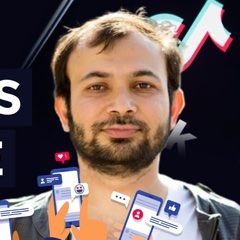
Shamanth Rao
Founder of RocketShip HQ, a paid user acquisition agency for apps
Where to hear and read about Shamanth Rao2 episodes and tests

 App MastersVideo Ads Example for Facebook & Mobile Advertising
 App MastersHow to Calculate Mobile Lifetime Value (LTV) Without a Lifetime of Data
Shamanth Rao is the founder of RocketShip HQ, a paid user acquisition agency that grows app downloads cost-effectively. The most useful thing to learn from him is to make cheap, native-looking creative from a repeatable checklist, and to judge spend against a day 365 LTV forecast built in a spreadsheet.
We use them almost as a checklist.
Video Ads Example for Facebook & Mobile Advertising
Shamanth Rao: the story and the lessons
1Shamanth Rao's five-point checklist for TikTok-style ads
Rao checks every creative against the same five elements. The elements are character-driven story, music and movement, portrayed emotion, exaggeration, and a raw unpolished look. RocketShip HQ aims to hit all five, or as many as it can.
His team uses the list almost as a routine test before making a video. It keeps the content looking native to the platform.
Rao builds the ad around a character, not gameplay or a testimonial. For a building and combat game, the ad showed no gameplay. An actor dared viewers with 'let's see if you can fight me'.
The ad plays a character in a scene, so it never reads as a pitch.
Rao never lets the actor say 'download this app'. A line like 'this app is awesome, come download' can work in other contexts but not on TikTok. The actors are shown using the app and dancing happily instead.
Any message is tied into the narrative rather than a call to action.
Rao tells actors to dance badly. TikTok is music-driven, so actors move and the music is added afterward. Those who don't dance are told to just move their hands around.
Some actors worry they aren't good dancers, and the team reassures them. His team sees a lot of success with this simple shortcut.
Rao opens with one clear emotion and pushes it to the extreme. One ad opened on a woman visibly shocked that she forgot her mom's birthday. For a money app, he suggests showing lots of money, even if it is just $1 bills.
He asks what the app makes people feel, positive or negative, and portrays it without words. Exaggerated action counts as well as exaggerated emotion.
Rao keeps ads raw and vertical, and never reuses slick Instagram creative. What works on Instagram does not work on TikTok, because polished content looks like an ad. Horizontal footage signals an outsider who doesn't know the platform.
The ad has to look candid and spontaneous, not scripted. Native-looking videos are what draw clicks and performance.
2How Rao makes creative cheaply and reuses it everywhere
Rao hires actors instead of influencers when he only needs the creative. Actors cost far less because you don't pay for an influencer's reach. RocketShip HQ keeps a network of actors since it runs many projects like this.
He uses influencers when the plan is to buy media on their audience. "The advantage of working with actors is they are a lot less expensive."
Rao produces most of the video inside TikTok's own editor. Text, music and effects can all be added in the app, then the video is downloaded to a phone. A video editor is only for finishing touches.
Rao runs one TikTok-style video on every platform. The same creative worked on Facebook feed, Instagram, stories and ad networks, including Instant and Snap. A square size works in feeds.
He says it works "amazingly well everywhere".
Rao lets a strong video carry the message and skips custom ad copy. He states the value proposition simply and ties it to the story. The platform's own buttons, such as learn more or play games, supply the call to action.
On Instagram, people know it is an ad and swipe up on their own, so there is no need to agonize over copy.
3How Rao forecasts day 365 LTV from 30 days of data
Rao defines LTV as revenue per user by a fixed day. A lifetime of data never exists, so LTV has to be a forecast to a set horizon such as day 60, 180 or 365. The same method works for each.
He picks the horizon that matches how long you can wait to recoup acquisition spend. The worked example targets day 365.
Rao starts from day 1 to day 30 cohorted revenue by channel. This export usually already sits in the mobile measurement partner (MMP), and can also be split by geo. The example compared organic and AppLovin separately.
Different sources have different curve shapes, so one blended curve hides the differences. "I typically recommend doing it by channel."
Rao fits a power trendline to cumulative revenue per user. In Google Sheets he charts cumulative ARPU by day, adds a power series trendline and shows the equation on the chart. The organic fit was about 0.323 × x^0.395.
The power curve captures how revenue growth slows over time, so it extends the curve's shape past day 30. Excel works just as well.
Rao plugs the equation into a table of days up to 365. Organic ARPU of $1.22 at day 30 becomes $1.63 at day 60, $1.91 at day 90, $2.51 at day 180 and about $3.32 at day 365.
The fitted curve gives $1.25 at day 30 against the real $1.22. He calls that small jump normal for a fitted curve.
Rao needs no database or code, only a spreadsheet. The aim is to take a limited amount of data, perhaps day 30 or even day 7, and extrapolate to day 365. That lets you act on LTV long before a full year of data exists.
Rao models each revenue stream separately. The single-curve method fits one stream, such as in-app purchases. Mixing IAP with ad revenue needs a different approach.
If your providers give day-by-day ad revenue, the same power-curve method can be run on the ad revenue alone.
4How Rao turns LTV into payback targets
Rao expresses each early day as a share of day 365 LTV. To recover 100% of costs by day 365, the example needs about 21% by day 7, 36% by day 30, 57% by day 90 and 75% by day 180.
Any other recovery goal can be set the same way. These checkpoints let you judge campaigns long before day 365 arrives.
Rao sets the day 7 buying target from that share. Organic day 7 ARPU of $0.71 against a day 365 LTV of about $3.32 is roughly 21%. He then sets the cost per install or bid so day 7 revenue covers that share of the cost.
He stresses that most acquisition is judged on a day 7 basis, so this is the figure to compare against. "A lot of acquisition activity is done based on a day seven calculus."
Video Ads Example for Facebook & Mobile Advertising
A five-point checklist for making TikTok-style video ads that also work on Facebook, Instagram and ad networks: character-driven, music and movement, portrayed emotion, exaggeration, and raw unpolished footage. It matters because one cheap, native-looking creative can be reused across platforms without heavy production or ad copy.
Rao checks every creative against the same five elements. The elements are character-driven story, music and movement, portrayed emotion, exaggeration, and a raw unpolished look. RocketShip HQ aims to hit all five, or as many as it can.
His team uses the list almost as a routine test before making a video. It keeps the content looking native to the platform.
Rao builds the ad around a character, not gameplay or a testimonial. For a building and combat game, the ad showed no gameplay. An actor dared viewers with 'let's see if you can fight me'.
The ad plays a character in a scene, so it never reads as a pitch.
Rao never lets the actor say 'download this app'. A line like 'this app is awesome, come download' can work in other contexts but not on TikTok. The actors are shown using the app and dancing happily instead.
Any message is tied into the narrative rather than a call to action.
Rao tells actors to dance badly. TikTok is music-driven, so actors move and the music is added afterward. Those who don't dance are told to just move their hands around.
Some actors worry they aren't good dancers, and the team reassures them. His team sees a lot of success with this simple shortcut.
Rao opens with one clear emotion and pushes it to the extreme. One ad opened on a woman visibly shocked that she forgot her mom's birthday. For a money app, he suggests showing lots of money, even if it is just $1 bills.
He asks what the app makes people feel, positive or negative, and portrays it without words. Exaggerated action counts as well as exaggerated emotion.
Rao keeps ads raw and vertical, and never reuses slick Instagram creative. What works on Instagram does not work on TikTok, because polished content looks like an ad. Horizontal footage signals an outsider who doesn't know the platform.
The ad has to look candid and spontaneous, not scripted. Native-looking videos are what draw clicks and performance.
Rao hires actors instead of influencers when he only needs the creative. Actors cost far less because you don't pay for an influencer's reach. RocketShip HQ keeps a network of actors since it runs many projects like this.
He uses influencers when the plan is to buy media on their audience. "The advantage of working with actors is they are a lot less expensive."
Rao produces most of the video inside TikTok's own editor. Text, music and effects can all be added in the app, then the video is downloaded to a phone. A video editor is only for finishing touches.
Rao runs one TikTok-style video on every platform. The same creative worked on Facebook feed, Instagram, stories and ad networks, including Instant and Snap. A square size works in feeds.
He says it works "amazingly well everywhere".
Rao lets a strong video carry the message and skips custom ad copy. He states the value proposition simply and ties it to the story. The platform's own buttons, such as learn more or play games, supply the call to action.
On Instagram, people know it is an ad and swipe up on their own, so there is no need to agonize over copy.
How to Calculate Mobile Lifetime Value (LTV) Without a Lifetime of Data
Shows how to estimate a day 365 lifetime value from only 7 to 30 days of cohorted revenue, using a spreadsheet and a power-curve trendline. The worked example turns an organic day 30 ARPU of 1.22 into a day 365 estimate of about 3.32, which gives concrete payback targets for paid acquisition.
Rao defines LTV as revenue per user by a fixed day. A lifetime of data never exists, so LTV has to be a forecast to a set horizon such as day 60, 180 or 365. The same method works for each.
He picks the horizon that matches how long you can wait to recoup acquisition spend. The worked example targets day 365.
Rao starts from day 1 to day 30 cohorted revenue by channel. This export usually already sits in the mobile measurement partner (MMP), and can also be split by geo. The example compared organic and AppLovin separately.
Different sources have different curve shapes, so one blended curve hides the differences. "I typically recommend doing it by channel."
Rao fits a power trendline to cumulative revenue per user. In Google Sheets he charts cumulative ARPU by day, adds a power series trendline and shows the equation on the chart. The organic fit was about 0.323 × x^0.395.
The power curve captures how revenue growth slows over time, so it extends the curve's shape past day 30. Excel works just as well.
Rao plugs the equation into a table of days up to 365. Organic ARPU of $1.22 at day 30 becomes $1.63 at day 60, $1.91 at day 90, $2.51 at day 180 and about $3.32 at day 365.
The fitted curve gives $1.25 at day 30 against the real $1.22. He calls that small jump normal for a fitted curve.
Rao needs no database or code, only a spreadsheet. The aim is to take a limited amount of data, perhaps day 30 or even day 7, and extrapolate to day 365. That lets you act on LTV long before a full year of data exists.
Rao models each revenue stream separately. The single-curve method fits one stream, such as in-app purchases. Mixing IAP with ad revenue needs a different approach.
If your providers give day-by-day ad revenue, the same power-curve method can be run on the ad revenue alone.
Rao expresses each early day as a share of day 365 LTV. To recover 100% of costs by day 365, the example needs about 21% by day 7, 36% by day 30, 57% by day 90 and 75% by day 180.
Any other recovery goal can be set the same way. These checkpoints let you judge campaigns long before day 365 arrives.
Rao sets the day 7 buying target from that share. Organic day 7 ARPU of $0.71 against a day 365 LTV of about $3.32 is roughly 21%. He then sets the cost per install or bid so day 7 revenue covers that share of the cost.
He stresses that most acquisition is judged on a day 7 basis, so this is the figure to compare against. "A lot of acquisition activity is done based on a day seven calculus."