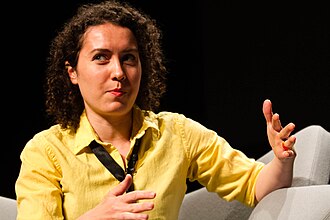
Maria Popova
Writer and founder of The Marginalian
Where to hear and read about Maria Popova1 episode or test

Maria Popova is a Bulgarian-born writer who founded Brain Pickings, now The Marginalian, a 20-year archive of writing on how reading can guide a life. The thing most worth learning from her is to write to understand your own life, building each piece from primary sources, long walks and slow attention rather than from planning or the pursuit of audience.
I write to understand my own life.
How to Write Something Truly Honest (Maria Popova Interview)
Maria Popova: the story and the lessons
1How Maria Popova started writing and built The Marginalian
Popova began the blog as a private record of how to live. She came from Bulgaria to the US for a liberal arts education and got 400-person lectures and standardized testing. She worked four jobs to pay for it, so she felt trapped.
She read at the library at night, wandered Philadelphia bookstores and used the early-2000s internet. She kept the record for herself, and it became Brain Pickings.
She read diaries and biographies to get through her hard 20s. She devoured the diaries and biographies of lesser-known people, and it comforted her to read how they suffered.
She cites James Baldwin in Life magazine, May 1963: you think your pain and suffering are alone in the history of the world, and then you read.
She renamed Brain Pickings after outgrowing its premise. She chose the name at 21, new to America, excited by puns and studying cognitive psychology, so the mind felt like the whole story. She now calls herself more anti-Cartesian every year.
Experience, she says, is embodied and emotional, not only mental. The site now holds more than 6 million pages, and the Library of Congress asked to make it part of its permanent archive.
A friend's poetry recital turned her toward poetry and science together. Emily Levine, a comedian and philosopher of science in her 70s, recited Prufrock in a packed Chelsea cafe, and Popova changed her mind about poetry. Levine then sent her a poem a day, and the friendship led to seven years of the show The Universe in Verse.
At one show, Patti Smith read a poem about dark matter while the discovery of dark matter was explained. Popova holds that science meets reality on its own terms and poetry deepens the terms on which we meet ourselves.
2Maria Popova's daily writing practice
Popova thinks on long walks and treats typing as transcription. She walks four hours a day and has written almost everything on foot. What she does at the keyboard is transcription.
On some walks she tries not to think, leaving incubation to do silent work. She keeps routines for presence, not output.
She keeps a diary that starts with observation and ends in contemplation. After years of introspective journals, she kept a daily diary of the outer world during four months in Patagonia. It turns a unit of objective reality into a unit of meaning.
She found it a conversation between the mind and the world, and incredibly rewarding.
She plans nothing and keeps a 20-year backlog of ideas. She has no editorial calendar, only a running log of what she means to write about. Ideas fade or return on their own.
She can scroll back to 2016, when she wanted to write about Susan Sontag's list of likes and dislikes. Revisiting such ideas with a decade more context makes her write them in a totally different way.
She shows up to write even when she is not in the mood. She cites Tchaikovsky writing to his patron Nadezhda von Meck, defending his work ethic over a slow concerto. Showing up opens the portal that inspiration alone does not.
She accepts that not every day's work will be good. Making something still counts for sanity, self-respect and growth.
She lets a source image sit overnight before writing a poem. Each night she picked a 19th-century bird drawing and read its ornithological description. She slept, then wrote a small poem from the words that surfaced by morning.
She made 100 of them, which became the card deck An Almanac of Birds: Divinations for Uncertain Days.
She spends days in a rabbit hole so the writing carries feeling. She spent five days learning about the eyes of the scallop, whose hexagonal crystals resemble the mirrors of the James Webb Space Telescope.
She says that without those days she would not have written about it with feeling. A quick summary gives facts, not the investment.
She uses nature to step out of her own story, then writes. Following Iris Murdoch's idea of unselfing, she lets art and the natural world pull her out of herself. She finds it in Patagonia and in the woods where she lives.
She then gives what she absorbed shape in writing, so the piece is not just about her.
3How Popova researches: primary sources and discovery
Popova goes to archives because the internet holds only a thin layer. She wants primary sources, not the surface Wikipedia page. The internet's 40-year depth is small beside what sits in university basements and libraries.
The 92nd Street Y holds undigitized recordings of Pablo Neruda's first US appearance and Susan Sontag's first big lecture. She calls the internet a simulacrum of memory.
She reads everything a person wrote before writing about them. Her book took seven years and included Walt Whitman's notebooks at the Library of Congress and Mary Shelley's journals at the Bodleian.
She calls it a real responsibility to render a life honorably and accurately. Relying on what is digitized would misrepresent a life.
She distrusts polished diaries and checks how a letter performs. Anaïs Nin wrote 14 volumes of diary knowing they would be published, and estates often edit what reaches readers. Diaries more than 200 years old she finds more reliable.
She likes letters that are both intimate and beautifully crafted, and notes Virginia Woolf thought deeply about every phrase and comma.
She values discovery over search. Search only finds what you already know to look for. In her grandmother's encyclopedias, looking up Burundi put an unknown beetle on the next page.
She sees hyperlinks as an association machine like the mind, and says algorithms and AI can only be predictive.
4What Maria Popova believes about writing and the self
Popova writes to understand her own life, not to be objective. She says no view of anything is objective: "I am the lens." She started writing 20 years ago to figure out how to live and still writes for that reason.
Readers are a moving bonus, not the reason.
She knows an audience exists but won't let it change the work. She says no artist is fully free of reception, and Oscar Wilde's aphorisms were already made for an audience.
She reacted to Wilde's claim that a true artist ignores the public as aspirational, not true.
She distrusts identities and opinions as the least true part of a person. She calls the self the costume of personality, a performance of personhood. Identities and opinions change most easily, so writing built on them is least true.
She writes from something deeper than that performance.
Popova trusts incremental revelation over epiphany. She has had epiphanies, but they don't stick, because a glimpse has to integrate with everything before it. Her deepest changes were transformation, never metamorphosis.
Seeing a pattern in yourself is quick. Changing it is wide, slow and deep, and the work does the changing.
She treats language as a map, not the territory. Language shapes the thought it holds, and thought shapes language, like Einstein's spacetime and matter. The great danger is mistaking the description for the reality.
She reaches what cannot be said directly through metaphor and poetry.
She follows Sontag in cutting back content so the thing can be seen. Sontag wrote that our task is to cut back content so that we can see the thing at all, long before the web used the word for culture.
For Sontag, content meant the stuff inside a work, not a unit to be sold.
She says a book lands differently as the reader changes. Some things she wrote with passion 10 or 15 years ago now leave her cold. Other texts hit harder on a second reading.
She treats reading as a relationship between reader, author and time.
5Why Popova refuses 'content' and distrusts AI
She runs no ads and rejects the word content. The Marginalian has never carried advertising in 20 years, which she calls a pretty radical choice. Content presumes a container, and the container is advertising.
Clickbait and listicles sell pages for ads. She says the web reduces people to eyeballs and writing to content, and she moves away from it because she finds it unsatisfying, not on moral grounds.
Popova sees AI as a source of information, not feeling. AI could tell her about the eye of a scallop, but not supply the days of immersion behind writing with feeling. She says it can only ever succeed, so it never collides with its own impossibility.
A reader once asked whether AI was involved in her bird divination cards, and she was horrified. She says only the artist knows the feeling a work came from, and reading to be moved is a different aim from being informed.

How to Write Something Truly Honest (Maria Popova Interview)
Maria Popova explains how she writes to understand her own life, building each piece from primary sources, long walks and close attention to the world. The habits worth stealing are her observe-then-contemplate diary, writing on foot, and keeping an unplanned backlog of ideas to return to years later.
Popova began the blog as a private record of how to live. She came from Bulgaria to the US for a liberal arts education and got 400-person lectures and standardized testing. She worked four jobs to pay for it, so she felt trapped.
She read at the library at night, wandered Philadelphia bookstores and used the early-2000s internet. She kept the record for herself, and it became Brain Pickings.
She read diaries and biographies to get through her hard 20s. She devoured the diaries and biographies of lesser-known people, and it comforted her to read how they suffered.
She cites James Baldwin in Life magazine, May 1963: you think your pain and suffering are alone in the history of the world, and then you read.
She renamed Brain Pickings after outgrowing its premise. She chose the name at 21, new to America, excited by puns and studying cognitive psychology, so the mind felt like the whole story. She now calls herself more anti-Cartesian every year.
Experience, she says, is embodied and emotional, not only mental. The site now holds more than 6 million pages, and the Library of Congress asked to make it part of its permanent archive.
A friend's poetry recital turned her toward poetry and science together. Emily Levine, a comedian and philosopher of science in her 70s, recited Prufrock in a packed Chelsea cafe, and Popova changed her mind about poetry. Levine then sent her a poem a day, and the friendship led to seven years of the show The Universe in Verse.
At one show, Patti Smith read a poem about dark matter while the discovery of dark matter was explained. Popova holds that science meets reality on its own terms and poetry deepens the terms on which we meet ourselves.
Popova thinks on long walks and treats typing as transcription. She walks four hours a day and has written almost everything on foot. What she does at the keyboard is transcription.
On some walks she tries not to think, leaving incubation to do silent work. She keeps routines for presence, not output.
She keeps a diary that starts with observation and ends in contemplation. After years of introspective journals, she kept a daily diary of the outer world during four months in Patagonia. It turns a unit of objective reality into a unit of meaning.
She found it a conversation between the mind and the world, and incredibly rewarding.
She plans nothing and keeps a 20-year backlog of ideas. She has no editorial calendar, only a running log of what she means to write about. Ideas fade or return on their own.
She can scroll back to 2016, when she wanted to write about Susan Sontag's list of likes and dislikes. Revisiting such ideas with a decade more context makes her write them in a totally different way.
She shows up to write even when she is not in the mood. She cites Tchaikovsky writing to his patron Nadezhda von Meck, defending his work ethic over a slow concerto. Showing up opens the portal that inspiration alone does not.
She accepts that not every day's work will be good. Making something still counts for sanity, self-respect and growth.
She lets a source image sit overnight before writing a poem. Each night she picked a 19th-century bird drawing and read its ornithological description. She slept, then wrote a small poem from the words that surfaced by morning.
She made 100 of them, which became the card deck An Almanac of Birds: Divinations for Uncertain Days.
She spends days in a rabbit hole so the writing carries feeling. She spent five days learning about the eyes of the scallop, whose hexagonal crystals resemble the mirrors of the James Webb Space Telescope.
She says that without those days she would not have written about it with feeling. A quick summary gives facts, not the investment.
She uses nature to step out of her own story, then writes. Following Iris Murdoch's idea of unselfing, she lets art and the natural world pull her out of herself. She finds it in Patagonia and in the woods where she lives.
She then gives what she absorbed shape in writing, so the piece is not just about her.
Popova goes to archives because the internet holds only a thin layer. She wants primary sources, not the surface Wikipedia page. The internet's 40-year depth is small beside what sits in university basements and libraries.
The 92nd Street Y holds undigitized recordings of Pablo Neruda's first US appearance and Susan Sontag's first big lecture. She calls the internet a simulacrum of memory.
She reads everything a person wrote before writing about them. Her book took seven years and included Walt Whitman's notebooks at the Library of Congress and Mary Shelley's journals at the Bodleian.
She calls it a real responsibility to render a life honorably and accurately. Relying on what is digitized would misrepresent a life.
She distrusts polished diaries and checks how a letter performs. Anaïs Nin wrote 14 volumes of diary knowing they would be published, and estates often edit what reaches readers. Diaries more than 200 years old she finds more reliable.
She likes letters that are both intimate and beautifully crafted, and notes Virginia Woolf thought deeply about every phrase and comma.
She values discovery over search. Search only finds what you already know to look for. In her grandmother's encyclopedias, looking up Burundi put an unknown beetle on the next page.
She sees hyperlinks as an association machine like the mind, and says algorithms and AI can only be predictive.
Popova writes to understand her own life, not to be objective. She says no view of anything is objective: "I am the lens." She started writing 20 years ago to figure out how to live and still writes for that reason.
Readers are a moving bonus, not the reason.
She knows an audience exists but won't let it change the work. She says no artist is fully free of reception, and Oscar Wilde's aphorisms were already made for an audience.
She reacted to Wilde's claim that a true artist ignores the public as aspirational, not true.
She distrusts identities and opinions as the least true part of a person. She calls the self the costume of personality, a performance of personhood. Identities and opinions change most easily, so writing built on them is least true.
She writes from something deeper than that performance.
Popova trusts incremental revelation over epiphany. She has had epiphanies, but they don't stick, because a glimpse has to integrate with everything before it. Her deepest changes were transformation, never metamorphosis.
Seeing a pattern in yourself is quick. Changing it is wide, slow and deep, and the work does the changing.
She treats language as a map, not the territory. Language shapes the thought it holds, and thought shapes language, like Einstein's spacetime and matter. The great danger is mistaking the description for the reality.
She reaches what cannot be said directly through metaphor and poetry.
She follows Sontag in cutting back content so the thing can be seen. Sontag wrote that our task is to cut back content so that we can see the thing at all, long before the web used the word for culture.
For Sontag, content meant the stuff inside a work, not a unit to be sold.
She says a book lands differently as the reader changes. Some things she wrote with passion 10 or 15 years ago now leave her cold. Other texts hit harder on a second reading.
She treats reading as a relationship between reader, author and time.
She runs no ads and rejects the word content. The Marginalian has never carried advertising in 20 years, which she calls a pretty radical choice. Content presumes a container, and the container is advertising.
Clickbait and listicles sell pages for ads. She says the web reduces people to eyeballs and writing to content, and she moves away from it because she finds it unsatisfying, not on moral grounds.
Popova sees AI as a source of information, not feeling. AI could tell her about the eye of a scallop, but not supply the days of immersion behind writing with feeling. She says it can only ever succeed, so it never collides with its own impossibility.
A reader once asked whether AI was involved in her bird divination cards, and she was horrified. She says only the artist knows the feeling a work came from, and reading to be moved is a different aim from being informed.