
The Marginalian
Maria Popova's long-running independent literary and ideas blog, formerly called Brain Pickings.
Where The Marginalian comes up1 episode or test

The Marginalian, formerly Brain Pickings, has run 20 years without ads, holds over 6 million pages of writing, and drew a Library of Congress request to archive it. Popova works from a loose idea backlog, not an editorial calendar, and revisits old ideas years later. The lesson: a durable, trusted product can come from a consistent purpose and a deliberate refusal of clickbait and ad-driven formats.
- 1Ads pay the billsAdvertising is the container for content
- 2Pages sell adsClicks become the goal
- 3Clickbait and listicles sell pagesCulture gets shallower
- 4Writing becomes contentHumans reduced to eyeballs
From Maria Popova interview
What was said about The Marginalian
1Twenty years without ads
A personal blog grew into an archive the Library of Congress wanted. The Marginalian began as Brain Pickings, a personal site Maria Popova started 20 years ago, and now holds more than 6 million pages of writing. The Library of Congress asked to make it part of its permanent archive.
Popova frames the site's purpose as a record of how reading can guide a life, with books as wisdom in confusion and comfort in suffering.
Refusing ads freed the site from writing for clicks. The site has never carried advertising in 20 years, which Popova calls "a pretty radical choice." She rejects calling writing "content" because content presumes a container, and the container is advertising: clickbait and listicles sell pages, and pages sell ads.
She says this model has made cultural material shallower, "reducing human beings to eyeballs and writing to content." She moved away from it because she found it unsatisfying, not on moral grounds.
2Why Brain Pickings became The Marginalian
Popova renamed the blog once its name no longer fit her thinking. She chose "Brain Pickings" at 21, new to America, excited by puns (which Bulgarian culture lacks) and studying cognitive psychology, so the mind felt like the whole story.
She now calls herself more "anti-Cartesian" each year: experience is embodied, emotional and integrated, so what we feed the brain does not define what we become. She dislikes the old name as naive wordplay built on that narrow view.
3How Popova decides what to write
A loose 20-year backlog replaces any editorial calendar. Popova has never planned a post. She keeps a running file of what she means to write about and dips in when she has time or wants to revisit something; she can scroll back and see that in 2016 she wanted to write about Susan Sontag's list of likes and dislikes.
Ideas fade or resurface on their own, and she returns to dropped ones a decade later with more associations, "revisiting them in a totally different way." She finds which interests fade and which return instructive in itself.
She writes to understand her own life, not to serve an audience. Popova started writing "to figure out how to live" and still writes for the same reason 20 years later. She says no objective view exists, even in impersonal-sounding pieces: "I am the lens."
Readers are a moving bonus, not the reason. Awareness of an audience is fine as long as it does not change what she makes.
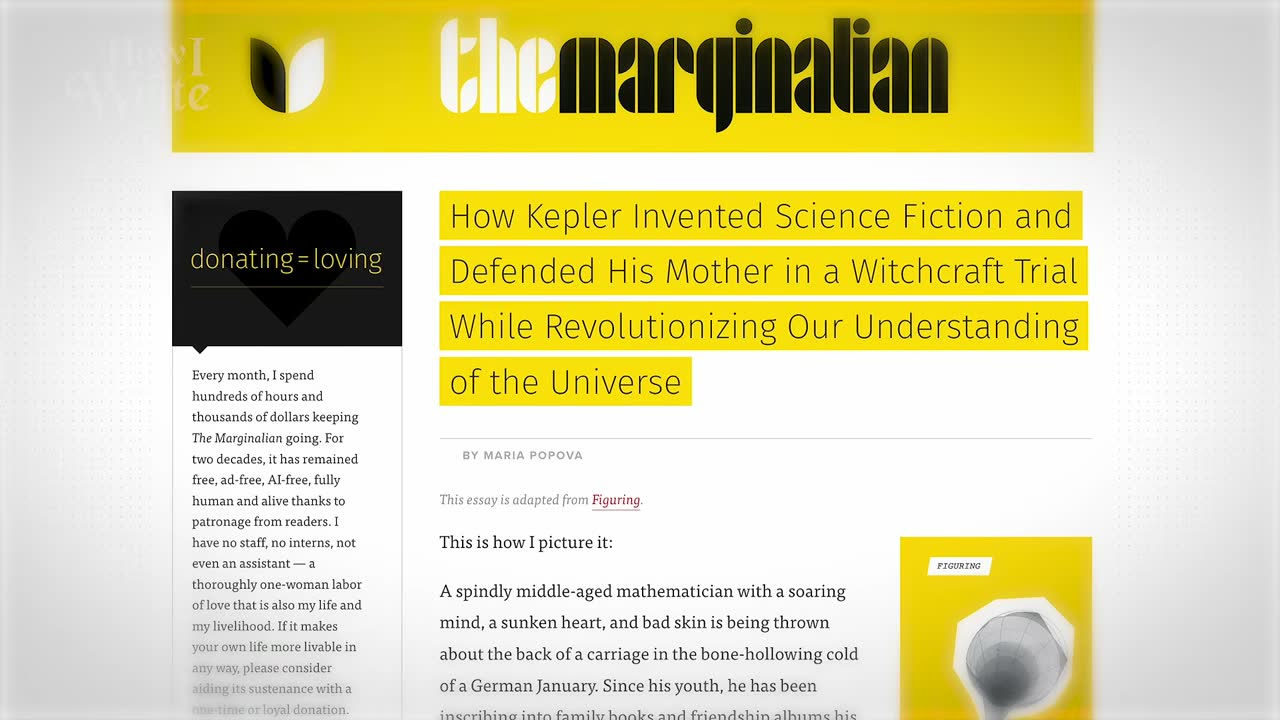
The Marginalian's page for Popova's essay on Kepler, illustrating her hyperlinked, wonder-driven site. Primary sources and walking feed the writing, not productivity routines. For her seven-year book she read Whitman's notebooks at the Library of Congress and Mary Shelley's journals at the Bodleian, arguing digitized material alone would misrepresent a life. She walks four hours a day and has written almost everything on foot, calling keyboard work "transcription."
She argues AI can supply information but not the feeling and time behind art: it could tell her about a scallop's eye, but without days in the papers she would not have written about it with feeling. She also says search fails at discovery, since you can only search for what you already know to look for.

How to Write Something Truly Honest (Maria Popova Interview)
It began as Brain Pickings, holds more than 6 million pages of writing, and the Library of Congress asked to add it to its permanent archive. It has never carried ads in 20 years, which she calls a pretty radical choice.
A personal blog grew into an archive the Library of Congress wanted. The Marginalian began as Brain Pickings, a personal site Maria Popova started 20 years ago, and now holds more than 6 million pages of writing. The Library of Congress asked to make it part of its permanent archive.
Popova frames the site's purpose as a record of how reading can guide a life, with books as wisdom in confusion and comfort in suffering.
Refusing ads freed the site from writing for clicks. The site has never carried advertising in 20 years, which Popova calls "a pretty radical choice." She rejects calling writing "content" because content presumes a container, and the container is advertising: clickbait and listicles sell pages, and pages sell ads.
She says this model has made cultural material shallower, "reducing human beings to eyeballs and writing to content." She moved away from it because she found it unsatisfying, not on moral grounds.
Popova renamed the blog once its name no longer fit her thinking. She chose "Brain Pickings" at 21, new to America, excited by puns (which Bulgarian culture lacks) and studying cognitive psychology, so the mind felt like the whole story.
She now calls herself more "anti-Cartesian" each year: experience is embodied, emotional and integrated, so what we feed the brain does not define what we become. She dislikes the old name as naive wordplay built on that narrow view.
A loose 20-year backlog replaces any editorial calendar. Popova has never planned a post. She keeps a running file of what she means to write about and dips in when she has time or wants to revisit something; she can scroll back and see that in 2016 she wanted to write about Susan Sontag's list of likes and dislikes.
Ideas fade or resurface on their own, and she returns to dropped ones a decade later with more associations, "revisiting them in a totally different way." She finds which interests fade and which return instructive in itself.
She writes to understand her own life, not to serve an audience. Popova started writing "to figure out how to live" and still writes for the same reason 20 years later. She says no objective view exists, even in impersonal-sounding pieces: "I am the lens."
Readers are a moving bonus, not the reason. Awareness of an audience is fine as long as it does not change what she makes.
The Marginalian's page for Popova's essay on Kepler, illustrating her hyperlinked, wonder-driven site. Primary sources and walking feed the writing, not productivity routines. For her seven-year book she read Whitman's notebooks at the Library of Congress and Mary Shelley's journals at the Bodleian, arguing digitized material alone would misrepresent a life. She walks four hours a day and has written almost everything on foot, calling keyboard work "transcription."
She argues AI can supply information but not the feeling and time behind art: it could tell her about a scallop's eye, but without days in the papers she would not have written about it with feeling. She also says search fails at discovery, since you can only search for what you already know to look for.
More in News & Media
 News & Media
Substack
A platform where writers publish newsletters and charge readers for subscriptions.

 22 sources · 36 tips
AppAdvice
An app discovery and news site that features app deals and promotions.
 16 sources · 26 tips
 News & Media
The New York Times
A major newspaper that rebuilt a digital bundle with games, cooking and Wirecutter.
10 sources · 29 tips News & Media
Marginal Revolution
Tyler Cowen's economics blog, written daily for over two decades.
3 sources · 18 tips News & Media
TechCrunch
A technology news publication known for startup and funding coverage.
8 sources · 14 tips News & Media
The New Yorker
A weekly magazine of essays, reporting, fiction and humor.
7 sources · 15 tips News & Media
Zinio
A digital newsstand app offering over 6,000 magazines on web, iOS and Android.
4 sources · 13 tips News & Media
Mark Manson
A self-help author and blogger known for The Subtle Art of Not Giving a F*ck.
2 sources · 19 tips