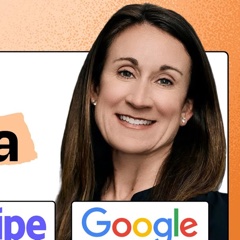
Jeanne DeWitt Grosser
COO at Vercel, formerly early sales leader at Stripe and Google
Where to hear and read about Jeanne DeWitt Grosser1 episode or test

Jeanne DeWitt Grosser is COO at Vercel, and she built Stripe's very early sales team after starting her career on Gmail at Google. The most useful thing to learn from her is to run go-to-market like a product: design the buyer's whole journey, then have engineers turn each repeatable human workflow into an agent.
it should take them 10 minutes to figure out you aren't a product manager.
What world-class GTM looks like in 2026 | Jeanne DeWitt Grosser (Vercel, Stripe, Google)
Jeanne DeWitt Grosser: the story and the lessons
1Jeanne DeWitt Grosser's path from Gmail to Stripe to Vercel
Grosser's first job out of college was on Gmail in 2004. Gmail launched on April 1 and she joined on June 1. Gmail was a massive JavaScript application with a gig of storage, which barely existed then.
That early product experience is the baseline she compares later markets against. Yahoo Mail took a full year to catch up and Hotmail took longer.
She built Stripe's very early sales team from the ground up. She spent nine years at Stripe and saw many lost customers come back and buy years later.
Stripe ran lean, with the principle that "efficiency is leverage". She got four outbound SDRs where most companies would have had 30.
Grosser now runs the whole revenue side as Vercel's COO. She oversees marketing, sales, customer success, revenue ops and field engineering. She has built go-to-market teams at several unicorns and advised dozens of companies.
She says the go-to-market engineer role already lets her team operate about 10 times faster.
Competitive diving taught her to repeat the dive and treat a no as data. After a bad landing a diver must climb back up and do the same dive immediately. She sees sales the same way: precise, repetitive, aiming for replicable outcomes and accurate forecasts.
A sales trainer told her yeses are great, nos are great, and maybe will kill you. Her mother's lines were "when the going gets tough, the tough get going" and "where there's a will there's a way".
2How Grosser thinks about go-to-market as one product
She defines go-to-market as every function that touches a customer or makes a dollar. That covers marketing, sales, technical sales, customer success, support and partnerships. She expects the 17 or so specialized roles to collapse into one lifecycle.
Each function chases a slightly different target, like a Venn diagram that never fully overlaps. Segmentation frameworks that differ from team to team are one example.
Grosser maps the buyer's path from first awareness to a five-year customer. The goal is a customer who is wall-to-wall on the platform five years later. She orchestrates that map the way you would design a product.
Each step can feel transactional and boring, or human, personalized and unique.
She argues that when products converge, the buying experience wins. Cloud computing let many companies build what once took a breakthrough, so products now differ only at the margin.
People buy many things because of how they feel about them. Her thesis is that the buying journey should therefore feel unique.
Grosser wants revenue leaders to think like general managers. Company strategy is product strategy meeting go-to-market strategy. A well-commercialized product makes more money more efficiently, so she leans into product and pricing strategy.
3How Vercel turned sales workflows into AI agents
A go-to-market engineer shadows the best SDR and encodes the workflow as an agent. The engineer first watches the top SDR, who may have seven tabs open across LinkedIn, ChatGPT and internal databases. The agent decides whether a lead is qualified and what to say, and a human reviews and sends.
The agent learns from what the reviewer rejects and edits. The goal is to trust it once the reviewer says yes often enough.
One part-time engineer replaced ten inbound SDRs with one reviewer. One engineer spent 25 to 30% of his time for six weeks. Ten inbound SDRs became one reviewer, and lead-to-opportunity conversion stayed flat.
The agent costs about $1,000 a year, against well over $1 million in salaries for the 10 SDRs. Nine of the 10 moved to outbound. It also needs fewer touches because it answers faster than a queue or a night-time lead.
She automates the most legible workflow first. Inbound came first because you can basically write it down and it is mostly deterministic. Outbound follows at the low end of the market, where one person decides.
In large enterprise, an agent may research the account but not send the message. Deep enterprise prospecting across many org layers will be the last to go.
Grosser built a deal bot that reads every call, email and Slack message. It began as a "lost bot" for quarterly loss reviews, then moved to real time. It posts into each customer's Slack channel, such as a warning that no economic buyer has been reached.
The quarter's biggest loss was blamed on price by the rep. The bot showed no one had reached the economic buyer and the ROI math did not convince. She treats such gaps as bugs to fix in weekly sprints: "They're bugs in your go to market process, so you should not have them."
She builds workflow-specific agents in-house and buys the generic ones. The lost-deal bot took about two days, roughly 40 hours. Your own content and workflow are what make an agent good.
Buying 20 tools for 20 jobs brings a procurement problem, which customers name as their biggest hurdle in deploying AI.
Her first GTM engineers were technical sales engineers who knew good sales. Vercel's first three were sales engineers, all former front-end developers. The agent is modeled on a rep with two years of experience.
Grosser, with 20 years of experience, spotted replies she would not have sent. Sales experience matters more than engineering pedigree.
Grosser documents the sales playbook before hiring a GTM engineer. Around 10 salespeople is a good size for turning a playbook into an agent. Strong startups often reach scale with no repeatable process, and an agent has nothing to copy then.
She says revenue operations should come earlier than founders think, and GTM engineering likely follows.
The sales team is customer zero for Vercel's own platform. Agents run on Vercel's AI cloud, using its workflow SDK and AI Gateway. The company's motto is that Vercel builds Vercel with Vercel.
Using the product on itself lets the team be a discerning customer and shows what is missing.
She uses agents to give sellers time with customers. Sellers have spent only 30 to 40% of their time with customers for 20 years. Her goal is 70%.
Stripe's 2017 attempt at automated outbound failed without AI. Project Rosalind was a database with one row per company on the planet and one column per attribute. The plan was an email template that was 80% fill-in-the-blank.
The false positive rate stayed too high even with data scientists. She is redoing the project at Vercel now, because the engineer builds agents rather than configuring tools like Outreach or Salesloft.
4Grosser's tactics for selling as an experience
Stripe's first sales call was a whiteboard session, not a quiz. The customer drew their payments architecture with the seller. Many left with a diagram they had never made before.
Stripe also learned what was in the stack, what it must displace and where the value lay. "They left that meeting with an asset."
Grosser adds value at every touch, even when the customer won't buy. Vercel's outreach shows prospects how their site performs alone and against peers. It also teaches when an MCP server makes sense and shares AEO knowledge.
At Stripe, customers lost in one cycle often returned three to five years later. Others simply come to see the company as insightful.
She publishes best-practice blueprints, not only generic docs. Large buyers want the best practice for their exact setup, like AWS's well-architected guides.
Marketplaces on Stripe disliked generic docs. Stripe had seen Lyft, Instacart and DoorDash, so it could say how to set up payments for a marketplace.
Grosser sells risk reduction to most buyers and upside mainly to founders. She cites roughly 80% of customers buying to avoid pain or reduce risk and 20% to gain upside. Enterprise buyers fear missing next quarter's target, losing to a competitor or brand damage.
She says the figures are approximate. It can feel off-brand to startups, but good questions show where a buyer is exposed.
She wants sellers to talk less than half the time. Founders often hear one pain point and jump to fixing it. Strong sellers go deep with the five W's before problem-solving.
Her rule: "if they ask a question, you should ask a question about the question and then respond."
5Grosser on segmentation, PLG and pricing
She segments by the attributes that change how a deal is sold. Small, medium and large is only a start. Stripe added growth potential and business model: B2B, B2C, platforms and marketplaces.
A customer growing 200% a year was worth more effort than one growing 8%. At Vercel she added site traffic and workload type.
Grosser let revenue data pick the attributes and kept them to three. In her first 30 days at Vercel she asked the head of data science what predicts a $100,000 customer versus a million-dollar one. She also looked at what clusters where Vercel wins repeatedly.
A handful of sellers cannot cover five segments. Because spend tracks traffic, OpenAI, at roughly 3,000 employees, was promoted to enterprise as a top-25 traffic site.
She teaches the segmentation framework to every new hire in week one. She presents it under the value of know your customer. New product managers then ask whether a back-end product is for an enterprise or a startup.
"A lot of times folks think segmentation is a go to market thing. I really think it's a company thing."
Grosser says add sales before PLG hits its ceiling. PLG fits most startups, but few buyers will pay a million dollars through self-serve. She cannot name a hundred-billion-dollar company that is PLG only.
Companies stall by waiting too long, since a repeatable sales process and a predictable outbound engine take a while to build.
She prices like a product and questions premium defaults. Price from where customers get value and where you incur cost. Stripe dropped the default free trial on Billing because integration effort kept users anyway.
About half of Vercel's enterprise SKU buyers were startups. Moving those features to self-serve in August drove growth in the PLG funnel.
6How Grosser hires and builds a sales org engineers respect
Her test: engineers should take 10 minutes to see a rep isn't a PM. She puts an account executive in front of 10 engineers. Deep product knowledge earns credibility, and she wants the best go-to-market orgs to be equal parts revenue driving and R&D.
She looks for hires with sales skills and a product mindset.
Grosser treats the sales team as a signal source for the roadmap. A 20-person sales team talks to far more customers in a week than a research team can.
Sellers must tell an objection to overcome from an opening in the market. A good seller knows when to say no, and says "I've heard this on the last three calls."
She hires the first seller once the ideal customer can be written down. About $1 million in ARR is the rough signal, if customers look alike. If they look nothing alike, the sale is still founder-led evangelism.
The founder hands over content, discovery questions and objection handling, but stays close to customers to learn where the product resonates next.
Grosser pairs experienced sellers with ex-consultants and bankers. Consultants and bankers are strong at quantitative and analytical work and learn that sales is a skill. Account executives learn to think about a P&L, talk to a CFO and present a TCO analysis.
She keeps sales comp flexible because strategy can change mid-year. Annual plans lock in what the company values 12 months ahead. Vercel wrote this year's plans before the AI cloud existed, and it launched mid-year.
She wants the motivation of upside without losing the freedom to pivot.

What world-class GTM looks like in 2026 | Jeanne DeWitt Grosser (Vercel, Stripe, Google)
Jeanne DeWitt Grosser explains how to run go-to-market like a product, from AI agents built by GTM engineers to segmentation, discovery and pricing. At Vercel, a lead agent costing about $1,000 a year let one SDR do the inbound work of ten while holding lead-to-opportunity conversion flat.
Grosser's first job out of college was on Gmail in 2004. Gmail launched on April 1 and she joined on June 1. Gmail was a massive JavaScript application with a gig of storage, which barely existed then.
That early product experience is the baseline she compares later markets against. Yahoo Mail took a full year to catch up and Hotmail took longer.
She built Stripe's very early sales team from the ground up. She spent nine years at Stripe and saw many lost customers come back and buy years later.
Stripe ran lean, with the principle that "efficiency is leverage". She got four outbound SDRs where most companies would have had 30.
Grosser now runs the whole revenue side as Vercel's COO. She oversees marketing, sales, customer success, revenue ops and field engineering. She has built go-to-market teams at several unicorns and advised dozens of companies.
She says the go-to-market engineer role already lets her team operate about 10 times faster.
Competitive diving taught her to repeat the dive and treat a no as data. After a bad landing a diver must climb back up and do the same dive immediately. She sees sales the same way: precise, repetitive, aiming for replicable outcomes and accurate forecasts.
A sales trainer told her yeses are great, nos are great, and maybe will kill you. Her mother's lines were "when the going gets tough, the tough get going" and "where there's a will there's a way".
She defines go-to-market as every function that touches a customer or makes a dollar. That covers marketing, sales, technical sales, customer success, support and partnerships. She expects the 17 or so specialized roles to collapse into one lifecycle.
Each function chases a slightly different target, like a Venn diagram that never fully overlaps. Segmentation frameworks that differ from team to team are one example.
Grosser maps the buyer's path from first awareness to a five-year customer. The goal is a customer who is wall-to-wall on the platform five years later. She orchestrates that map the way you would design a product.
Each step can feel transactional and boring, or human, personalized and unique.
She argues that when products converge, the buying experience wins. Cloud computing let many companies build what once took a breakthrough, so products now differ only at the margin.
People buy many things because of how they feel about them. Her thesis is that the buying journey should therefore feel unique.
Grosser wants revenue leaders to think like general managers. Company strategy is product strategy meeting go-to-market strategy. A well-commercialized product makes more money more efficiently, so she leans into product and pricing strategy.
A go-to-market engineer shadows the best SDR and encodes the workflow as an agent. The engineer first watches the top SDR, who may have seven tabs open across LinkedIn, ChatGPT and internal databases. The agent decides whether a lead is qualified and what to say, and a human reviews and sends.
The agent learns from what the reviewer rejects and edits. The goal is to trust it once the reviewer says yes often enough.
One part-time engineer replaced ten inbound SDRs with one reviewer. One engineer spent 25 to 30% of his time for six weeks. Ten inbound SDRs became one reviewer, and lead-to-opportunity conversion stayed flat.
The agent costs about $1,000 a year, against well over $1 million in salaries for the 10 SDRs. Nine of the 10 moved to outbound. It also needs fewer touches because it answers faster than a queue or a night-time lead.
She automates the most legible workflow first. Inbound came first because you can basically write it down and it is mostly deterministic. Outbound follows at the low end of the market, where one person decides.
In large enterprise, an agent may research the account but not send the message. Deep enterprise prospecting across many org layers will be the last to go.
Grosser built a deal bot that reads every call, email and Slack message. It began as a "lost bot" for quarterly loss reviews, then moved to real time. It posts into each customer's Slack channel, such as a warning that no economic buyer has been reached.
The quarter's biggest loss was blamed on price by the rep. The bot showed no one had reached the economic buyer and the ROI math did not convince. She treats such gaps as bugs to fix in weekly sprints: "They're bugs in your go to market process, so you should not have them."
She builds workflow-specific agents in-house and buys the generic ones. The lost-deal bot took about two days, roughly 40 hours. Your own content and workflow are what make an agent good.
Buying 20 tools for 20 jobs brings a procurement problem, which customers name as their biggest hurdle in deploying AI.
Her first GTM engineers were technical sales engineers who knew good sales. Vercel's first three were sales engineers, all former front-end developers. The agent is modeled on a rep with two years of experience.
Grosser, with 20 years of experience, spotted replies she would not have sent. Sales experience matters more than engineering pedigree.
Grosser documents the sales playbook before hiring a GTM engineer. Around 10 salespeople is a good size for turning a playbook into an agent. Strong startups often reach scale with no repeatable process, and an agent has nothing to copy then.
She says revenue operations should come earlier than founders think, and GTM engineering likely follows.
The sales team is customer zero for Vercel's own platform. Agents run on Vercel's AI cloud, using its workflow SDK and AI Gateway. The company's motto is that Vercel builds Vercel with Vercel.
Using the product on itself lets the team be a discerning customer and shows what is missing.
She uses agents to give sellers time with customers. Sellers have spent only 30 to 40% of their time with customers for 20 years. Her goal is 70%.
Stripe's 2017 attempt at automated outbound failed without AI. Project Rosalind was a database with one row per company on the planet and one column per attribute. The plan was an email template that was 80% fill-in-the-blank.
The false positive rate stayed too high even with data scientists. She is redoing the project at Vercel now, because the engineer builds agents rather than configuring tools like Outreach or Salesloft.
Stripe's first sales call was a whiteboard session, not a quiz. The customer drew their payments architecture with the seller. Many left with a diagram they had never made before.
Stripe also learned what was in the stack, what it must displace and where the value lay. "They left that meeting with an asset."
Grosser adds value at every touch, even when the customer won't buy. Vercel's outreach shows prospects how their site performs alone and against peers. It also teaches when an MCP server makes sense and shares AEO knowledge.
At Stripe, customers lost in one cycle often returned three to five years later. Others simply come to see the company as insightful.
She publishes best-practice blueprints, not only generic docs. Large buyers want the best practice for their exact setup, like AWS's well-architected guides.
Marketplaces on Stripe disliked generic docs. Stripe had seen Lyft, Instacart and DoorDash, so it could say how to set up payments for a marketplace.
Grosser sells risk reduction to most buyers and upside mainly to founders. She cites roughly 80% of customers buying to avoid pain or reduce risk and 20% to gain upside. Enterprise buyers fear missing next quarter's target, losing to a competitor or brand damage.
She says the figures are approximate. It can feel off-brand to startups, but good questions show where a buyer is exposed.
She wants sellers to talk less than half the time. Founders often hear one pain point and jump to fixing it. Strong sellers go deep with the five W's before problem-solving.
Her rule: "if they ask a question, you should ask a question about the question and then respond."
She segments by the attributes that change how a deal is sold. Small, medium and large is only a start. Stripe added growth potential and business model: B2B, B2C, platforms and marketplaces.
A customer growing 200% a year was worth more effort than one growing 8%. At Vercel she added site traffic and workload type.
Grosser let revenue data pick the attributes and kept them to three. In her first 30 days at Vercel she asked the head of data science what predicts a $100,000 customer versus a million-dollar one. She also looked at what clusters where Vercel wins repeatedly.
A handful of sellers cannot cover five segments. Because spend tracks traffic, OpenAI, at roughly 3,000 employees, was promoted to enterprise as a top-25 traffic site.
She teaches the segmentation framework to every new hire in week one. She presents it under the value of know your customer. New product managers then ask whether a back-end product is for an enterprise or a startup.
"A lot of times folks think segmentation is a go to market thing. I really think it's a company thing."
Grosser says add sales before PLG hits its ceiling. PLG fits most startups, but few buyers will pay a million dollars through self-serve. She cannot name a hundred-billion-dollar company that is PLG only.
Companies stall by waiting too long, since a repeatable sales process and a predictable outbound engine take a while to build.
She prices like a product and questions premium defaults. Price from where customers get value and where you incur cost. Stripe dropped the default free trial on Billing because integration effort kept users anyway.
About half of Vercel's enterprise SKU buyers were startups. Moving those features to self-serve in August drove growth in the PLG funnel.
Her test: engineers should take 10 minutes to see a rep isn't a PM. She puts an account executive in front of 10 engineers. Deep product knowledge earns credibility, and she wants the best go-to-market orgs to be equal parts revenue driving and R&D.
She looks for hires with sales skills and a product mindset.
Grosser treats the sales team as a signal source for the roadmap. A 20-person sales team talks to far more customers in a week than a research team can.
Sellers must tell an objection to overcome from an opening in the market. A good seller knows when to say no, and says "I've heard this on the last three calls."
She hires the first seller once the ideal customer can be written down. About $1 million in ARR is the rough signal, if customers look alike. If they look nothing alike, the sale is still founder-led evangelism.
The founder hands over content, discovery questions and objection handling, but stays close to customers to learn where the product resonates next.
Grosser pairs experienced sellers with ex-consultants and bankers. Consultants and bankers are strong at quantitative and analytical work and learn that sales is a skill. Account executives learn to think about a P&L, talk to a CFO and present a TCO analysis.
She keeps sales comp flexible because strategy can change mid-year. Annual plans lock in what the company values 12 months ahead. Vercel wrote this year's plans before the AI cloud existed, and it launched mid-year.
She wants the motivation of upside without losing the freedom to pivot.
 Vercel