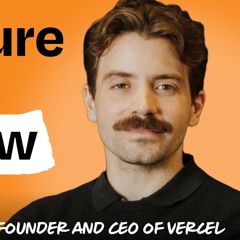
Guillermo Rauch
Founder and CEO of Vercel, creator of Next.js and Socket.IO
Where to hear and read about Guillermo Rauch1 episode or test

Guillermo Rauch is the founder and CEO of Vercel and the creator of Next.js and Socket.IO, and he now leads v0, which turns prompts into shippable web products. The lesson most worth taking: pair AI that does the translation work with your own knowledge of how things work and many hours watching real users.
Try to quantify how much time you expose yourself to watching how people use your products and you'll develop that muscle.
Everyone’s an engineer now: Inside v0’s mission to create 100 million builders | Guillermo Rauch
Guillermo Rauch: the story and the lessons
1Guillermo Rauch and the mission behind v0
Rauch keeps turning hard technology into something easy to use. He created Socket.IO, which broadcasts changes between collaborators in Notion, and Next.js, which powers Claude, Grok and Midjourney. He founded Vercel, which makes v0.
Both earlier tools still demanded development skills. v0 aims to let people who don't code ship real products that look as good as the best sites on the web.
Rauch sized v0 by counting builders, not developers. He counts about 5 million React developers and 20 million JavaScript developers, then goes past them. His napkin minimum is 100 million, based on Slack's roughly 100 million monthly users who talk about products they want built.
v0 had over 1.3 million users, and the day before the interview was its biggest day ever. He calls the 100 million figure a "back of the napkin, minimum calculation".
Rauch's long open source bet put Vercel's tools inside the models. Next.js, React, Tailwind and shadcn were already in LLM training data, so ChatGPT wrote that code well from the start. The first v0 prototype may have predated ChatGPT and ran on GPT 3.5.
v0 now runs a pipeline of models across OpenAI, Gemini and Claude, each handling the tasks it is best at.
Rauch sees v0 as social, intent-first product building. He treats it as the next step after GitHub's social coding. v0 Community passed 20,000 submissions in under a month, with top apps forked 1,200, 1,500 and 6,000 times.
A Git commit summarizes intent after the work is done. In v0 the intent comes first and the code follows, so people start from someone else's app and make it their own.
2How Rauch gets results from v0
Rauch describes the experience and lets the tool choose the implementation. He asked v0 for "the best flight radar on the planet" and it chose Mapbox and Leaflet on its own. He built it on plane Wi-Fi in under two hours on a $20 plan, work he says would take engineers weeks.
Over-prescribing blocks better answers. v0 once used a CSS sepia filter he didn't know existed, so he advises "some suspension of disbelief".
Rauch unsticks v0 by telling it to try something else. He treats the chat like coaching an agency or a junior engineer. A bare "just try something else" has often fixed things with no further direction.
A Luma Labs designer stuck at about 120 iterations pasted v0's code into ChatGPT o1 and got a fix. Visible, editable Next.js code is the escape hatch.
Rauch starts from forks and screenshots instead of a blank box. A blank prompt box causes writer's block, so he forks a close community app and prompts changes. A Fortune.com screenshot produced a news site, and a second sepia screenshot restyled the whole thing.
He suggests screenshotting your own art boards and Slack posts rather than cloning other sites.
Rauch steers design with style words and plain criticism. Terms like neobrutalist, minimalist, newspaper-like, vintage or "like a telegram" unlock looks you would not think of. A bank CIO disliked v0's first take on his music festival brochure, and after Rauch told him to prompt "make it more jazzy and make it pop", he preferred the result to the original designer's lineup.
Rauch says he is still learning what v0 can do with design.
Rauch cuts big projects into one file or component. Very large code bases are v0's weak spot because the model can lose track over a long context. Giving it one component or one file lowers that risk.
Next.js routes a page from a single file, much like PHP, which suits how LLMs work with files.
3What Rauch says builders should learn now
Rauch says knowing how things work beats memorized specialization. He once hired specialists whose job was turning Figma designs into CSS layout code. He now expects that translation work to fade, and rebuilding his own website took 10 to 15 prompts with one model generation and 2 with the next.
Vocabulary like CSS, layout and databases lets you steer the model. Foundational infrastructure skills stay valuable because models orchestrate existing tools rather than writing a compiler or a cloud.
Rauch pushes his kids toward math, eloquence and presenting. He wants them to know words well, as a "global mental map of symbolic systems", and takes them to hackathons to watch people present ideas. The latest was the BLOOM Hackathon at the University of San Francisco.
When the cost of building falls, you need an audience and a signature brand. He says prompt enhancement tools cannot replace the thinking you bring.
Rauch wants builders to read generated code, starting with JavaScript. He asks for a high-level grasp of what the code does, not syntax recall. A Ramp engineer who knew only Next.js ran the company's Super Bowl ad traffic at 43x with 100 percent uptime.
He calls JavaScript the English of programming languages, and the major models pair it with React for web apps.
Rauch treats taste as a skill you can develop. He says to try many products, ship your own, watch how people react and go back to the drawing board. He studies details such as Grok submitting on Enter on desktop but adding a new line on mobile.
He says he sees taste "as a skill that it can develop", not a gift.
4How Rauch runs Vercel and builds quality in
Rauch makes exposure hours an operating principle. He color-codes his calendar for customer meetings, and about a third of his meetings one week were with customers. Customers demo live to the executive team or the whole company, and each demo surfaces an unknown pain.
He says makers overrate how well their products work and calls watching users "exposing yourself to the pain of reality".
Rauch copied Stripe's feedback button to hear users daily. Early Vercel used a button with four emojis that posted straight into Slack. It brought in tens or hundreds of notes a day.
In v0, users send thumbs and bug reports pointing to where the AI went wrong, which improves the next model, prompts and examples.
Rauch says the best builders say no nine times for every yes. He compares a feature to adopting a puppy that grows into a beast needing care. A great product is a thousand small details, so you are never done.
Vercel uses Vercel and v0 heavily to build Vercel and v0. He points to Midjourney's mobile web as proof that love, restraint and testing pay off.
Rauch lets users see the AI's thinking and edit its code. After DeepSeek made visible thinking tokens a killer feature, v0 showed its reasoning so users can correct it. Rauch says v0 retains better than other AI products he has built.
Users who hit a bug are vocal because they depend on it daily. A small disclaimer under the input warns that errors will happen.
Rauch lets every function ship through Demo Fridays and live specs. Vercel has 150 engineers among 600 people, and some of its best v0 creations come from marketing, sales and product. A designer's interactive compute demo built in v0 became one of Rauch's most viral X posts.
Product managers spec in working software: the deploy-from-v0 feature was a live PRD with error, success and slow-stream states. He sees the permission to build as the cultural backdrop for this.
Rauch backs expert-built AI tools and won't oversell v0. He cites chatprd.com, OpenEvidence and Get GC.AI, whose CEO is a lawyer and which Vercel's legal team prefers to ChatGPT. He agrees with a user who called v0 a "super genius five-year old PhD with ADHD".
He expects AI to stay a copilot that humans direct, since it does not always know what we want.

Everyone’s an engineer now: Inside v0’s mission to create 100 million builders | Guillermo Rauch
Guillermo Rauch explains how v0 turns prompts into real, shippable web products, and how to prompt it, get unstuck, build taste and run a team where everyone can ship. He built a working flight radar app in under two hours on a $20 plan, work he estimates would take engineers weeks.
Rauch keeps turning hard technology into something easy to use. He created Socket.IO, which broadcasts changes between collaborators in Notion, and Next.js, which powers Claude, Grok and Midjourney. He founded Vercel, which makes v0.
Both earlier tools still demanded development skills. v0 aims to let people who don't code ship real products that look as good as the best sites on the web.
Rauch sized v0 by counting builders, not developers. He counts about 5 million React developers and 20 million JavaScript developers, then goes past them. His napkin minimum is 100 million, based on Slack's roughly 100 million monthly users who talk about products they want built.
v0 had over 1.3 million users, and the day before the interview was its biggest day ever. He calls the 100 million figure a "back of the napkin, minimum calculation".
Rauch's long open source bet put Vercel's tools inside the models. Next.js, React, Tailwind and shadcn were already in LLM training data, so ChatGPT wrote that code well from the start. The first v0 prototype may have predated ChatGPT and ran on GPT 3.5.
v0 now runs a pipeline of models across OpenAI, Gemini and Claude, each handling the tasks it is best at.
Rauch sees v0 as social, intent-first product building. He treats it as the next step after GitHub's social coding. v0 Community passed 20,000 submissions in under a month, with top apps forked 1,200, 1,500 and 6,000 times.
A Git commit summarizes intent after the work is done. In v0 the intent comes first and the code follows, so people start from someone else's app and make it their own.
Rauch describes the experience and lets the tool choose the implementation. He asked v0 for "the best flight radar on the planet" and it chose Mapbox and Leaflet on its own. He built it on plane Wi-Fi in under two hours on a $20 plan, work he says would take engineers weeks.
Over-prescribing blocks better answers. v0 once used a CSS sepia filter he didn't know existed, so he advises "some suspension of disbelief".
Rauch unsticks v0 by telling it to try something else. He treats the chat like coaching an agency or a junior engineer. A bare "just try something else" has often fixed things with no further direction.
A Luma Labs designer stuck at about 120 iterations pasted v0's code into ChatGPT o1 and got a fix. Visible, editable Next.js code is the escape hatch.
Rauch starts from forks and screenshots instead of a blank box. A blank prompt box causes writer's block, so he forks a close community app and prompts changes. A Fortune.com screenshot produced a news site, and a second sepia screenshot restyled the whole thing.
He suggests screenshotting your own art boards and Slack posts rather than cloning other sites.
Rauch steers design with style words and plain criticism. Terms like neobrutalist, minimalist, newspaper-like, vintage or "like a telegram" unlock looks you would not think of. A bank CIO disliked v0's first take on his music festival brochure, and after Rauch told him to prompt "make it more jazzy and make it pop", he preferred the result to the original designer's lineup.
Rauch says he is still learning what v0 can do with design.
Rauch cuts big projects into one file or component. Very large code bases are v0's weak spot because the model can lose track over a long context. Giving it one component or one file lowers that risk.
Next.js routes a page from a single file, much like PHP, which suits how LLMs work with files.
Rauch says knowing how things work beats memorized specialization. He once hired specialists whose job was turning Figma designs into CSS layout code. He now expects that translation work to fade, and rebuilding his own website took 10 to 15 prompts with one model generation and 2 with the next.
Vocabulary like CSS, layout and databases lets you steer the model. Foundational infrastructure skills stay valuable because models orchestrate existing tools rather than writing a compiler or a cloud.
Rauch pushes his kids toward math, eloquence and presenting. He wants them to know words well, as a "global mental map of symbolic systems", and takes them to hackathons to watch people present ideas. The latest was the BLOOM Hackathon at the University of San Francisco.
When the cost of building falls, you need an audience and a signature brand. He says prompt enhancement tools cannot replace the thinking you bring.
Rauch wants builders to read generated code, starting with JavaScript. He asks for a high-level grasp of what the code does, not syntax recall. A Ramp engineer who knew only Next.js ran the company's Super Bowl ad traffic at 43x with 100 percent uptime.
He calls JavaScript the English of programming languages, and the major models pair it with React for web apps.
Rauch treats taste as a skill you can develop. He says to try many products, ship your own, watch how people react and go back to the drawing board. He studies details such as Grok submitting on Enter on desktop but adding a new line on mobile.
He says he sees taste "as a skill that it can develop", not a gift.
Rauch makes exposure hours an operating principle. He color-codes his calendar for customer meetings, and about a third of his meetings one week were with customers. Customers demo live to the executive team or the whole company, and each demo surfaces an unknown pain.
He says makers overrate how well their products work and calls watching users "exposing yourself to the pain of reality".
Rauch copied Stripe's feedback button to hear users daily. Early Vercel used a button with four emojis that posted straight into Slack. It brought in tens or hundreds of notes a day.
In v0, users send thumbs and bug reports pointing to where the AI went wrong, which improves the next model, prompts and examples.
Rauch says the best builders say no nine times for every yes. He compares a feature to adopting a puppy that grows into a beast needing care. A great product is a thousand small details, so you are never done.
Vercel uses Vercel and v0 heavily to build Vercel and v0. He points to Midjourney's mobile web as proof that love, restraint and testing pay off.
Rauch lets users see the AI's thinking and edit its code. After DeepSeek made visible thinking tokens a killer feature, v0 showed its reasoning so users can correct it. Rauch says v0 retains better than other AI products he has built.
Users who hit a bug are vocal because they depend on it daily. A small disclaimer under the input warns that errors will happen.
Rauch lets every function ship through Demo Fridays and live specs. Vercel has 150 engineers among 600 people, and some of its best v0 creations come from marketing, sales and product. A designer's interactive compute demo built in v0 became one of Rauch's most viral X posts.
Product managers spec in working software: the deploy-from-v0 feature was a live PRD with error, success and slow-stream states. He sees the permission to build as the cultural backdrop for this.
Rauch backs expert-built AI tools and won't oversell v0. He cites chatprd.com, OpenEvidence and Get GC.AI, whose CEO is a lawyer and which Vercel's legal team prefers to ChatGPT. He agrees with a user who called v0 a "super genius five-year old PhD with ADHD".
He expects AI to stay a copilot that humans direct, since it does not always know what we want.

 Vercel