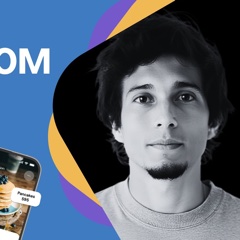
Jake Castillo
Co-founder, Cal AI (now part of MyFitnessPal)
Where to hear and read about Jake Castillo1 episode or test

Jake Castillo is co-founder of Cal AI, the calorie tracker now part of MyFitnessPal, and ran its marketing to over 15 million downloads. The thing most worth learning from him is to pay creators whose audiences want what your app solves, using flat deals capped by revenue per thousand views, and to read the comments rather than the view counts.
Views can lie, followers can lie, but comments cannot.
How Cal AI turned creators into a growth machine — Jake Castillo, Cal AI
Jake Castillo: the story and the lessons
1How Jake Castillo ended up at Cal AI
Castillo met Cal AI's CEO Zach while both moonlighted at StudyBuddy. Jake worked consulting from 8 to 8, then on StudyBuddy until 2 AM. Zach started there as an intern while still in high school.
Zach left in April 2024 and Jake quit in May. Two days later Zach DMed him on a Twitter account he rarely checked, seen only while backing up a new phone, and asked him to help with marketing for the app he built.
He joined a four-person team where each founder owned one domain. Zach, Blake Anderson, Henry Langmack and Jake each had their own area, and they got along despite a large age gap. Jake had $70,000 in student loans and a new house, so he was risk averse.
Working with young people who had "no fear" pushed him to get comfortable being uncomfortable.
Castillo stayed on after the MyFitnessPal sale to keep Cal AI itself. Cal AI has over 15 million downloads. Jake is nearly a year in, longer than the usual three-month transition, and his goal is still the number one calorie tracker in the world.
CEO Zach handled the deal, Jake did marketing only and Henry did development only. Price and terms were not shared. Jake sees Cal AI as his legacy.
2How Castillo turned creators into Cal AI's growth channel
An early creator who said yes to everything gave Cal AI its format. Dawson Gibbs took on extra work without demanding a rate and tried many angles and formats. Cal AI found a working format fast, then copied it across fitness influencers.
Many creators charge for anything outside scope. Jake gave Dawson a bonus instead, and they became close friends. "If you treat the relationship strictly as transactional, it's going to always be transactional."
Castillo chose fitness because supply was large and the content already fit. Fitness had huge numbers of creators, few brands, and many creators who had never had a brand deal. Their weekly what I eat in a day videos made scanning meals an easy ask.
Dawson's conversions proved the thesis. An astrology app, by contrast, has few creators and rival apps may hold exclusive deals, so each app has to test supply, format and demo fit.
He built creator content around a three-beat magic moment. Scan, analyze, result made viewers do a double take. It had to be understood in seconds, or the mention read as an ad and never went viral.
An app with no magic moment is better served by hard-sell paid ads. Jake says groups of three suit how brains take in information.
Castillo removed small UI details that broke the magic moment. The streak pop-up added a fourth beat, so creators skipped the first scan of the day. Cal AI also made a creator build showing its name and logo while scanning.
Subtle integrations got a "tracked with Cal AI" caption, but blunt ones did not because it hurt views. "No marketing program should ever feel like a finished product."
He messaged creators every day for 18 months. The goal was roughly 500 signed creators from about 10,000 contacted. Most never replied or asked for rates he could not afford.
People who try it for a day say they will not do it again, which is why it stays an edge. Health and fitness is probably the biggest niche on social media, so another creator was always available.
Castillo systemized creator management so bandwidth never became the limit. A heavily automated Google Sheet managed hundreds of creators, with 50 to 70 posting on a single day. Jake's eight years in management consulting taught him to scale complex operations.
Existing tools disappointed him, so he built Virality, which stores deals, sends contracts, tracks posts and views, works out bonuses and payment dates, and gives a renewal score. He expected it to launch around the end of October.
He built in public and was unafraid of clones. The team posted wins and failures on Twitter, and critics warned it fed rivals. Jake saw no threat because clones copied the surface while the team obsessed over small improvements.
Twitter threads asking whether clones were the best app opportunity sent traffic to Cal AI. People disappointed by a clone searched Google and the App Store, where Cal AI ranked first.
3Jake Castillo's rules for paying and choosing creators
Castillo never pays a CPM above his revenue per thousand views. Revenue per 1,000 views varies by niche and is a hard ceiling. Each rate is set from the views a creator can reasonably be expected to get.
Some creators refuse, and Jake accepts that. He measured RPM early by watching download and sales spikes after a single post, when no other marketing was running. "You can't pay a CPM that is higher than that RPM."
He prefers flat-rate deals to keep the upside of a viral hit. Break-even is set by a creator's average views, and the profit sits in the one post that goes mega viral. One creator posted 10,000 to 12,000 views for two months, then hit 7 million and never fell under 500,000.
If a creator asks for a fixed sum like $1,000 a month, Jake can often agree and raise the deliverables. Getting on a call and showing he is a regular person helped creators meet in the middle.
Castillo reads comment sections instead of views or followers. For a niche, he reads the comments on its biggest creators to see if people want what the app solves. For a single creator, thank-you comments from people asking how to train convert, and fire emojis do not.
He expects about one creator in ten to convert, and comments are how he finds that one. He separates a plain following from a cult-like one and plants his flag with the cult-like one.
He signs promising creators before their numbers catch up. A cult-like following is a lagging indicator, so creators with strong content and small views accept lower pay. Jake signed one around the 12th to 15th creator he ever signed, who later had a 7 million view video.
The creator earned little at first. Jake kept the friendship and later connected him with other brands. Watching many creators is what lets him spot them early.
Castillo pays unprompted bonuses and calls generosity slightly selfish. Some bonuses came with no ask, like "you crushed it this month, here you go." Jake says no one in the space does that.
Over a long horizon he expects generosity to come back, and happy creators refer their friends.
He uses a renewal score once attribution gets murky. With several creators going viral on the same day, views cannot say who drove a spike. The score weighs many metrics, and incrementality tests and follower demographics help.
Comments, likes and saves also show whose video drove the spike. Jake argues the best founders and marketers are strong at data analysis for this reason.
Cal AI's affiliate program pays a flat $10 once per sale. The public program pays $10 for each signup that results in a sale, not per download. David Barnard puts that at about 33% of gross margin.
Aligned incentives make it a win-win. A one-time payout avoids lifetime renewal obligations that could complicate selling the app.
4Where Castillo's bets failed and why copying him is risky
UFC creators looked perfect on paper and produced no download spike. Fighters track every calorie when cutting weight, and the team expected UFC to open the door to 1,000 more creators. Several UFC creators were signed for thousands of dollars each with no result.
Audience research showed viewers enjoy watching someone else on a severe diet and do not want to do it. "Big bold bets" was a core value, and a deal losing a couple of thousand dollars is offset by winners that can earn hundreds of thousands.
Mukbang failed for the same reason: viewers wanted a reward, not numbers. Creators eat 10,000 calories or more in one sitting, and the plan was to announce 20,000 calories first and show how easy tracking is. Viewers treat it as a cheat day and do not want calorie counts.
The lesson Jake draws is to ask why viewers watch and what psychological motive drives them, not only what the creator can make.
Castillo says copying Cal AI is the easiest way to blow money. The playbook worked because of hard daily work and many small tested details in one specific market. Each app needs to fit it to its own supply of creators, format and demo.
He admits luck and tailwinds helped but says work "increases your surface area for luck." His biggest fail was a bunch of influencer deals that did not work, which he treats as the cost of learning.
He says growth is simple but not easy, and lives in avoided work. Many people do everything except the work. Jake's view is that if it sucks, you are probably doing something right.
"It's in the work you're avoiding."
5How Cal AI approached paid ads, onboarding and price
Castillo added paid ads after a couple of months and built dedicated creative. Paid ads take less work than influencers and spread risk. Reusing influencer videos gave some results, but dedicated paid creative did far better.
Organic videos swing for a viral hit with a subtle mention, while in paid every view costs money so the sell should be hard and clear. The hook must relate to the product, a lesson he credits to friends at Speechify. Tools like Tribe supply creative free for a share of ad spend.
He makes ads, store page and onboarding tell one story. Ads name the pain, and onboarding repeats it, shows what it has caused and asks what if there were an easier way, before presenting the app.
Jake compares a mismatch to a five-star lobby leading to a dirty room, which feels like a betrayal. People accept a modest room if the lobby matched it. Onboarding is probably the most impactful part of the path.
Cal AI held its price at $30 a year to win mind share. Co-founder Blake Anderson held that profit comes second to being the easiest app to buy. Cal AI stayed at $30 a year while MyFitnessPal charged about $70.
Jake's consulting instinct was to cut costs and raise prices, but the price was tested a lot and stayed low. The audience was young, with less disposable income and a shorter history with the problem. Barnard adds that low prices only work in markets that can go big.

How Cal AI turned creators into a growth machine — Jake Castillo, Cal AI
Cal AI's co-founder explains how creator partnerships, a visual magic moment, and flat-rate deals capped by revenue per thousand views took the calorie tracker past 15 million downloads. He also covers why UFC and mukbang creators flopped, how to read comment sections, and why a $30 a year price was chosen to win mind share.
Castillo met Cal AI's CEO Zach while both moonlighted at StudyBuddy. Jake worked consulting from 8 to 8, then on StudyBuddy until 2 AM. Zach started there as an intern while still in high school.
Zach left in April 2024 and Jake quit in May. Two days later Zach DMed him on a Twitter account he rarely checked, seen only while backing up a new phone, and asked him to help with marketing for the app he built.
He joined a four-person team where each founder owned one domain. Zach, Blake Anderson, Henry Langmack and Jake each had their own area, and they got along despite a large age gap. Jake had $70,000 in student loans and a new house, so he was risk averse.
Working with young people who had "no fear" pushed him to get comfortable being uncomfortable.
Castillo stayed on after the MyFitnessPal sale to keep Cal AI itself. Cal AI has over 15 million downloads. Jake is nearly a year in, longer than the usual three-month transition, and his goal is still the number one calorie tracker in the world.
CEO Zach handled the deal, Jake did marketing only and Henry did development only. Price and terms were not shared. Jake sees Cal AI as his legacy.
An early creator who said yes to everything gave Cal AI its format. Dawson Gibbs took on extra work without demanding a rate and tried many angles and formats. Cal AI found a working format fast, then copied it across fitness influencers.
Many creators charge for anything outside scope. Jake gave Dawson a bonus instead, and they became close friends. "If you treat the relationship strictly as transactional, it's going to always be transactional."
Castillo chose fitness because supply was large and the content already fit. Fitness had huge numbers of creators, few brands, and many creators who had never had a brand deal. Their weekly what I eat in a day videos made scanning meals an easy ask.
Dawson's conversions proved the thesis. An astrology app, by contrast, has few creators and rival apps may hold exclusive deals, so each app has to test supply, format and demo fit.
He built creator content around a three-beat magic moment. Scan, analyze, result made viewers do a double take. It had to be understood in seconds, or the mention read as an ad and never went viral.
An app with no magic moment is better served by hard-sell paid ads. Jake says groups of three suit how brains take in information.
Castillo removed small UI details that broke the magic moment. The streak pop-up added a fourth beat, so creators skipped the first scan of the day. Cal AI also made a creator build showing its name and logo while scanning.
Subtle integrations got a "tracked with Cal AI" caption, but blunt ones did not because it hurt views. "No marketing program should ever feel like a finished product."
He messaged creators every day for 18 months. The goal was roughly 500 signed creators from about 10,000 contacted. Most never replied or asked for rates he could not afford.
People who try it for a day say they will not do it again, which is why it stays an edge. Health and fitness is probably the biggest niche on social media, so another creator was always available.
Castillo systemized creator management so bandwidth never became the limit. A heavily automated Google Sheet managed hundreds of creators, with 50 to 70 posting on a single day. Jake's eight years in management consulting taught him to scale complex operations.
Existing tools disappointed him, so he built Virality, which stores deals, sends contracts, tracks posts and views, works out bonuses and payment dates, and gives a renewal score. He expected it to launch around the end of October.
He built in public and was unafraid of clones. The team posted wins and failures on Twitter, and critics warned it fed rivals. Jake saw no threat because clones copied the surface while the team obsessed over small improvements.
Twitter threads asking whether clones were the best app opportunity sent traffic to Cal AI. People disappointed by a clone searched Google and the App Store, where Cal AI ranked first.
Castillo never pays a CPM above his revenue per thousand views. Revenue per 1,000 views varies by niche and is a hard ceiling. Each rate is set from the views a creator can reasonably be expected to get.
Some creators refuse, and Jake accepts that. He measured RPM early by watching download and sales spikes after a single post, when no other marketing was running. "You can't pay a CPM that is higher than that RPM."
He prefers flat-rate deals to keep the upside of a viral hit. Break-even is set by a creator's average views, and the profit sits in the one post that goes mega viral. One creator posted 10,000 to 12,000 views for two months, then hit 7 million and never fell under 500,000.
If a creator asks for a fixed sum like $1,000 a month, Jake can often agree and raise the deliverables. Getting on a call and showing he is a regular person helped creators meet in the middle.
Castillo reads comment sections instead of views or followers. For a niche, he reads the comments on its biggest creators to see if people want what the app solves. For a single creator, thank-you comments from people asking how to train convert, and fire emojis do not.
He expects about one creator in ten to convert, and comments are how he finds that one. He separates a plain following from a cult-like one and plants his flag with the cult-like one.
He signs promising creators before their numbers catch up. A cult-like following is a lagging indicator, so creators with strong content and small views accept lower pay. Jake signed one around the 12th to 15th creator he ever signed, who later had a 7 million view video.
The creator earned little at first. Jake kept the friendship and later connected him with other brands. Watching many creators is what lets him spot them early.
Castillo pays unprompted bonuses and calls generosity slightly selfish. Some bonuses came with no ask, like "you crushed it this month, here you go." Jake says no one in the space does that.
Over a long horizon he expects generosity to come back, and happy creators refer their friends.
He uses a renewal score once attribution gets murky. With several creators going viral on the same day, views cannot say who drove a spike. The score weighs many metrics, and incrementality tests and follower demographics help.
Comments, likes and saves also show whose video drove the spike. Jake argues the best founders and marketers are strong at data analysis for this reason.
Cal AI's affiliate program pays a flat $10 once per sale. The public program pays $10 for each signup that results in a sale, not per download. David Barnard puts that at about 33% of gross margin.
Aligned incentives make it a win-win. A one-time payout avoids lifetime renewal obligations that could complicate selling the app.
UFC creators looked perfect on paper and produced no download spike. Fighters track every calorie when cutting weight, and the team expected UFC to open the door to 1,000 more creators. Several UFC creators were signed for thousands of dollars each with no result.
Audience research showed viewers enjoy watching someone else on a severe diet and do not want to do it. "Big bold bets" was a core value, and a deal losing a couple of thousand dollars is offset by winners that can earn hundreds of thousands.
Mukbang failed for the same reason: viewers wanted a reward, not numbers. Creators eat 10,000 calories or more in one sitting, and the plan was to announce 20,000 calories first and show how easy tracking is. Viewers treat it as a cheat day and do not want calorie counts.
The lesson Jake draws is to ask why viewers watch and what psychological motive drives them, not only what the creator can make.
Castillo says copying Cal AI is the easiest way to blow money. The playbook worked because of hard daily work and many small tested details in one specific market. Each app needs to fit it to its own supply of creators, format and demo.
He admits luck and tailwinds helped but says work "increases your surface area for luck." His biggest fail was a bunch of influencer deals that did not work, which he treats as the cost of learning.
He says growth is simple but not easy, and lives in avoided work. Many people do everything except the work. Jake's view is that if it sucks, you are probably doing something right.
"It's in the work you're avoiding."
Castillo added paid ads after a couple of months and built dedicated creative. Paid ads take less work than influencers and spread risk. Reusing influencer videos gave some results, but dedicated paid creative did far better.
Organic videos swing for a viral hit with a subtle mention, while in paid every view costs money so the sell should be hard and clear. The hook must relate to the product, a lesson he credits to friends at Speechify. Tools like Tribe supply creative free for a share of ad spend.
He makes ads, store page and onboarding tell one story. Ads name the pain, and onboarding repeats it, shows what it has caused and asks what if there were an easier way, before presenting the app.
Jake compares a mismatch to a five-star lobby leading to a dirty room, which feels like a betrayal. People accept a modest room if the lobby matched it. Onboarding is probably the most impactful part of the path.
Cal AI held its price at $30 a year to win mind share. Co-founder Blake Anderson held that profit comes second to being the easiest app to buy. Cal AI stayed at $30 a year while MyFitnessPal charged about $70.
Jake's consulting instinct was to cut costs and raise prices, but the price was tested a lot and stayed low. The audience was young, with less disposable income and a shorter history with the problem. Barnard adds that low prices only work in markets that can go big.
 Cal AI

