
Cal AI
A calorie tracking app that logs meals from photos, grown largely through influencer and UGC videos.
Cal AI grew by paying hundreds of fitness creators flat rates tied to a visible scan, analyze, result moment: about 220,000 reached, 2,000 to 3,000 signed, $1.5M MRR in 8 months, $50M ARR in under two years at $30 a year. Lesson: pair a demoable hook with cheap, high-volume creator deals, minimum view clauses and daily outreach, then add paid ads.
- One-button MVP launchesPhoto in, calories and macros out
- Creator promotion startsFitness creators show the scan
- $1.5M MRRCreator videos drive downloads
- MyFitnessPal acquires Cal AILikely buying the distribution skill
From Cal AI founders and team on podcasts
What was said about Cal AI
1Distribution first: a one-hook app built for the camera
Cal AI shipped a one-button MVP and started promoting it in month two. The high-school founders built the app in a month or two. The first version had one plus button: take a photo, see that meal's calories and macros. It did not even show a daily total.
It launched in May 2024, reached about $1.5M MRR roughly 8 months in, and passed $50M ARR in under two years. The reasoning was that cheap AI coding moved the bottleneck from product to distribution. Host Phil Carter: start with "what's going to win in the channel, and then work backwards to the product."
Creator content only sells an app with a magic moment grasped in seconds. Cal AI's scan, analyze, result sequence made viewers do a double take. It was the first app to track calories from a picture, which Alfie Dickens calls "a viral moment in itself."
Jake Castillo says that without such a moment an integration reads as an ad, never goes viral, and the app is better served by hard-sell paid ads. The scan also solved a real problem, since tedious manual logging is why most people quit calorie tracking.
The team reshaped the app itself so it reads well inside a video. Text is legible from a distance and the logo sits on every core screen, so viewers know which app to download. A separate creator build shows the Cal AI name while scanning, plus a streak and meal history that look like real ongoing use.
The streak pop-up added a fourth beat to the three-step flow, so creators skipped their first scan of the day. A "tracked with Cal AI" caption went on subtle integrations but not blunt ones, because it hurt views. Jake: "No marketing program should ever feel like a finished product."
Test a feature by whether its title or a 10-second demo sells it. Daniel Heintzman applies Tony Fadell's press release method: the title alone should make people want the feature, as "take a picture and see the calories and macros" does. Phil Carter's version is to write the launch tweet or TikTok before building.
Flame built an eye-catching AI loading animation, citing Cal AI's scanning feature as the model of a product built for TikTok.
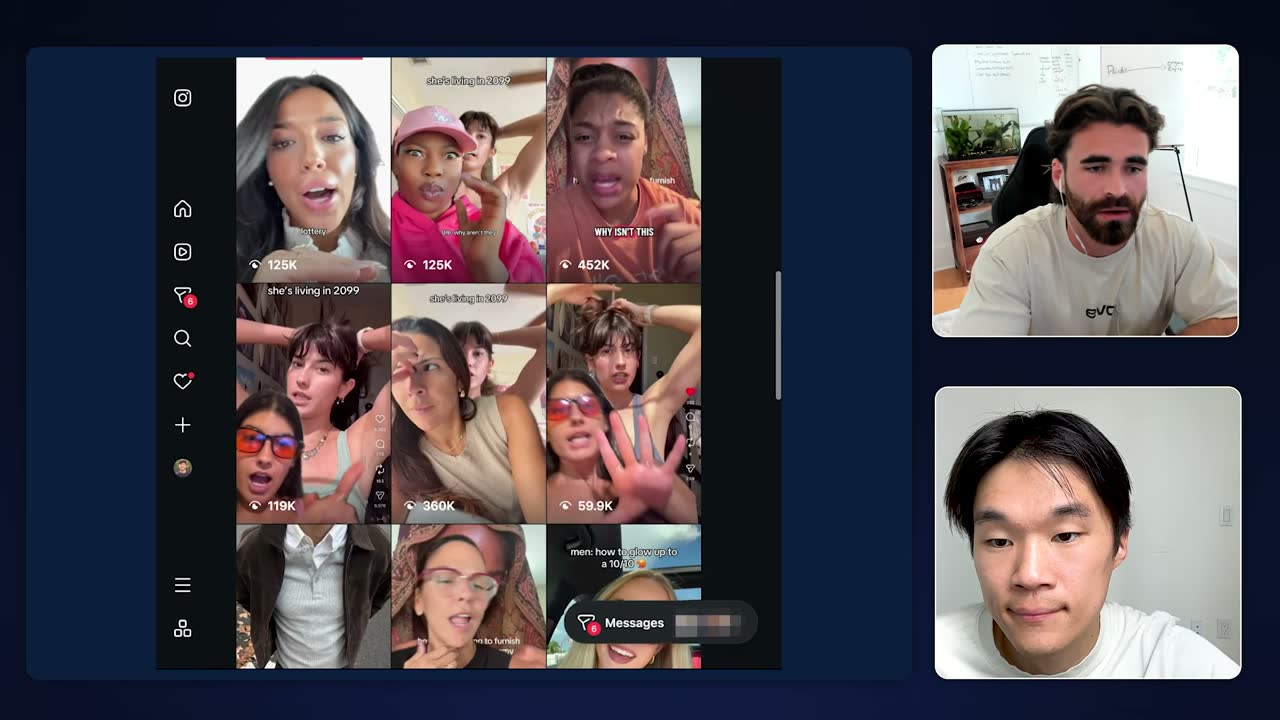
Dup's Instagram grid of green-screen reaction videos, drawing between 59.9K and 452K views each. Pick ideas that are novel, easy to show, and in a big market. Daniel's three criteria all fit Cal AI: photo calorie counting was a novel angle, it was easy to understand in videos, and calorie tracking is a huge market where MyFitnessPal is massive.
Applying a novel idea to an already popular niche means solving fewer unknowns. He prefers testing with influencers because views are guaranteed, so only downloads and payment are being tested, while UGC also tests virality.
2Choosing creator niches: why fitness worked and UFC and mukbang flopped
Fitness had endless creators, few brands, and videos that already showed food. Fitness creators were mostly offered protein powder and athleisure deals, so many had never had a brand deal, and their weekly "what I eat in a day" videos made a meal scan an easy ask. A fit creator is also visible proof of the result.
Dawson Gibbs, the first influencer, tried many formats and proved one that was then copied across similar creators. He was the face of Cal AI for five months, his page plus the brand's accounts drew about 200 million views, and he recruited about 100 creators. An astrology app, by contrast, has few creators and rivals may hold exclusive deals.
Choose niches by why viewers watch, not what the creator does. UFC looked perfect because fighters track every calorie, but several UFC creators signed for thousands of dollars each produced no download spike. Mukbang, recipe and cooking videos also converted poorly and were cut early.
UFC viewers watch "on their couch as they're drinking beer and eating pizza"; food viewers want to relax, not see calorie numbers, and treat the content as a reward or cheat day. Healthy meal videos only did okay. "Big bold bets" was a core value, since a loss of a couple of thousand dollars is offset by winners worth hundreds of thousands.
Judge creators by their comments and worst posts, not views or followers. Leg-day videos drawing fire emojis do not convert; ones drawing thanks for explaining how to train hamstrings do. Cal AI looks for creators who consistently hit about 100k views per video, judged on their worst posts.
Jake expects about one in ten creators to convert, and says to read the biggest creators' comments to test a whole niche. Carter strips out a creator's top three to five posts when judging. Jake: "Views can lie, followers can lie, but comments cannot."
Sign strong creators cheaply before their following catches up. A creator signed early posted 10,000 to 12,000 views for two months, hit a 7 million view video in month three, and never fell below 500,000 afterward.
Jake calls a cult-like following a lagging indicator, and spots good creators "whose time just hasn't caught up yet" by reviewing many of them.
Test each niche with one creator before adding more. One creator cost $20,000 for a month and brought $120,000 in signups, but a second creator in the same niche did poorly. Some mom influencers were profitable at a $10 CPM and others flopped.
Alfie concluded that more creators in a niche can cut ROI because viewers have already seen the app. Fitness was big enough to absorb many, across bodybuilders, gym bros, women's fitness and weight loss. Broad comedy creators, like one scanning fries at a McDonald's drive-thru, gave cheap views but weak buyers.
Big creators using the app in daily vlogs turned it into a trend. Mormon Wives cast member Jesse scanned her breakfast without naming the app, and one such video brought a couple of hundred promo code uses, sometimes thousands. Her posts ran just before and after season 3, so her CPM was very low despite her fame.
Cal AI asked for four videos a month and held CPMs low early, since people see a product about seven times before buying; once viewers recognized the app it could pay more per deal and still profit. Love Island's Harry fell short because his comments were about Shakira. The goal was "the app that everyone uses," not a fitness tool.
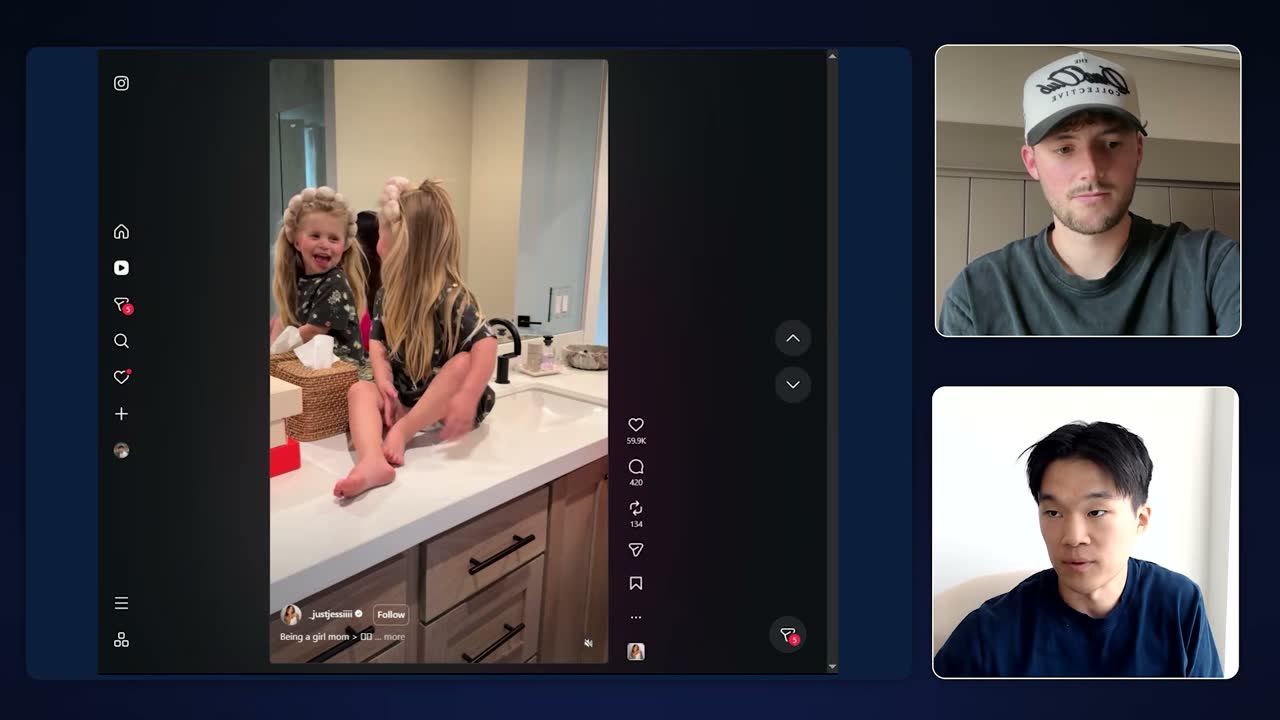
Instagram reel by influencer justjessiii, 59.9K likes, which drove hundreds of Cal AI promo-code uses.
3Creator deal terms that kept spend profitable
Never pay a CPM above your revenue per thousand views. Cal AI measured RPM by watching download and sales spikes after a single creator post, which was easy when influencers were the only channel. Each creator's rate was set from their expected views, and creators who wanted more were let go.
Jake could not remember whether the RPM was $1 or $10. "You can't pay a CPM that is higher than that RPM, otherwise you are guaranteed to not be profitable."
Flat rates keep the upside when a post goes mega viral. Pricing a flat fee to a creator's average views gives roughly break-even, and the profit comes from the one video that explodes. Per-view pricing gives that upside away.
Bonuses or scaled deals can be added when useful. Jake: it "allows you to capture the asymmetry that is algorithmic content."
Set a minimum view clause below the creator's own boast. When a creator claimed a million views, Cal AI agreed and put the floor at 700,000 to 800,000, so they couldn't back down and the CPM stayed profitable. Bonuses paid out above the floor.
The floor is meant to be "super achievable" every month so neither side ends up unhappy; Daniel saw creators quit at earlier apps after balking at a minimum and missing views. Alfie had never heard of these clauses before Cal AI, and Zach spread the idea on podcasts.
Brief creators with two rules, not a script: show the core screens early. Creators show the camera, the photo being analyzed and the result, within the first 15 seconds. Otherwise they keep making their normal videos and "sneak our app in."
Scripts make posts look like ads and sink views, and would not scale to the roughly 300 creators posting in one month. Creators dislike word-for-word scripts, so this pitch often lowered their rates. Retention on most videos "goes straight down," so end-of-video placements miss most viewers.
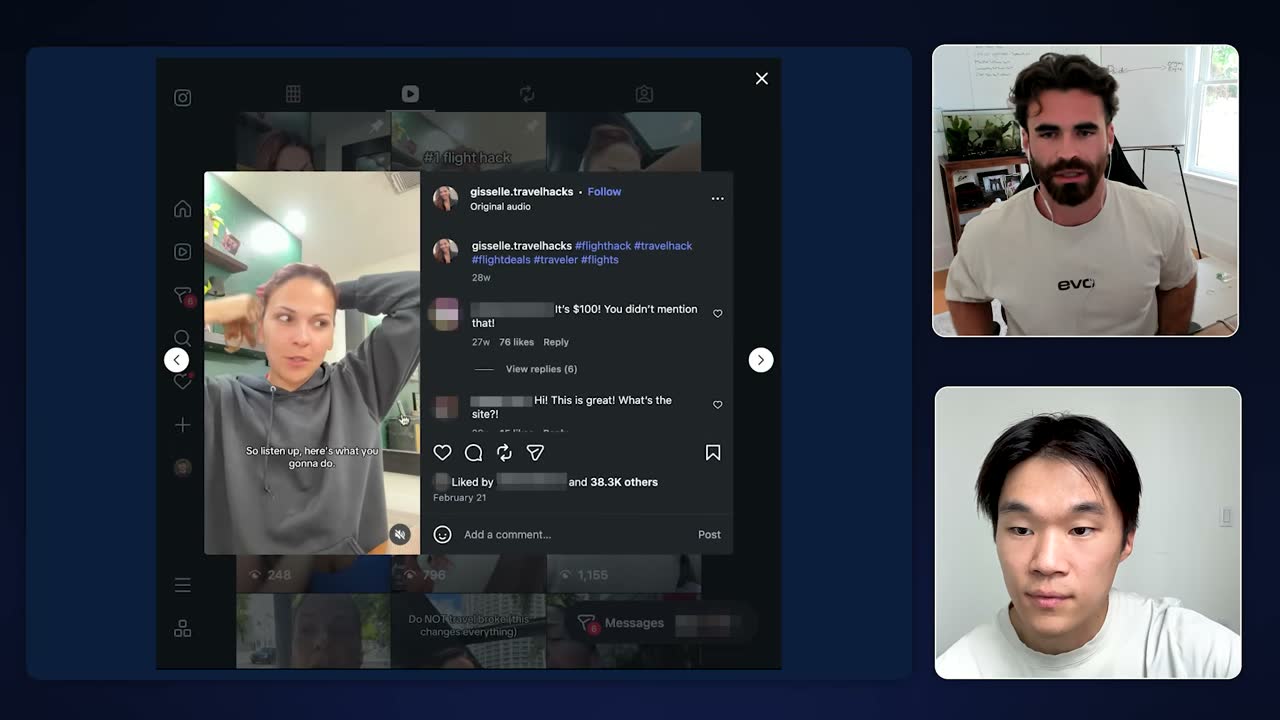
Instagram post by gisselle.travelhacks with 38.3K likes, using a ponytail visual hook.
4Signing and running hundreds of creators
- 1Email 2,000 creators daily25 assistants, 100 emails each
- 2AI handles first repliesExpect around 10% replies
- 3Move to a callBefore talking rates
- 4Sign about 1%2,000 to 3,000 of 220,000
From Jake Castillo and Alfie Dickens
Outreach was a daily numbers game run for 18 months. About 25 assistants each aimed for 100 emails a day, roughly 2,000 a day, reaching about 220,000 influencers and signing 2,000 to 3,000, about 1%. Jake personally messaged creators every day for 18 months.
Email beat DMs, which platforms cap. An AI system handled first replies and negotiation so assistants only sent the opening email, and monthly cash or voucher contests kept them motivated. Expect around 10% replies.
Move creators to a call before talking rates. Most creators first ask for the budget. Alfie answered with what Cal AI wanted (seamless videos, a long-term partnership) and invited them to a call, which he says probably 10xes the chance of a good deal.
With agents, Cal AI built rapport with the manager first and then asked to add the creator to the group chat, which led to multiple deals with a reality TV star.
Treating creators as partners got better content and more referrals. Cal AI paid unrequested bonuses when a creator crushed a month and paid signed creators about $100 for each friend they brought in. Dawson Gibbs took on extra formats without charging, which is how the winning format was found.
Referrals came with personal numbers, bypassing agency markups. Jake: "If you treat the relationship strictly as transactional, it's going to always be transactional." Alfie still talks to creators he signed two years ago.
Systems and a renewal score made hundreds of creators manageable. Jake ran the program from a heavily automated Google Sheet with 50 to 70 creators posting on a single day, then built software (Virality) for deals, contracts, post tracking, bonuses and payments.
Because several posts went viral the same day, attribution was murky, so Cal AI combined many data points into a renewal score and used incrementality tests and follower demographics.
Rising creator prices are pushing Cal AI back toward UGC. Agents now represent creators with only 5,000 to 10,000 views per video, and $1 to $2 CPM deals became much harder to find in the last 6 months.
UGC gives cheaper views but likely lower conversion, since it lacks a followed creator's trust. Alfie would run both at the same time.
5Paid ads and affiliates layered on creators
Dedicated ad creative beat recycled creator videos. Cal AI first ran repurposed influencer videos, which were built for organic views. The paid team then started an affiliate program of dozens of creators making only Cal AI videos for ads, paid by commission, and growth took a step change when it went all in on paid.
Ads converted better because many viewers already knew the app from creators. Paid ads should hard-sell with a hook related to the product, since every view is paid for.
The public affiliate program pays a flat $10 per paid signup. It is a one-time payout, roughly 33% of a $30 sale.
A one-time flat payment avoids long-running revenue obligations that could complicate selling the app.
6The $30 price and positioning beside MyFitnessPal
Cal AI priced at $30 a year to win mind share, not profit. Co-founder Blake Anderson pushed to be the easiest app to buy. Cal AI charges about $30 a year or $10 a month, against about $70 a year for MyFitnessPal and $80 to $120 for incumbents.
The audience was young with little disposable income, and a cheap app feels like an impulse purchase people recommend freely. The effect on conversion and word of mouth is argued, not measured. Jake says pricing should fit your own market, not copy Cal AI.
Speed and simplicity won users MyFitnessPal didn't serve. Cal AI targets younger users who want fast logging and value speed over perfect macros, and it drew many people who had never tracked calories. MyFitnessPal serves serious users who accept friction.
Critics said the AI wasn't accurate, but the app never promised 100%; later it added barcode scanning and a food database. David Barnard floated tiers of $30 a year for 70 to 80% accuracy and $100 for 90%.
7Onboarding, paywall and retention features
Ads, onboarding and paywall repeat one pain-and-demo story. Onboarding repeats the pain points from ads before the price appears, so $30 a year feels like nothing. The first screen and the paywall both show a video of someone photographing a meal and seeing calories counted.
Onboarding animations and illustrations tested well by making the app feel more personalized. Onboarding and paywall conversion were already above industry standard when Daniel joined, so the team touched them less than people assume.
Cal AI's "try it for 50% off" framing beat a table paywall. Jonathan Parra borrowed the framing from Cal AI and replaced a plan comparison table with that headline, a big image of the app and a large CTA, for a 111% conversion rate increase.
The test ran on Jonathan's apps, not Cal AI. Caleb Dean also copied Cal AI's onboarding for Runafy's first version.
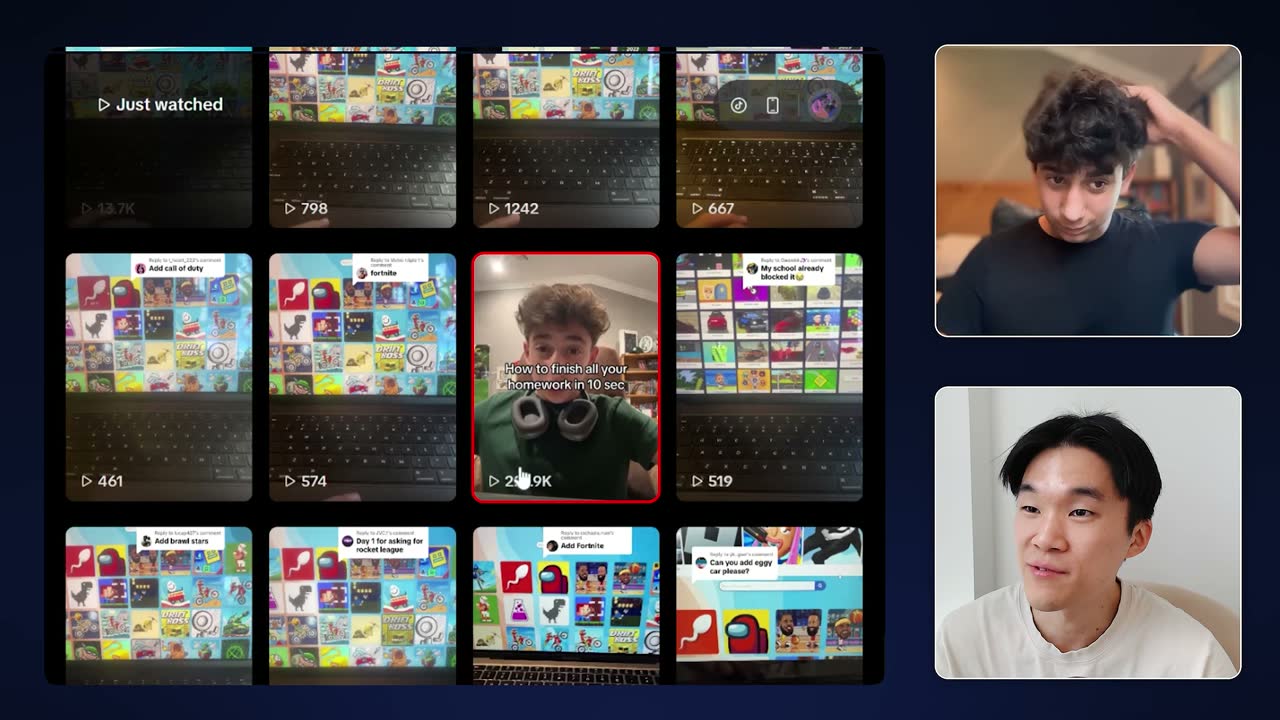
TikTok account grid showing the Problem Pal "finish all your homework in 10 sec" video, ~200K views. A 3-day trial made day-3 retention the product priority. Daniel fixed bugs, redesigned the food database, camera and food detail screens, and added streaks and groups so trial users got enough value to stay subscribed.
Groups started as private friend groups, then added public interest groups with streak leaderboards.
Shareable features add proof from friends, but impact is unmeasured. Streaks, milestone badges, progress photos and meal sharing give users something to post, and a $10 referral can be used during onboarding before paying. A Thanksgiving promotion gave free access when people already post what they ate.
Daniel says most growth still came from influencers and paid ads, and the team could not isolate the referral or sharing effect. "People just only want to download apps that other people that they know use."
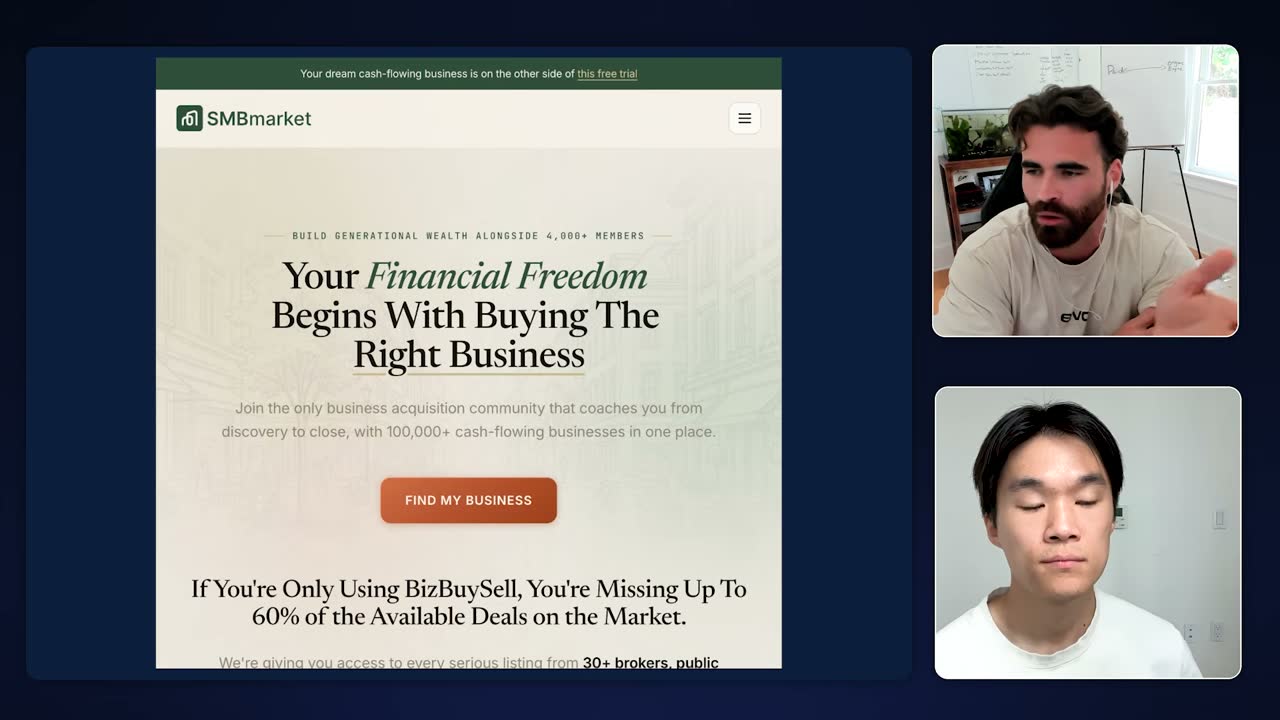
SMBmarket's landing page pitching business acquisition, claiming 4,000+ members and 100,000+ cash-flowing listings.
8Speed, copycats and the MyFitnessPal sale
Cal AI shared its playbook publicly because its edge was compounding details. The team posted wins and failures on Twitter and drew clones, but Twitter threads about clones sent traffic to Cal AI, and disappointed clone users searched and found Cal AI ranked first.
Jake: "small incremental improvements compound over time to be an insurmountable mountain that competition can't climb." He also warns that copying Cal AI is the easiest way to blow money, yet founders like Cedric Roberge and Caleb Dean modeled apps on it.
The team ships ideas the same or next day. Cal AI's culture prioritizes speed and one core focus. Its co-founders say motivation on a new feature lasts only about 2 weeks.
Daniel says joining MyFitnessPal adds structure the team is learning from.
Execution won a crowded market, and MyFitnessPal bought the distribution skill. Cal AI entered a seemingly saturated calorie counting market and won through hustle and marketing, then was acquired by MyFitnessPal in late 2025.
Josh of Blue Throne thinks MyFitnessPal likely bought the team's distribution skill to graduate younger scanner users into its wider suite. Cal AI started the food scanning category, which others now narrow further, such as trackers for GLP-1 users.

The Influencer Marketing Math That Made Cal AI Profitable
Cal AI pays creators about $400 for four cross-posted videos plus capped view bonuses near one million views, and keeps CPM below RPM. Most UGC videos lose money at about $20 each, while one or two videos a month reach millions of views and cover roughly 28 failures. Early on, each influencer video showed as a clear download spike, such as 100 an hour rising to 200.
Creator content only sells an app with a magic moment grasped in seconds. Cal AI's scan, analyze, result sequence made viewers do a double take. It was the first app to track calories from a picture, which Alfie Dickens calls "a viral moment in itself."
Jake Castillo says that without such a moment an integration reads as an ad, never goes viral, and the app is better served by hard-sell paid ads. The scan also solved a real problem, since tedious manual logging is why most people quit calorie tracking.
The team reshaped the app itself so it reads well inside a video. Text is legible from a distance and the logo sits on every core screen, so viewers know which app to download. A separate creator build shows the Cal AI name while scanning, plus a streak and meal history that look like real ongoing use.
The streak pop-up added a fourth beat to the three-step flow, so creators skipped their first scan of the day. A "tracked with Cal AI" caption went on subtle integrations but not blunt ones, because it hurt views. Jake: "No marketing program should ever feel like a finished product."
Fitness had endless creators, few brands, and videos that already showed food. Fitness creators were mostly offered protein powder and athleisure deals, so many had never had a brand deal, and their weekly "what I eat in a day" videos made a meal scan an easy ask. A fit creator is also visible proof of the result.
Dawson Gibbs, the first influencer, tried many formats and proved one that was then copied across similar creators. He was the face of Cal AI for five months, his page plus the brand's accounts drew about 200 million views, and he recruited about 100 creators. An astrology app, by contrast, has few creators and rivals may hold exclusive deals.
Choose niches by why viewers watch, not what the creator does. UFC looked perfect because fighters track every calorie, but several UFC creators signed for thousands of dollars each produced no download spike. Mukbang, recipe and cooking videos also converted poorly and were cut early.
UFC viewers watch "on their couch as they're drinking beer and eating pizza"; food viewers want to relax, not see calorie numbers, and treat the content as a reward or cheat day. Healthy meal videos only did okay. "Big bold bets" was a core value, since a loss of a couple of thousand dollars is offset by winners worth hundreds of thousands.
Judge creators by their comments and worst posts, not views or followers. Leg-day videos drawing fire emojis do not convert; ones drawing thanks for explaining how to train hamstrings do. Cal AI looks for creators who consistently hit about 100k views per video, judged on their worst posts.
Jake expects about one in ten creators to convert, and says to read the biggest creators' comments to test a whole niche. Carter strips out a creator's top three to five posts when judging. Jake: "Views can lie, followers can lie, but comments cannot."
Sign strong creators cheaply before their following catches up. A creator signed early posted 10,000 to 12,000 views for two months, hit a 7 million view video in month three, and never fell below 500,000 afterward.
Jake calls a cult-like following a lagging indicator, and spots good creators "whose time just hasn't caught up yet" by reviewing many of them.
Never pay a CPM above your revenue per thousand views. Cal AI measured RPM by watching download and sales spikes after a single creator post, which was easy when influencers were the only channel. Each creator's rate was set from their expected views, and creators who wanted more were let go.
Jake could not remember whether the RPM was $1 or $10. "You can't pay a CPM that is higher than that RPM, otherwise you are guaranteed to not be profitable."
Flat rates keep the upside when a post goes mega viral. Pricing a flat fee to a creator's average views gives roughly break-even, and the profit comes from the one video that explodes. Per-view pricing gives that upside away.
Bonuses or scaled deals can be added when useful. Jake: it "allows you to capture the asymmetry that is algorithmic content."
Outreach was a daily numbers game run for 18 months. About 25 assistants each aimed for 100 emails a day, roughly 2,000 a day, reaching about 220,000 influencers and signing 2,000 to 3,000, about 1%. Jake personally messaged creators every day for 18 months.
Email beat DMs, which platforms cap. An AI system handled first replies and negotiation so assistants only sent the opening email, and monthly cash or voucher contests kept them motivated. Expect around 10% replies.
Treating creators as partners got better content and more referrals. Cal AI paid unrequested bonuses when a creator crushed a month and paid signed creators about $100 for each friend they brought in. Dawson Gibbs took on extra formats without charging, which is how the winning format was found.
Referrals came with personal numbers, bypassing agency markups. Jake: "If you treat the relationship strictly as transactional, it's going to always be transactional." Alfie still talks to creators he signed two years ago.
Systems and a renewal score made hundreds of creators manageable. Jake ran the program from a heavily automated Google Sheet with 50 to 70 creators posting on a single day, then built software (Virality) for deals, contracts, post tracking, bonuses and payments.
Because several posts went viral the same day, attribution was murky, so Cal AI combined many data points into a renewal score and used incrementality tests and follower demographics.
Dedicated ad creative beat recycled creator videos. Cal AI first ran repurposed influencer videos, which were built for organic views. The paid team then started an affiliate program of dozens of creators making only Cal AI videos for ads, paid by commission, and growth took a step change when it went all in on paid.
Ads converted better because many viewers already knew the app from creators. Paid ads should hard-sell with a hook related to the product, since every view is paid for.
The public affiliate program pays a flat $10 per paid signup. It is a one-time payout, roughly 33% of a $30 sale.
A one-time flat payment avoids long-running revenue obligations that could complicate selling the app.
Cal AI priced at $30 a year to win mind share, not profit. Co-founder Blake Anderson pushed to be the easiest app to buy. Cal AI charges about $30 a year or $10 a month, against about $70 a year for MyFitnessPal and $80 to $120 for incumbents.
The audience was young with little disposable income, and a cheap app feels like an impulse purchase people recommend freely. The effect on conversion and word of mouth is argued, not measured. Jake says pricing should fit your own market, not copy Cal AI.
Ads, onboarding and paywall repeat one pain-and-demo story. Onboarding repeats the pain points from ads before the price appears, so $30 a year feels like nothing. The first screen and the paywall both show a video of someone photographing a meal and seeing calories counted.
Onboarding animations and illustrations tested well by making the app feel more personalized. Onboarding and paywall conversion were already above industry standard when Daniel joined, so the team touched them less than people assume.
Cal AI shared its playbook publicly because its edge was compounding details. The team posted wins and failures on Twitter and drew clones, but Twitter threads about clones sent traffic to Cal AI, and disappointed clone users searched and found Cal AI ranked first.
Jake: "small incremental improvements compound over time to be an insurmountable mountain that competition can't climb." He also warns that copying Cal AI is the easiest way to blow money, yet founders like Cedric Roberge and Caleb Dean modeled apps on it.

How Cal AI turned creators into a growth machine — Jake Castillo, Cal AI
Grew by paying fitness creators flat rates under revenue per thousand views, built around a scan, analyze, result magic moment. It has over 15 million downloads, charges $30 a year, pays $10 per sale to affiliates, and is now part of MyFitnessPal.
Fitness had endless creators, few brands, and videos that already showed food. Fitness creators were mostly offered protein powder and athleisure deals, so many had never had a brand deal, and their weekly "what I eat in a day" videos made a meal scan an easy ask. A fit creator is also visible proof of the result.
Dawson Gibbs, the first influencer, tried many formats and proved one that was then copied across similar creators. He was the face of Cal AI for five months, his page plus the brand's accounts drew about 200 million views, and he recruited about 100 creators. An astrology app, by contrast, has few creators and rivals may hold exclusive deals.

Meet The Marketing Genius Behind Cal AI
Built an influencer machine of 200+ creators at once, reaching about 220,000 influencers and signing 2,000 to 3,000, using minimum view clauses and seamless in-video app placement. The first app to track calories from a picture, it aimed to become a trend and now explores UGC as influencer prices rise.
Creator content only sells an app with a magic moment grasped in seconds. Cal AI's scan, analyze, result sequence made viewers do a double take. It was the first app to track calories from a picture, which Alfie Dickens calls "a viral moment in itself."
Jake Castillo says that without such a moment an integration reads as an ad, never goes viral, and the app is better served by hard-sell paid ads. The scan also solved a real problem, since tedious manual logging is why most people quit calorie tracking.
Choose niches by why viewers watch, not what the creator does. UFC looked perfect because fighters track every calorie, but several UFC creators signed for thousands of dollars each produced no download spike. Mukbang, recipe and cooking videos also converted poorly and were cut early.
UFC viewers watch "on their couch as they're drinking beer and eating pizza"; food viewers want to relax, not see calorie numbers, and treat the content as a reward or cheat day. Healthy meal videos only did okay. "Big bold bets" was a core value, since a loss of a couple of thousand dollars is offset by winners worth hundreds of thousands.
Test each niche with one creator before adding more. One creator cost $20,000 for a month and brought $120,000 in signups, but a second creator in the same niche did poorly. Some mom influencers were profitable at a $10 CPM and others flopped.
Alfie concluded that more creators in a niche can cut ROI because viewers have already seen the app. Fitness was big enough to absorb many, across bodybuilders, gym bros, women's fitness and weight loss. Broad comedy creators, like one scanning fries at a McDonald's drive-thru, gave cheap views but weak buyers.
Big creators using the app in daily vlogs turned it into a trend. Mormon Wives cast member Jesse scanned her breakfast without naming the app, and one such video brought a couple of hundred promo code uses, sometimes thousands. Her posts ran just before and after season 3, so her CPM was very low despite her fame.
Cal AI asked for four videos a month and held CPMs low early, since people see a product about seven times before buying; once viewers recognized the app it could pay more per deal and still profit. Love Island's Harry fell short because his comments were about Shakira. The goal was "the app that everyone uses," not a fitness tool.
Instagram reel by influencer justjessiii, 59.9K likes, which drove hundreds of Cal AI promo-code uses. Set a minimum view clause below the creator's own boast. When a creator claimed a million views, Cal AI agreed and put the floor at 700,000 to 800,000, so they couldn't back down and the CPM stayed profitable. Bonuses paid out above the floor.
The floor is meant to be "super achievable" every month so neither side ends up unhappy; Daniel saw creators quit at earlier apps after balking at a minimum and missing views. Alfie had never heard of these clauses before Cal AI, and Zach spread the idea on podcasts.
Brief creators with two rules, not a script: show the core screens early. Creators show the camera, the photo being analyzed and the result, within the first 15 seconds. Otherwise they keep making their normal videos and "sneak our app in."
Scripts make posts look like ads and sink views, and would not scale to the roughly 300 creators posting in one month. Creators dislike word-for-word scripts, so this pitch often lowered their rates. Retention on most videos "goes straight down," so end-of-video placements miss most viewers.
Instagram post by gisselle.travelhacks with 38.3K likes, using a ponytail visual hook. Outreach was a daily numbers game run for 18 months. About 25 assistants each aimed for 100 emails a day, roughly 2,000 a day, reaching about 220,000 influencers and signing 2,000 to 3,000, about 1%. Jake personally messaged creators every day for 18 months.
Email beat DMs, which platforms cap. An AI system handled first replies and negotiation so assistants only sent the opening email, and monthly cash or voucher contests kept them motivated. Expect around 10% replies.
Move creators to a call before talking rates. Most creators first ask for the budget. Alfie answered with what Cal AI wanted (seamless videos, a long-term partnership) and invited them to a call, which he says probably 10xes the chance of a good deal.
With agents, Cal AI built rapport with the manager first and then asked to add the creator to the group chat, which led to multiple deals with a reality TV star.
Treating creators as partners got better content and more referrals. Cal AI paid unrequested bonuses when a creator crushed a month and paid signed creators about $100 for each friend they brought in. Dawson Gibbs took on extra formats without charging, which is how the winning format was found.
Referrals came with personal numbers, bypassing agency markups. Jake: "If you treat the relationship strictly as transactional, it's going to always be transactional." Alfie still talks to creators he signed two years ago.
Rising creator prices are pushing Cal AI back toward UGC. Agents now represent creators with only 5,000 to 10,000 views per video, and $1 to $2 CPM deals became much harder to find in the last 6 months.
UGC gives cheaper views but likely lower conversion, since it lacks a followed creator's trust. Alfie would run both at the same time.
Speed and simplicity won users MyFitnessPal didn't serve. Cal AI targets younger users who want fast logging and value speed over perfect macros, and it drew many people who had never tracked calories. MyFitnessPal serves serious users who accept friction.
Critics said the AI wasn't accurate, but the app never promised 100%; later it added barcode scanning and a food database. David Barnard floated tiers of $30 a year for 70 to 80% accuracy and $100 for 90%.

How Cal AI Hit $50M ARR in 2 Years by Nailing Product/Channel Fit on TikTok
Launched in May 2024 and passed $50M ARR in under two years, reaching $1.5M MRR about 8 months in. It grew through hundreds of fitness creators (about 300 posting in one month), then paid ads and affiliates, priced around $30 a year, and was acquired by MyFitnessPal in late 2025.
Execution won a crowded market, and MyFitnessPal bought the distribution skill. Cal AI entered a seemingly saturated calorie counting market and won through hustle and marketing, then was acquired by MyFitnessPal in late 2025.
Josh of Blue Throne thinks MyFitnessPal likely bought the team's distribution skill to graduate younger scanner users into its wider suite. Cal AI started the food scanning category, which others now narrow further, such as trackers for GLP-1 users.
Grow Your App With These Simple Referral Tricks
Founder Zach used many influencers to push the app past $20M a year, and explained his influencer approach on the My First Million podcast.
Execution won a crowded market, and MyFitnessPal bought the distribution skill. Cal AI entered a seemingly saturated calorie counting market and won through hustle and marketing, then was acquired by MyFitnessPal in late 2025.
Josh of Blue Throne thinks MyFitnessPal likely bought the team's distribution skill to graduate younger scanner users into its wider suite. Cal AI started the food scanning category, which others now narrow further, such as trackers for GLP-1 users.
This Calorie Tracker App Makes $800,000 a Month (Cal AI)
Launched April 2024 and reached about 300,000 downloads and over $800,000 a month in revenue per Sensor Tower. Viral social videos drive downloads, and a long onboarding mixing questions, social proof and commitment leads to a trial paywall that could be simplified with a weekly plan and a free first scan.
Cal AI shared its playbook publicly because its edge was compounding details. The team posted wins and failures on Twitter and drew clones, but Twitter threads about clones sent traffic to Cal AI, and disappointed clone users searched and found Cal AI ranked first.
Jake: "small incremental improvements compound over time to be an insurmountable mountain that competition can't climb." He also warns that copying Cal AI is the easiest way to blow money, yet founders like Cedric Roberge and Caleb Dean modeled apps on it.
Before You Spend $1 on Meta Ads, Watch This
A Cal AI ad running since June 3 is only 9 seconds long: a calorie-tracking hook, the app in use, then the App Store badge. Its long run suggests it is working, making it a model to copy.
The 1 Billion Views Content Strategy Every App Should Steal in 2026
It made Dawson its first influencer and he was its face for five months. His page plus the brand's TikTok and Instagram drew about 200 million views, and he recruited about 100 creators for it.
Cal AI shipped a one-button MVP and started promoting it in month two. The high-school founders built the app in a month or two. The first version had one plus button: take a photo, see that meal's calories and macros. It did not even show a daily total.
It launched in May 2024, reached about $1.5M MRR roughly 8 months in, and passed $50M ARR in under two years. The reasoning was that cheap AI coding moved the bottleneck from product to distribution. Host Phil Carter: start with "what's going to win in the channel, and then work backwards to the product."
The team reshaped the app itself so it reads well inside a video. Text is legible from a distance and the logo sits on every core screen, so viewers know which app to download. A separate creator build shows the Cal AI name while scanning, plus a streak and meal history that look like real ongoing use.
The streak pop-up added a fourth beat to the three-step flow, so creators skipped their first scan of the day. A "tracked with Cal AI" caption went on subtle integrations but not blunt ones, because it hurt views. Jake: "No marketing program should ever feel like a finished product."
Test a feature by whether its title or a 10-second demo sells it. Daniel Heintzman applies Tony Fadell's press release method: the title alone should make people want the feature, as "take a picture and see the calories and macros" does. Phil Carter's version is to write the launch tweet or TikTok before building.
Flame built an eye-catching AI loading animation, citing Cal AI's scanning feature as the model of a product built for TikTok.
Dup's Instagram grid of green-screen reaction videos, drawing between 59.9K and 452K views each. Fitness had endless creators, few brands, and videos that already showed food. Fitness creators were mostly offered protein powder and athleisure deals, so many had never had a brand deal, and their weekly "what I eat in a day" videos made a meal scan an easy ask. A fit creator is also visible proof of the result.
Dawson Gibbs, the first influencer, tried many formats and proved one that was then copied across similar creators. He was the face of Cal AI for five months, his page plus the brand's accounts drew about 200 million views, and he recruited about 100 creators. An astrology app, by contrast, has few creators and rivals may hold exclusive deals.
Judge creators by their comments and worst posts, not views or followers. Leg-day videos drawing fire emojis do not convert; ones drawing thanks for explaining how to train hamstrings do. Cal AI looks for creators who consistently hit about 100k views per video, judged on their worst posts.
Jake expects about one in ten creators to convert, and says to read the biggest creators' comments to test a whole niche. Carter strips out a creator's top three to five posts when judging. Jake: "Views can lie, followers can lie, but comments cannot."
Set a minimum view clause below the creator's own boast. When a creator claimed a million views, Cal AI agreed and put the floor at 700,000 to 800,000, so they couldn't back down and the CPM stayed profitable. Bonuses paid out above the floor.
The floor is meant to be "super achievable" every month so neither side ends up unhappy; Daniel saw creators quit at earlier apps after balking at a minimum and missing views. Alfie had never heard of these clauses before Cal AI, and Zach spread the idea on podcasts.
Brief creators with two rules, not a script: show the core screens early. Creators show the camera, the photo being analyzed and the result, within the first 15 seconds. Otherwise they keep making their normal videos and "sneak our app in."
Scripts make posts look like ads and sink views, and would not scale to the roughly 300 creators posting in one month. Creators dislike word-for-word scripts, so this pitch often lowered their rates. Retention on most videos "goes straight down," so end-of-video placements miss most viewers.
Instagram post by gisselle.travelhacks with 38.3K likes, using a ponytail visual hook. Dedicated ad creative beat recycled creator videos. Cal AI first ran repurposed influencer videos, which were built for organic views. The paid team then started an affiliate program of dozens of creators making only Cal AI videos for ads, paid by commission, and growth took a step change when it went all in on paid.
Ads converted better because many viewers already knew the app from creators. Paid ads should hard-sell with a hook related to the product, since every view is paid for.
Cal AI priced at $30 a year to win mind share, not profit. Co-founder Blake Anderson pushed to be the easiest app to buy. Cal AI charges about $30 a year or $10 a month, against about $70 a year for MyFitnessPal and $80 to $120 for incumbents.
The audience was young with little disposable income, and a cheap app feels like an impulse purchase people recommend freely. The effect on conversion and word of mouth is argued, not measured. Jake says pricing should fit your own market, not copy Cal AI.
Speed and simplicity won users MyFitnessPal didn't serve. Cal AI targets younger users who want fast logging and value speed over perfect macros, and it drew many people who had never tracked calories. MyFitnessPal serves serious users who accept friction.
Critics said the AI wasn't accurate, but the app never promised 100%; later it added barcode scanning and a food database. David Barnard floated tiers of $30 a year for 70 to 80% accuracy and $100 for 90%.
Ads, onboarding and paywall repeat one pain-and-demo story. Onboarding repeats the pain points from ads before the price appears, so $30 a year feels like nothing. The first screen and the paywall both show a video of someone photographing a meal and seeing calories counted.
Onboarding animations and illustrations tested well by making the app feel more personalized. Onboarding and paywall conversion were already above industry standard when Daniel joined, so the team touched them less than people assume.
Shareable features add proof from friends, but impact is unmeasured. Streaks, milestone badges, progress photos and meal sharing give users something to post, and a $10 referral can be used during onboarding before paying. A Thanksgiving promotion gave free access when people already post what they ate.
Daniel says most growth still came from influencers and paid ads, and the team could not isolate the referral or sharing effect. "People just only want to download apps that other people that they know use."
SMBmarket's landing page pitching business acquisition, claiming 4,000+ members and 100,000+ cash-flowing listings. The team ships ideas the same or next day. Cal AI's culture prioritizes speed and one core focus. Its co-founders say motivation on a new feature lasts only about 2 weeks.
Daniel says joining MyFitnessPal adds structure the team is learning from.
Execution won a crowded market, and MyFitnessPal bought the distribution skill. Cal AI entered a seemingly saturated calorie counting market and won through hustle and marketing, then was acquired by MyFitnessPal in late 2025.
Josh of Blue Throne thinks MyFitnessPal likely bought the team's distribution skill to graduate younger scanner users into its wider suite. Cal AI started the food scanning category, which others now narrow further, such as trackers for GLP-1 users.
Do This Before Running ANY Paid Social Media Marketing
Puts about 90% of its ad spend on Meta, a little on Apple Ads, and about 60% of spend in the US. Its best ad is 19 seconds: a 315 lb to defined abs transformation hook, then a 9 second app demo, then the App Store page.
Creator content only sells an app with a magic moment grasped in seconds. Cal AI's scan, analyze, result sequence made viewers do a double take. It was the first app to track calories from a picture, which Alfie Dickens calls "a viral moment in itself."
Jake Castillo says that without such a moment an integration reads as an ad, never goes viral, and the app is better served by hard-sell paid ads. The scan also solved a real problem, since tedious manual logging is why most people quit calorie tracking.
Pick ideas that are novel, easy to show, and in a big market. Daniel's three criteria all fit Cal AI: photo calorie counting was a novel angle, it was easy to understand in videos, and calorie tracking is a huge market where MyFitnessPal is massive.
Applying a novel idea to an already popular niche means solving fewer unknowns. He prefers testing with influencers because views are guaranteed, so only downloads and payment are being tested, while UGC also tests virality.
Ads, onboarding and paywall repeat one pain-and-demo story. Onboarding repeats the pain points from ads before the price appears, so $30 a year feels like nothing. The first screen and the paywall both show a video of someone photographing a meal and seeing calories counted.
Onboarding animations and illustrations tested well by making the app feel more personalized. Onboarding and paywall conversion were already above industry standard when Daniel joined, so the team touched them less than people assume.
A 3-day trial made day-3 retention the product priority. Daniel fixed bugs, redesigned the food database, camera and food detail screens, and added streaks and groups so trial users got enough value to stay subscribed.
Groups started as private friend groups, then added public interest groups with streak leaderboards.
Shareable features add proof from friends, but impact is unmeasured. Streaks, milestone badges, progress photos and meal sharing give users something to post, and a $10 referral can be used during onboarding before paying. A Thanksgiving promotion gave free access when people already post what they ate.
Daniel says most growth still came from influencers and paid ads, and the team could not isolate the referral or sharing effect. "People just only want to download apps that other people that they know use."
SMBmarket's landing page pitching business acquisition, claiming 4,000+ members and 100,000+ cash-flowing listings. The team ships ideas the same or next day. Cal AI's culture prioritizes speed and one core focus. Its co-founders say motivation on a new feature lasts only about 2 weeks.
Daniel says joining MyFitnessPal adds structure the team is learning from.
We’ve Tested 100s of Paywalls. Here’s What Actually Converts.
Its onboarding uses a video, a reminder and a timeline before the paywall. One client copied the flow, but a simple paywall with a video beat the longer version.
Test a feature by whether its title or a 10-second demo sells it. Daniel Heintzman applies Tony Fadell's press release method: the title alone should make people want the feature, as "take a picture and see the calories and macros" does. Phil Carter's version is to write the launch tweet or TikTok before building.
Flame built an eye-catching AI loading animation, citing Cal AI's scanning feature as the model of a product built for TikTok.
Dup's Instagram grid of green-screen reaction videos, drawing between 59.9K and 452K views each. Speed and simplicity won users MyFitnessPal didn't serve. Cal AI targets younger users who want fast logging and value speed over perfect macros, and it drew many people who had never tracked calories. MyFitnessPal serves serious users who accept friction.
Critics said the AI wasn't accurate, but the app never promised 100%; later it added barcode scanning and a food database. David Barnard floated tiers of $30 a year for 70 to 80% accuracy and $100 for 90%.
Make Ugly Ads to Grow Your App – Yuliya Lennox (Solid Starts)
It entered a seemingly saturated calorie counting market and won through hustle and fast execution, not a defensible product.
Speed and simplicity won users MyFitnessPal didn't serve. Cal AI targets younger users who want fast logging and value speed over perfect macros, and it drew many people who had never tracked calories. MyFitnessPal serves serious users who accept friction.
Critics said the AI wasn't accurate, but the app never promised 100%; later it added barcode scanning and a food database. David Barnard floated tiers of $30 a year for 70 to 80% accuracy and $100 for 90%.
$172M of App Building Advice in 50 Minutes
Cal AI started the food scanning category, fed by LLMs. MyFitnessPal likely bought its team for distribution skill, to graduate younger scanner users into its wider suite.
Cal AI's "try it for 50% off" framing beat a table paywall. Jonathan Parra borrowed the framing from Cal AI and replaced a plan comparison table with that headline, a big image of the app and a large CTA, for a 111% conversion rate increase.
The test ran on Jonathan's apps, not Cal AI. Caleb Dean also copied Cal AI's onboarding for Runafy's first version.
TikTok account grid showing the Problem Pal "finish all your homework in 10 sec" video, ~200K views. Cal AI shared its playbook publicly because its edge was compounding details. The team posted wins and failures on Twitter and drew clones, but Twitter threads about clones sent traffic to Cal AI, and disappointed clone users searched and found Cal AI ranked first.
Jake: "small incremental improvements compound over time to be an insurmountable mountain that competition can't climb." He also warns that copying Cal AI is the easiest way to blow money, yet founders like Cedric Roberge and Caleb Dean modeled apps on it.
The Paywall Strategy That Increased Conversions by 56%
Cited as the example of putting five stars at the top of a screen with social proof when asking for a review.
I speedran an ai app to $100k in 70 days.
Cedric studied it as one of the apps that won through influencer marketing, and copied that approach rather than what rival GLP apps did.
Test a feature by whether its title or a 10-second demo sells it. Daniel Heintzman applies Tony Fadell's press release method: the title alone should make people want the feature, as "take a picture and see the calories and macros" does. Phil Carter's version is to write the launch tweet or TikTok before building.
Flame built an eye-catching AI loading animation, citing Cal AI's scanning feature as the model of a product built for TikTok.
Dup's Instagram grid of green-screen reaction videos, drawing between 59.9K and 452K views each.
The 14-Year-Old Who Built a $14k/Month AI App
Founded by Evan's older brother Zach, whose risk-taking mindset shaped how Evan approaches testing marketing channels.
Cal AI's "try it for 50% off" framing beat a table paywall. Jonathan Parra borrowed the framing from Cal AI and replaced a plan comparison table with that headline, a big image of the app and a large CTA, for a 111% conversion rate increase.
The test ran on Jonathan's apps, not Cal AI. Caleb Dean also copied Cal AI's onboarding for Runafy's first version.
TikTok account grid showing the Problem Pal "finish all your homework in 10 sec" video, ~200K views.
I speedran a new app from 0 to $2m/year in 6 months (here's how)
Was already making a couple million a month when Daniel joined, with onboarding and paywall conversion above industry standard. Its 3-day trial made retention the focus, so the team added groups, streaks, milestone badges and sharing, and influencers show three screens (camera, loading, food detail). MyFitnessPal acquired it less than 2 years after founding.
The AI Growth Playbook for Subscription Apps – Phil Carter, Elemental Growth
Its photo-to-macros demo worked as a hook because the AI experience was fresh. It was bought by MyFitnessPal, and the host floated tiers of $30 a year for 70 to 80% accuracy and $100 for 90%.
Insights from RevenueCat’s 2026 State of Subscription Apps Report
Won users who want speed over perfect macros, with accuracy only needing to be good enough, and was then acquired by MyFitnessPal. Its founders found their users without knowing how to code.
I speedran an ai app from 0 to $100k exit in 26 days
Its onboarding was one of the winners Caleb studied and copied for Runafy's first version.
The Top 10% of Apps Grew 306%. Everyone Else? Barely Beat Inflation | SOSA 2026
Sold for a very large sum, cited as a novel use of AI on an old problem.
Full App Growth Guide 2026 - How to Make Viral Content to Get Users & Make Your App Retentive
Its scanning feature is cited as an example of a product feature that looks good on camera, which inspired Flame's AI loader animation.
I made 4,000 app paywalls and learned this
The 'try the app for 50% off' paywall framing came from this app, and the simplified version with a big image beat a table paywall.
The Most Important Element of App Store Optimization (ASO Keyword Research)
Ranks only number four for "calorie tracker" despite having it in the title, yet holds 154 number one keywords (vs 5 for Calorie AI) thanks to influencer and paid marketing. Its screenshots moved from pancakes to salads and high-protein food, then went back to older ones, possibly an A/B test.
Black Hat App Growth Strategies You Don’t Know (But Your Competitors Might Be Using)
It asks for a review before the paywall, which Young finds shadier than asking after it.
How to 3X Your App Store Ratings
It asks for a rating about 75% through onboarding, before the paywall, with five stars, a 'made for people like you' line, and real ratings with images. Steve recommends copying that screen exactly.
This Morning Routine App Makes Almost $1 Million a Year!
Its paywall, with 7-day trial steps and a reminder promise, is suggested as a model for Routinery. One App Masters client saw better results using only its first screen instead of three paywall screens.
7 Counterintuitive App Growth Strategies That Actually Work | Steve P. Young at MAU 2025
Its style of longer flow was tested by a client against a single video paywall page, and the single page won, even though the audience guessed the longer flow would.
How to Transform ANY Business into a Profitable APP Business #appbusiness #appdevelopers
Its onboarding login has an X, and sign-up is required only after the trial starts, which is the example used to show flipping sign-in after the paywall.
More in Health & Fitness
 Health & Fitness
Calm
A meditation and sleep app with guided sessions and celebrity-narrated Sleep Stories.
45 sources · 102 tips Health & Fitness
Headspace
A meditation and mental wellness app with guided sessions and subscriptions.
 27 sources · 50 tips
 Health & Fitness
Flo
A data tool that combines app analytics into one view and is adding AI agents.
 10 sources · 31 tips
 Health & Fitness
Ladder
A strength training app with human coaches, a workout journal and a nutrition feature.
12 sources · 39 tips Health & Fitness
Zero
An intermittent fasting tracker app that teaches fasting and builds habits toward metabolic health.
6 sources · 21 tips Health & Fitness
Rise
A sleep and energy app that helps people track and pay down their sleep debt.
3 sources · 29 tips Health & Fitness
Runna
A personalized running coach app that builds adaptive training plans around a runner's race goals.
6 sources · 28 tips Health & Fitness
Strava
A fitness social platform for runners and cyclists.
13 sources · 13 tips