Eric Glyman
Co-founder and co-CEO of Ramp
Where to hear and read about Eric Glyman1 episode or test

Eric Glyman is the co-founder and co-CEO of Ramp, the finance automation company that over 70,000 businesses use to pay, manage and account for their spending. The lesson most worth taking from him is how inverting an industry's core assumption, then measuring the company on customers' dollars and hours saved, can win a market people thought was 175 years too crowded to enter.
What if I worked really hard to help you spend less
The $44 Billion Company Automating Your Company's Finances
Eric Glyman: the story and the lessons
1How Eric Glyman built Ramp by inverting the card industry
Glyman bet customers wanted to spend less, not earn more points. Every card company competed on points and rewards that pushed customers to spend more. Glyman saw that CFOs wanted more money in the bank and employees wanted less time on expenses, so Ramp set out to help them spend less.
People thought Ramp was 175 years late to a crowded industry. The inversion opened new questions, like why one purchase involves two systems and why bill pay, procurement and treasury need separate tools.
Ramp sells time while banks sell money. Banks compete on rewards, rebates, working capital, loans and interest. Ramp moves funds too, but from the start it tried to sell the automated knowledge work around each payment.
The original pain point was wasted hours on expense reports and matching payments to close the books. "Really what we were trying to sell you was time."
Every Ramp product must save customers time or money. The mission is to help every owner get more out of every dollar and hour. Glyman calls cards, expense tools, bill pay and accounting automation just products, scaffolding for that service.
Because the mission is endless, the products can change while the goal stays fixed. He cares less about how many dollars move than about the value of each movement.
Glyman questions and simplifies a process before automating it. He runs every money process through Elon's algorithm: ask whose requirement it is, cut unneeded steps, simplify, speed up, and only then automate. The result is smart cards that check policy in real time, write the memo and push data to accounting, which he calls zero-touch expenses.
A vendor invoice that once took 50 clicks is checked against the contract and filled in automatically. Automating an unquestioned process just speeds up waste.
The inversion produced real scale and real customer results. Over 3% of US corporate card transactions and nearly 1% of all corporate transactions run on Ramp. The typical customer cuts expenses by over 5% a year and grows revenue a median 16%, against a US average of 3% to 4%.
Ramp is doubling revenue each year at multibillion-dollar scale and has had five straight quarters of accelerating revenue growth.
2Glyman's scoreboard of dollars and hours saved
Glyman thinks a leader's main job is choosing the scoreboard. He calls a company a legal fiction that starts as two people on a couch and grows to thousands only through a common purpose. The leader must decide how progress is measured.
"In some sense, a company is just a fiction." Ramp spends an incredible amount of time on what the right scoreboard is.
Ramp keeps only values every founder strongly agrees with. His elementary school had about 20 values and he could not remember any. Ramp kept a few measurable ones, including "We win when our customers win."
He cites Henry Ford: "Money comes naturally as a result of service."
Ramp counts dollars blocked and hours saved for every customer. It connects to each customer's accounting software as a source of truth and tallies blocked dollars and automated expense reports. Each month the team asks whether customers saved more, in aggregate and individually.
The scoreboard sits on office walls, in the biggest Slack channels and on the first slide of every prospect meeting. Staff can pull it anytime from dashboards or the internal agent Ramp Research.
One saved hour compounds across every customer. A statement line like "UBR STAR 478" once sent finance staff into pivot tables to learn it was $50,000 at Uber. Ramp automated that merchant matching once and saved the hour for 20,000 other companies.
Features like this came from watching where finance teams wasted hours. Glyman still says Ramp is not good enough yet.
3How Eric Glyman hires and builds teams
Glyman hires on proof of work and spikes, not resumes. AI makes power laws more extreme: a top person once 10 or 100 times as effective could now be 1,000 times. So he looks for an award, a product or a body of work that feels electric.
Several Ramp engineers played Minecraft 80 to 100 hours a week at 15. One built private servers popular enough to pay his way through college and opened Ramp to a network of other developers. "I'm far more interested in proof of work."
Ramp trusts referrals and work trials over long interviews. Recruiters search for active GitHub users and leaders of fringe communities. Glyman says two business days working with someone reveal more than 15 hours of interviews.
Referrals carry asymmetric information about who someone really is versus who they present.
He recruits the smartest freshmen before the market prices them in. By junior summer or five years into a career, quant firms and AI labs compete for the same people. Glyman says you can spot a school's smartest students within a semester and offer them early internships.
Heavy early responsibility makes them want to stay, and other freshmen follow the smartest one.
Candidates' own ambitions must line up with Ramp's mission. He asks where candidates hope to be in 5, 10 and 15 years and what drives them. If he can't see the link to Ramp's work, he drops them.
Alternatives like AGI or multi-planetary life exist, so nobody owes Ramp their interest.
Glyman wants to work with the same people for a very long time. Trust lets colleagues finish each other's sentences, which raises the throughput of every hour without changing talent. He points to MrBeast's crew, with well over 10,000 hours together, and Munger and Buffett no longer needing to call.
"I want to work with them for a long, long, long time." He wants Ramp to be his last company, saying scar tissue lets you move with more efficiency.
He calls tolerating free-riders one of the most damaging mistakes. When equally paid, equally owning peers don't pull their weight, hard workers ask why they should bother. Glyman wants a team where iron sharpens iron.
He says he is not the smartest person at Ramp, "not even close," and sees his job as unblocking others so they decide fast and ship.
Glyman expects AI to let generalists flatten specialist silos. At 10 people staff say they work at Ramp; at 200 to 500 they say they are a salesperson, and sales may know no engineers. He likens it to the Tower of Babel.
Models have read more filings than any accountant, and he jokes he is the best doctor he has been. Tools now let a product builder sell, so companies can question whether their shape still fits.
4Eric Glyman on design in B2B software
Ramp held itself to consumer-grade design from day one. B2B software rarely aims for elegance, and Ramp's design has been widely copied. Glyman echoes Tobi Lütke, who removed confusing push-or-pull doors from Shopify offices.
The principle: the way you do one thing is the way you do everything.
Glyman designs by watching behavior, not building what customers ask. B2B tools start clean, then add a feature per request until they need a PhD to use. Breville's designer watched people undercook or burn toast and added a A Bit More button, among its most-used features.
No customer would ask for it. "I think that great design is following and understanding." Nobody wants a credit card or an expense app; expenses should do themselves and books should close themselves.
5Why Glyman treats the AI labs as Ramp's real competitor
Ramp sells automated knowledge work, which is what labs sell. Because the product is the process around the payment, Glyman sees the labs as the closest comparison, not other fintechs.
He treats the competition as a spur: iron sharpens iron.
Owning the layer where money moves is Ramp's durable edge. If intelligence becomes functionally free, Ramp's value is sitting in the payment flow to stop wasted dollars before they leave. Others find the waste two months later.
He sees no sign of AI progress slowing: people once marveled at a sensible paragraph and now quibble over one wrong footnote in a 100-page dossier.
Glyman builds for the ecosystem, as air conditioning built Las Vegas. Born in Las Vegas, he notes air conditioning made whole cities without producing robber-baron families. He expects AI to be bigger than the Industrial Revolution and asks what to build when intelligence is cheap.
He expects some labs to be among the best businesses ever, but warns that this can blind builders to everything else worth building.
He anchors Ramp on what customers will always want. Like Bezos with lower prices, selection and faster delivery, Glyman bets on the timeless desire for more out of every dollar and hour.
"You should be focusing on the timeless if you're trying to build an enduring brand."
6Glyman's bet on token spend and agentic payments
Glyman expects token spend to become a third mega spending category. Unlike most software, every AI job has a marginal cost, and five years ago no company budgeted for it. He cites two labs on track for over $300 billion a year, about 1% of US GDP, and Uber's CTO spending a year's AI budget in a quarter.
Ramp shows whether spend was OpEx or R&D, who spent it and the return. Early-adopter customers in this category drive part of Ramp's growth.
Ramp routes simple tasks to cheaper models. About six months after a frontier model ships, an open-weight model nearly as good costs about one one-hundredth as much. Ramp's token spend management watches what was requested and output and finds better routing.
He calls the frontier model advanced alien intelligence that need not edit your email.
He expects agents to negotiate with agents using company policy. Employees are limited agents who can book a hotel but not a $2 million Ferrari. Glyman expects that spending policy to become software that agents use to buy on companies' behalf.
One firm auto-renews $10 million of software a year with a person checking each department. Ramp can already show whether a $100 per-seat price is above or below market.
Glyman wants Ramp to allocate money, not just record it. Finance graduates dream of steering resources but spend 80% to 90% of their time on rote tasks because data is split across tools. Ramp holds payments, audit trail and policy together to see whether each dollar made money, was neutral or was wasted.
The aim is to "make sure the most worthwhile cause and the highest return on the dollar gets the dollar."

The $44 Billion Company Automating Your Company's Finances
Ramp shows how a company can win a crowded market by inverting the industry's core assumption and measuring itself on customers' dollars and hours saved. Glyman's decision to sell time instead of money, and to treat AI labs as the real competitor, shapes how Ramp hires, designs and prices in the AI era.
Glyman bet customers wanted to spend less, not earn more points. Every card company competed on points and rewards that pushed customers to spend more. Glyman saw that CFOs wanted more money in the bank and employees wanted less time on expenses, so Ramp set out to help them spend less.
People thought Ramp was 175 years late to a crowded industry. The inversion opened new questions, like why one purchase involves two systems and why bill pay, procurement and treasury need separate tools.
Ramp sells time while banks sell money. Banks compete on rewards, rebates, working capital, loans and interest. Ramp moves funds too, but from the start it tried to sell the automated knowledge work around each payment.
The original pain point was wasted hours on expense reports and matching payments to close the books. "Really what we were trying to sell you was time."
Every Ramp product must save customers time or money. The mission is to help every owner get more out of every dollar and hour. Glyman calls cards, expense tools, bill pay and accounting automation just products, scaffolding for that service.
Because the mission is endless, the products can change while the goal stays fixed. He cares less about how many dollars move than about the value of each movement.
Glyman questions and simplifies a process before automating it. He runs every money process through Elon's algorithm: ask whose requirement it is, cut unneeded steps, simplify, speed up, and only then automate. The result is smart cards that check policy in real time, write the memo and push data to accounting, which he calls zero-touch expenses.
A vendor invoice that once took 50 clicks is checked against the contract and filled in automatically. Automating an unquestioned process just speeds up waste.
The inversion produced real scale and real customer results. Over 3% of US corporate card transactions and nearly 1% of all corporate transactions run on Ramp. The typical customer cuts expenses by over 5% a year and grows revenue a median 16%, against a US average of 3% to 4%.
Ramp is doubling revenue each year at multibillion-dollar scale and has had five straight quarters of accelerating revenue growth.
Glyman thinks a leader's main job is choosing the scoreboard. He calls a company a legal fiction that starts as two people on a couch and grows to thousands only through a common purpose. The leader must decide how progress is measured.
"In some sense, a company is just a fiction." Ramp spends an incredible amount of time on what the right scoreboard is.
Ramp keeps only values every founder strongly agrees with. His elementary school had about 20 values and he could not remember any. Ramp kept a few measurable ones, including "We win when our customers win."
He cites Henry Ford: "Money comes naturally as a result of service."
Ramp counts dollars blocked and hours saved for every customer. It connects to each customer's accounting software as a source of truth and tallies blocked dollars and automated expense reports. Each month the team asks whether customers saved more, in aggregate and individually.
The scoreboard sits on office walls, in the biggest Slack channels and on the first slide of every prospect meeting. Staff can pull it anytime from dashboards or the internal agent Ramp Research.
One saved hour compounds across every customer. A statement line like "UBR STAR 478" once sent finance staff into pivot tables to learn it was $50,000 at Uber. Ramp automated that merchant matching once and saved the hour for 20,000 other companies.
Features like this came from watching where finance teams wasted hours. Glyman still says Ramp is not good enough yet.
Glyman hires on proof of work and spikes, not resumes. AI makes power laws more extreme: a top person once 10 or 100 times as effective could now be 1,000 times. So he looks for an award, a product or a body of work that feels electric.
Several Ramp engineers played Minecraft 80 to 100 hours a week at 15. One built private servers popular enough to pay his way through college and opened Ramp to a network of other developers. "I'm far more interested in proof of work."
Ramp trusts referrals and work trials over long interviews. Recruiters search for active GitHub users and leaders of fringe communities. Glyman says two business days working with someone reveal more than 15 hours of interviews.
Referrals carry asymmetric information about who someone really is versus who they present.
He recruits the smartest freshmen before the market prices them in. By junior summer or five years into a career, quant firms and AI labs compete for the same people. Glyman says you can spot a school's smartest students within a semester and offer them early internships.
Heavy early responsibility makes them want to stay, and other freshmen follow the smartest one.
Candidates' own ambitions must line up with Ramp's mission. He asks where candidates hope to be in 5, 10 and 15 years and what drives them. If he can't see the link to Ramp's work, he drops them.
Alternatives like AGI or multi-planetary life exist, so nobody owes Ramp their interest.
Glyman wants to work with the same people for a very long time. Trust lets colleagues finish each other's sentences, which raises the throughput of every hour without changing talent. He points to MrBeast's crew, with well over 10,000 hours together, and Munger and Buffett no longer needing to call.
"I want to work with them for a long, long, long time." He wants Ramp to be his last company, saying scar tissue lets you move with more efficiency.
He calls tolerating free-riders one of the most damaging mistakes. When equally paid, equally owning peers don't pull their weight, hard workers ask why they should bother. Glyman wants a team where iron sharpens iron.
He says he is not the smartest person at Ramp, "not even close," and sees his job as unblocking others so they decide fast and ship.
Glyman expects AI to let generalists flatten specialist silos. At 10 people staff say they work at Ramp; at 200 to 500 they say they are a salesperson, and sales may know no engineers. He likens it to the Tower of Babel.
Models have read more filings than any accountant, and he jokes he is the best doctor he has been. Tools now let a product builder sell, so companies can question whether their shape still fits.
Ramp held itself to consumer-grade design from day one. B2B software rarely aims for elegance, and Ramp's design has been widely copied. Glyman echoes Tobi Lütke, who removed confusing push-or-pull doors from Shopify offices.
The principle: the way you do one thing is the way you do everything.
Glyman designs by watching behavior, not building what customers ask. B2B tools start clean, then add a feature per request until they need a PhD to use. Breville's designer watched people undercook or burn toast and added a A Bit More button, among its most-used features.
No customer would ask for it. "I think that great design is following and understanding." Nobody wants a credit card or an expense app; expenses should do themselves and books should close themselves.
Ramp sells automated knowledge work, which is what labs sell. Because the product is the process around the payment, Glyman sees the labs as the closest comparison, not other fintechs.
He treats the competition as a spur: iron sharpens iron.
Owning the layer where money moves is Ramp's durable edge. If intelligence becomes functionally free, Ramp's value is sitting in the payment flow to stop wasted dollars before they leave. Others find the waste two months later.
He sees no sign of AI progress slowing: people once marveled at a sensible paragraph and now quibble over one wrong footnote in a 100-page dossier.
Glyman builds for the ecosystem, as air conditioning built Las Vegas. Born in Las Vegas, he notes air conditioning made whole cities without producing robber-baron families. He expects AI to be bigger than the Industrial Revolution and asks what to build when intelligence is cheap.
He expects some labs to be among the best businesses ever, but warns that this can blind builders to everything else worth building.
He anchors Ramp on what customers will always want. Like Bezos with lower prices, selection and faster delivery, Glyman bets on the timeless desire for more out of every dollar and hour.
"You should be focusing on the timeless if you're trying to build an enduring brand."
Glyman expects token spend to become a third mega spending category. Unlike most software, every AI job has a marginal cost, and five years ago no company budgeted for it. He cites two labs on track for over $300 billion a year, about 1% of US GDP, and Uber's CTO spending a year's AI budget in a quarter.
Ramp shows whether spend was OpEx or R&D, who spent it and the return. Early-adopter customers in this category drive part of Ramp's growth.
Ramp routes simple tasks to cheaper models. About six months after a frontier model ships, an open-weight model nearly as good costs about one one-hundredth as much. Ramp's token spend management watches what was requested and output and finds better routing.
He calls the frontier model advanced alien intelligence that need not edit your email.
He expects agents to negotiate with agents using company policy. Employees are limited agents who can book a hotel but not a $2 million Ferrari. Glyman expects that spending policy to become software that agents use to buy on companies' behalf.
One firm auto-renews $10 million of software a year with a person checking each department. Ramp can already show whether a $100 per-seat price is above or below market.
Glyman wants Ramp to allocate money, not just record it. Finance graduates dream of steering resources but spend 80% to 90% of their time on rote tasks because data is split across tools. Ramp holds payments, audit trail and policy together to see whether each dollar made money, was neutral or was wasted.
The aim is to "make sure the most worthwhile cause and the highest return on the dollar gets the dollar."
More from Ramp
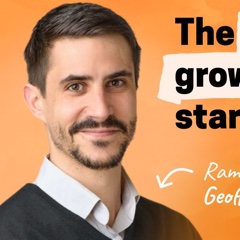 Guest
Geoff Charles
VP of Product at Ramp
 Ramp
 1 source · 18 tips
Austin Hay
Head of Marketing Technology at Ramp, former VP of Business Operations at Runway and VP of Growth at mParticle, Reforge instructor
Ramp1 source · 19 tipsSri Batchu
Head of Growth at Ramp; previously growth strategy and operations at Instacart, early employee at Opendoor
Ramp1 source · 19 tips