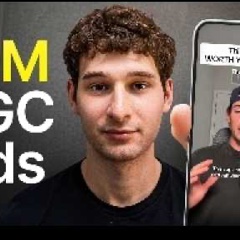
Drew Levin
Co-founder, SideShift (UGC creator marketplace), interviewed by Joseph Choi
Where to hear and read about Drew Levin1 episode or test

Drew Levin is the tech co-founder of SideShift, a UGC creator marketplace that runs programs for some of the most viral consumer apps. The most useful thing to learn from him is to run UGC as a managed testing engine: find high-engagement formats, then put Spark or partnership ad money behind the organic winners.
You want the creators to feel like they're winning.
I Studied 1,000,000 UGC Ads, This Is What Will Grow Your App
Drew Levin: the story and the lessons
1Drew Levin and how SideShift built its creator supply
Levin is the tech co-founder who also covers support and sales. He handles customer support, customer success and sometimes sales. SideShift runs UGC for some of the most viral consumer apps, so it sees live which content pulls views and downloads.
About 5,000 new brands create SideShift accounts every month, and many expect to go viral at once.
SideShift spent more on a creator course than on the product. It began as a marketplace for restaurants and bars hiring college students, and those creators couldn't make good content. The fix was a 6-hour Duolingo-style course for everyday people.
After a month or two, trained creators earn $10,000 to $15,000. Some grow into campaign managers, and some start UGC agencies that run on SideShift.
SideShift fronts creator pay when a brand doesn't pay. Reliable payouts make creators prefer to take jobs through the platform. The cost runs close to six figures a month.
Creators also teach their friends, which grows supply.
Levin expects almost every big brand to move to UGC. A year ago only small indie hackers ran UGC. Now one of the biggest apps or consumer brands switches or tests UGC every week, and he is certain almost all will pivot within 4 years.
He says Fortune 500s usually lag the trend by a year and a half to two years.
2How Levin picks videos to copy and boost
Levin treats engagement rate as the viral signal. Engagement is likes, comments, saves and shares divided by views. Above 7.5 to 8% is good, and above 12% tends to go very viral.
A video with only 5,000 views but strong engagement still signals something. He says that if he built a model to pick viral videos, he would use this metric.
He tests $20 of Spark behind any video above about 8% engagement. High-engagement videos usually run well below a dollar CPM on Spark. It is the cheapest way to get installs for apps that already have good organic content.
GoWish reached #1 on the App Store almost entirely through Spark.
He runs Spark for a week and kills it below 5% engagement. Spend starts at $50 to $100 a day per video. Candidates are ranked by comments first, then engagement rate, then views.
A video that starts near 15% organic engagement keeps its CPM flat until engagement falls to about 5%. Comments like what is that app? predict good conversion.
He sparks videos that hit three to five times the account's usual views. Beyond direct ROI, this tends to lift later organic posts. Spend also signals a legitimate account and helps it out of a shadowban.
He adds a timing rule: don't spark early. Let a video climb for a day or two, even at 100,000 views a day.
Levin keeps sparked views out of creator view bonuses. If a video has 800,000 organic views and a Spark adds 200,000, the creator may feel owed a bonus on the paid views. Paying it would erase the savings.
SideShift built a way to separate sparked views from organic ones, and he says to make it explicit in the contract.
Organic-boosted traffic converts better than pure paid, in his view. A user who finds a video organically must stop scrolling, search the App Store, download, buy and return to comment. Videos on an account that isn't yours also look native.
He says partnership ads usually convert better than Spark, even on UGC accounts with a few thousand followers. On Meta he targets early rather than optimizing for reach, the reverse of TikTok.
3How Levin structures a UGC team
Levin hires one campaign manager for every 10 creators. The ratio can stretch to 15, and fewer than five per manager wastes money. Managers also recruit and cull creators, since low pay per video means high churn.
Suno hit #1 in the App Store music category with about eight managers who also coach. Managers protect budget and output, while coaches improve the creative with notes like your tone's too slow.
He makes creator onboarding identical, short and easy. The flow is a message, a 5-minute call, then a Notion page to join and submit handles. He suggests starting with 10 creators on the same process and a weekly review call.
Creators are not always the smartest tools in the shed, so any friction stalls the launch. Some apps hire one person full time to run creator interviews.
Founders review videos before posting, then step back. In the first 3 days, the best managers review videos before posting and give heavy feedback. Once CPMs stay under $4, day-to-day work goes to campaign managers.
In the top 50 SideShift programs, founders mainly do payouts and monthly check-ins. Levin says to step in quickly when CPMs start to rise.
He builds on a system for finding formats, not one format. Formats come and go, so the system that keeps finding new ones wins. He locks in two or three top creators as the backbone so churn never sinks the program.
He also says to pick a steady creator source first, such as TikTok outreach or SideShift.
SideShift's own job-market format shows a format evolving for a year. A co-founder tied the product to job-market stress, and 6 or 7 of 15 creator videos got 150K to 300K views. A year later a campaign manager remade it as a talking head story.
The new version reached 9.6M views at 16% engagement. The founder cracked the format first, then handed it to all creators.
Levin says founders must earn creator loyalty. Loyalty is low in this game, so top founders text their best creators and send gifts. Experienced creators help launch a program but can't be relied on fully.
4Levin's rules for paying creators
He pays a retainer first, with view bonuses that don't stack. Top programs pay about $800 a month for 60 videos plus unstacked bonuses. A creator hitting 100K and then 1M gets only the $1,000 bonus, not $1,100.
Many creators aren't financially secure and want pay early. Four months before the interview a $400 base plus a $2 CPM was the hot structure, and teams keep looking for new ones.
He designs payouts to collect free views without cheating creators. After the bonus window, later views are free. Above $30 to 50K a month in spend, founders feel it, and the last bonus can sit at 1M views for $500 to $800 with nothing paid after.
"You're trying to get as many free views as possible without screwing the creator."
Tight caps cost one startup its best creator. A creator got 180M Instagram views in two weeks, including a 45M video. His payout was capped at about $4K, where it would have been about $75K uncapped.
He marched into the startup's office and the startup lost him. Levin says a cap to save $50 on a 10-million-view creator can cost thousands later.
He pays bonuses only on the best-performing cross-posted platform. Creators post each video to TikTok, Snapchat, YouTube and Instagram, and the bonus pays on the best one. This hedges cost, and SideShift now automates it.
The 60 videos a month are cross-posted on four platforms, so two unique videos a day become eight posts.
Levin avoids pure performance pay for creators. Paying only on sales or ad spend gives brands infinite upside and puts all the risk on creators. One creator made 35 videos before earning a dollar.
He says he would never take that deal as a creator, though he would as a brand.
He never outprices the market, except for a proven star. A creator with sub $2 CPMs on every campaign could justify a $10,000 retainer in month one. New creators start on CPM only, or about $200 to $300 for the same package.
A study app paid one TikTok creator with about 100K followers on a brand-new account, and one video drove about $20K MRR. The $800 package is for creators with one or two past campaigns.
5Content angles Levin sees working
Levin says to get under people's skin while showing value. For polarizing products like AI, provocative content raises comments, engagement and watch time, which TikTok rewards. Suno leans into hate for AI music in its comments and hit #1 in music.
His caveat is not to put other brands down.
He sees earn-or-get-something apps winning on organic. Settlemate and Snag give people something to share or earn. Health scanning and GLP-1 apps ride a trend, and GLP-1 companies are probably the most common new SideShift sign-ups.
Levin says any product can be turned into viral content, and apps can build virality into the product itself.
He is testing 10-minute story videos with the CTA at minute nine. One top creator grew a single account to 10,000 followers for one brand, then reused it for new brands. Average watch time is 16%.
This breaks the fresh-account-per-brand model. Levin calls it completely new and says he is still learning it.
6What Levin says to expect, and what his data leaves out
Levin tells founders to budget for high CPMs in month one. Expect $5 to $8 CPMs in month one, under $3 by month three, and under $1 after that. Programs spending over $100,000 a month typically run 80 to 90 cents.
CPMs start high because retainers underperform, not because rates are higher. It takes a month or two to find about three solid creators.
He says viral week-one results are possible but not normal. Programs fail when founders expect instant virality and skip systems. Giving creators videos already viral in the niche speeds results.
Results aren't linear: ROI is strong on the way up, but money burns quickly on the way down. A running program can work like a cash-flowing side income, kicking out $5,000 of cash.
His numbers come from his own marketplace and top customers. The CPMs, engagement thresholds and ratios have no data on failed programs or how common success is.
The promised 80% UGC cost cut is never explained, and the cost of creator churn and lost trust from capped payouts is only anecdotal.

I Studied 1,000,000 UGC Ads, This Is What Will Grow Your App
Shows how top consumer apps run UGC programs: how to structure creator teams, pay creators, and put Spark and partnership ad money behind organic winners. The programs mentioned reached 500 million views and #1 on the App Store, with CPMs under 90 cents.
Levin is the tech co-founder who also covers support and sales. He handles customer support, customer success and sometimes sales. SideShift runs UGC for some of the most viral consumer apps, so it sees live which content pulls views and downloads.
About 5,000 new brands create SideShift accounts every month, and many expect to go viral at once.
SideShift spent more on a creator course than on the product. It began as a marketplace for restaurants and bars hiring college students, and those creators couldn't make good content. The fix was a 6-hour Duolingo-style course for everyday people.
After a month or two, trained creators earn $10,000 to $15,000. Some grow into campaign managers, and some start UGC agencies that run on SideShift.
SideShift fronts creator pay when a brand doesn't pay. Reliable payouts make creators prefer to take jobs through the platform. The cost runs close to six figures a month.
Creators also teach their friends, which grows supply.
Levin expects almost every big brand to move to UGC. A year ago only small indie hackers ran UGC. Now one of the biggest apps or consumer brands switches or tests UGC every week, and he is certain almost all will pivot within 4 years.
He says Fortune 500s usually lag the trend by a year and a half to two years.
Levin treats engagement rate as the viral signal. Engagement is likes, comments, saves and shares divided by views. Above 7.5 to 8% is good, and above 12% tends to go very viral.
A video with only 5,000 views but strong engagement still signals something. He says that if he built a model to pick viral videos, he would use this metric.
He tests $20 of Spark behind any video above about 8% engagement. High-engagement videos usually run well below a dollar CPM on Spark. It is the cheapest way to get installs for apps that already have good organic content.
GoWish reached #1 on the App Store almost entirely through Spark.
He runs Spark for a week and kills it below 5% engagement. Spend starts at $50 to $100 a day per video. Candidates are ranked by comments first, then engagement rate, then views.
A video that starts near 15% organic engagement keeps its CPM flat until engagement falls to about 5%. Comments like what is that app? predict good conversion.
He sparks videos that hit three to five times the account's usual views. Beyond direct ROI, this tends to lift later organic posts. Spend also signals a legitimate account and helps it out of a shadowban.
He adds a timing rule: don't spark early. Let a video climb for a day or two, even at 100,000 views a day.
Levin keeps sparked views out of creator view bonuses. If a video has 800,000 organic views and a Spark adds 200,000, the creator may feel owed a bonus on the paid views. Paying it would erase the savings.
SideShift built a way to separate sparked views from organic ones, and he says to make it explicit in the contract.
Organic-boosted traffic converts better than pure paid, in his view. A user who finds a video organically must stop scrolling, search the App Store, download, buy and return to comment. Videos on an account that isn't yours also look native.
He says partnership ads usually convert better than Spark, even on UGC accounts with a few thousand followers. On Meta he targets early rather than optimizing for reach, the reverse of TikTok.
Levin hires one campaign manager for every 10 creators. The ratio can stretch to 15, and fewer than five per manager wastes money. Managers also recruit and cull creators, since low pay per video means high churn.
Suno hit #1 in the App Store music category with about eight managers who also coach. Managers protect budget and output, while coaches improve the creative with notes like your tone's too slow.
He makes creator onboarding identical, short and easy. The flow is a message, a 5-minute call, then a Notion page to join and submit handles. He suggests starting with 10 creators on the same process and a weekly review call.
Creators are not always the smartest tools in the shed, so any friction stalls the launch. Some apps hire one person full time to run creator interviews.
Founders review videos before posting, then step back. In the first 3 days, the best managers review videos before posting and give heavy feedback. Once CPMs stay under $4, day-to-day work goes to campaign managers.
In the top 50 SideShift programs, founders mainly do payouts and monthly check-ins. Levin says to step in quickly when CPMs start to rise.
He builds on a system for finding formats, not one format. Formats come and go, so the system that keeps finding new ones wins. He locks in two or three top creators as the backbone so churn never sinks the program.
He also says to pick a steady creator source first, such as TikTok outreach or SideShift.
SideShift's own job-market format shows a format evolving for a year. A co-founder tied the product to job-market stress, and 6 or 7 of 15 creator videos got 150K to 300K views. A year later a campaign manager remade it as a talking head story.
The new version reached 9.6M views at 16% engagement. The founder cracked the format first, then handed it to all creators.
Levin says founders must earn creator loyalty. Loyalty is low in this game, so top founders text their best creators and send gifts. Experienced creators help launch a program but can't be relied on fully.
He pays a retainer first, with view bonuses that don't stack. Top programs pay about $800 a month for 60 videos plus unstacked bonuses. A creator hitting 100K and then 1M gets only the $1,000 bonus, not $1,100.
Many creators aren't financially secure and want pay early. Four months before the interview a $400 base plus a $2 CPM was the hot structure, and teams keep looking for new ones.
He designs payouts to collect free views without cheating creators. After the bonus window, later views are free. Above $30 to 50K a month in spend, founders feel it, and the last bonus can sit at 1M views for $500 to $800 with nothing paid after.
"You're trying to get as many free views as possible without screwing the creator."
Tight caps cost one startup its best creator. A creator got 180M Instagram views in two weeks, including a 45M video. His payout was capped at about $4K, where it would have been about $75K uncapped.
He marched into the startup's office and the startup lost him. Levin says a cap to save $50 on a 10-million-view creator can cost thousands later.
He pays bonuses only on the best-performing cross-posted platform. Creators post each video to TikTok, Snapchat, YouTube and Instagram, and the bonus pays on the best one. This hedges cost, and SideShift now automates it.
The 60 videos a month are cross-posted on four platforms, so two unique videos a day become eight posts.
Levin avoids pure performance pay for creators. Paying only on sales or ad spend gives brands infinite upside and puts all the risk on creators. One creator made 35 videos before earning a dollar.
He says he would never take that deal as a creator, though he would as a brand.
He never outprices the market, except for a proven star. A creator with sub $2 CPMs on every campaign could justify a $10,000 retainer in month one. New creators start on CPM only, or about $200 to $300 for the same package.
A study app paid one TikTok creator with about 100K followers on a brand-new account, and one video drove about $20K MRR. The $800 package is for creators with one or two past campaigns.
Levin says to get under people's skin while showing value. For polarizing products like AI, provocative content raises comments, engagement and watch time, which TikTok rewards. Suno leans into hate for AI music in its comments and hit #1 in music.
His caveat is not to put other brands down.
He sees earn-or-get-something apps winning on organic. Settlemate and Snag give people something to share or earn. Health scanning and GLP-1 apps ride a trend, and GLP-1 companies are probably the most common new SideShift sign-ups.
Levin says any product can be turned into viral content, and apps can build virality into the product itself.
He is testing 10-minute story videos with the CTA at minute nine. One top creator grew a single account to 10,000 followers for one brand, then reused it for new brands. Average watch time is 16%.
This breaks the fresh-account-per-brand model. Levin calls it completely new and says he is still learning it.
Levin tells founders to budget for high CPMs in month one. Expect $5 to $8 CPMs in month one, under $3 by month three, and under $1 after that. Programs spending over $100,000 a month typically run 80 to 90 cents.
CPMs start high because retainers underperform, not because rates are higher. It takes a month or two to find about three solid creators.
He says viral week-one results are possible but not normal. Programs fail when founders expect instant virality and skip systems. Giving creators videos already viral in the niche speeds results.
Results aren't linear: ROI is strong on the way up, but money burns quickly on the way down. A running program can work like a cash-flowing side income, kicking out $5,000 of cash.
His numbers come from his own marketplace and top customers. The CPMs, engagement thresholds and ratios have no data on failed programs or how common success is.
The promised 80% UGC cost cut is never explained, and the cost of creator churn and lost trust from capped payouts is only anecdotal.
 SideShift