
SideShift
A platform for running UGC creator programs, with creator discovery, tracking, payments and paid ad tools.
SideShift grew from a creator marketplace into an ads platform, and its operators show organic-first works: Praktika runs 100+ creators on it, and one top program passed 10,000 posts and 500M views. Founders can start at $2,000 to $4,000, pay a base plus a CPM, call 5 or 6 videos above 10,000 views a fit, then put about $100 a day behind proven winners.
- 1Find content fit$2,000 to $4,000, 30 to 60 videos
- 2Put 90% on winner10% of creators keep testing formats
- 3Pick winners for paid5 to 10x views, 8 to 10% engagement
- 4Run $100 a dayAcross winners for 14 days
- 5Scale on positive ROAS$300, then $1,000 a day
From Nick Lawton, SideShift co-founder
What was said about SideShift
1How SideShift went from creator marketplace to ads platform
SideShift started as a creator marketplace and is becoming an ads platform. It began with creator discovery, tracking and payments, then moved toward running paid ads. Its V3 adds organic attribution overlays, a Sidekick agent and the ability to run Meta and TikTok ads.
Co-founder Nick Lawton describes an integration to run organic winners as Meta and TikTok ads, and an AI agent that runs a campaign from a budget, a website and a creator count. It onboarded about 30 agencies this summer, and its manager network is still mostly in tier-one countries.
It won by building creator quality that older marketplaces ignored. Earlier marketplaces scraped TikTok and cold-emailed people, so their pools filled with gifted-campaign beauty and fashion creators, a poor fit for apps. SideShift built around scrappy everyday creators instead.
Joseph Choi, whose viral doc told founders to hire scrappy creators rather than influencers, says SideShift made that doc obsolete and is the only good marketplace in his view.
It manufactures creator supply with a 6-hour training course. SideShift built a Duolingo-style 6-hour course for everyday people and spent more money and time on it than on the product itself. Trained creators earn about $10,000 to $15,000 after a month or two.
Some graduates become campaign managers or start their own UGC agencies. SideShift also fronts creator payouts when brands don't pay.
Its customer range gives it a wide view of what converts. About 5,000 new brands sign up each month, from founders spending a couple thousand dollars to top spenders putting in $250,000 to over $700,000 a month. Customers include Cursor, and Praktika runs its 100+ creator program on it with in-house analytics add-ons.
One top program passed 10,000 posts and 500M views. Peptide, GLP-1 and health-scanning apps are among the fastest-growing and most common new sign-ups. Nearly all the playbook figures come from SideShift's own executives and customers, with no data on failed programs.
2SideShift's own job-market format
- Master's degree, no job
- Text over a screen
- 6 or 7 of 15 hit 150K to 300K views
- Remade a year later
- Campaign manager tells the story
- 9.6M views at 16% engagement
Talking-head story reached 9.6M views
From Nick Lawton, SideShift co-founder
SideShift tied its product to a stressful trend: the bad job market. A founder cracked a format relating job-market frustration to the platform, then handed it to all creators. Six or seven of 15 creator videos got 150,000 to 300,000 views.
The first version was a non-talking-head video: a master's degree, no job, text over a screen. A year later a campaign manager remade it as a talking-head story that reached 9.6M views at 16% engagement. "We were just trying to relate what's going on in the world to our platform and product."
Organic creators' problem videos can become formats by adding a CTA. SideShift took organic job-market complaint videos and turned them into campaign formats by adding a call to action. Nick Lawton calls a subtle, natural CTA one of the biggest hurdles in UGC.
His test: can the video show your app solving that problem, such as a creator showing an app where they showed an iPad. He cautions to check how it converts before trusting it.
A non-converting warm-up format still earns its place. SideShift's zoo job rejection video plugs the product, converts poorly, but warms up new accounts and engages the niche. One version reached 700,000 likes and the format is still used a year later.
Warm-up videos skip the CTA and chase views to show the algorithm the account is a real person. Controversial formats warm accounts best but are hard to add a CTA to.
Income-related apps like SideShift struggle with TikTok shadow bans. TikTok shadow-bans many videos where the value prop is helping users earn money, such as crypto, trading and SideShift itself. Over the past 3 to 6 months Instagram has driven about 10 to 20% more views than TikTok in aggregate.
Facebook Reels crossposting is an easy add-on, and creators on a good bonus will post there for no extra base pay or a nominal increase.
3Finding content market fit on a small budget
Spend the first month and $2,000 to $4,000 only on finding fit. Pay about $600 to $800 for 30 to 60 videos plus a $1 to $2 CPM view bonus. Fit means five or six videos in the campaign hitting about 10,000 views, then studying their watch time and retention.
Nick counts a video as viral only after 100,000 views, so 10,000 is the early signal; another framing is at least one 10,000-view video in the first 180 to 300. Many people quit UGC early because they skip this validation phase. Founders without budget should make the videos themselves.
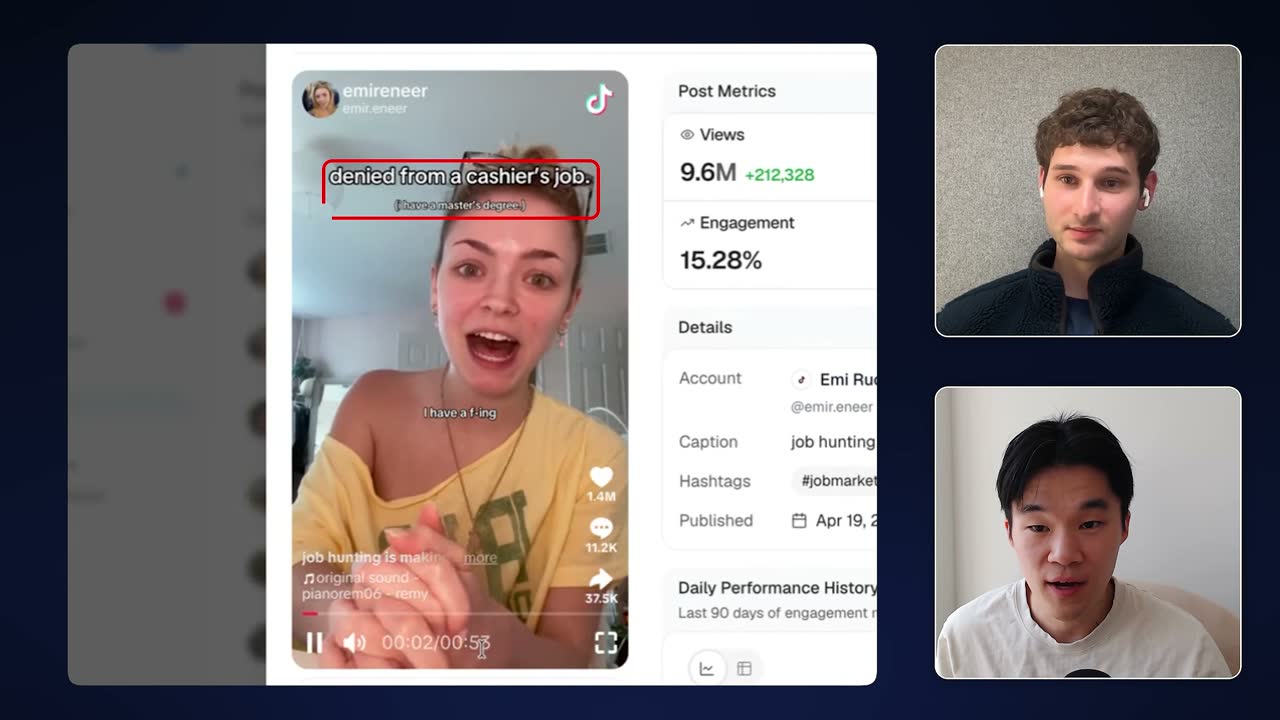
TikTok talking-head ad "denied from a cashier's job" hitting 9.6M views at 15.28% engagement. Remix a competitor's proven format by 10 to 20% rather than inventing one. Research competitors on TikTok and Instagram before launch and plug your product into a few candidate formats. Exact copies from day-zero accounts often fail because the competitor's accounts are already warmed up.
Giving creators videos already viral in the niche speeds up results.
Comments asking about the app matter more than views. A peptide slideshow got 17,900 views but comments asked "what the heck is AI"; another got only 10,000 views but comments asked about the app. Nick says AI UGC is great for vanity views but he has not seen it convert.
A real creator doing a simple before and after, like "my face before peptides" with a CTA at the end, beats AI formats. Ten million monthly views from slideshows converting at 0.0001% is "burning money on fire." No conversion data backs the AI claim.
Very narrow niches now beat broad ones. Knitting, ballet and wrestling or MMA convert better because the content speaks to one audience. Broad monetization niches like side hustles and crypto saturated 6 to 12 months ago, so cloned formats die fast.
In a crowded niche dozens of teams clone a new format and audiences notice; in a narrow one a format can be pushed much further. Content that triggers emotion, like Suno leaning into AI-music hate or GLP-1 apps leaning into health fears, also spreads best.
Grow past a niche's ceiling through adjacent audiences and cheaper markets. Ballet alone caps near $10,000 a month, while the wider dance community can carry an app toward $100,000 or a million. A US video costing $25 may cost about $15 in LATAM, so those markets work as testing grounds.
Start with three to five creators in one market. Both product capabilities and creator formats need to speak to the new personas.
4Paying creators
A guaranteed base plus a per-view bonus works best. Nick's structure is $600 with a $1 to $2 CPM, uncapped to reward virality or capped to protect profit. Top programs pay $800 a month for 60 videos plus unstacked view bonuses.
Unstacked bonuses let the brand collect free views after the bonus window ends. Praktika pays a fixed fee plus a views bonus but bends the structure for strong talent: "If there is a good talent, just do whatever to hire this person."
Separate sparked views from organic ones in the contract. If a video has 800,000 organic views and you spark it to 200,000 more, creators may expect a bonus on the paid views. Track the two and state in the contract that sparked views earn no bonus.
SideShift built a way to tell sparked views from organic ones for this reason.
Have creators cross-post everywhere but pay only for the best platform. Creators post each video to TikTok, Snapchat, YouTube and Instagram, and the bonus pays only on the best performer. You pay once even if all four do well.
Clueless and other companies run this, and SideShift now automates it.
Paying a share of ad sales lowers brand risk. When ads run through a tracked platform, creators can get a retainer plus a percentage of the ad sales they drive instead of a CPM. This shifts risk away from the brand compared with a retainer or CPM alone.
The model appeals to creators and draws in TikTok Shop creators who already know it.
5Staffing and running a creator program
Hire a generalist manager once you pass about 10 creators. The first hire has gone viral and worked with creators, ideally with some brand-side time, on a $2,000 to $4,000 monthly retainer plus about 5% of creator bonuses. Start with a one-month pilot; the retainer scales at about $150 per creator.
Few founders have 20 to 30 hours a week for UGC. The bonus cut pushes the manager to catch bad posts and find winning formats, like a sales manager earning a share of team results.
Keep one manager per 10 creators, stretching to 15. Fewer than five creators per manager wastes money. Founders or managers review videos before posting at the start and pull back once CPMs stay under $4.
Managers handle logistics, posting and culling; coaches improve creative. Suno hit #1 in its App Store category with about eight managers who also coach. In the top 50 programs founders only do payouts and monthly check-ins.
Hire storytellers who respond fast, not creators with big past numbers. Talking-to-camera storytelling is the hardest skill to teach, while past views may come from an easy format. Fast replies, good onboarding questions and real product interest beat a "10 star resume."
Creators on more than five campaigns tend to go rogue and ghost within a week or two. Recruits with a campaign or two behind them come cheap and build loyalty.
Onboard everyone the same short way and manage them in one group chat. The flow is a message, a 5-minute call, then a Notion page to submit handles, starting with 10 creators and a weekly review call. All creators share one group chat where videos are broken down by watch time and variables like wording or audio.
Reviewers record Loom videos dissecting clips, separating bad messaging from bad content. Lock in two or three top creators as the program's backbone so churn never sinks it.
After a winner, put 90% of creators on it and 10% on testing. Recruit more creators or revisit passed-over applicants with a 5 to 10 minute call, then add them to the chat with a visible leaderboard. One or two creators keep testing new formats for when the winner saturates.
Creators on view bonuses copy a format harder once they see a peer win. Some operators run one format "into oblivion," but Nick keeps "a slightly smaller basket to the side just in case."
6Turning organic winners into paid ads
Pick organic videos for paid by engagement and comment sentiment. Across 11,000 posts, videos with 5 to 10x a creator's normal views, 8 to 10% or more engagement and comments about the product did much better as paid ads. SideShift's own bar for spend is about 5% engagement.
Drew Levin tests $20 behind any video above about 8% engagement, expects CPMs under $1, and kills the Spark below 5%. Flopped organic videos are worth testing too: "just because a video flopped doesn't mean that that video was for nothing." GoWish reached #1 on the App Store almost entirely through Spark.
Start winner spend at $100 a day and scale on positive ROAS. Once organic works and the marketing budget is above about $10,000 a month, run $100 a day across winners for 14 days, then $300 and $1,000 a day if ROAS is positive. Getting 75 cents back per dollar means the video lacked organic fit.
SideShift itself began paid at about $100 a day; the biggest teams run up to $100,000 a day.
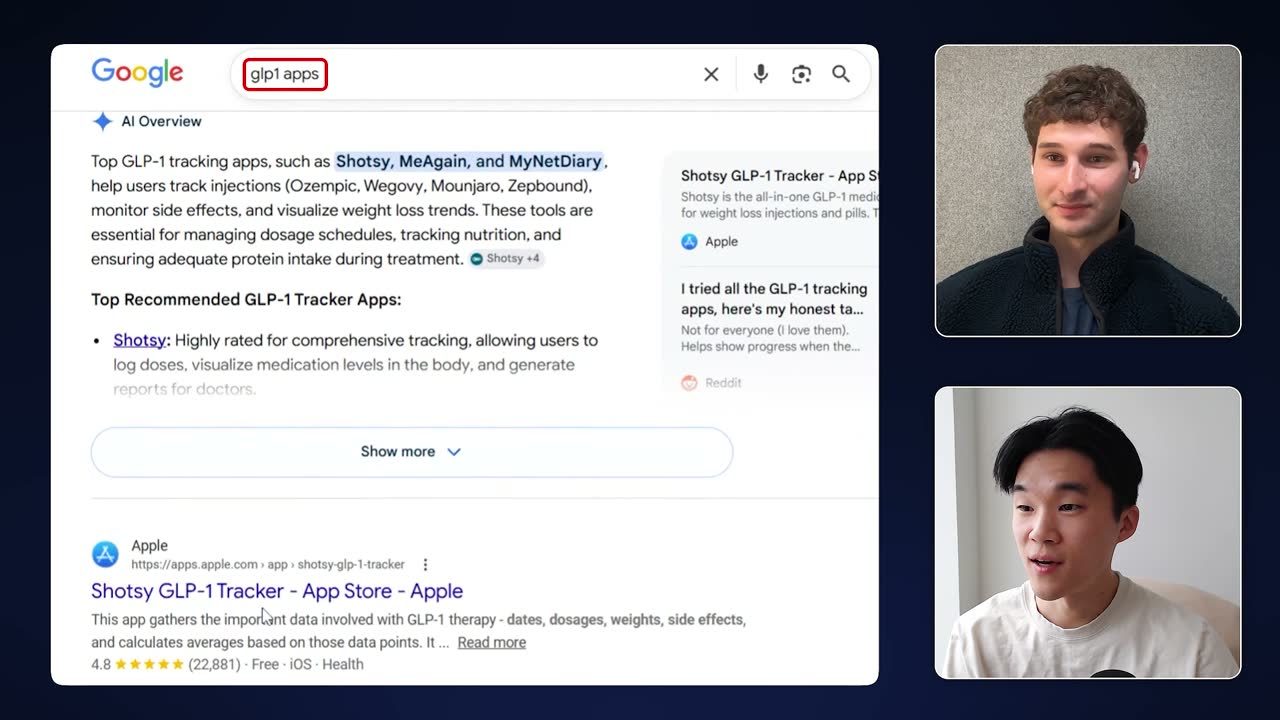
Google search for "glp1 apps" surfaces Shotsy GLP-1 Tracker, rated 4.8 with 22,881 reviews. Use Meta for conversions and TikTok Spark for cheap reach. Spark ads have no button, so you can only measure an attributable CPM; Meta ads have a button and give conversion attribution, so real scale comes from Meta. Spark suits videos that already carry a strong organic CTA.
Paid also supplies attribution through UTM links and trial starts that organic lacks.
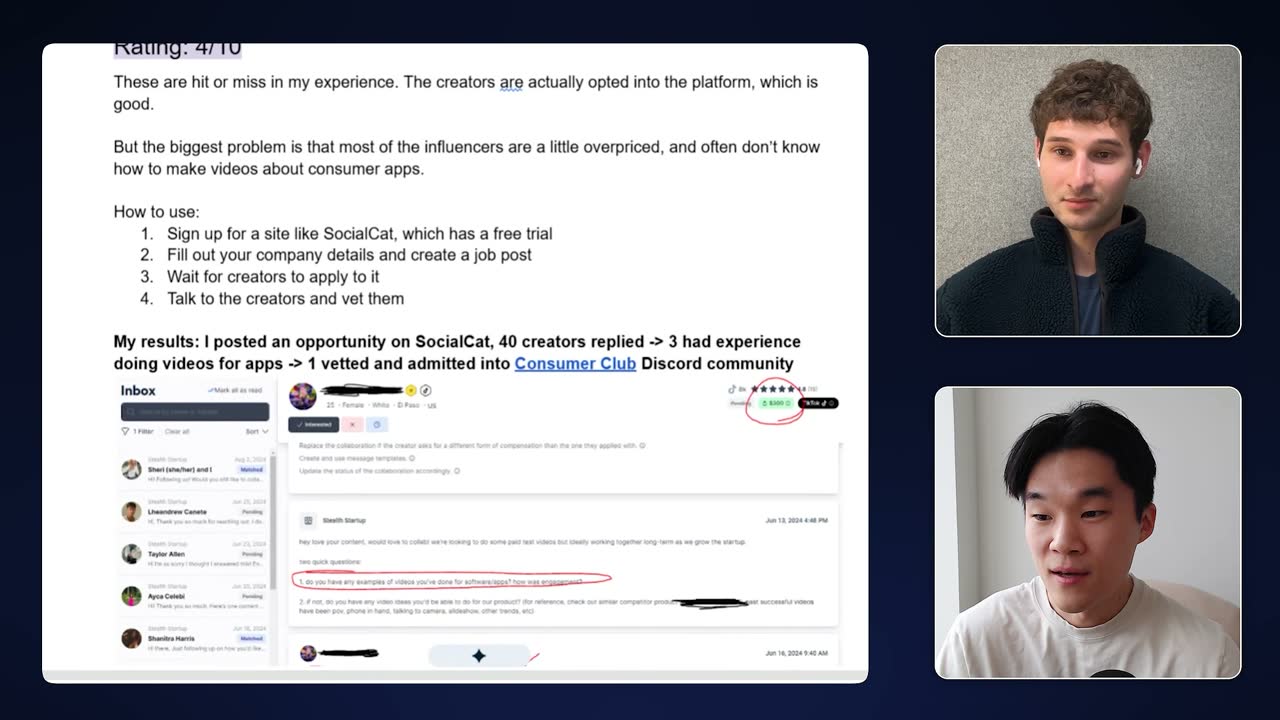
Doc rating creator marketplaces 4/10: SocialCat post drew 40 creators, only 1 vetted. Big brands treat organic as 20% testing and paid as 80% scale. Brands spending six figures a month on SideShift may spend seven to eight figures on performance, testing dozens of creatives daily and funding winners. New teams should learn organic first, then add paid on proven winners.
Expect $5 to $8 CPMs in month one, under $3 by month three and under $1 after; big programs run 80 to 90 cents. Nick says the biggest gap is between organic-only teams and those running organic plus paid.
Overlay posting spikes on installs and revenue to attribute organic. At scale you only feel the million-view hits, so overlay posting spikes against App Store installs and Stripe or RevenueCat revenue to see which content converts. Check creator audience geography to detect view botting.
"It's always the attribution piece that is so foggy, that is so gray."

How To Grow Your App 23x Faster Than The Competition
Moved from a creator marketplace with tracking and payments to an ads platform, and its V3 adds organic attribution overlays, a Sidekick agent and Meta and TikTok ad running. It onboarded about 30 agencies this summer, and its manager network is still mostly tier-one countries.
Its customer range gives it a wide view of what converts. About 5,000 new brands sign up each month, from founders spending a couple thousand dollars to top spenders putting in $250,000 to over $700,000 a month. Customers include Cursor, and Praktika runs its 100+ creator program on it with in-house analytics add-ons.
One top program passed 10,000 posts and 500M views. Peptide, GLP-1 and health-scanning apps are among the fastest-growing and most common new sign-ups. Nearly all the playbook figures come from SideShift's own executives and customers, with no data on failed programs.
A guaranteed base plus a per-view bonus works best. Nick's structure is $600 with a $1 to $2 CPM, uncapped to reward virality or capped to protect profit. Top programs pay $800 a month for 60 videos plus unstacked view bonuses.
Unstacked bonuses let the brand collect free views after the bonus window ends. Praktika pays a fixed fee plus a views bonus but bends the structure for strong talent: "If there is a good talent, just do whatever to hire this person."
#1 UGC EXPERT Reveals How To Market Consumer Apps
Co-founder Nick Lawton sees hundreds of campaigns, from founders starting at a couple thousand dollars to top spenders putting in $250,000 to over $700,000 a month. It is building an integration to run organic winners as Meta and TikTok ads, plus an AI agent that runs campaigns from a budget, a website and a creator count.
SideShift started as a creator marketplace and is becoming an ads platform. It began with creator discovery, tracking and payments, then moved toward running paid ads. Its V3 adds organic attribution overlays, a Sidekick agent and the ability to run Meta and TikTok ads.
Co-founder Nick Lawton describes an integration to run organic winners as Meta and TikTok ads, and an AI agent that runs a campaign from a budget, a website and a creator count. It onboarded about 30 agencies this summer, and its manager network is still mostly in tier-one countries.
Income-related apps like SideShift struggle with TikTok shadow bans. TikTok shadow-bans many videos where the value prop is helping users earn money, such as crypto, trading and SideShift itself. Over the past 3 to 6 months Instagram has driven about 10 to 20% more views than TikTok in aggregate.
Facebook Reels crossposting is an easy add-on, and creators on a good bonus will post there for no extra base pay or a nominal increase.
Very narrow niches now beat broad ones. Knitting, ballet and wrestling or MMA convert better because the content speaks to one audience. Broad monetization niches like side hustles and crypto saturated 6 to 12 months ago, so cloned formats die fast.
In a crowded niche dozens of teams clone a new format and audiences notice; in a narrow one a format can be pushed much further. Content that triggers emotion, like Suno leaning into AI-music hate or GLP-1 apps leaning into health fears, also spreads best.
Grow past a niche's ceiling through adjacent audiences and cheaper markets. Ballet alone caps near $10,000 a month, while the wider dance community can carry an app toward $100,000 or a million. A US video costing $25 may cost about $15 in LATAM, so those markets work as testing grounds.
Start with three to five creators in one market. Both product capabilities and creator formats need to speak to the new personas.
Paying a share of ad sales lowers brand risk. When ads run through a tracked platform, creators can get a retainer plus a percentage of the ad sales they drive instead of a CPM. This shifts risk away from the brand compared with a retainer or CPM alone.
The model appeals to creators and draws in TikTok Shop creators who already know it.
Hire a generalist manager once you pass about 10 creators. The first hire has gone viral and worked with creators, ideally with some brand-side time, on a $2,000 to $4,000 monthly retainer plus about 5% of creator bonuses. Start with a one-month pilot; the retainer scales at about $150 per creator.
Few founders have 20 to 30 hours a week for UGC. The bonus cut pushes the manager to catch bad posts and find winning formats, like a sales manager earning a share of team results.
Keep one manager per 10 creators, stretching to 15. Fewer than five creators per manager wastes money. Founders or managers review videos before posting at the start and pull back once CPMs stay under $4.
Managers handle logistics, posting and culling; coaches improve creative. Suno hit #1 in its App Store category with about eight managers who also coach. In the top 50 programs founders only do payouts and monthly check-ins.
Hire storytellers who respond fast, not creators with big past numbers. Talking-to-camera storytelling is the hardest skill to teach, while past views may come from an easy format. Fast replies, good onboarding questions and real product interest beat a "10 star resume."
Creators on more than five campaigns tend to go rogue and ghost within a week or two. Recruits with a campaign or two behind them come cheap and build loyalty.
Onboard everyone the same short way and manage them in one group chat. The flow is a message, a 5-minute call, then a Notion page to submit handles, starting with 10 creators and a weekly review call. All creators share one group chat where videos are broken down by watch time and variables like wording or audio.
Reviewers record Loom videos dissecting clips, separating bad messaging from bad content. Lock in two or three top creators as the program's backbone so churn never sinks it.
Pick organic videos for paid by engagement and comment sentiment. Across 11,000 posts, videos with 5 to 10x a creator's normal views, 8 to 10% or more engagement and comments about the product did much better as paid ads. SideShift's own bar for spend is about 5% engagement.
Drew Levin tests $20 behind any video above about 8% engagement, expects CPMs under $1, and kills the Spark below 5%. Flopped organic videos are worth testing too: "just because a video flopped doesn't mean that that video was for nothing." GoWish reached #1 on the App Store almost entirely through Spark.
Overlay posting spikes on installs and revenue to attribute organic. At scale you only feel the million-view hits, so overlay posting spikes against App Store installs and Stripe or RevenueCat revenue to see which content converts. Check creator audience geography to detect view botting.
"It's always the attribution piece that is so foggy, that is so gray."
I Studied 1,000,000 UGC Ads, This Is What Will Grow Your App
Levin's marketplace sees live which content pulls views and downloads, with about 5,000 new brands signing up monthly. It trains creators with a 6-hour course (trained creators earn $10,000 to $15,000 after a month or two), fronts payouts when brands don't pay, and separates sparked views from organic ones for bonuses. A top program passed 10,000 posts and 500M views.
SideShift started as a creator marketplace and is becoming an ads platform. It began with creator discovery, tracking and payments, then moved toward running paid ads. Its V3 adds organic attribution overlays, a Sidekick agent and the ability to run Meta and TikTok ads.
Co-founder Nick Lawton describes an integration to run organic winners as Meta and TikTok ads, and an AI agent that runs a campaign from a budget, a website and a creator count. It onboarded about 30 agencies this summer, and its manager network is still mostly in tier-one countries.
Its customer range gives it a wide view of what converts. About 5,000 new brands sign up each month, from founders spending a couple thousand dollars to top spenders putting in $250,000 to over $700,000 a month. Customers include Cursor, and Praktika runs its 100+ creator program on it with in-house analytics add-ons.
One top program passed 10,000 posts and 500M views. Peptide, GLP-1 and health-scanning apps are among the fastest-growing and most common new sign-ups. Nearly all the playbook figures come from SideShift's own executives and customers, with no data on failed programs.
SideShift tied its product to a stressful trend: the bad job market. A founder cracked a format relating job-market frustration to the platform, then handed it to all creators. Six or seven of 15 creator videos got 150,000 to 300,000 views.
The first version was a non-talking-head video: a master's degree, no job, text over a screen. A year later a campaign manager remade it as a talking-head story that reached 9.6M views at 16% engagement. "We were just trying to relate what's going on in the world to our platform and product."
Organic creators' problem videos can become formats by adding a CTA. SideShift took organic job-market complaint videos and turned them into campaign formats by adding a call to action. Nick Lawton calls a subtle, natural CTA one of the biggest hurdles in UGC.
His test: can the video show your app solving that problem, such as a creator showing an app where they showed an iPad. He cautions to check how it converts before trusting it.
A non-converting warm-up format still earns its place. SideShift's zoo job rejection video plugs the product, converts poorly, but warms up new accounts and engages the niche. One version reached 700,000 likes and the format is still used a year later.
Warm-up videos skip the CTA and chase views to show the algorithm the account is a real person. Controversial formats warm accounts best but are hard to add a CTA to.
Spend the first month and $2,000 to $4,000 only on finding fit. Pay about $600 to $800 for 30 to 60 videos plus a $1 to $2 CPM view bonus. Fit means five or six videos in the campaign hitting about 10,000 views, then studying their watch time and retention.
Nick counts a video as viral only after 100,000 views, so 10,000 is the early signal; another framing is at least one 10,000-view video in the first 180 to 300. Many people quit UGC early because they skip this validation phase. Founders without budget should make the videos themselves.
TikTok talking-head ad "denied from a cashier's job" hitting 9.6M views at 15.28% engagement. Remix a competitor's proven format by 10 to 20% rather than inventing one. Research competitors on TikTok and Instagram before launch and plug your product into a few candidate formats. Exact copies from day-zero accounts often fail because the competitor's accounts are already warmed up.
Giving creators videos already viral in the niche speeds up results.
Comments asking about the app matter more than views. A peptide slideshow got 17,900 views but comments asked "what the heck is AI"; another got only 10,000 views but comments asked about the app. Nick says AI UGC is great for vanity views but he has not seen it convert.
A real creator doing a simple before and after, like "my face before peptides" with a CTA at the end, beats AI formats. Ten million monthly views from slideshows converting at 0.0001% is "burning money on fire." No conversion data backs the AI claim.
A guaranteed base plus a per-view bonus works best. Nick's structure is $600 with a $1 to $2 CPM, uncapped to reward virality or capped to protect profit. Top programs pay $800 a month for 60 videos plus unstacked view bonuses.
Unstacked bonuses let the brand collect free views after the bonus window ends. Praktika pays a fixed fee plus a views bonus but bends the structure for strong talent: "If there is a good talent, just do whatever to hire this person."
Paying a share of ad sales lowers brand risk. When ads run through a tracked platform, creators can get a retainer plus a percentage of the ad sales they drive instead of a CPM. This shifts risk away from the brand compared with a retainer or CPM alone.
The model appeals to creators and draws in TikTok Shop creators who already know it.
Onboard everyone the same short way and manage them in one group chat. The flow is a message, a 5-minute call, then a Notion page to submit handles, starting with 10 creators and a weekly review call. All creators share one group chat where videos are broken down by watch time and variables like wording or audio.
Reviewers record Loom videos dissecting clips, separating bad messaging from bad content. Lock in two or three top creators as the program's backbone so churn never sinks it.
After a winner, put 90% of creators on it and 10% on testing. Recruit more creators or revisit passed-over applicants with a 5 to 10 minute call, then add them to the chat with a visible leaderboard. One or two creators keep testing new formats for when the winner saturates.
Creators on view bonuses copy a format harder once they see a peer win. Some operators run one format "into oblivion," but Nick keeps "a slightly smaller basket to the side just in case."
Pick organic videos for paid by engagement and comment sentiment. Across 11,000 posts, videos with 5 to 10x a creator's normal views, 8 to 10% or more engagement and comments about the product did much better as paid ads. SideShift's own bar for spend is about 5% engagement.
Drew Levin tests $20 behind any video above about 8% engagement, expects CPMs under $1, and kills the Spark below 5%. Flopped organic videos are worth testing too: "just because a video flopped doesn't mean that that video was for nothing." GoWish reached #1 on the App Store almost entirely through Spark.
Start winner spend at $100 a day and scale on positive ROAS. Once organic works and the marketing budget is above about $10,000 a month, run $100 a day across winners for 14 days, then $300 and $1,000 a day if ROAS is positive. Getting 75 cents back per dollar means the video lacked organic fit.
SideShift itself began paid at about $100 a day; the biggest teams run up to $100,000 a day.
Google search for "glp1 apps" surfaces Shotsy GLP-1 Tracker, rated 4.8 with 22,881 reviews. Use Meta for conversions and TikTok Spark for cheap reach. Spark ads have no button, so you can only measure an attributable CPM; Meta ads have a button and give conversion attribution, so real scale comes from Meta. Spark suits videos that already carry a strong organic CTA.
Paid also supplies attribution through UTM links and trial starts that organic lacks.
Doc rating creator marketplaces 4/10: SocialCat post drew 40 creators, only 1 vetted. Big brands treat organic as 20% testing and paid as 80% scale. Brands spending six figures a month on SideShift may spend seven to eight figures on performance, testing dozens of creatives daily and funding winners. New teams should learn organic first, then add paid on proven winners.
Expect $5 to $8 CPMs in month one, under $3 by month three and under $1 after; big programs run 80 to 90 cents. Nick says the biggest gap is between organic-only teams and those running organic plus paid.

How Praktika built a profitable $50M ARR AI business — Adam Turaev, Praktika
Praktika runs its 100+ creator program on SideShift, with internal add-ons for analytics and reporting.
It won by building creator quality that older marketplaces ignored. Earlier marketplaces scraped TikTok and cold-emailed people, so their pools filled with gifted-campaign beauty and fashion creators, a poor fit for apps. SideShift built around scrappy everyday creators instead.
Joseph Choi, whose viral doc told founders to hire scrappy creators rather than influencers, says SideShift made that doc obsolete and is the only good marketplace in his view.
It manufactures creator supply with a 6-hour training course. SideShift built a Duolingo-style 6-hour course for everyday people and spent more money and time on it than on the product itself. Trained creators earn about $10,000 to $15,000 after a month or two.
Some graduates become campaign managers or start their own UGC agencies. SideShift also fronts creator payouts when brands don't pay.
Its customer range gives it a wide view of what converts. About 5,000 new brands sign up each month, from founders spending a couple thousand dollars to top spenders putting in $250,000 to over $700,000 a month. Customers include Cursor, and Praktika runs its 100+ creator program on it with in-house analytics add-ons.
One top program passed 10,000 posts and 500M views. Peptide, GLP-1 and health-scanning apps are among the fastest-growing and most common new sign-ups. Nearly all the playbook figures come from SideShift's own executives and customers, with no data on failed programs.
SideShift tied its product to a stressful trend: the bad job market. A founder cracked a format relating job-market frustration to the platform, then handed it to all creators. Six or seven of 15 creator videos got 150,000 to 300,000 views.
The first version was a non-talking-head video: a master's degree, no job, text over a screen. A year later a campaign manager remade it as a talking-head story that reached 9.6M views at 16% engagement. "We were just trying to relate what's going on in the world to our platform and product."
Remix a competitor's proven format by 10 to 20% rather than inventing one. Research competitors on TikTok and Instagram before launch and plug your product into a few candidate formats. Exact copies from day-zero accounts often fail because the competitor's accounts are already warmed up.
Giving creators videos already viral in the niche speeds up results.
Very narrow niches now beat broad ones. Knitting, ballet and wrestling or MMA convert better because the content speaks to one audience. Broad monetization niches like side hustles and crypto saturated 6 to 12 months ago, so cloned formats die fast.
In a crowded niche dozens of teams clone a new format and audiences notice; in a narrow one a format can be pushed much further. Content that triggers emotion, like Suno leaning into AI-music hate or GLP-1 apps leaning into health fears, also spreads best.
A guaranteed base plus a per-view bonus works best. Nick's structure is $600 with a $1 to $2 CPM, uncapped to reward virality or capped to protect profit. Top programs pay $800 a month for 60 videos plus unstacked view bonuses.
Unstacked bonuses let the brand collect free views after the bonus window ends. Praktika pays a fixed fee plus a views bonus but bends the structure for strong talent: "If there is a good talent, just do whatever to hire this person."
Separate sparked views from organic ones in the contract. If a video has 800,000 organic views and you spark it to 200,000 more, creators may expect a bonus on the paid views. Track the two and state in the contract that sparked views earn no bonus.
SideShift built a way to tell sparked views from organic ones for this reason.
Have creators cross-post everywhere but pay only for the best platform. Creators post each video to TikTok, Snapchat, YouTube and Instagram, and the bonus pays only on the best performer. You pay once even if all four do well.
Clueless and other companies run this, and SideShift now automates it.
Keep one manager per 10 creators, stretching to 15. Fewer than five creators per manager wastes money. Founders or managers review videos before posting at the start and pull back once CPMs stay under $4.
Managers handle logistics, posting and culling; coaches improve creative. Suno hit #1 in its App Store category with about eight managers who also coach. In the top 50 programs founders only do payouts and monthly check-ins.
Onboard everyone the same short way and manage them in one group chat. The flow is a message, a 5-minute call, then a Notion page to submit handles, starting with 10 creators and a weekly review call. All creators share one group chat where videos are broken down by watch time and variables like wording or audio.
Reviewers record Loom videos dissecting clips, separating bad messaging from bad content. Lock in two or three top creators as the program's backbone so churn never sinks it.
Pick organic videos for paid by engagement and comment sentiment. Across 11,000 posts, videos with 5 to 10x a creator's normal views, 8 to 10% or more engagement and comments about the product did much better as paid ads. SideShift's own bar for spend is about 5% engagement.
Drew Levin tests $20 behind any video above about 8% engagement, expects CPMs under $1, and kills the Spark below 5%. Flopped organic videos are worth testing too: "just because a video flopped doesn't mean that that video was for nothing." GoWish reached #1 on the App Store almost entirely through Spark.
Big brands treat organic as 20% testing and paid as 80% scale. Brands spending six figures a month on SideShift may spend seven to eight figures on performance, testing dozens of creatives daily and funding winners. New teams should learn organic first, then add paid on proven winners.
Expect $5 to $8 CPMs in month one, under $3 by month three and under $1 after; big programs run 80 to 90 cents. Nick says the biggest gap is between organic-only teams and those running organic plus paid.

The UGC Marketing Playbook Behind 300M+ Monthly Views
Early on, platforms like SideShift bring many applicants to a campaign, which suits newcomers. Later Nicole relies on friends' communities, Discord applications and recommendations, and says platforms are only about 5% of the work.
More in Marketing & growth tools
 Marketing & growth tools
App Masters
An app marketing and growth consultancy run by Steve P. Young, which also hosts a podcast.
115 sources · 465 tipsApple Search Ads
Apple's ad platform for promoting apps in the App Store.
 44 sources · 132 tips
 Marketing & growth tools
Meta
The parent company of Facebook, Instagram, WhatsApp and Threads, run by Mark Zuckerberg.

 42 sources · 106 tips
 Marketing & growth tools
Sensor Tower
An app intelligence and ASO platform with keyword rankings, competitor research and download estimates.
42 sources · 90 tips Marketing & growth tools
Mobile Action
An app store optimization and mobile marketing intelligence platform.
28 sources · 81 tips Marketing & growth tools
HubSpot
A CRM and marketing software platform built for small and medium businesses.
14 sources · 41 tips Marketing & growth tools
AdMob
Google's mobile ad monetization platform with mediation, open bidding and unified payments for app developers.
10 sources · 47 tips Marketing & growth tools
AppsFlyer
A mobile attribution and marketing analytics platform for app marketers.
17 sources · 30 tips