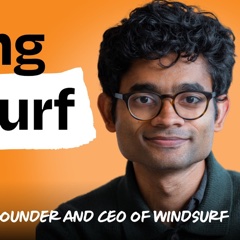
Varun Mohan
Co-founder and CEO of Windsurf (formerly Codeium)
Where to hear and read about Varun Mohan1 episode or test

Varun Mohan is co-founder and CEO of Windsurf (formerly Codeium), which grew out of a GPU infrastructure company and passed 1 million developers in four months. The most useful lesson is to drop a beloved hypothesis the moment new facts break it, then stay small and hungry enough to bet the whole company on the next one.
Every six to 12 months, it should make our existing product look silly.
Building a magical AI code editor used by over 1m developers in 4 months: Inside Windsurf
Varun Mohan: the story and the lessons
1How Varun Mohan pivoted Codeium twice into Windsurf
Mohan started with GPU virtualization and was doing fine. The company began about four years before the interview, selling GPU virtualization and compiler software for deep learning. By mid 2022 it had a couple million in revenue, about 10,000 GPUs under management, eight people and positive free cash flow.
The bet assumed many model architectures would persist, so offloading GPU complexity would be valuable.
He killed the infrastructure business when its core assumption failed. By mid 2023 everything looked like a transformer, where earlier there were tens of architectures such as convolutional, graph and recurrent networks and LSTMs. The team switched overnight to applications despite having raised $28 million and making money.
A side project dilutes focus on the real bet, so the pivot had to be total. "You should never be too in love with your ideas."
Codeium began as free autocomplete, which infrastructure skills made cheap to serve. It predicted the next one to four lines and was free in VSCode, JetBrains, Eclipse, Visual Studio, Vim and Emacs. Large enterprises then asked for a secure version tuned to their private code.
Mohan says value in AI builds up at the application layer, not in infrastructure.
He built a whole IDE because VS Code's APIs capped the product. For inline refactor suggestions in VS Code the team had to generate images next to the cursor. Moving the same autocomplete models into Windsurf tripled the acceptance rate, because the UI could finally show them natively.
"Same ML models, it just tripled." Over a million developers tried Windsurf in four months, with hundreds of thousands active each month.
Mohan wishes he and his co-founder had been wrong sooner. They often wish a decision had come months earlier, even when outsiders said the timing was right. They started at peak zero-interest-rate time with irrational confidence they shouldn't have had.
Founders must believe in themselves to get out of bed, which makes honest re-evaluation hard.
2How Windsurf competes: enterprise, big code bases and its own models
Mohan built an enterprise sales team early because big buyers came to him. Large enterprises reached out in mid 2023 and the founders ran tens of concurrent pilots. A VP of sales joined by the end of 2023, and the go-to-market team is now over 80 people.
As a GPU infrastructure company he sold the product himself, didn't know how to scale that, and hired no one. Early angels included Carlos Delatorre, a former CRO of MongoDB. "If you want to sell to the Fortune 500, it is very hard to do that purely by swiping a credit card."
Windsurf differentiates on understanding huge existing code bases. Dell has single code bases over 100 million lines, about 1.5 billion tokens, far beyond any context window. Windsurf's own models read code across thousands of GPUs and rank the relevant snippets.
Tools like Bolt and Lovable write new code from scratch, while Windsurf works inside a million-line code base without breaking it. The focus came from the infrastructure background and enterprise customers.
Windsurf trains its own models only where user data gives an edge. Sonnet does the planning. The retrieval model is fully pre-trained in-house, and the edit and autocomplete models are post-trained on open source ones.
The edit model is faster and holds more of the code base in context. Mohan says they will not train a model "for the sake of ego".
User behavior data is the moat, not pure code planning. Windsurf gets tens of millions of pieces of feedback every hour, much of it half-typed code that frontier models rarely saw in training. Whether a user accepted a change after retrieval shows whether retrieval was good.
Mohan cannot make a coherent argument for being best at pure planning. App builders that only consume high-level web elements struggle to differentiate.
He supports JetBrains and local builds instead of forcing a switch. JetBrains-based IDEs hold 70 to 80% of Java developers, and some enterprises with over 10,000 developers have more than half of them on JetBrains. Windsurf works there because JetBrains is extensible and VS Code is not.
Windsurf also runs on the user's own machine, unlike cloud builders such as Lovable and Replit, since some projects need system dependencies like Nvidia drivers. It has FedRAMP compliance and a hybrid mode that keeps indexed code on the customer's tenant.
Windsurf tracks the developer's own edits as well as the agent's. In the demo, renaming a property to Title String made the AI update every other place that used it, and the app still loaded.
With AI writing most code, developers mostly review, so the IDE has custom review flows. "Everything the user has done, the AI also knows."
3Mohan's rules for hiring and running a small company
Mohan hires only when a function is underwater. Windsurf has about 160 people, with over 50 in engineering and over 80 in go-to-market. A hire is added only when the team asks for help and cannot cover its priorities.
Extra hires invent work and politics. "I want the company to almost be this dehydrated entity and every hire is like a little bit of water." The aim is the smallest company that can meet its ambition, not leanness for its own sake.
He uses scarcity to force ruthless prioritization. When a team says it can only do one of two things, the less important one is dropped instead of adding people. A company wins by doing one thing really well and failing nine.
"I just need to get an A+ on the one class that matters. And then I can get an F in all the other classes." An F means deprioritizing, not anything illegal.
Nobody owns people, and value is not tied to team size. Projects have directly responsible individuals, and engineers move to whichever project matters most. The most valuable person does the most ambitious project with the fewest people.
"There's no notion of someone owning people at the company. That is a very bad and gnarly idea."
He tells candidates the job is hard and screens for mission. Beyond a high technical bar, Windsurf screens for passion about the mission. About 0.6% of candidates pass, and the take-home filters another 10 to 15 times on top.
A candidate who says "I work smart" is a warning sign, because smart people who also work hard are the competition. One person not pulling weight hurts the signal about the bar more than raw output. Candidates may use AI, but an on-site whiteboard checks they can think on their feet.
Core engineers act as their own product managers. Developers are the users, so their intuition is the product sense. Three product strategy people link enterprise demands, such as FedRAMP, to technical capability.
Teams stay at two-pizza size so leaders can still work in the technology. "I think it's dangerous to have leaders that don't understand the technology deeply and are not building."
He keeps hiring engineers because cheaper building raises their value. Mohan says even 200 engineers in the long run would probably be too low for Windsurf's vision. Companies with a high technology ceiling should hire more as building gets cheaper.
JPMorgan Chase spends $17 billion a year on software and has over 50,000 engineers.
4What Varun Mohan thinks AI means for engineers and software
Mohan expects AI to write over 90% of code, but not 10X output. Engineers also review, test, debug, design and deploy. By Amdahl's Law, if coding is 30 of 100 units of time and drops to 3, the whole process is only 27% faster.
Windsurf sees 30 to 40% productivity gains. "If AI is writing over 90% of the code, that doesn't mean engineers are 10X as productive."
He sees agency as the scarce skill. Engineering splits into what to solve, how to solve it, and solving it. AI takes the last fully and increasingly the middle one, so deciding what to build matters most.
Mohan says schools train people to follow defined paths, and startups hire for high agency because a company that doesn't innovate dies by default. He still thinks a computer science degree pays, as training in problem solving and trade-offs.
Windsurf's non-engineers built their own tools and saved over $500,000. Sales and go-to-market staff built apps with Windsurf instead of buying SaaS. The head of partnerships had never built software and made his own partner portal.
The company created a secure way to deploy these apps internally. "We've saved over half a million dollars of SaaS products we were going to buy."
He expects niche vertical SaaS to lose ground to custom tools. Vertical products thrived because each customer wanted about 10% of a kitchen sink of features and could not build it alone. Domain experts can now build that 10% with the integrations they lacked.
He names sales, legal and finance software as examples at risk. "Each individual company only wanted 10% of the features."
He tells users to prompt AI editors with small, explicit changes. A vague request can trigger many irrelevant edits, and refactoring a large directory risks wrecking 20 files. Autocomplete accepted only 30% of the time is fine because users know when to ignore it.
The tool's strengths shift every three months, so users should re-test their gut feeling. "Be a little bit patient and both patient and explicit."
Mohan wants Windsurf to make its own product look silly every six to 12 months. Windsurf ships a wave every couple of weeks, but the bets that matter are three to nine months out. Adding the one more button users request is not why Windsurf will win.
Users still can't be ignored, because they're the reason you exist. Being the first agentic IDE depreciates fast unless the team re-proves itself in ways users aren't asking for.
He urges people to use AI tools hands-on across role boundaries. Mohan says build apps, make mocks and edit your existing code base. A product manager at JPMorgan Chase could open Windsurf, change a signup step and have it make a PR.
Many coworkers don't know these tools exist, so he expects big gains in the next year. "Now everything's open season."

Building a magical AI code editor used by over 1m developers in 4 months: Inside Windsurf
Varun Mohan explains how Codeium pivoted twice, from GPU virtualization to an IDE plugin to its own AI IDE, and how it hires, sells to enterprises and builds product. Windsurf passed 1 million developers in four months, and its own sales and partnerships staff built custom apps that saved over $500k in SaaS spend.
Mohan started with GPU virtualization and was doing fine. The company began about four years before the interview, selling GPU virtualization and compiler software for deep learning. By mid 2022 it had a couple million in revenue, about 10,000 GPUs under management, eight people and positive free cash flow.
The bet assumed many model architectures would persist, so offloading GPU complexity would be valuable.
He killed the infrastructure business when its core assumption failed. By mid 2023 everything looked like a transformer, where earlier there were tens of architectures such as convolutional, graph and recurrent networks and LSTMs. The team switched overnight to applications despite having raised $28 million and making money.
A side project dilutes focus on the real bet, so the pivot had to be total. "You should never be too in love with your ideas."
Codeium began as free autocomplete, which infrastructure skills made cheap to serve. It predicted the next one to four lines and was free in VSCode, JetBrains, Eclipse, Visual Studio, Vim and Emacs. Large enterprises then asked for a secure version tuned to their private code.
Mohan says value in AI builds up at the application layer, not in infrastructure.
He built a whole IDE because VS Code's APIs capped the product. For inline refactor suggestions in VS Code the team had to generate images next to the cursor. Moving the same autocomplete models into Windsurf tripled the acceptance rate, because the UI could finally show them natively.
"Same ML models, it just tripled." Over a million developers tried Windsurf in four months, with hundreds of thousands active each month.
Mohan wishes he and his co-founder had been wrong sooner. They often wish a decision had come months earlier, even when outsiders said the timing was right. They started at peak zero-interest-rate time with irrational confidence they shouldn't have had.
Founders must believe in themselves to get out of bed, which makes honest re-evaluation hard.
Mohan built an enterprise sales team early because big buyers came to him. Large enterprises reached out in mid 2023 and the founders ran tens of concurrent pilots. A VP of sales joined by the end of 2023, and the go-to-market team is now over 80 people.
As a GPU infrastructure company he sold the product himself, didn't know how to scale that, and hired no one. Early angels included Carlos Delatorre, a former CRO of MongoDB. "If you want to sell to the Fortune 500, it is very hard to do that purely by swiping a credit card."
Windsurf differentiates on understanding huge existing code bases. Dell has single code bases over 100 million lines, about 1.5 billion tokens, far beyond any context window. Windsurf's own models read code across thousands of GPUs and rank the relevant snippets.
Tools like Bolt and Lovable write new code from scratch, while Windsurf works inside a million-line code base without breaking it. The focus came from the infrastructure background and enterprise customers.
Windsurf trains its own models only where user data gives an edge. Sonnet does the planning. The retrieval model is fully pre-trained in-house, and the edit and autocomplete models are post-trained on open source ones.
The edit model is faster and holds more of the code base in context. Mohan says they will not train a model "for the sake of ego".
User behavior data is the moat, not pure code planning. Windsurf gets tens of millions of pieces of feedback every hour, much of it half-typed code that frontier models rarely saw in training. Whether a user accepted a change after retrieval shows whether retrieval was good.
Mohan cannot make a coherent argument for being best at pure planning. App builders that only consume high-level web elements struggle to differentiate.
He supports JetBrains and local builds instead of forcing a switch. JetBrains-based IDEs hold 70 to 80% of Java developers, and some enterprises with over 10,000 developers have more than half of them on JetBrains. Windsurf works there because JetBrains is extensible and VS Code is not.
Windsurf also runs on the user's own machine, unlike cloud builders such as Lovable and Replit, since some projects need system dependencies like Nvidia drivers. It has FedRAMP compliance and a hybrid mode that keeps indexed code on the customer's tenant.
Windsurf tracks the developer's own edits as well as the agent's. In the demo, renaming a property to Title String made the AI update every other place that used it, and the app still loaded.
With AI writing most code, developers mostly review, so the IDE has custom review flows. "Everything the user has done, the AI also knows."
Mohan hires only when a function is underwater. Windsurf has about 160 people, with over 50 in engineering and over 80 in go-to-market. A hire is added only when the team asks for help and cannot cover its priorities.
Extra hires invent work and politics. "I want the company to almost be this dehydrated entity and every hire is like a little bit of water." The aim is the smallest company that can meet its ambition, not leanness for its own sake.
He uses scarcity to force ruthless prioritization. When a team says it can only do one of two things, the less important one is dropped instead of adding people. A company wins by doing one thing really well and failing nine.
"I just need to get an A+ on the one class that matters. And then I can get an F in all the other classes." An F means deprioritizing, not anything illegal.
Nobody owns people, and value is not tied to team size. Projects have directly responsible individuals, and engineers move to whichever project matters most. The most valuable person does the most ambitious project with the fewest people.
"There's no notion of someone owning people at the company. That is a very bad and gnarly idea."
He tells candidates the job is hard and screens for mission. Beyond a high technical bar, Windsurf screens for passion about the mission. About 0.6% of candidates pass, and the take-home filters another 10 to 15 times on top.
A candidate who says "I work smart" is a warning sign, because smart people who also work hard are the competition. One person not pulling weight hurts the signal about the bar more than raw output. Candidates may use AI, but an on-site whiteboard checks they can think on their feet.
Core engineers act as their own product managers. Developers are the users, so their intuition is the product sense. Three product strategy people link enterprise demands, such as FedRAMP, to technical capability.
Teams stay at two-pizza size so leaders can still work in the technology. "I think it's dangerous to have leaders that don't understand the technology deeply and are not building."
He keeps hiring engineers because cheaper building raises their value. Mohan says even 200 engineers in the long run would probably be too low for Windsurf's vision. Companies with a high technology ceiling should hire more as building gets cheaper.
JPMorgan Chase spends $17 billion a year on software and has over 50,000 engineers.
Mohan expects AI to write over 90% of code, but not 10X output. Engineers also review, test, debug, design and deploy. By Amdahl's Law, if coding is 30 of 100 units of time and drops to 3, the whole process is only 27% faster.
Windsurf sees 30 to 40% productivity gains. "If AI is writing over 90% of the code, that doesn't mean engineers are 10X as productive."
He sees agency as the scarce skill. Engineering splits into what to solve, how to solve it, and solving it. AI takes the last fully and increasingly the middle one, so deciding what to build matters most.
Mohan says schools train people to follow defined paths, and startups hire for high agency because a company that doesn't innovate dies by default. He still thinks a computer science degree pays, as training in problem solving and trade-offs.
Windsurf's non-engineers built their own tools and saved over $500,000. Sales and go-to-market staff built apps with Windsurf instead of buying SaaS. The head of partnerships had never built software and made his own partner portal.
The company created a secure way to deploy these apps internally. "We've saved over half a million dollars of SaaS products we were going to buy."
He expects niche vertical SaaS to lose ground to custom tools. Vertical products thrived because each customer wanted about 10% of a kitchen sink of features and could not build it alone. Domain experts can now build that 10% with the integrations they lacked.
He names sales, legal and finance software as examples at risk. "Each individual company only wanted 10% of the features."
He tells users to prompt AI editors with small, explicit changes. A vague request can trigger many irrelevant edits, and refactoring a large directory risks wrecking 20 files. Autocomplete accepted only 30% of the time is fine because users know when to ignore it.
The tool's strengths shift every three months, so users should re-test their gut feeling. "Be a little bit patient and both patient and explicit."
Mohan wants Windsurf to make its own product look silly every six to 12 months. Windsurf ships a wave every couple of weeks, but the bets that matter are three to nine months out. Adding the one more button users request is not why Windsurf will win.
Users still can't be ignored, because they're the reason you exist. Being the first agentic IDE depreciates fast unless the team re-proves itself in ways users aren't asking for.
He urges people to use AI tools hands-on across role boundaries. Mohan says build apps, make mocks and edit your existing code base. A product manager at JPMorgan Chase could open Windsurf, change a signup step and have it make a PR.
Many coworkers don't know these tools exist, so he expects big gains in the next year. "Now everything's open season."