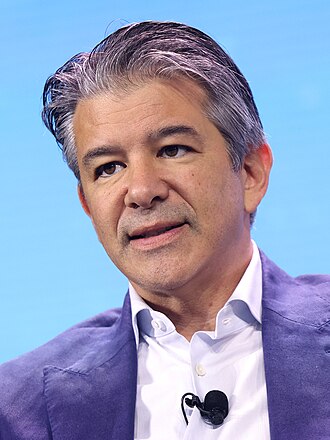
Travis Kalanick
Co-founder of Uber, now founder of Adams, a physical AI and robotics company
Where to hear and read about Travis Kalanick1 episode or test

Travis Kalanick co-founded Uber, fought its global ride-sharing wars against Didi and taxi regulation, was pushed out in 2017, and now runs Adams, a physical AI and robotics company. The thing most worth learning from him is to treat hard contests as processes: win markets with an efficiency edge rather than lobbying, raise money through an auction rather than a fixed price, and grow only as fast as your capacity to solve the problems you create.
If it is not painful, you're clearly not pushing hard enough.
Excellence Is the Capacity To Take Pain | Travis Kalanick, Founder of Uber
Travis Kalanick: the story and the lessons
1Travis Kalanick's path to Uber and beyond
Kalanick has been drawn to 'impossible' problems since childhood. He says the sparkle in his eye when someone says 'it can't be done' goes back to childhood, and he liked complexity from day one.
Uber turned this into a cultural value, 'super pumped': infectious enthusiasm about the hard things. He notes some things called impossible are actually easy, and others are hard but possible.
Before Uber he went four years without salary. His pre-Uber startup ran out of money several times, and he lost friends along the way.
He had to be 'epically precise' just to pay the bills, a habit that later shaped how he ran Uber.
By 33 he was already an angel investor. He had put a couple million dollars into friends' startups and was the first investor in Expensify.
He says his past experience shaped him, not his age.
After leaving Uber he spent months fending off lawfare. His first six or seven months after Uber went to civil and criminal legal battles.
He says 2010s business headlines became narratives rather than facts, with fabrications and 'a substantial perversion of truth.' People who know him say his public persona and the real person could not be more different, and serious founders speak well of him.
2Why Kalanick says excellence is the capacity to take pain
Kalanick's founder pillar is outlasting rivals on pain. His line is 'I can take more pain than the other guy, and I'll prove it.' A marathoner at mile 21 is not smiling, because if he felt no pain someone else would push harder.
He shares Herb Kelleher's view of stress: 'I don't handle it. I like it.'
He argues easy work adds nothing to human progress. Six months on a beach may be valuable to you but advances nothing; a writer only contributes by honing words before someone else has the thought.
Years of adversity gave him fierceness with calm inside. He saves that fierceness for questions of right and wrong.
He also warns constant adversity numbs you, and there is power in staying bothered by what is wrong.
He outgrew fear of failure and now works three times faster. Fear pushed him early but also bogged him down; by 2017 he was moving past it, and the core of his Adams vision note took an hour and a half to write.
He says fear of failure gets a founder places but never all the way to world class.
3How Kalanick took Uber into China
Kalanick treated China as starting a new business. Uber had made a point that cities and countries did not matter, but China differed in about a hundred ways, down to a different GPS system that changed how Uber tracked cars.
In 2013 he sent a crew of early Uber people to live in a Chinese apartment for about two weeks and meet everyone they could. A Chinese entrepreneur told him it was the worst idea ever. He names only Apple and Elon Musk as Western successes there.
He took a 7% partner instead of the demanded 50%. Everyone said Uber needed a Chinese partner owning half the company, but nobody could explain why, so he tried without one.
Under regulatory heat Uber later gave about 7% to a trusted partner, because at the ministerial level someone in China has to vouch for you. His reasoning: 'I'm going to try. Screw it.'
Uber innovated while Didi copied at speed. In 2014 Uber moved from niche Uber Black to peer-to-peer ride sharing, branded 'the people's Uber' with red cars in the app, while Didi was built on taxis that treat app rides as second class.
He calls Uber a warrior poet and Didi pure warriors. At one point Uber's top 10 cities by rides were all Chinese, at two or three dollars a ride against $13 to $15 in the US.
He told China's transport minister instability would end Uber. During the July 2015 European taxi strikes, the minister threw three Western newspapers on the table and called it a problem.
Kalanick answered that Western democracies deliver progress only under threat of instability while China is the reverse, and that any hint of instability would get Uber shut down immediately. Officials never treated Uber as unstable.
The China war spread worldwide through state-backed money. Uber spent tens of millions of dollars a month fighting Didi, and Chinese sovereign wealth funds poured billions into Uber's rivals in other regions to drain its resources.
The Chinese government ultimately favored Didi.
4How Kalanick wins subsidy wars with efficiency
A bigger network wins because it runs cheaper, not because it subsidizes more. Easier signup, higher completion rates, shorter pickups and less driver dead time let a larger network price lower without subsidy.
At 10 billion rides a year, a two dollar subsidy per ride would be $20 billion, which nobody funds. 'At some point efficiency outstrips subsidy.'
A small, well-funded rival has a built-in edge. A rival one-tenth the size spends one-tenth as much and gains share unless the leader outspends it ten to one, or perhaps seven to one with an efficiency edge.
He let rivals reach 50% share to test efficiency. If Uber could hold 50% share at a higher price than the rival, its system was more efficient and it could dial up pressure knowing the rival would lose.
'If I can maintain 50% market share while having a higher price, then my system is more efficient than them.'
Driver bonuses forced rivals to defend their whole base. Offering something like $1,000 to a new driver completing 100 trips in a week pulled supply, so the rival had to subsidize all its drivers even though Uber took only a few.
He says he is half-remembering the details after ten years.
He found Rockefeller's obsession with tiny savings 'way more hardcore'. Rockefeller cut solder drops per barrel from 50 to 49, saving $2,500 the first year and hundreds of thousands at scale, across a thousand such details.
Kalanick read about him only after Uber, and notes that Uber's antitrust lawyers set limits Rockefeller never had.
5Why Kalanick refused to win through regulation
Uber aimed to serve customers best, never to use law against rivals. Uber never got a regulation passed to hurt a competitor and never donated to a campaign to get something passed.
Its motto: 'the one who serves the customer best gets all the customers.' He separates a monopoly earned by competing from one built by being anti-competitive.
He sees New York taxis as a cartel built by lobbying. Free licenses became capped, then sellable medallions, then leasable; drivers paid about $40,000 a year for a 12-hour shift while the holder collected about $80,000 a year per car.
He calls taxis the most intense regulatory capture he has seen, and defines anti-capitalism as any limit on free entry or free choice.
6Travis Kalanick's fundraising playbook
Kalanick attaches to a process, never a price. Nine months after Uber's $3.5 billion round in August 2013, Bill Gurley urged taking a first term sheet at about $6 billion; two months later Uber closed at a $17.5 billion pre-money valuation.
Without alternatives, he says, the VC keeps pushing and the deal can blow up. 'I never get attached to a price. I get attached to a process.'
He ran five simultaneous rooms for a week. Rooms were sorted by check size ($250 million plus, $100 million, $50 million, $25 million), 12 hours a day, with the same story told in each; he sat in the top room.
The format grew from iterating until it became the natural form, and its cost must be weighed against the deal resources available.
Bids, not the founder's ask, set the price. Each investor fills a sheet of how much they would invest at prices like $8, $9, $10, $12 or $14 billion, which adds up to a demand curve.
Bidders cut at the clearing price can refill their sheets; after a couple of rounds the curve shifts right and the round closes. In winner-take-all rounds he walks bidders up 'x plus 5' at a time.
He opens low so he never anchors too early. Founders fixed on a price end up negotiating down; he starts low, saying the price is at least here, and once someone leans forward he has a bidder.
His pitch proves the win, and trims rigor in a boom. In normal markets he weaves numbers into a story until the formula is 'QED'; at peak Uber that ran two hours.
In a super cycle, with a possible 100x three to five years out, numbers cannot prove the case, so the pitch leans on theory and shrinks to about 45 minutes.
7Kalanick on investors, the 2017 ouster and his own mistakes
He thinks a VC's top bar is to do no harm. He guesses about 10% of VCs do no harm and 1% actually help.
He contrasts the operator, a chess grandmaster playing 60 to 80 hours a week, with the VC, an enthusiast checking in every three months who wants to make a mark. He likens VCs to a lion that takes down a limping antelope even when not hungry.
In 2017 Benchmark ran a war room against him. He describes a weekly crisis from an unspoken activist investor he believes wanted liquidity, while Uber was quietly preparing an IPO.
He calls Gurley a catastrophist, and says Emil Michael handled much of the investor relations calmly.
He starts from his own part, not victimhood. He did not tell Benchmark about the IPO and did not give Gurley the deference he wanted, which he thinks would have 'changed everything.'
He also says insiders who joined the coup should not have been in the company and he suspected something beforehand. 'You got to be really careful not to get into victim mentality.'
He ran too close to the line for a company Uber's size. He ran a $70 billion company like someone afraid he could not pay next week's groceries.
He says he never had 'chalk on his shoe' and can defend every decision, but at that scale people expect a wide margin even when you are right, which he did not understand then.
8Travis Kalanick's rules for managing growth
Problem solving must keep pace with problem creation. His 'meta problem' says the rate of solving must stay at or above the rate of creating; problems 'come ashore' six months or more after decisions like going to China.
If solving falls behind, stop creating problems. He still wants interesting problems, like a math professor, and says 'the only constraint on our imagination is management capacity.'
He uses the fewest rules that keep chaos out. Too much order brings bureaucracy and too much chaos does the same, so a leader finds the line between them.
Uber's one early rule was his approval on pricing. In the first 20 to 30 cities, 23-year-old launchers could not go live until he approved the pricing call; London took 8 to 10 hours, and by city 20 it took five minutes and he stopped attending.
Pricing was 'the sum of all strategy,' covering regulation, car type, driver wages and travel patterns. Each answer went into the playbook, so he never solved the same problem twice.
At Adams he aligns up front and holds accountability after. Each business has an empowered line leader, with sub-unit leaders in large ones, after agreeing what to accomplish, how, and what is risky.
He spends his few hours on 'the most impactful problems that are not already being solved,' and the same remit flows down to every level.
9Why Kalanick builds specialized robots at Adams
Adams automates one industry at a time with specialized machines. The plan is to make big moves in one industry, 'get our sea legs,' then move on.
He is not anti-humanoid; humanoids suit varied small tasks in human homes, but you would not have one drive a car.
At scale a purpose-built machine beats rows of humanoids. 1,000 pancakes an hour would need about 100 humanoids, versus an apparatus pushing out around 100 pancakes every few minutes.
Food's 30-minute half-life forces production and logistics within 15 minutes of customers, combining industrial real estate, robotic production and robotic couriers.
He sees land and movement as the base of physical AI. Adams aims to make mines produce 20% more gold a year without owning them, and treats automated movement as the ignition for mining, food and transport.
One large US food supplier spends $3 billion a year on labor moving pallets by forklift. 'Land is the whole damn thing.'
He picks ideas that fit him, like a business soulmate. Food caught him through Uber Eats, which he calls finding your sport.
He frames civilization as slowing entropy and progress as ordering the world toward 'happiness and liberty and transcendence.'

Excellence Is the Capacity To Take Pain | Travis Kalanick, Founder of Uber
Kalanick's story shows how to build a company by taking on problems others call impossible, winning on service and efficiency instead of lobbying, and running with as few rules as possible. The decision that makes it worth hearing is how he ran fundraising and market wars as processes (an auction, an efficiency edge) rather than fights over a single price.
Kalanick has been drawn to 'impossible' problems since childhood. He says the sparkle in his eye when someone says 'it can't be done' goes back to childhood, and he liked complexity from day one.
Uber turned this into a cultural value, 'super pumped': infectious enthusiasm about the hard things. He notes some things called impossible are actually easy, and others are hard but possible.
Before Uber he went four years without salary. His pre-Uber startup ran out of money several times, and he lost friends along the way.
He had to be 'epically precise' just to pay the bills, a habit that later shaped how he ran Uber.
By 33 he was already an angel investor. He had put a couple million dollars into friends' startups and was the first investor in Expensify.
He says his past experience shaped him, not his age.
After leaving Uber he spent months fending off lawfare. His first six or seven months after Uber went to civil and criminal legal battles.
He says 2010s business headlines became narratives rather than facts, with fabrications and 'a substantial perversion of truth.' People who know him say his public persona and the real person could not be more different, and serious founders speak well of him.
Kalanick's founder pillar is outlasting rivals on pain. His line is 'I can take more pain than the other guy, and I'll prove it.' A marathoner at mile 21 is not smiling, because if he felt no pain someone else would push harder.
He shares Herb Kelleher's view of stress: 'I don't handle it. I like it.'
He argues easy work adds nothing to human progress. Six months on a beach may be valuable to you but advances nothing; a writer only contributes by honing words before someone else has the thought.
Years of adversity gave him fierceness with calm inside. He saves that fierceness for questions of right and wrong.
He also warns constant adversity numbs you, and there is power in staying bothered by what is wrong.
He outgrew fear of failure and now works three times faster. Fear pushed him early but also bogged him down; by 2017 he was moving past it, and the core of his Adams vision note took an hour and a half to write.
He says fear of failure gets a founder places but never all the way to world class.
Kalanick treated China as starting a new business. Uber had made a point that cities and countries did not matter, but China differed in about a hundred ways, down to a different GPS system that changed how Uber tracked cars.
In 2013 he sent a crew of early Uber people to live in a Chinese apartment for about two weeks and meet everyone they could. A Chinese entrepreneur told him it was the worst idea ever. He names only Apple and Elon Musk as Western successes there.
He took a 7% partner instead of the demanded 50%. Everyone said Uber needed a Chinese partner owning half the company, but nobody could explain why, so he tried without one.
Under regulatory heat Uber later gave about 7% to a trusted partner, because at the ministerial level someone in China has to vouch for you. His reasoning: 'I'm going to try. Screw it.'
Uber innovated while Didi copied at speed. In 2014 Uber moved from niche Uber Black to peer-to-peer ride sharing, branded 'the people's Uber' with red cars in the app, while Didi was built on taxis that treat app rides as second class.
He calls Uber a warrior poet and Didi pure warriors. At one point Uber's top 10 cities by rides were all Chinese, at two or three dollars a ride against $13 to $15 in the US.
He told China's transport minister instability would end Uber. During the July 2015 European taxi strikes, the minister threw three Western newspapers on the table and called it a problem.
Kalanick answered that Western democracies deliver progress only under threat of instability while China is the reverse, and that any hint of instability would get Uber shut down immediately. Officials never treated Uber as unstable.
The China war spread worldwide through state-backed money. Uber spent tens of millions of dollars a month fighting Didi, and Chinese sovereign wealth funds poured billions into Uber's rivals in other regions to drain its resources.
The Chinese government ultimately favored Didi.
A bigger network wins because it runs cheaper, not because it subsidizes more. Easier signup, higher completion rates, shorter pickups and less driver dead time let a larger network price lower without subsidy.
At 10 billion rides a year, a two dollar subsidy per ride would be $20 billion, which nobody funds. 'At some point efficiency outstrips subsidy.'
A small, well-funded rival has a built-in edge. A rival one-tenth the size spends one-tenth as much and gains share unless the leader outspends it ten to one, or perhaps seven to one with an efficiency edge.
He let rivals reach 50% share to test efficiency. If Uber could hold 50% share at a higher price than the rival, its system was more efficient and it could dial up pressure knowing the rival would lose.
'If I can maintain 50% market share while having a higher price, then my system is more efficient than them.'
Driver bonuses forced rivals to defend their whole base. Offering something like $1,000 to a new driver completing 100 trips in a week pulled supply, so the rival had to subsidize all its drivers even though Uber took only a few.
He says he is half-remembering the details after ten years.
He found Rockefeller's obsession with tiny savings 'way more hardcore'. Rockefeller cut solder drops per barrel from 50 to 49, saving $2,500 the first year and hundreds of thousands at scale, across a thousand such details.
Kalanick read about him only after Uber, and notes that Uber's antitrust lawyers set limits Rockefeller never had.
Uber aimed to serve customers best, never to use law against rivals. Uber never got a regulation passed to hurt a competitor and never donated to a campaign to get something passed.
Its motto: 'the one who serves the customer best gets all the customers.' He separates a monopoly earned by competing from one built by being anti-competitive.
He sees New York taxis as a cartel built by lobbying. Free licenses became capped, then sellable medallions, then leasable; drivers paid about $40,000 a year for a 12-hour shift while the holder collected about $80,000 a year per car.
He calls taxis the most intense regulatory capture he has seen, and defines anti-capitalism as any limit on free entry or free choice.
Kalanick attaches to a process, never a price. Nine months after Uber's $3.5 billion round in August 2013, Bill Gurley urged taking a first term sheet at about $6 billion; two months later Uber closed at a $17.5 billion pre-money valuation.
Without alternatives, he says, the VC keeps pushing and the deal can blow up. 'I never get attached to a price. I get attached to a process.'
He ran five simultaneous rooms for a week. Rooms were sorted by check size ($250 million plus, $100 million, $50 million, $25 million), 12 hours a day, with the same story told in each; he sat in the top room.
The format grew from iterating until it became the natural form, and its cost must be weighed against the deal resources available.
Bids, not the founder's ask, set the price. Each investor fills a sheet of how much they would invest at prices like $8, $9, $10, $12 or $14 billion, which adds up to a demand curve.
Bidders cut at the clearing price can refill their sheets; after a couple of rounds the curve shifts right and the round closes. In winner-take-all rounds he walks bidders up 'x plus 5' at a time.
He opens low so he never anchors too early. Founders fixed on a price end up negotiating down; he starts low, saying the price is at least here, and once someone leans forward he has a bidder.
His pitch proves the win, and trims rigor in a boom. In normal markets he weaves numbers into a story until the formula is 'QED'; at peak Uber that ran two hours.
In a super cycle, with a possible 100x three to five years out, numbers cannot prove the case, so the pitch leans on theory and shrinks to about 45 minutes.
He thinks a VC's top bar is to do no harm. He guesses about 10% of VCs do no harm and 1% actually help.
He contrasts the operator, a chess grandmaster playing 60 to 80 hours a week, with the VC, an enthusiast checking in every three months who wants to make a mark. He likens VCs to a lion that takes down a limping antelope even when not hungry.
In 2017 Benchmark ran a war room against him. He describes a weekly crisis from an unspoken activist investor he believes wanted liquidity, while Uber was quietly preparing an IPO.
He calls Gurley a catastrophist, and says Emil Michael handled much of the investor relations calmly.
He starts from his own part, not victimhood. He did not tell Benchmark about the IPO and did not give Gurley the deference he wanted, which he thinks would have 'changed everything.'
He also says insiders who joined the coup should not have been in the company and he suspected something beforehand. 'You got to be really careful not to get into victim mentality.'
He ran too close to the line for a company Uber's size. He ran a $70 billion company like someone afraid he could not pay next week's groceries.
He says he never had 'chalk on his shoe' and can defend every decision, but at that scale people expect a wide margin even when you are right, which he did not understand then.
Problem solving must keep pace with problem creation. His 'meta problem' says the rate of solving must stay at or above the rate of creating; problems 'come ashore' six months or more after decisions like going to China.
If solving falls behind, stop creating problems. He still wants interesting problems, like a math professor, and says 'the only constraint on our imagination is management capacity.'
He uses the fewest rules that keep chaos out. Too much order brings bureaucracy and too much chaos does the same, so a leader finds the line between them.
Uber's one early rule was his approval on pricing. In the first 20 to 30 cities, 23-year-old launchers could not go live until he approved the pricing call; London took 8 to 10 hours, and by city 20 it took five minutes and he stopped attending.
Pricing was 'the sum of all strategy,' covering regulation, car type, driver wages and travel patterns. Each answer went into the playbook, so he never solved the same problem twice.
At Adams he aligns up front and holds accountability after. Each business has an empowered line leader, with sub-unit leaders in large ones, after agreeing what to accomplish, how, and what is risky.
He spends his few hours on 'the most impactful problems that are not already being solved,' and the same remit flows down to every level.
Adams automates one industry at a time with specialized machines. The plan is to make big moves in one industry, 'get our sea legs,' then move on.
He is not anti-humanoid; humanoids suit varied small tasks in human homes, but you would not have one drive a car.
At scale a purpose-built machine beats rows of humanoids. 1,000 pancakes an hour would need about 100 humanoids, versus an apparatus pushing out around 100 pancakes every few minutes.
Food's 30-minute half-life forces production and logistics within 15 minutes of customers, combining industrial real estate, robotic production and robotic couriers.
He sees land and movement as the base of physical AI. Adams aims to make mines produce 20% more gold a year without owning them, and treats automated movement as the ignition for mining, food and transport.
One large US food supplier spends $3 billion a year on labor moving pallets by forklift. 'Land is the whole damn thing.'
He picks ideas that fit him, like a business soulmate. Food caught him through Uber Eats, which he calls finding your sport.
He frames civilization as slowing entropy and progress as ordering the world toward 'happiness and liberty and transcendence.'
 Uber
