
Uber
A ride-hailing app that connects riders with nearby drivers.
Uber replaced a $14-$20 price range with a single estimated price after users anchored on the top of the range and booked less. Rides per user rose by a double-digit percentage. Lesson: reduce price uncertainty at checkout. Separately, Life360's landing-alert partnership with Uber shows partner offers work when they add real user value.
- Showed $14-$20 at checkout
- Users fixated on the high end
- Ride felt more expensive
- Users felt uncertain, booked less
- Showed one estimated price
- Users saw a specific cost
- Less hesitation at decision
Double-digit increase in rides per user
From Uber A/B test on checkout pricing
What was said about Uber
Uber swapped a price range for one estimate and rides per user rose. Uber first showed a $14-$20 range at checkout to better manage traffic and costs. Users fixated on the high end, felt uncertain and booked less. Showing a single estimated price led to a double-digit increase in rides per user.
When shown $14-$20, users focused on the upper figure rather than the midpoint, which made the ride feel more expensive. The lesson is to be specific about cost at the moment of decision to build trust and cut hesitation. If a range is unavoidable, expect the top number to drive the choice.
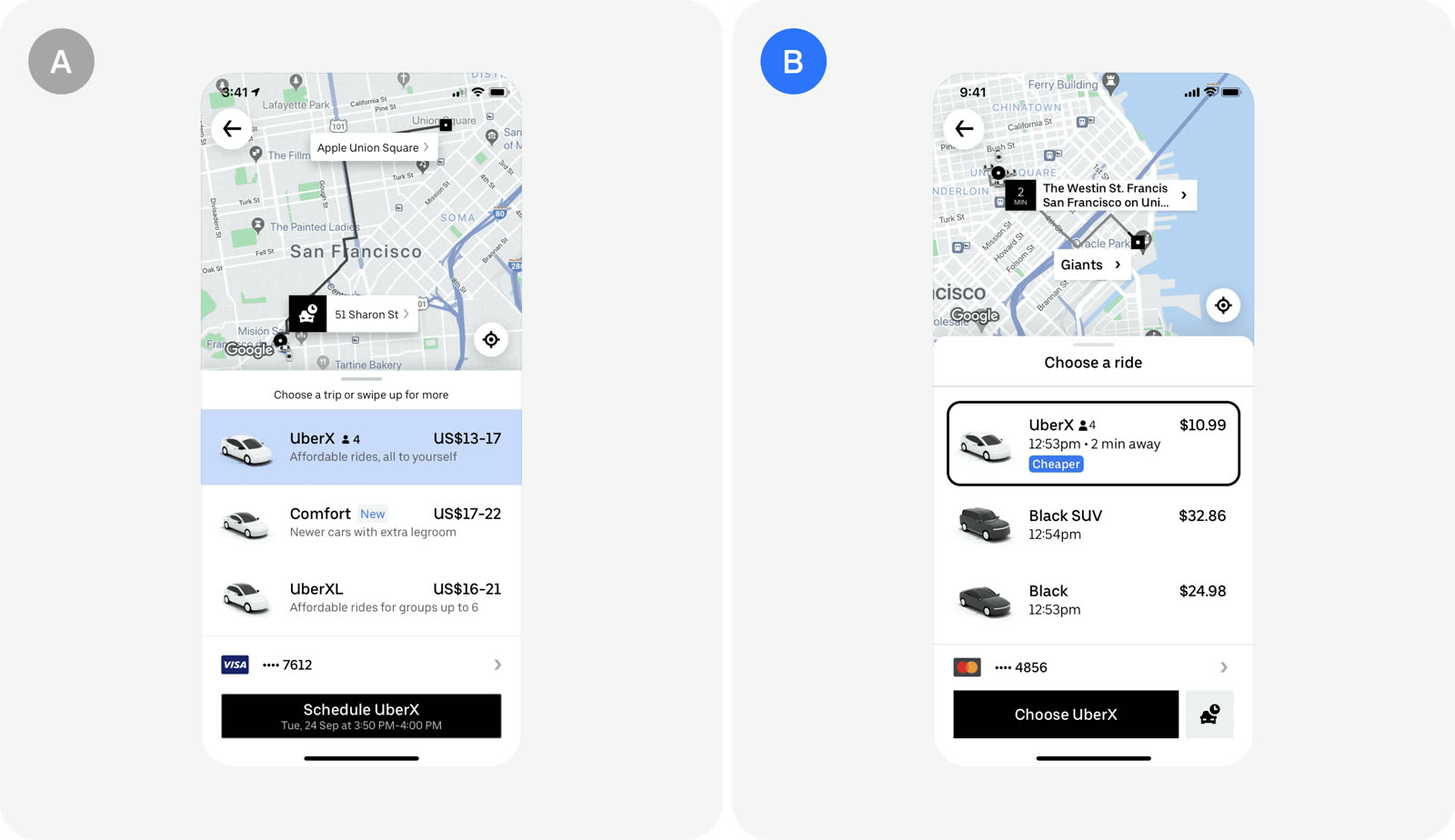
Version A and version B as Uber tested them. A landing notification built at a hackathon started Uber's partnership with Life360. Uber proposed offering a ride when someone lands, an offer tied to a user's location and context. It is cited as an example of partner offers that add real user value.
The stated baseline for any ad or offer is do no harm: "make sure that the ads are not intrusive, not invasive, and they're not unwelcome by the audience." Life360 only started ads in the last 2 years, at a company about 15 years old.

Clearer pricing estimate: Uber's A/B test
Replaced a $14-$20 ride price range with a single estimated price after users fixated on the top of the range and booked less. The change produced a double-digit increase in rides per user.
Uber swapped a price range for one estimate and rides per user rose. Uber first showed a $14-$20 range at checkout to better manage traffic and costs. Users fixated on the high end, felt uncertain and booked less. Showing a single estimated price led to a double-digit increase in rides per user.
When shown $14-$20, users focused on the upper figure rather than the midpoint, which made the ride feel more expensive. The lesson is to be specific about cost at the moment of decision to build trust and cut hesitation. If a range is unavoidable, expect the top number to drive the choice.
Version A and version B as Uber tested them.

Excellence Is the Capacity To Take Pain | Travis Kalanick, Founder of Uber
Kalanick fought Didi in China with tens of millions a month in subsidies, switched to peer-to-peer in 2014, and saw its top 10 cities by rides become Chinese. He gated each city launch on a pricing call, which shrank from 8 to 10 hours for London to five minutes by city 20, and ran a five-room fundraising auction.
A landing notification built at a hackathon started Uber's partnership with Life360. Uber proposed offering a ride when someone lands, an offer tied to a user's location and context. It is cited as an example of partner offers that add real user value.
The stated baseline for any ad or offer is do no harm: "make sure that the ads are not intrusive, not invasive, and they're not unwelcome by the audience." Life360 only started ads in the last 2 years, at a company about 15 years old.

From ChatGPT to Instagram to Uber: The quiet architect behind the world’s most popular products
Deng ran the Rider app, where price and ETA were the product and Uber was largely an operations company built on existing GPS phones and cars. Rider app was re-architected from spaghetti code, a venue abstraction for pickups helped drive 4x user growth in two years, and Reserve is nearing $5 billion a year.
When to invest in new acquisition channels | Adam Grenier (Uber, MasterClass)
Adam spent four years there building its growth marketing infrastructure and team as head of growth marketing and innovation. Central and city teams scoped problems differently, and accepting both views built rapport. He burned out there amid constant travel, politics and a team of 150 he barely knew.

Protecting Freemium at 100M Users AND Driving $500M Revenue – Giordano Contestabile, Life360
The partnership began with a landing notification feature built at a hackathon, where Uber proposed offering a ride when someone lands. It is an example of ads that add real user value.
Tony Xu of DoorDash: Surviving 1,000 Days of Startup Hell
DoorDash offered 20 UberX drivers a guaranteed $25 an hour against their roughly $20 to switch, and only one of 40 drivers moved. UberX drivers were mostly men in their 40s working full time, unlike early Dashers. In 2016 headlines claimed Uber and Amazon would win delivery.
Mental models for building products people love ft. Stewart Butterfield
It once asked only 'Where would you like to go?' plus an 'other' option holding everything else, a model for showing the two or three most common actions.
A 4-step framework for building delightful products | Nesrine Changuel (Spotify, Google, Skype)
After a driver cancelled, the guest expected to write an essay to get a refund but got her money back in two clicks. That removed the stress and made her willing to take more trips. Uber has also invested heavily in making users feel secure.
Daniel Ek, Spotify | David Senra
Ek urged Dara Khosrowshahi to take the Uber CEO job, arguing the impact on the future of cities would bring more happiness than staying content at Expedia.
How marketplaces win: Liquidity, growth levers, quality, more | Benjamin Lauzier (Lyft, Thumbtack)
Uber was about 30 times bigger than Lyft and onboarded drivers through local offices with DMV-style group sessions. It got meaningful supply by converting riders into drivers, and its logistics bet on food and parcel delivery let it rebound faster after COVID.
The original growth hacker reveals his secrets | Sean Ellis (author of “Hacking Growth”)
Uses weekly rides as its North Star metric, with the time frame capturing how often people engage.
Lessons from scaling Uber and Opendoor | Brian Tolkin (Head of Product at Opendoor, ex-Uber)
Early Uber put most engineering into dispatch and pricing, and ops covered the rest. Driver onboarding moved from one-on-one sessions to classes to video, and at about a thousand drivers a week license validation moved to automated checks. Product operations was created to link global ops teams with central product. The first San Francisco beta matched commuters within companies and could never reach enough liquidity. The team pivoted to a $5 anywhere in San Francisco promotion to see how high metrics could climb, and the Chengdu launch had to be fixed overnight before a 6 AM go-live.
Business strategy with Hamilton Helmer (author of 7 Powers)
Uber beat Lyft through a well-played war of attrition resting on modest, local scale economies, not a strong network. It misdefined itself as international transportation, then pulled back from forays like China, and Uber Eats reuses its driver side.
Kunal Shah on winning in India, second-order thinking, the philosophy of startups, and more
Used as the example of a Delta 4 product: a cab rates about 3 and Uber about 9, a delta of 6. Users forgive occasional failures and talk about it.
Geoffrey Moore on finding your beachhead, crossing the chasm, and dominating a market
It unlocked the backseat of the car and a free labor force, and it shows Main Street turning products into services. Early on, many women refused Uber until their friends used it.
The hierarchy of engagement | Sarah Tavel (Benchmark, Greylock, Pinterest)
It added a referral bonus to driver word of mouth, and some drivers earned more from referrals than driving. It grew from black cars to UberX to UberPool in cities where it already dominated, and raised heavily against Lyft.
Crafting a compelling product vision | Ebi Atawodi (YouTube, Netflix, Uber)
Its vision was a continuous trip with no parking, in cities where about 25% of space is parking. Ebi used the 'more money, more problems' doc, a Clipper-replacing headline and a one-wallet vision, and saw the #DeleteUber wave of 400,000 deletions.
Marketplace lessons from Uber, Airbnb, Bumble, and more | Ramesh Johari (Stanford professor)
Sells removal of friction, not rides. It turned a subsidized driver base into rider demand with free ride coupons at events and parties, and sets prices itself so pricing needs strong data scientists.
Picking sharp problems, increasing virality, and unique product frameworks | Oji Udezue (Typeform)
It has no viral trap because it compresses the cab workflow so much that it spreads on its own. After Austin kicked it out and other apps filled the gap, it returned a year later and crushed them with no campaign.
Lessons on product sense, AI, the first mile experience, and the messy middle | Scott Belsky (Adobe)
Held up as a durable consumer product that built a network effect and tapped excess capacity that was always there.
Mastering paid growth | Jonathan Becker (Thrive Digital)
Becker won Uber in 2013 after confessing he exploited its branded keywords at $20 per referral signup, earning tens of thousands. Uber hired him to fix it and stayed a client for 10 years.
An inside look at how Figma builds product | Yuhki Yamashita (CPO of Figma)
Engineers who watched a driver struggle felt embarrassed and fixed the problem, and staff rode Ubers to work. OKRs there were either easy-to-move but meaningless or important but unprovable (incremental trips), and some research insights became memes quoted by leaders.
The art and science of pricing | Madhavan Ramanujam (Monetizing Innovation, Simon-Kucher)
Its car types (X, Black, Comfort, Pool) map to different rider needs. Comfort sits between UberX and Black and lets you request a quiet ride, and with one car type Uber would be a very different company.
Leaving big tech to build the #1 technology newsletter | Gergely Orosz (The Pragmatic Engineer)
Orosz joined in 2016 on a doubled offer, mostly in stock, and promised himself to take a risk if it went public. Pandemic layoffs cut half of his 30-person group and pushed him to leave and write.
Developing a growth model + marketplace growth strategy | Dan Hockenmaier
It guarantees drivers first-week earnings to lift bad first experiences to average. Liquidity is a wait of about four to five minutes, and it famously lost money on every ride early on.

Amazon Web Services
Started on AWS as one of the early startups that benefited from credit card provisioning.

Yelp App Store Optimization Audit
Its app name is still just "Uber", so adding a few keywords could help it the way it helped Yelp.
More in Travel
 Travel
Airbnb
A marketplace where hosts list unique homes and travelers book stays in 220 countries.
 46 sources · 87 tips
 Travel
Lyft
A ride-hailing app connecting riders with drivers, positioned as a semi-managed marketplace.
7 sources · 14 tips Travel
Waymo
A fully driverless ride-hailing service that operates autonomous cars in select US cities.
8 sources · 12 tips Travel
Southwest Airlines
A low-cost US airline that flies only Boeing 737s and focuses on short-haul routes.
 4 sources · 22 tips
 Travel
AllTrails
A trail discovery and navigation app for hiking, trail running, mountain biking and backpacking.
4 sources · 20 tips Travel
BYHOURS
A booking platform for regular hotel rooms rented by the hour for short stays.
1 source · 12 tips Travel
Nomad Table
A solo travel app where users post activities and nearby travelers get notified and can join.
 1 source · 16 tips
 Travel
onX
A maker of outdoor navigation apps with land boundary maps for hunting, off-roading, backcountry skiing and fishing.
1 source · 16 tips