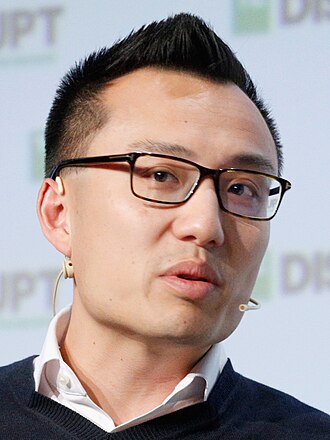
Tony Xu
Co-founder and CEO of DoorDash
Where to hear and read about Tony Xu1 episode or test

Tony Xu is the co-founder and CEO of DoorDash, which he started in 2013 as a Stanford student by delivering food himself from a $9 web page and grew through about 1,000 days of failed fundraising into a delivery network in more than 40 countries. The lesson most worth taking from him is that doing the work by hand and running constant experiments uncovers truths about the physical world that analysis and bigger budgets cannot.
we'd rather die trying to be excellent than live to be mediocre.
Tony Xu of DoorDash: Surviving 1,000 Days of Startup Hell
Tony Xu: the story and the lessons
1Where Tony Xu came from and how he found DoorDash
Xu grew up washing dishes beside his mother in a restaurant. His mother worked three jobs a day for 12 years, one of them as a restaurant waitress.
That background fed his belief that local businesses create the GDP that pays for neighborhoods, schools, police and parks, which became DoorDash's mission to grow local economies.
Interviewing 300 small businesses surfaced a baker's binder of refused orders. The founders talked to about 300 businesses from San Jose to San Francisco. A one-person bakery kept a binder of delivery orders it had turned down because it could not fulfill them.
That led Xu to ask why nobody offered delivery in 2013.
Almost no restaurant delivered in 2013, so the market was wide open. Of about a million US restaurants, only 20,000 to 25,000 delivered, mostly pizza shops and some Chinese places in big cities.
Existing services were lead-generation sites that faxed orders to restaurants, which then delivered themselves. The real question was what about everyone else.
2How Tony Xu tested DoorDash before building it
The first DoorDash shipped in 43 minutes for $9. It was a static page called Palo Alto Delivery with eight PDF menus, a Google Voice number that rang all four founders' phones, and a Square reader for payment.
The founders suspected delivery might be rare because nobody wanted it, so they tested demand before anything else. "What is the fastest way to see whether or not consumers would care?"
Restaurants came first because they offered the densest network. The founders compared restaurants, groceries, convenience stores and retail. Restaurants had about a million locations against a couple hundred thousand grocery stores.
The hypothesis was that fast delivery needs many consumer to store connections, and that density built on meals could later carry everything else.
Suburban Palo Alto beat dense San Francisco on delivery speed. Deliveries ran faster in Palo Alto thanks to easy parking, single-family homes and no lobbies or elevators. The nearest restaurants to Stanford were 2 miles away, so demand was real.
Starting there was not a choice, since the founders were students. Its hub-and-spoke layout, common to most US towns, became the first hint that logistics could work outside city centers while rivals chased downtowns.
Delivering by hand revealed the customer was a busy mom. The core buyer had young children, little time and no wish to pack a stroller into a car for a crowded restaurant.
Xu funded the business himself while carrying student debt, spent nothing on marketing and tracked drivers with Find My Friends, because he wanted organic demand rather than growth bought with discounts.
Xu spent Y Combinator answering three numbers, not chasing demo day. In summer 2013 the goal was to learn whether consumers would pay $6, whether restaurants would partner for 15%, and whether drivers could earn a workable wage.
Volume was about 10 orders a day with a best day of 21, mostly from a small loyal group of Stanford users. The team worked from an apartment from 10 a.m. to 2 a.m. while classmates mocked the hummus deliveries in Xu's Honda.
Doing every delivery showed the hidden complexity of the business. A single delivery broke into about 20 steps, each with its own delays, and even the minimum test needed a consumer site, a restaurant app, a driver app and dispatch.
None of the founders had logistics experience. "You actually have no idea actually what are all the sources of delay in an order until you actually go and do the work."
3The Stanford game meltdown and why Xu thinks trust resets daily
After a Stanford game every order ran an hour late. On a Saturday in September 2013, the team's third month, post-game orders swamped the four founders and they could not even shut the website off.
The founders refunded everyone unasked, at 40% of their cash. Around 10 p.m. they decided within about 15 seconds to refund every customer, though only two or three weeks of cash remained. Then they delivered cookies at 5 a.m.
Nobody had asked for a refund. Xu says it was one of many such experiences, not a single one.
Xu believes past orders buy nothing for tomorrow. Customers judge every order on selection, price, speed, accuracy and how problems get handled, so trust must be earned again each day.
"The scoreboard goes back down to zero tomorrow." There is no such thing as set it and forget it.
Xu builds on customer wants that never change. Customers will always want more selection, lower prices and faster delivery, and he says common sense questions about direction reveal this.
"It's not rocket science. The rocket science is how do you make it happen." The hard work is hiding the complexity behind a simple button.
4How Tony Xu built DoorDash as a learning machine
Xu treats the physical world as chaos only a learning system handles. Delay causes are undocumented, from an apple moved between aisles to wrong gate codes, and at millions of orders a day one-in-a-million events become routine.
This data cannot be scraped once and handed to an LLM. The answer is prevention plus a fast emergency response system. "It's always the data that you can't see that kills you."
About 95% of experiments fail, and the rest compound. Tens of thousands of experiments run, and roughly 5% reach customers. Ideas move from hacky unscalable tests to products to engineered systems.
Engineering capacity limits the loop, so the aim is to make the path from learning to shipping as tight as possible. "The most important thing is actually building systems."
A cheap test showed drivers do not follow money alone. Within weeks of starting, Xu offered 20 Dashers and 20 UberX drivers $25 an hour against their roughly $20 to switch. Only one of 40 moved.
Early Dashers were younger, about half women, and used bikes and scooters. Today more than half are women, the average works three to four hours a week, and 90% drive under 10 hours.
Xu settles debates by shipping experiments, not by meeting. He compares DoorDash's suburb finding to Sam Walton's small-town discovery, an earned secret found because money was short.
Much of the physical world is counterintuitive, so it has to be tested rather than mapped in a conference room.
The invisible operation made one rival quit and join DoorDash. A European rival founder holding a term sheet to raise a fresh $1 billion blurted out "I can't beat him" and sold instead.
He now runs DoorDash's European business and reports to Xu, and says the advantage lies in what outsiders can't see.
5Tony Xu's habit of doing customer support himself
Xu still does customer support every day. He sees messages from consumers, merchants, Dashers and advertisers and owes each a solved problem, not just a reply.
"The greatest killer of a business is usually silence." He calls complaints freebies, free observability into what dashboards miss.
He values edge-case anecdotes because they disagree with the data. Data rightly wins prioritization, but improving a product means improving its tails, where power users and brand-new users sit.
New users show how hard a first order is after 13 years of customers learning the product. Power users hit the most real-world chaos.
Xu debugs long complaints like an engineer. He traces the order step by step in internal tools, forms a hypothesis, then calls or emails the Dasher or consumer to check it.
A 2,000-word Dasher email can expose breaks across the physical world, the systems and the products.
He fights growth's habit of hiding customers behind metrics. No metric a public company reports is one customers know or care about, so he builds repeating habits to keep solving their problems central.
"The only religion at this company is to solve problems for customers."
6How Tony Xu hires for action
The final interview was $20 and 8 hours to win 100 customers. Candidates were offered a plane ticket home if they wanted to quit, and engineers did deliveries with Xu in his Honda.
He wanted the Rhodes scholar who is also a Navy SEAL: "someone who's going to do something to go and collect information as opposed to someone who's going to collect data."
Christopher Payne earned the COO role by delivering unprompted. After one conversation he drove deliveries for four hours with his son, then wrote a 30,000-word email on why the logistics algorithm sucked.
The future president, then a CFO candidate, brought a multi-megabyte financial model to a coffee chat and debated it line by line for over four hours.
Xu found no school or company that reliably produced good hires. He looks for bias for action, care for details, holding opposing ideas and strong followership.
The best hires always worked to get better, even at burger-making or karaoke, a habit he sees as close to DoorDash's scientific process. Early engineers paused coding at 10 p.m. to take out the trash.
7Surviving 1,000 days of startup hell
Easy early rounds made the 2016 drought a shock. The Series A and B each closed in under a week. On his first vacation, with a Series C term sheet in hand, LinkedIn and Salesforce fell 30 to 40% and investors backed out.
He had asked to close the round first but went along when the investor said not to worry. He counted over 100 rejections and stopped counting after 50.
Outside DoorDash looked broken while inside the numbers improved. Headlines said Uber and Amazon would win, yet unit economics kept improving city after city for about three years.
Losses came from launching new markets, where DoorDash pays drivers to stay on the road before orders arrive.
Xu showed every number at all-hands, including falling cash. He gathered 20 to 25 leaders around one goal: keep growing, get more profitable and don't run out of cash, an and, never an or.
"If I obsessed over anything else, the markets or what people were writing about us or another rejection from an investor, I think I was going to go certainly nuts."
Scarcity forced DoorDash to win on retention, not spending. Unable to outspend rivals, it had to build a product with better retention and engagement.
Xu says the products that best solved customer problems tended to be built when resources were tightest, and cites the Wright brothers spending about $1,500 against Samuel Langley's roughly $500,000.
Friends, routine and a daily notebook kept him going. He kept running marathons, kept date nights with his wife and leaned on wanting teammates to succeed.
He admits he didn't have it together every period. Worst case, he told himself, they would die trying, as on the Stanford game day.
8How Tony Xu runs DoorDash's new bets
Xu runs one system for the core and another for bets. The core is a big airplane getting a mid-air engine transplant; new bets are paper airplanes searching for product-market fit.
They differ in success measures, talent, resourcing, timelines and error bars. Separate goals and incentives matter more than separate buildings, and the bigger the plane, the more paper planes it needs.
New projects earn funding stage by stage with customer proof. Anyone can propose an idea, but only an experiment showing customers want it enters planning. The bar is being 10 times better than the status quo.
Budgets start small even for expensive projects. "You kind of have to earn your right to the next stage."
DoorDash built its own robot when no partner would. Robotaxis drew the capital, so DoorDash started its own project in 2019 and shipped the Dot in the Phoenix and Scottsdale area last year.
The Dot drives on roads, sidewalks and bike lanes to solve the last 10 feet. Xu calls the journey mostly pain and suffering.
Xu wants DoorDash to be every merchant's first call. Structured local data feeds merchants alerts on out-of-stocks, underpriced items and bundles, and DoorDash can run pricing and promotion experiments for one-person shops.
The idea traces to a California farmer who asked in 2014 whether DoorDash could run his trucks; Xu said not yet. DoorDash now runs warehouses for retailers like Kroger and CVS.
Xu sees AI as a faster learning loop. One person can now prototype, run an experiment, analyze it and ship to a small group alone.
He says agents handle functional work like coding but not yet cross-functional work, and that data only matters when paired with the action that finishes the job.
9Tony Xu's personal rules as CEO
Xu does not track the stock price. His finance team reminds him of the market cap on earnings calls; his routine stays on teams hitting the plan, teams inventing the future, and customers.
"It's not something I get to control and it's also not what is fulfilling or motivating to me."
He admires Zuckerberg's willingness to be a beginner again. Xu sits on Meta's board and sees the trap of success as wanting to hold on to it.
Big bets must be placed before data shows you are on the right track. He also traded notes with YC-era peers at Airbnb, Stripe and Coinbase.
Jiu jitsu taught him to hold opposites and improve 1% daily. The best fighters are firm yet relaxed and drop their plan in a split second when a position is lost.
Elite practitioners talk about tiny details at the edges of a move, not silver bullets.
Xu believes the way to expertise is doing the work. In 13 years DoorDash went from rivals using fax machines to the age of AI on the same idea.
"There is no better way to be an expert than to do the work."

Tony Xu of DoorDash: Surviving 1,000 Days of Startup Hell
DoorDash's story shows how a broke founding team found a wide-open market by doing every job themselves, running experiments instead of debating, and staying close to customers through a long fundraising drought. The choices that made it worth hearing: starting in suburban Palo Alto instead of city centers, refunding every late order with almost no cash, and surviving about 1,000 days of hostile markets to win.
Xu grew up washing dishes beside his mother in a restaurant. His mother worked three jobs a day for 12 years, one of them as a restaurant waitress.
That background fed his belief that local businesses create the GDP that pays for neighborhoods, schools, police and parks, which became DoorDash's mission to grow local economies.
Interviewing 300 small businesses surfaced a baker's binder of refused orders. The founders talked to about 300 businesses from San Jose to San Francisco. A one-person bakery kept a binder of delivery orders it had turned down because it could not fulfill them.
That led Xu to ask why nobody offered delivery in 2013.
Almost no restaurant delivered in 2013, so the market was wide open. Of about a million US restaurants, only 20,000 to 25,000 delivered, mostly pizza shops and some Chinese places in big cities.
Existing services were lead-generation sites that faxed orders to restaurants, which then delivered themselves. The real question was what about everyone else.
The first DoorDash shipped in 43 minutes for $9. It was a static page called Palo Alto Delivery with eight PDF menus, a Google Voice number that rang all four founders' phones, and a Square reader for payment.
The founders suspected delivery might be rare because nobody wanted it, so they tested demand before anything else. "What is the fastest way to see whether or not consumers would care?"
Restaurants came first because they offered the densest network. The founders compared restaurants, groceries, convenience stores and retail. Restaurants had about a million locations against a couple hundred thousand grocery stores.
The hypothesis was that fast delivery needs many consumer to store connections, and that density built on meals could later carry everything else.
Suburban Palo Alto beat dense San Francisco on delivery speed. Deliveries ran faster in Palo Alto thanks to easy parking, single-family homes and no lobbies or elevators. The nearest restaurants to Stanford were 2 miles away, so demand was real.
Starting there was not a choice, since the founders were students. Its hub-and-spoke layout, common to most US towns, became the first hint that logistics could work outside city centers while rivals chased downtowns.
Delivering by hand revealed the customer was a busy mom. The core buyer had young children, little time and no wish to pack a stroller into a car for a crowded restaurant.
Xu funded the business himself while carrying student debt, spent nothing on marketing and tracked drivers with Find My Friends, because he wanted organic demand rather than growth bought with discounts.
Xu spent Y Combinator answering three numbers, not chasing demo day. In summer 2013 the goal was to learn whether consumers would pay $6, whether restaurants would partner for 15%, and whether drivers could earn a workable wage.
Volume was about 10 orders a day with a best day of 21, mostly from a small loyal group of Stanford users. The team worked from an apartment from 10 a.m. to 2 a.m. while classmates mocked the hummus deliveries in Xu's Honda.
Doing every delivery showed the hidden complexity of the business. A single delivery broke into about 20 steps, each with its own delays, and even the minimum test needed a consumer site, a restaurant app, a driver app and dispatch.
None of the founders had logistics experience. "You actually have no idea actually what are all the sources of delay in an order until you actually go and do the work."
After a Stanford game every order ran an hour late. On a Saturday in September 2013, the team's third month, post-game orders swamped the four founders and they could not even shut the website off.
The founders refunded everyone unasked, at 40% of their cash. Around 10 p.m. they decided within about 15 seconds to refund every customer, though only two or three weeks of cash remained. Then they delivered cookies at 5 a.m.
Nobody had asked for a refund. Xu says it was one of many such experiences, not a single one.
Xu believes past orders buy nothing for tomorrow. Customers judge every order on selection, price, speed, accuracy and how problems get handled, so trust must be earned again each day.
"The scoreboard goes back down to zero tomorrow." There is no such thing as set it and forget it.
Xu builds on customer wants that never change. Customers will always want more selection, lower prices and faster delivery, and he says common sense questions about direction reveal this.
"It's not rocket science. The rocket science is how do you make it happen." The hard work is hiding the complexity behind a simple button.
Xu treats the physical world as chaos only a learning system handles. Delay causes are undocumented, from an apple moved between aisles to wrong gate codes, and at millions of orders a day one-in-a-million events become routine.
This data cannot be scraped once and handed to an LLM. The answer is prevention plus a fast emergency response system. "It's always the data that you can't see that kills you."
About 95% of experiments fail, and the rest compound. Tens of thousands of experiments run, and roughly 5% reach customers. Ideas move from hacky unscalable tests to products to engineered systems.
Engineering capacity limits the loop, so the aim is to make the path from learning to shipping as tight as possible. "The most important thing is actually building systems."
A cheap test showed drivers do not follow money alone. Within weeks of starting, Xu offered 20 Dashers and 20 UberX drivers $25 an hour against their roughly $20 to switch. Only one of 40 moved.
Early Dashers were younger, about half women, and used bikes and scooters. Today more than half are women, the average works three to four hours a week, and 90% drive under 10 hours.
Xu settles debates by shipping experiments, not by meeting. He compares DoorDash's suburb finding to Sam Walton's small-town discovery, an earned secret found because money was short.
Much of the physical world is counterintuitive, so it has to be tested rather than mapped in a conference room.
The invisible operation made one rival quit and join DoorDash. A European rival founder holding a term sheet to raise a fresh $1 billion blurted out "I can't beat him" and sold instead.
He now runs DoorDash's European business and reports to Xu, and says the advantage lies in what outsiders can't see.
Xu still does customer support every day. He sees messages from consumers, merchants, Dashers and advertisers and owes each a solved problem, not just a reply.
"The greatest killer of a business is usually silence." He calls complaints freebies, free observability into what dashboards miss.
He values edge-case anecdotes because they disagree with the data. Data rightly wins prioritization, but improving a product means improving its tails, where power users and brand-new users sit.
New users show how hard a first order is after 13 years of customers learning the product. Power users hit the most real-world chaos.
Xu debugs long complaints like an engineer. He traces the order step by step in internal tools, forms a hypothesis, then calls or emails the Dasher or consumer to check it.
A 2,000-word Dasher email can expose breaks across the physical world, the systems and the products.
He fights growth's habit of hiding customers behind metrics. No metric a public company reports is one customers know or care about, so he builds repeating habits to keep solving their problems central.
"The only religion at this company is to solve problems for customers."
The final interview was $20 and 8 hours to win 100 customers. Candidates were offered a plane ticket home if they wanted to quit, and engineers did deliveries with Xu in his Honda.
He wanted the Rhodes scholar who is also a Navy SEAL: "someone who's going to do something to go and collect information as opposed to someone who's going to collect data."
Christopher Payne earned the COO role by delivering unprompted. After one conversation he drove deliveries for four hours with his son, then wrote a 30,000-word email on why the logistics algorithm sucked.
The future president, then a CFO candidate, brought a multi-megabyte financial model to a coffee chat and debated it line by line for over four hours.
Xu found no school or company that reliably produced good hires. He looks for bias for action, care for details, holding opposing ideas and strong followership.
The best hires always worked to get better, even at burger-making or karaoke, a habit he sees as close to DoorDash's scientific process. Early engineers paused coding at 10 p.m. to take out the trash.
Easy early rounds made the 2016 drought a shock. The Series A and B each closed in under a week. On his first vacation, with a Series C term sheet in hand, LinkedIn and Salesforce fell 30 to 40% and investors backed out.
He had asked to close the round first but went along when the investor said not to worry. He counted over 100 rejections and stopped counting after 50.
Outside DoorDash looked broken while inside the numbers improved. Headlines said Uber and Amazon would win, yet unit economics kept improving city after city for about three years.
Losses came from launching new markets, where DoorDash pays drivers to stay on the road before orders arrive.
Xu showed every number at all-hands, including falling cash. He gathered 20 to 25 leaders around one goal: keep growing, get more profitable and don't run out of cash, an and, never an or.
"If I obsessed over anything else, the markets or what people were writing about us or another rejection from an investor, I think I was going to go certainly nuts."
Scarcity forced DoorDash to win on retention, not spending. Unable to outspend rivals, it had to build a product with better retention and engagement.
Xu says the products that best solved customer problems tended to be built when resources were tightest, and cites the Wright brothers spending about $1,500 against Samuel Langley's roughly $500,000.
Friends, routine and a daily notebook kept him going. He kept running marathons, kept date nights with his wife and leaned on wanting teammates to succeed.
He admits he didn't have it together every period. Worst case, he told himself, they would die trying, as on the Stanford game day.
Xu runs one system for the core and another for bets. The core is a big airplane getting a mid-air engine transplant; new bets are paper airplanes searching for product-market fit.
They differ in success measures, talent, resourcing, timelines and error bars. Separate goals and incentives matter more than separate buildings, and the bigger the plane, the more paper planes it needs.
New projects earn funding stage by stage with customer proof. Anyone can propose an idea, but only an experiment showing customers want it enters planning. The bar is being 10 times better than the status quo.
Budgets start small even for expensive projects. "You kind of have to earn your right to the next stage."
DoorDash built its own robot when no partner would. Robotaxis drew the capital, so DoorDash started its own project in 2019 and shipped the Dot in the Phoenix and Scottsdale area last year.
The Dot drives on roads, sidewalks and bike lanes to solve the last 10 feet. Xu calls the journey mostly pain and suffering.
Xu wants DoorDash to be every merchant's first call. Structured local data feeds merchants alerts on out-of-stocks, underpriced items and bundles, and DoorDash can run pricing and promotion experiments for one-person shops.
The idea traces to a California farmer who asked in 2014 whether DoorDash could run his trucks; Xu said not yet. DoorDash now runs warehouses for retailers like Kroger and CVS.
Xu sees AI as a faster learning loop. One person can now prototype, run an experiment, analyze it and ship to a small group alone.
He says agents handle functional work like coding but not yet cross-functional work, and that data only matters when paired with the action that finishes the job.
Xu does not track the stock price. His finance team reminds him of the market cap on earnings calls; his routine stays on teams hitting the plan, teams inventing the future, and customers.
"It's not something I get to control and it's also not what is fulfilling or motivating to me."
He admires Zuckerberg's willingness to be a beginner again. Xu sits on Meta's board and sees the trap of success as wanting to hold on to it.
Big bets must be placed before data shows you are on the right track. He also traded notes with YC-era peers at Airbnb, Stripe and Coinbase.
Jiu jitsu taught him to hold opposites and improve 1% daily. The best fighters are firm yet relaxed and drop their plan in a split second when a position is lost.
Elite practitioners talk about tiny details at the edges of a move, not silver bullets.
Xu believes the way to expertise is doing the work. In 13 years DoorDash went from rivals using fax machines to the age of AI on the same idea.
"There is no better way to be an expert than to do the work."
 DoorDash
