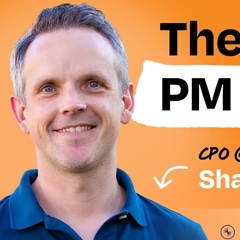
Shaun Clowes
Chief Product Officer at Confluent; former CPO at MuleSoft and Metromile; first head of growth at Atlassian
Where to hear and read about Shaun Clowes1 episode or test

Shaun Clowes is Chief Product Officer at Confluent, and earlier led product at MuleSoft and Metromile and built Atlassian's first B2B growth team. The most useful thing to learn from him is to spend your time outside the building and treat data as a compass that tests your thinking, not a GPS that gives you the answer.
Data is more like a compass than a GPS.
Why great AI products are all about the data | Shaun Clowes (CPO at Confluent)
Shaun Clowes: the story and the lessons
1Shaun Clowes's path through product and growth
Clowes started as an engineer and moved through four product leadership jobs. He spent six years at Atlassian, where he ran Jira Agile and built the first B2B growth team. He then became chief product officer at Metromile, ran MuleSoft inside Salesforce, and is now CPO at Confluent.
Metromile was a public auto insurance technology company. MuleSoft was a billion-dollar business inside Salesforce. He also created two Reforge courses, on retention and engagement and on data for product managers.
He picks each job to fill a gap, like a bingo card. His roles span Atlassian with no sales team, consumer insurance at Metromile, back-end integration at MuleSoft and Salesforce's distribution machine. Each gave him pattern matching from a different side.
Metromile let him build a product a grandmother could use. Salesforce showed him a sales and marketing operation he called a PhD in marketing. Early on he ran a pre-sales engineering group, which made him ask whether software could be sold at scale with no sales team.
He wants people shaped like scribbles, broad and deep in several things. Clowes can go three clicks below simple financial analysis. He has rarely regretted going deep on something outside his job, since the worst case is learning something he never uses.
The best case is that it becomes the tool he needs for an important problem. He saw this ideal in Atlassian's general counsel, Tom Kennedy, who stayed silent through a 15-minute strategy debate and then showed the room was contradicting what the company had said a year earlier. The room changed course.
He learned that influence rests on caring before being right. His motto is that people don't care what you know until they know that you care. He began as an engineer focused on technical correctness.
He now puts relationships and understanding each other's incentives ahead of being right.
2How Clowes works as a product manager
Clowes spends most thinking time on customers, market and competitors. He says to start every document from the customer's, market's and competitor's point of view, then back it with anecdotes and bits of data. PMs who do this improve almost immediately.
Colleagues stop resisting and start wanting the PM to win, because the bet looks good. Politics, scrum management and delivery never solve the real job, which is differentiated value only you can deliver.
He builds a system for hearing from people he doesn't normally hear from. Most PMs think they listen widely but hear from the usual people, never synthesize and never seek the counterfactual. Occasional customer calls get counted as research.
His fix is a structured routine that brings back analysis, and compares how the product is actually used with what people say. Otherwise it is "just more activity, no outcomes."
Clowes sizes interview research at 7 to 14 people with neutral questions. By the Nielsen number, fewer than 7 interviews teach too little and more than 14 teach little that is new. Leading questions only get customers to say what you want to be true.
If the research isn't set up to learn, an LLM only reads back a summary of what you wanted to hear.
He asks ChatGPT where his strategy does not fit what customers said. He pastes in customer interviews and his strategy, and asks for the mismatches rather than the confirmations. He can also paste a competitor's positioning document and ask whether it fits customers better than his own.
Public documents derive from strategy, so an LLM can infer what a competitor will probably do. That once took sweat work, and he says it is sometimes creepy.
Confluent uses LLMs to cluster inbound customer requests by meaning. Across hundreds or thousands of requests from the field and customers, LLMs group the ones that are the same concept even when the words differ. The team sees which ideas are rising or fading.
He calls this a feedback river, an idea he credits to Sachin Rekhi. It also includes interviews, NPS and competitor information, and plain ChatGPT or Claude is mostly good enough.
He protects outside-in time from the calendar. Clowes says PMs are often ruled by their calendar, and you have to force the outside-in time to happen. No one else will do that thinking for you.
3Why Clowes calls data a compass, not a GPS
Clowes uses data to test ideas, not to hand him the answer. He once called himself data-driven and has run data teams at several companies. Now he says data mostly tells you whether what you said is ridiculous or whether something might be there.
Intuition is a data sifter built from data you've already seen. He warns against using data as a weapon to force people your way: "If you look at data as a way of giving you the answer, you're always wrong."
He treats a surprising result as wrong until proven otherwise. He checks the sample and selection bias, then looks a click before, a click after and a click up to the business goal. An onboarding fix that touches only 2% of users is meaningless.
An intervention may hold in week two while everyone churns in week three. Retained users may also have a lower average sale price, when the real goal is happy customers paying more.
He never presents a weak analysis with authority. A flawed analysis delivered confidently costs more credibility than showing none. Clowes has seen people shot down live for bringing a knife to a gunfight.
His rule: "It would be better not to show up with an analysis that isn't clear than it would be to show up with an analysis that's dumb."
Clowes decides with roughly 30% to 70% of the data. Quoting Colin Powell, he says deciding with under 30% of the data is a big mistake and waiting for about 70% is too slow. PMs are paid to make good decisions that deliver business benefit.
He sees the skill as balancing speed against the data you have.
His growth team held out 10% of people from every experiment. The global holdout gave a baseline to compare against any later cohort of the same vintage, so the team could see net lift over time instead of the first win.
He cites Shopify's growth head saying about 40% of positive experiments turn neutral over time. A fading benefit may be an opportunity not capitalized on, but he still wants net lift measured, which is why growth is so hard.
He says people still do far too little cohort analysis. Clowes recommends The Lean Startup mainly for its cohort analysis lessons. He also names INSPIRED by Marty Cagan as holding many key lessons of product management.
4Clowes on building AI products and why incumbents survive
Clowes says great AI products are a data management problem. A model knows only what it was trained on and what you hand it right now. Models are mostly replaceable and prompts matter less than context, so he puts about 90% of the effort into data work.
His example is an HR bot at a company like Workday, which needs employee records, benefits, local law and company policy, all linked together. A simple pipeline into an LLM leads to long frustration. He sees Anthropic's experience, as described by Mike Krieger, pointing the same way.
He expects AI to strengthen incumbent business software. Jira, Workday and Salesforce look like forms on databases, but the lock-in is years of configured workflows and business rules. Even if agents replace the user interface, they must follow those rules.
Even Salesforce can't list how software is sold inside a customer's instance without reading the code. With endless clones, each new one adds close to zero value, and buyers default to the premier vendor.
Challengers must meet the bar and be different, with data in the workflow. A cheaper, not-as-good clone has no angle. He points to Ashby, the applicant tracking system people praise, for tying time-to-fill, hiring outcomes and attrition to actions inside the workflow.
He adds that distribution stays the hardest problem, because getting into the consideration set is harder now that cold email and LinkedIn are flooded with LLM spam.
He values the right data in the right place over owning data. First-party data is useless if you can't bring it to bear at the moment users need it. Everyone is already surrounded by data.
5How Clowes built B2B growth and product-led growth
He built Atlassian's first B2B growth team around 2012. It began as a bet that B2C growth techniques would work for software sold to businesses. Most B2B companies relied on distribution, marketing and customer success to cover product faults.
The practice had no name yet and was just called growth. It later became product-led growth.
Growth teams pass through three phases: prove, systematize, embed. First the team must show any growth exists, a fairly random search. Then it must make wins repeat and scale the PLG lens from acquisition to activation, retention and upsell.
Finally it must fit among product, sales and marketing, since growth sits in everyone else's sandpit. Teams fail when they find no wins, when wins look random, or when they can't explain the wins they find.
He says someone must be paid to care about the end user. In B2B the buyer drives the RFP, so requirements ignore end users. Unless someone's incentive is measuring end-user success, caring about it stays a hobby.
Poor early experiences become an opening for competitors. He cites Charlie Munger: show me the incentive and I'll show you the outcome.
He runs PLG and enterprise sales so each feeds the other. Confluent has credit card self-serve signups and an enterprise team selling to some of the biggest banks. PLG feeds sales, and sales feeds the PLG funnel with leads not yet ready.
Few customers with big revenue leaves you captive, and many customers with little revenue can't sustain operations. Atlassian had about 80,000 customers when he left, so a competitor winning 1,000 barely dents it.
6The zombie product Clowes should have killed
A product with no right to win stayed alive for two years. The product measured and cut a company's environmental impact, such as the power use of computers and air conditioning. The company had the wrong place, timing and distribution.
The idea was timely and is still an active area of research and investment. The team was blinded by the potential.
He says it should have been called dead after six months. It was killed only when a customer offered to pay millions, because signing would have bound the company to it. The extra year and a half was an accidental drain on resources.
His lesson: "A good idea at the wrong company is a bad product," and he should at least have tried to say it was dead far sooner.

Why great AI products are all about the data | Shaun Clowes (CPO at Confluent)
Shaun Clowes explains how product managers can become far more effective by living outside the building, using data as a compass rather than a GPS, and treating data management as the core of any AI product. He draws on building Atlassian's first B2B growth team and running product at MuleSoft, Metromile and Confluent.
Clowes started as an engineer and moved through four product leadership jobs. He spent six years at Atlassian, where he ran Jira Agile and built the first B2B growth team. He then became chief product officer at Metromile, ran MuleSoft inside Salesforce, and is now CPO at Confluent.
Metromile was a public auto insurance technology company. MuleSoft was a billion-dollar business inside Salesforce. He also created two Reforge courses, on retention and engagement and on data for product managers.
He picks each job to fill a gap, like a bingo card. His roles span Atlassian with no sales team, consumer insurance at Metromile, back-end integration at MuleSoft and Salesforce's distribution machine. Each gave him pattern matching from a different side.
Metromile let him build a product a grandmother could use. Salesforce showed him a sales and marketing operation he called a PhD in marketing. Early on he ran a pre-sales engineering group, which made him ask whether software could be sold at scale with no sales team.
He wants people shaped like scribbles, broad and deep in several things. Clowes can go three clicks below simple financial analysis. He has rarely regretted going deep on something outside his job, since the worst case is learning something he never uses.
The best case is that it becomes the tool he needs for an important problem. He saw this ideal in Atlassian's general counsel, Tom Kennedy, who stayed silent through a 15-minute strategy debate and then showed the room was contradicting what the company had said a year earlier. The room changed course.
He learned that influence rests on caring before being right. His motto is that people don't care what you know until they know that you care. He began as an engineer focused on technical correctness.
He now puts relationships and understanding each other's incentives ahead of being right.
Clowes spends most thinking time on customers, market and competitors. He says to start every document from the customer's, market's and competitor's point of view, then back it with anecdotes and bits of data. PMs who do this improve almost immediately.
Colleagues stop resisting and start wanting the PM to win, because the bet looks good. Politics, scrum management and delivery never solve the real job, which is differentiated value only you can deliver.
He builds a system for hearing from people he doesn't normally hear from. Most PMs think they listen widely but hear from the usual people, never synthesize and never seek the counterfactual. Occasional customer calls get counted as research.
His fix is a structured routine that brings back analysis, and compares how the product is actually used with what people say. Otherwise it is "just more activity, no outcomes."
Clowes sizes interview research at 7 to 14 people with neutral questions. By the Nielsen number, fewer than 7 interviews teach too little and more than 14 teach little that is new. Leading questions only get customers to say what you want to be true.
If the research isn't set up to learn, an LLM only reads back a summary of what you wanted to hear.
He asks ChatGPT where his strategy does not fit what customers said. He pastes in customer interviews and his strategy, and asks for the mismatches rather than the confirmations. He can also paste a competitor's positioning document and ask whether it fits customers better than his own.
Public documents derive from strategy, so an LLM can infer what a competitor will probably do. That once took sweat work, and he says it is sometimes creepy.
Confluent uses LLMs to cluster inbound customer requests by meaning. Across hundreds or thousands of requests from the field and customers, LLMs group the ones that are the same concept even when the words differ. The team sees which ideas are rising or fading.
He calls this a feedback river, an idea he credits to Sachin Rekhi. It also includes interviews, NPS and competitor information, and plain ChatGPT or Claude is mostly good enough.
He protects outside-in time from the calendar. Clowes says PMs are often ruled by their calendar, and you have to force the outside-in time to happen. No one else will do that thinking for you.
Clowes uses data to test ideas, not to hand him the answer. He once called himself data-driven and has run data teams at several companies. Now he says data mostly tells you whether what you said is ridiculous or whether something might be there.
Intuition is a data sifter built from data you've already seen. He warns against using data as a weapon to force people your way: "If you look at data as a way of giving you the answer, you're always wrong."
He treats a surprising result as wrong until proven otherwise. He checks the sample and selection bias, then looks a click before, a click after and a click up to the business goal. An onboarding fix that touches only 2% of users is meaningless.
An intervention may hold in week two while everyone churns in week three. Retained users may also have a lower average sale price, when the real goal is happy customers paying more.
He never presents a weak analysis with authority. A flawed analysis delivered confidently costs more credibility than showing none. Clowes has seen people shot down live for bringing a knife to a gunfight.
His rule: "It would be better not to show up with an analysis that isn't clear than it would be to show up with an analysis that's dumb."
Clowes decides with roughly 30% to 70% of the data. Quoting Colin Powell, he says deciding with under 30% of the data is a big mistake and waiting for about 70% is too slow. PMs are paid to make good decisions that deliver business benefit.
He sees the skill as balancing speed against the data you have.
His growth team held out 10% of people from every experiment. The global holdout gave a baseline to compare against any later cohort of the same vintage, so the team could see net lift over time instead of the first win.
He cites Shopify's growth head saying about 40% of positive experiments turn neutral over time. A fading benefit may be an opportunity not capitalized on, but he still wants net lift measured, which is why growth is so hard.
He says people still do far too little cohort analysis. Clowes recommends The Lean Startup mainly for its cohort analysis lessons. He also names INSPIRED by Marty Cagan as holding many key lessons of product management.
Clowes says great AI products are a data management problem. A model knows only what it was trained on and what you hand it right now. Models are mostly replaceable and prompts matter less than context, so he puts about 90% of the effort into data work.
His example is an HR bot at a company like Workday, which needs employee records, benefits, local law and company policy, all linked together. A simple pipeline into an LLM leads to long frustration. He sees Anthropic's experience, as described by Mike Krieger, pointing the same way.
He expects AI to strengthen incumbent business software. Jira, Workday and Salesforce look like forms on databases, but the lock-in is years of configured workflows and business rules. Even if agents replace the user interface, they must follow those rules.
Even Salesforce can't list how software is sold inside a customer's instance without reading the code. With endless clones, each new one adds close to zero value, and buyers default to the premier vendor.
Challengers must meet the bar and be different, with data in the workflow. A cheaper, not-as-good clone has no angle. He points to Ashby, the applicant tracking system people praise, for tying time-to-fill, hiring outcomes and attrition to actions inside the workflow.
He adds that distribution stays the hardest problem, because getting into the consideration set is harder now that cold email and LinkedIn are flooded with LLM spam.
He values the right data in the right place over owning data. First-party data is useless if you can't bring it to bear at the moment users need it. Everyone is already surrounded by data.
He built Atlassian's first B2B growth team around 2012. It began as a bet that B2C growth techniques would work for software sold to businesses. Most B2B companies relied on distribution, marketing and customer success to cover product faults.
The practice had no name yet and was just called growth. It later became product-led growth.
Growth teams pass through three phases: prove, systematize, embed. First the team must show any growth exists, a fairly random search. Then it must make wins repeat and scale the PLG lens from acquisition to activation, retention and upsell.
Finally it must fit among product, sales and marketing, since growth sits in everyone else's sandpit. Teams fail when they find no wins, when wins look random, or when they can't explain the wins they find.
He says someone must be paid to care about the end user. In B2B the buyer drives the RFP, so requirements ignore end users. Unless someone's incentive is measuring end-user success, caring about it stays a hobby.
Poor early experiences become an opening for competitors. He cites Charlie Munger: show me the incentive and I'll show you the outcome.
He runs PLG and enterprise sales so each feeds the other. Confluent has credit card self-serve signups and an enterprise team selling to some of the biggest banks. PLG feeds sales, and sales feeds the PLG funnel with leads not yet ready.
Few customers with big revenue leaves you captive, and many customers with little revenue can't sustain operations. Atlassian had about 80,000 customers when he left, so a competitor winning 1,000 barely dents it.
A product with no right to win stayed alive for two years. The product measured and cut a company's environmental impact, such as the power use of computers and air conditioning. The company had the wrong place, timing and distribution.
The idea was timely and is still an active area of research and investment. The team was blinded by the potential.
He says it should have been called dead after six months. It was killed only when a customer offered to pay millions, because signing would have bound the company to it. The extra year and a half was an accidental drain on resources.
His lesson: "A good idea at the wrong company is a bad product," and he should at least have tried to say it was dead far sooner.