Robert Macfarlane
Nature writer and author (Macfarlane)
Where to hear and read about Robert Macfarlane2 episodes and tests
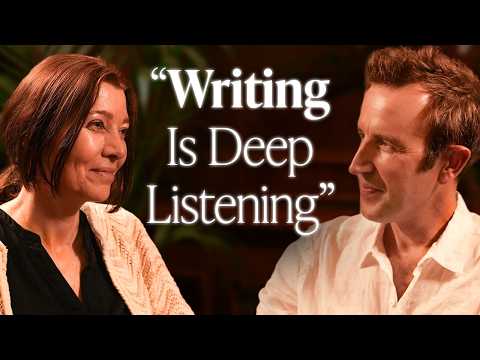
 How I WriteThe Deepest Conversation You’ll Ever Watch About Writing (Shafak & Macfarlane Interview)
 How I WriteCambridge Professor: Why All Writing Sounds the Same Now (Robert Macfarlane)
Robert Macfarlane is a nature writer, Cambridge teacher and lyricist whose books on mountains, underland and rivers are built from sound, precise words and years of notebooks. The most useful thing to learn from him is how he matches the rhythm and texture of his sentences to the thing he describes, so the reader feels it in the body.
Language will always be late for light.
The Deepest Conversation You’ll Ever Watch About Writing (Shafak & Macfarlane Interview)
Robert Macfarlane: the story and the lessons
1Robert Macfarlane: the mountain-raised writer behind Is a River Alive?
Macfarlane grew up in mountains and says his heart is made of them. Mountains made him alert and open to the world: the light feels brighter, snow on the face sharper, and the air runs 'like a wire in your nose'. Danger demands alertness, which means risk assessment but also openness to whatever meets you.
Mountains wore away the usual boundaries and shells of the self, and they still do. In his words: 'my heart is made of mountains and always will be'.
He writes about birds, rivers, trees and mountains, and also writes songs. His books include Mountains of the Mind, The Wild Places, Underland, The Lost Words and Is a River Alive?, and a field guide with a rhyming cuckoo entry. His lyric work covers four full-length choral works and several albums.
He has written an improvised jazz opera staged at a former nuclear weapons testing site. His newest choral piece, The World Tree, is about the felling of the Sycamore Gap tree on Hadrian's Wall.
Macfarlane spent 22 years learning to write Is a River Alive? He calls it the book he spent 22 years learning to write, and mostly the last 10. Big books take him four to eight years each.
After 22 years writing feels naturalized, yet the rule stays the same: show up, since even a paragraph makes the book a paragraph longer.
He reads far outside literature and asks scientists about their work. His master's thesis covered the relations between the new physics and contemporary British poetry. He calls himself a 'Labrador puppy' with scientists, asking Cambridge geologists what a curbstone is made of.
Glaciologist Robert Mulvaney gave him sand grains from the base of an Antarctic ice core, dating from when Antarctica's bedrock was forming as a desert. Teaching at Cambridge fills his time, so he rarely teaches writing.
2Why Macfarlane says language always fails, and writes anyway
Macfarlane says language is always late to its subject. No sentence can meet an encounter with a river or mountain, so for him the craft lies in how well language fails. He finds the beauty in the shattering, in how the pieces fall and what they are made of.
Accepting the failure first lets him write toward the experience without pretending to capture it.
He leans into metaphor instead of chasing exact correspondence. Metaphor distorts on purpose; he cites Aristotle's 'like unlikeness'. He hates the verb 'capture' because it turns nature into a caged captive, and compares his stance to Monet painting an impression rather than the scene.
Once you stop feeling you are falling short, you can evoke the subject instead of copying it.
He writes astonishment plainly and refuses hyperbole. Extravagant language to match an astonishing moment leaves prose hollow and false. Purple prose lies, so he renders the empirical basis of what he felt and lets that carry it.
For a ghostly night on an English hilltop he told only how he perceived it, and the gaps let the reader become a co-writer who fills them in.
He wants each sentence to send the reader off thinking. Squared-off sentences leave no room for the reader's mind to stir. His line that English has no verb 'to river', yet a river is all verb, works as a sendoff.
The question grows more complex in retrospect: the reader assents at first, then starts to wonder how one would translate it.
3How Macfarlane makes nonfiction sing
Macfarlane lets the sound of the subject set the rhythm. His cuckoo entry in the field guide opens in rhyming couplets with a two-tone rocking beat and internal rhyme, because the bird sets its own beat. It then turns to the bird's counterfeit eggs and folklore.
'I think you need to let language sing a little as well.' He argues rhythm, sound patterns and echoes belong in nonfiction, which readers rarely listen to for sound.
He rewrites first lines hundreds of times. He treats a first line as an opening song that tells the reader they are crossing a threshold. 'The wind was rising so I went to the wood' packs alliteration, rhythm and a puzzle into one sentence.
'12,000 years ago a river is born' is less rhythmic but more ominous. The next line, flints lie white as eyes, then rises and flows, echoes the sound of eyes in rises. Readers may not notice the internal rhyme, but they sit up.
He writes speed with long 'and' chains and shrinking clauses. In rapids passages the clauses between the ands get shorter and quicker, verbs turn active, and he drops articles, so it is 'river rams fingers' not 'the river'. The reader runs out of breath as the swimmer did.
He calls it a syntax of panic and rapidity. Slow, flat water got different rhythms and tones from the fast water.
Sentences in Is a River Alive? run as long as two pages. One is 515 words long. He loves the em dash as liquid punctuation because it flows both ways, so meaning can eddy back up a sentence or run down it.
A full stop, by contrast, bangs down the hard end of a thought. He also uses verbless one-line paragraphs, which Grammarly objects to.
He chooses between glass-clear and thick, heavy language. Clear prose lets the reader see the scene with nothing in between. Thick prose makes them feel each word's weight. He takes 'palp and heft' from Seamus Heaney, whom he learned the feel from more than anyone.
Wrong texture is a tremendous interference: the reader feels dragged through heavy water and wants to get away.
He does not treat 'cut extra words' as a rule. He is a subtractionist only at times. Walter Pater wanted to burn with a hard and gemlike flame long before Hemingway and Raymond Carver made cutting a creed, and Macfarlane's one-line images are faceted like gems.
Each landscape asks for its own bespoke language, so he judges where he is and what he is trying to do.
He aims at the reader's body first, using claustrophobia over vertigo. He calls this sympathetic kinesthesia: affecting heartbeat and breathing, not only the mind. In the Paris catacombs he crawled a passage so tight his nose touched the roof, and about a hundred readers said they had to skip it.
It was the most afraid he felt in his eight years in the underland. His vertigo scenes never made readers stop.
4Macfarlane's word hoard and what songs taught him
He uses rare words only when they are more precise. He argues precision is a function of lyricism, and every book ends with a glossary. The Gaelic word 'run' names the shadows clouds cast on moorland on a bright, windy day, which English needs a long sentence to say.
His sample entries include 'sump', a pit into which waste liquids drain, and 'supervoid', a vast region of space with almost no matter.
He spent about two and a half years raiding old glossaries. He worked through 19th-century regional glossaries of words for water, land and weather, and interviewed people who keep threatened languages. Finlay MacLeod, a Gaelic speaker, gave him a peat glossary of around 150 words for aspects of moorland.
Much of this lexicon is oral and was never written down.
He treats language death as the loss of knowledge. When the last speaker dies and no one passes the language on, recordings survive but the language does not live. He calls it a kind of biocultural collapse, the deletion of knowledge carried over many generations.
Scottish Gaelic fell as low as about 53,000 speakers and is now recovering slightly.
Writing songs taught this prose control freak to let go. Singing forces attention to how one word flows into the next; a glottal stop mid-phrase blocks the singer. He now thinks about the sound currents of single phrases.
In 'Uncanny Valley' the nursery-rhyme words are set off the beat, so words and guitar rub together. The same idea carried into the river book, where language had to 'glitch itself' to meet the river being.
Old English and Gaelic show him how to pack meaning. Old English kennings fuse two words into a metaphor: bone-cage for the body, whale road for the sea. He calls Gaelic place names a 'Gaelic positioning system': Ben suggests a rounded hill, Stob a sharper peak, Sgurr a tooth-sharp one.
Buachaille Etive Mòr means the big shepherd of the valley of Etive, and the peak guards the head of the glen.
5How Macfarlane builds a book from notebooks to ending
He fills small pocket notebooks with fragments, then jots again at night. He carries A6 notebooks and fills them with what he calls qualia, shards of mica: images and scraps of conversation. Each night, even at 4,000 metres or 100 miles down a river, he writes by head torch in the tent while it is fresh.
He sticks feathers, earth and leaves in the back as memory aids, and nobody else could read the notebooks.
Back home he pulls each fragment's thread on screen. With five to ten notebooks he works through them page by page at the keyboard. Each fragment is the end of a thread of memory, and pulling it opens the whole scene and starts a web of connections.
He calls the page a condensation surface, and says pen and paper do what pixel and keyboard can't.
He highlights images that keep returning and calls it heartwork. Across the eight years of Underland the open hand recurred, from ochre cave stencils to spray-can graffiti in the Paris catacombs. Noticing the recurrence gave the book its deeper work.
He borrows the term from Rilke's Letters to a Young Poet. Cave hands are outlines, so what we see is the mark of an absence, and the catacomb hands were sprayed about 20 years earlier against 36,000 years for the cave hands.
He starts a book from a small question that works as a portal. His first book, Mountains of the Mind, began with 'Why climb mountains?' Mallory's 'Because it's there' did not help, and answering took 300 pages. He never reached the end of any of these questions.
He compares the question to a caving sump opening into a huge cavern, or the Narnia wardrobe, and the book opens with his grandmother's wardrobe of fur coats.
He writes a letter to his future self before a long book. Addressed to 'Dear Rob, the future Rob', it says what he hopes the book will be and do. It is an evocation, not a set of commandments, since books take three to eight years and both he and the world change.
Rereading it at the end, he finds it sometimes hugely discrepant and sometimes surprisingly close. He also pins quotes, not questions, to his desk; for the river book it was Ursula Le Guin.
He builds books as mosaics and writes like a potter. He writes about a hundred set pieces out of order, with a wet lump first and ornament last. If stuck, he jumps downstream and writes a later scene.
He moves pieces around like a kaleidoscope until relations appear. In the last 5 to 10 percent the book accelerates in a series of clicks, which he links to Auden's poem that 'comes right with a click like a closing box'.
He stops each day knowing the next sentence. Knowing the next sentence works like pushing off on a bike, so the next morning he only has to finish it. He contrasts himself with Alan Hollinghurst, who writes one perfect handwritten page a day.
He picks his tool by form: notebooks sized to the piece and a pen with ink from 110 rivers for lyrics and short poems, a screen for work that needs moving around.
6How Macfarlane wrote Is a River Alive?
Macfarlane moved from writing about rivers to being written by one. He calls himself a preposition obsessive. Writing with a river means co-thinking and co-writing, and being written by one is a step further, a metaphysically huge distance from 'about' to 'by'.
At the end of the journey he felt the river creating language through him.
A river trip that went wrong shaped the book. On the Magpie River in Quebec, dropped by float plane at the head of a 75 km lake, the river ran at 275 cubic meters a second instead of about 150. It threw the travelers into six-foot waves and rocks.
The ordeal wore him down physically and 'unlearned' him. At the end he felt two auras overlapping, a brush with the divine, and decided language only needs to register an analog of it.
He rewrote the ending three times as the river supplied better ones. First came a choir of seals in the Gulf of St. Lawrence at the end of an 11-day paddle to the sea, whose cries he had mistaken for jet skis. Then the river wrote the ending through him.
The third came at the springs near his home, where he saw himself dead and his children putting a pinch of ash in the water. He felt time is a river and we are never standing dry-footed on the bank.
He writes people into nature books now and mostly transcribes them. He seeks travel companions fascinated by something. Mycologist Giuliana Furci sensed fungi before she saw them and found a single specimen in a huge Ecuadorian cloud forest, twice.
He says such writing is mostly transcription, so the books are full of true dialogue. He compares real conversation to building a fire together, which makes companions a kind of co-writer.
7Macfarlane's working habits for showing up
Macfarlane runs daily and sends himself voice notes. He has his best ideas running, at what he says is 6 or 7 miles an hour, and later deciphers the notes as panting messages from his tired self. Kierkegaard put the mind's best pace at 3 miles an hour.
Because the body is busy with the ground, the mind frees up. He finds distraction more generative than boredom, and writes on his hand if he has a pen.
He tells young writers to beware the fetish of the desk. Arranging the perfect desk, sharp pencil and silence can become devotion to preparing to write, and then the real problem arrives abruptly. He likes writing on trains, where an hour and 22 minutes forces a thought down.
'Beware the fetish of the desk.'
His first rule for writers is 'ass on chair'. It hurts and feels like banging your head on a blackboard, but you do not run from it. His second rule is to look for patterns, because they light up for reader and writer.
Writing is hard but not coal mining, and writers sit comfortably at a desk even when the work is 'brain hurty'.
8What Macfarlane thinks writing is for
He holds that science deepens wonder instead of ending it. A rainbow is the 'charismatic megafauna of wonder', and he is fine with unweaving it, against Keats. Some of the most astonishing writing he reads is technical.
A small thing seen well opens onto the vast: Blake's grain of sand, and the microscope and telescope cracking open other scales in the 17th century.
He calls reason a flame in a cave, not a floodlight. A flame lights a small patch of wall and follows you, so a writer chooses what to light and which mysteries to hint at. Rationalism and technocracy gave immense blessings but outlawed the idea that a tree might speak or a river might be alive.
He says Nature's secrets outrun Francis Bacon's urge to torment nature until she yields them.
He writes spells for children to speak aloud in The Lost Words. The otter spell runs on internal rhyme: 'Otter enters water without falter.' Families send him films of children on riverbanks chanting it and asking where the otter is.
For children, wonder leads and rhythm and sound do the work.
He wants readers to see the world differently afterward. The letters that please him most say a book changed how the reader saw the world, even for a day. Readers write that they now talk to a fig tree or have joined a local river guardianship group.
He says we have more than five senses because we have literature and art, which are other ways of seeing and being.
He tests each book with a casket test. He asks whether a reader a hundred years on, digging the book up, would see that it really tried to wrestle with the crisis of its moment. The test is not whether it solved anything.
He says no one writes from beyond the shadow of ecological crisis, and that a book need not address it directly but should carry a 'splinter of love'. He thinks he fails the test, but finds the question a good discipline.
He refuses AI in his writing and warns writers to resist it. He tolerates only spell check, and takes Grammarly's objection to his verbless one-line paragraphs as a badge of success. Such tools lift average prose while erasing distinctiveness.
He also objects to language models being trained on authors' books without license or permission, and says writing has much to fear from AI.
The Deepest Conversation You’ll Ever Watch About Writing (Shafak & Macfarlane Interview)
Two writers talk about how to turn wonder and attention into sentences, with fiction and nonfiction drawing on the same rhythm, intuition and listening. The most useful habit is to give the work real attention, whether that means shaking ideas loose on a run, letting a subject set the sound of the prose, or testing a book against the future.
He writes about birds, rivers, trees and mountains, and also writes songs. His books include Mountains of the Mind, The Wild Places, Underland, The Lost Words and Is a River Alive?, and a field guide with a rhyming cuckoo entry. His lyric work covers four full-length choral works and several albums.
He has written an improvised jazz opera staged at a former nuclear weapons testing site. His newest choral piece, The World Tree, is about the felling of the Sycamore Gap tree on Hadrian's Wall.
He reads far outside literature and asks scientists about their work. His master's thesis covered the relations between the new physics and contemporary British poetry. He calls himself a 'Labrador puppy' with scientists, asking Cambridge geologists what a curbstone is made of.
Glaciologist Robert Mulvaney gave him sand grains from the base of an Antarctic ice core, dating from when Antarctica's bedrock was forming as a desert. Teaching at Cambridge fills his time, so he rarely teaches writing.
Macfarlane says language is always late to its subject. No sentence can meet an encounter with a river or mountain, so for him the craft lies in how well language fails. He finds the beauty in the shattering, in how the pieces fall and what they are made of.
Accepting the failure first lets him write toward the experience without pretending to capture it.
Macfarlane lets the sound of the subject set the rhythm. His cuckoo entry in the field guide opens in rhyming couplets with a two-tone rocking beat and internal rhyme, because the bird sets its own beat. It then turns to the bird's counterfeit eggs and folklore.
'I think you need to let language sing a little as well.' He argues rhythm, sound patterns and echoes belong in nonfiction, which readers rarely listen to for sound.
He rewrites first lines hundreds of times. He treats a first line as an opening song that tells the reader they are crossing a threshold. 'The wind was rising so I went to the wood' packs alliteration, rhythm and a puzzle into one sentence.
'12,000 years ago a river is born' is less rhythmic but more ominous. The next line, flints lie white as eyes, then rises and flows, echoes the sound of eyes in rises. Readers may not notice the internal rhyme, but they sit up.
He builds books as mosaics and writes like a potter. He writes about a hundred set pieces out of order, with a wet lump first and ornament last. If stuck, he jumps downstream and writes a later scene.
He moves pieces around like a kaleidoscope until relations appear. In the last 5 to 10 percent the book accelerates in a series of clicks, which he links to Auden's poem that 'comes right with a click like a closing box'.
He stops each day knowing the next sentence. Knowing the next sentence works like pushing off on a bike, so the next morning he only has to finish it. He contrasts himself with Alan Hollinghurst, who writes one perfect handwritten page a day.
He picks his tool by form: notebooks sized to the piece and a pen with ink from 110 rivers for lyrics and short poems, a screen for work that needs moving around.
He rewrote the ending three times as the river supplied better ones. First came a choir of seals in the Gulf of St. Lawrence at the end of an 11-day paddle to the sea, whose cries he had mistaken for jet skis. Then the river wrote the ending through him.
The third came at the springs near his home, where he saw himself dead and his children putting a pinch of ash in the water. He felt time is a river and we are never standing dry-footed on the bank.
Macfarlane runs daily and sends himself voice notes. He has his best ideas running, at what he says is 6 or 7 miles an hour, and later deciphers the notes as panting messages from his tired self. Kierkegaard put the mind's best pace at 3 miles an hour.
Because the body is busy with the ground, the mind frees up. He finds distraction more generative than boredom, and writes on his hand if he has a pen.
He tells young writers to beware the fetish of the desk. Arranging the perfect desk, sharp pencil and silence can become devotion to preparing to write, and then the real problem arrives abruptly. He likes writing on trains, where an hour and 22 minutes forces a thought down.
'Beware the fetish of the desk.'
He holds that science deepens wonder instead of ending it. A rainbow is the 'charismatic megafauna of wonder', and he is fine with unweaving it, against Keats. Some of the most astonishing writing he reads is technical.
A small thing seen well opens onto the vast: Blake's grain of sand, and the microscope and telescope cracking open other scales in the 17th century.
He calls reason a flame in a cave, not a floodlight. A flame lights a small patch of wall and follows you, so a writer chooses what to light and which mysteries to hint at. Rationalism and technocracy gave immense blessings but outlawed the idea that a tree might speak or a river might be alive.
He says Nature's secrets outrun Francis Bacon's urge to torment nature until she yields them.
He wants readers to see the world differently afterward. The letters that please him most say a book changed how the reader saw the world, even for a day. Readers write that they now talk to a fig tree or have joined a local river guardianship group.
He says we have more than five senses because we have literature and art, which are other ways of seeing and being.
He tests each book with a casket test. He asks whether a reader a hundred years on, digging the book up, would see that it really tried to wrestle with the crisis of its moment. The test is not whether it solved anything.
He says no one writes from beyond the shadow of ecological crisis, and that a book need not address it directly but should carry a 'splinter of love'. He thinks he fails the test, but finds the question a good discipline.
Cambridge Professor: Why All Writing Sounds the Same Now (Robert Macfarlane)
Robert Macfarlane explains how he builds nature writing from sound, rhythm, precise words and small notebooks, and why he refuses to flatten his sentences into plain, average prose. The technique worth hearing is how he matches syntax to the thing described, so a reader feels a rapid in the breath and the body rather than just being told about it.
Macfarlane grew up in mountains and says his heart is made of them. Mountains made him alert and open to the world: the light feels brighter, snow on the face sharper, and the air runs 'like a wire in your nose'. Danger demands alertness, which means risk assessment but also openness to whatever meets you.
Mountains wore away the usual boundaries and shells of the self, and they still do. In his words: 'my heart is made of mountains and always will be'.
He writes about birds, rivers, trees and mountains, and also writes songs. His books include Mountains of the Mind, The Wild Places, Underland, The Lost Words and Is a River Alive?, and a field guide with a rhyming cuckoo entry. His lyric work covers four full-length choral works and several albums.
He has written an improvised jazz opera staged at a former nuclear weapons testing site. His newest choral piece, The World Tree, is about the felling of the Sycamore Gap tree on Hadrian's Wall.
Macfarlane spent 22 years learning to write Is a River Alive? He calls it the book he spent 22 years learning to write, and mostly the last 10. Big books take him four to eight years each.
After 22 years writing feels naturalized, yet the rule stays the same: show up, since even a paragraph makes the book a paragraph longer.
He reads far outside literature and asks scientists about their work. His master's thesis covered the relations between the new physics and contemporary British poetry. He calls himself a 'Labrador puppy' with scientists, asking Cambridge geologists what a curbstone is made of.
Glaciologist Robert Mulvaney gave him sand grains from the base of an Antarctic ice core, dating from when Antarctica's bedrock was forming as a desert. Teaching at Cambridge fills his time, so he rarely teaches writing.
He leans into metaphor instead of chasing exact correspondence. Metaphor distorts on purpose; he cites Aristotle's 'like unlikeness'. He hates the verb 'capture' because it turns nature into a caged captive, and compares his stance to Monet painting an impression rather than the scene.
Once you stop feeling you are falling short, you can evoke the subject instead of copying it.
He writes astonishment plainly and refuses hyperbole. Extravagant language to match an astonishing moment leaves prose hollow and false. Purple prose lies, so he renders the empirical basis of what he felt and lets that carry it.
For a ghostly night on an English hilltop he told only how he perceived it, and the gaps let the reader become a co-writer who fills them in.
He wants each sentence to send the reader off thinking. Squared-off sentences leave no room for the reader's mind to stir. His line that English has no verb 'to river', yet a river is all verb, works as a sendoff.
The question grows more complex in retrospect: the reader assents at first, then starts to wonder how one would translate it.
Macfarlane lets the sound of the subject set the rhythm. His cuckoo entry in the field guide opens in rhyming couplets with a two-tone rocking beat and internal rhyme, because the bird sets its own beat. It then turns to the bird's counterfeit eggs and folklore.
'I think you need to let language sing a little as well.' He argues rhythm, sound patterns and echoes belong in nonfiction, which readers rarely listen to for sound.
He rewrites first lines hundreds of times. He treats a first line as an opening song that tells the reader they are crossing a threshold. 'The wind was rising so I went to the wood' packs alliteration, rhythm and a puzzle into one sentence.
'12,000 years ago a river is born' is less rhythmic but more ominous. The next line, flints lie white as eyes, then rises and flows, echoes the sound of eyes in rises. Readers may not notice the internal rhyme, but they sit up.
He writes speed with long 'and' chains and shrinking clauses. In rapids passages the clauses between the ands get shorter and quicker, verbs turn active, and he drops articles, so it is 'river rams fingers' not 'the river'. The reader runs out of breath as the swimmer did.
He calls it a syntax of panic and rapidity. Slow, flat water got different rhythms and tones from the fast water.
Sentences in Is a River Alive? run as long as two pages. One is 515 words long. He loves the em dash as liquid punctuation because it flows both ways, so meaning can eddy back up a sentence or run down it.
A full stop, by contrast, bangs down the hard end of a thought. He also uses verbless one-line paragraphs, which Grammarly objects to.
He chooses between glass-clear and thick, heavy language. Clear prose lets the reader see the scene with nothing in between. Thick prose makes them feel each word's weight. He takes 'palp and heft' from Seamus Heaney, whom he learned the feel from more than anyone.
Wrong texture is a tremendous interference: the reader feels dragged through heavy water and wants to get away.
He does not treat 'cut extra words' as a rule. He is a subtractionist only at times. Walter Pater wanted to burn with a hard and gemlike flame long before Hemingway and Raymond Carver made cutting a creed, and Macfarlane's one-line images are faceted like gems.
Each landscape asks for its own bespoke language, so he judges where he is and what he is trying to do.
He aims at the reader's body first, using claustrophobia over vertigo. He calls this sympathetic kinesthesia: affecting heartbeat and breathing, not only the mind. In the Paris catacombs he crawled a passage so tight his nose touched the roof, and about a hundred readers said they had to skip it.
It was the most afraid he felt in his eight years in the underland. His vertigo scenes never made readers stop.
He uses rare words only when they are more precise. He argues precision is a function of lyricism, and every book ends with a glossary. The Gaelic word 'run' names the shadows clouds cast on moorland on a bright, windy day, which English needs a long sentence to say.
His sample entries include 'sump', a pit into which waste liquids drain, and 'supervoid', a vast region of space with almost no matter.
He spent about two and a half years raiding old glossaries. He worked through 19th-century regional glossaries of words for water, land and weather, and interviewed people who keep threatened languages. Finlay MacLeod, a Gaelic speaker, gave him a peat glossary of around 150 words for aspects of moorland.
Much of this lexicon is oral and was never written down.
He treats language death as the loss of knowledge. When the last speaker dies and no one passes the language on, recordings survive but the language does not live. He calls it a kind of biocultural collapse, the deletion of knowledge carried over many generations.
Scottish Gaelic fell as low as about 53,000 speakers and is now recovering slightly.
Writing songs taught this prose control freak to let go. Singing forces attention to how one word flows into the next; a glottal stop mid-phrase blocks the singer. He now thinks about the sound currents of single phrases.
In 'Uncanny Valley' the nursery-rhyme words are set off the beat, so words and guitar rub together. The same idea carried into the river book, where language had to 'glitch itself' to meet the river being.
Old English and Gaelic show him how to pack meaning. Old English kennings fuse two words into a metaphor: bone-cage for the body, whale road for the sea. He calls Gaelic place names a 'Gaelic positioning system': Ben suggests a rounded hill, Stob a sharper peak, Sgurr a tooth-sharp one.
Buachaille Etive Mòr means the big shepherd of the valley of Etive, and the peak guards the head of the glen.
He fills small pocket notebooks with fragments, then jots again at night. He carries A6 notebooks and fills them with what he calls qualia, shards of mica: images and scraps of conversation. Each night, even at 4,000 metres or 100 miles down a river, he writes by head torch in the tent while it is fresh.
He sticks feathers, earth and leaves in the back as memory aids, and nobody else could read the notebooks.
Back home he pulls each fragment's thread on screen. With five to ten notebooks he works through them page by page at the keyboard. Each fragment is the end of a thread of memory, and pulling it opens the whole scene and starts a web of connections.
He calls the page a condensation surface, and says pen and paper do what pixel and keyboard can't.
He highlights images that keep returning and calls it heartwork. Across the eight years of Underland the open hand recurred, from ochre cave stencils to spray-can graffiti in the Paris catacombs. Noticing the recurrence gave the book its deeper work.
He borrows the term from Rilke's Letters to a Young Poet. Cave hands are outlines, so what we see is the mark of an absence, and the catacomb hands were sprayed about 20 years earlier against 36,000 years for the cave hands.
He starts a book from a small question that works as a portal. His first book, Mountains of the Mind, began with 'Why climb mountains?' Mallory's 'Because it's there' did not help, and answering took 300 pages. He never reached the end of any of these questions.
He compares the question to a caving sump opening into a huge cavern, or the Narnia wardrobe, and the book opens with his grandmother's wardrobe of fur coats.
He writes a letter to his future self before a long book. Addressed to 'Dear Rob, the future Rob', it says what he hopes the book will be and do. It is an evocation, not a set of commandments, since books take three to eight years and both he and the world change.
Rereading it at the end, he finds it sometimes hugely discrepant and sometimes surprisingly close. He also pins quotes, not questions, to his desk; for the river book it was Ursula Le Guin.
He builds books as mosaics and writes like a potter. He writes about a hundred set pieces out of order, with a wet lump first and ornament last. If stuck, he jumps downstream and writes a later scene.
He moves pieces around like a kaleidoscope until relations appear. In the last 5 to 10 percent the book accelerates in a series of clicks, which he links to Auden's poem that 'comes right with a click like a closing box'.
He stops each day knowing the next sentence. Knowing the next sentence works like pushing off on a bike, so the next morning he only has to finish it. He contrasts himself with Alan Hollinghurst, who writes one perfect handwritten page a day.
He picks his tool by form: notebooks sized to the piece and a pen with ink from 110 rivers for lyrics and short poems, a screen for work that needs moving around.
Macfarlane moved from writing about rivers to being written by one. He calls himself a preposition obsessive. Writing with a river means co-thinking and co-writing, and being written by one is a step further, a metaphysically huge distance from 'about' to 'by'.
At the end of the journey he felt the river creating language through him.
A river trip that went wrong shaped the book. On the Magpie River in Quebec, dropped by float plane at the head of a 75 km lake, the river ran at 275 cubic meters a second instead of about 150. It threw the travelers into six-foot waves and rocks.
The ordeal wore him down physically and 'unlearned' him. At the end he felt two auras overlapping, a brush with the divine, and decided language only needs to register an analog of it.
He writes people into nature books now and mostly transcribes them. He seeks travel companions fascinated by something. Mycologist Giuliana Furci sensed fungi before she saw them and found a single specimen in a huge Ecuadorian cloud forest, twice.
He says such writing is mostly transcription, so the books are full of true dialogue. He compares real conversation to building a fire together, which makes companions a kind of co-writer.
His first rule for writers is 'ass on chair'. It hurts and feels like banging your head on a blackboard, but you do not run from it. His second rule is to look for patterns, because they light up for reader and writer.
Writing is hard but not coal mining, and writers sit comfortably at a desk even when the work is 'brain hurty'.
He holds that science deepens wonder instead of ending it. A rainbow is the 'charismatic megafauna of wonder', and he is fine with unweaving it, against Keats. Some of the most astonishing writing he reads is technical.
A small thing seen well opens onto the vast: Blake's grain of sand, and the microscope and telescope cracking open other scales in the 17th century.
He calls reason a flame in a cave, not a floodlight. A flame lights a small patch of wall and follows you, so a writer chooses what to light and which mysteries to hint at. Rationalism and technocracy gave immense blessings but outlawed the idea that a tree might speak or a river might be alive.
He says Nature's secrets outrun Francis Bacon's urge to torment nature until she yields them.
He writes spells for children to speak aloud in The Lost Words. The otter spell runs on internal rhyme: 'Otter enters water without falter.' Families send him films of children on riverbanks chanting it and asking where the otter is.
For children, wonder leads and rhythm and sound do the work.
He refuses AI in his writing and warns writers to resist it. He tolerates only spell check, and takes Grammarly's objection to his verbless one-line paragraphs as a badge of success. Such tools lift average prose while erasing distinctiveness.
He also objects to language models being trained on authors' books without license or permission, and says writing has much to fear from AI.