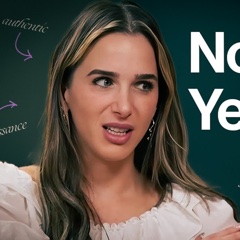
Riva Tez
Essayist and investor who writes on philosophy, history and faith
Where to hear and read about Riva Tez1 episode or test

Riva Tez is an essayist and investor who writes on philosophy, history and faith, and who runs on slow reading, long stretches of solitary thought and writing only when she feels strongly. The most useful thing to learn from her is to follow curiosity with no fixed goal until an under-explored story appears, then write it in one pass while you still care.
you can't necessarily think yourself into the answers. You have to create space for the answers to come to you.
Why No One Should Watch Netflix – Riva Tez
Riva Tez: the story and the lessons
1Riva Tez's path from a non-Christian home to philosophy and faith
Tez grew up with no fixed idea of normal. Her parents and upbringing weren't conventional, so career, relationships and beliefs all seemed open to reconsideration. She came from a non-Christian family, read the Bible as a child, and shaped herself as an atheist at university.
She returned to religious texts as she got older. Her daily Bible study with two study Bibles has lasted six months, and she says it changed her more than any other learning habit.
An old English school gave her Latin, Greek and a fountain pen. Her school was built in the 16th century and was celebrating its 500th birthday. Latin and Greek were taught by default, and she had to write with a fountain pen from age 4 to 18.
She credits reading Homer, Euripides and the Bible early with showing her that people have always asked the same questions.
She wanted philosophy to answer questions, not recite them. She opened her application by quoting Bertrand Russell, who called philosophy a no man's land between theology and science. She was told to leave solving the questions to other fields.
Studying Cartesian dualism without talking to neurologists or psychiatrists struck her as redundant.
Tez has already lived several lives and wants more. Her first company was a toy store, with a philosophy school for kids, Petit Plato's, in the back. One pupil, Hermione, now studies philosophy and theology, as Tez did.
She wants to live in Tokyo, drive a bus and be a detective, and prefers "dream as if you'll live forever" to "live as if you'll die tomorrow".
2How Riva Tez researches: no goal, primary sources, obsessive cycles
She researches with no goal until something odd shows up. Tez set out to read the New Testament, asked which copy was oldest, then how it was discovered, and ended up with about 80 pages on manuscript history.
She says a PhD forces a niche question inside a paradigm, while free-flow research finds what that misses. "It's just so fun to go in and not have a goal, right?"
She goes to primary sources when a popular story sounds fishy. The Wikipedia account of the Codex Sinaiticus, with monks burning a costly parchment Bible as fuel, seemed wrong to her because heretical texts are usually buried. She read the primary sources and found the one center still studying them.
She doubts the fourth-century date and suspects its finder, Tischendorf, wanted glory. She says this doesn't refute Christianity. She donates to Daniel Wallace's Center for the Study of New Testament Manuscripts.
Tez lets obsession arrive in cycles instead of forcing daily output. Her research comes in phases that take over everything else, with notes covering the wall of her desk in Vegas. Her pathogen essay came from about six months of thinking about little else.
She used to force it and now lets it happen when it happens. At 34 she refuses a regimented schedule of writing before the gym.
She thinks for hours a day with nothing in her hands. Tez lies in bed or walks up to eight miles in the morning, leaving a vacuum where scattered thoughts can join up. A flower's colors can spark a thought in another field.
When she asked friends how long they spend thinking each day, they said they are always doing something.
3How Riva Tez writes
She writes when she cares so much the words pour out. Her essay on the West came in one sitting during lockdown. She was angry and chose to write instead of protest, and she used no thesaurus.
The essay opens by saying the West is dying and we are killing it. "If you can get to that point where you care so much, the writing comes very naturally."
She left her angriest draft unsoftened. After rereading it she considered toning it down, then decided to keep it as her heart wanted. She says people love authenticity and over-professionalizing removes it.
She avoids heavy drinking, drugs and SSRIs so her emotions stay near the surface, and when her father died she chose to grieve.
Tez builds a mood like a painter, not just an argument. She compares her kind of writing to pointillism, a word painting in which many details add up to a scene. She took an oil painting course, though she says she can't paint, to think in another medium.
She points to Rilke noticing the fine detail in a door, a chair or a flower.
She puts ideas into characters so readers can recognize them. Tez praises Ayn Rand for embodying virtues in characters. Difficult people now remind her of Lillian Rearden from Atlas Shrugged, which gave her a framework for understanding them.
She says the same of Homer, Euripides and Shakespeare, who put human qualities into characters.
Tez writes by hand to keep the mistakes. She wants a good fountain pen because typing divorces her from the formality of her thoughts. She compares writing to jazz, where a mistake can become the best material.
Typing means "delete, delete, delete, and so you lose the mistakes."
She turned a one-take speech into a short film by cutting it. For the Urbit conference in Miami she wrote only bullet points, saw the slides an hour before, gave the talk in one go and got a standing ovation. The film is that recording cut down, with the crypto references removed and the philosophy and history kept.
Mike Ma designed the slides and shaped the content. Stock footage was chosen by asking what feeling each sentence invokes. She can't watch it herself, since a voice is too personal.
4What Riva Tez reads, refuses and believes
Tez has never watched Netflix and accepts the cost. She has seen perhaps one of the 50 top-grossing films of the last decade, left Twitter a year ago, and got lost halfway through Barbie, which she watched to review. She loses cultural references and gains time for reading.
"I'd rather read the Odyssey a hundred times than watch Netflix."
She rereads and memorizes old texts to see their structure. A friend named Jimmy knows scripture better than anyone because he memorizes whole chapters. Tez says repetition over months reveals a text's structure and subtleties.
She also rereads books that moved her, expecting lessons she missed before.
Old texts give her the humility her voice grows from. She sees the Aeneid and the Odyssey as the next foundational books after the Bible. Knowing she is not living in the greatest moment of human intellect gives her something to learn from.
"In that humility, I find my voice."
She reads what pulls her and drops the rest. Tez ignores what friends and bestseller lists push, noting that most bestsellers tell you that you are messed up and how to be less so. She digs into one area until another looks interesting.
If someone says they don't like reading, she suggests they are not buying the right books.
Tez distrusts demands for data on inherited common sense. Weeks after her essay on Nietzsche's walking tour, a study said walking is good for you, which she calls comedy. She says Avicenna described germ theory in the 11th century and no one cared.
She does not oppose questioning. She objects to needing to prove what generations already passed on, and she thinks Occam's razor is misused as a tool for rationalism.
She argues science and the humanities should not be split. She cites C. P. Snow's The Two Cultures and notes that Einstein died with a book by an Indian mystic beside his bed. She says AI researchers skip philosophy's work on belief and agency.
She fears synthetic biology more than bigger language models, and says questioning materialism is treated as heresy.

Why No One Should Watch Netflix – Riva Tez
Riva Tez argues that the best writing comes from open-ended research, quiet thinking time and real feeling, not from optimizing, consuming media or following consensus. Her most useful habit is following curiosity with no fixed goal until the odd, under-explored story shows up, then writing it in one pass while she cares.
Tez grew up with no fixed idea of normal. Her parents and upbringing weren't conventional, so career, relationships and beliefs all seemed open to reconsideration. She came from a non-Christian family, read the Bible as a child, and shaped herself as an atheist at university.
She returned to religious texts as she got older. Her daily Bible study with two study Bibles has lasted six months, and she says it changed her more than any other learning habit.
An old English school gave her Latin, Greek and a fountain pen. Her school was built in the 16th century and was celebrating its 500th birthday. Latin and Greek were taught by default, and she had to write with a fountain pen from age 4 to 18.
She credits reading Homer, Euripides and the Bible early with showing her that people have always asked the same questions.
She wanted philosophy to answer questions, not recite them. She opened her application by quoting Bertrand Russell, who called philosophy a no man's land between theology and science. She was told to leave solving the questions to other fields.
Studying Cartesian dualism without talking to neurologists or psychiatrists struck her as redundant.
Tez has already lived several lives and wants more. Her first company was a toy store, with a philosophy school for kids, Petit Plato's, in the back. One pupil, Hermione, now studies philosophy and theology, as Tez did.
She wants to live in Tokyo, drive a bus and be a detective, and prefers "dream as if you'll live forever" to "live as if you'll die tomorrow".
She researches with no goal until something odd shows up. Tez set out to read the New Testament, asked which copy was oldest, then how it was discovered, and ended up with about 80 pages on manuscript history.
She says a PhD forces a niche question inside a paradigm, while free-flow research finds what that misses. "It's just so fun to go in and not have a goal, right?"
She goes to primary sources when a popular story sounds fishy. The Wikipedia account of the Codex Sinaiticus, with monks burning a costly parchment Bible as fuel, seemed wrong to her because heretical texts are usually buried. She read the primary sources and found the one center still studying them.
She doubts the fourth-century date and suspects its finder, Tischendorf, wanted glory. She says this doesn't refute Christianity. She donates to Daniel Wallace's Center for the Study of New Testament Manuscripts.
Tez lets obsession arrive in cycles instead of forcing daily output. Her research comes in phases that take over everything else, with notes covering the wall of her desk in Vegas. Her pathogen essay came from about six months of thinking about little else.
She used to force it and now lets it happen when it happens. At 34 she refuses a regimented schedule of writing before the gym.
She thinks for hours a day with nothing in her hands. Tez lies in bed or walks up to eight miles in the morning, leaving a vacuum where scattered thoughts can join up. A flower's colors can spark a thought in another field.
When she asked friends how long they spend thinking each day, they said they are always doing something.
She writes when she cares so much the words pour out. Her essay on the West came in one sitting during lockdown. She was angry and chose to write instead of protest, and she used no thesaurus.
The essay opens by saying the West is dying and we are killing it. "If you can get to that point where you care so much, the writing comes very naturally."
She left her angriest draft unsoftened. After rereading it she considered toning it down, then decided to keep it as her heart wanted. She says people love authenticity and over-professionalizing removes it.
She avoids heavy drinking, drugs and SSRIs so her emotions stay near the surface, and when her father died she chose to grieve.
Tez builds a mood like a painter, not just an argument. She compares her kind of writing to pointillism, a word painting in which many details add up to a scene. She took an oil painting course, though she says she can't paint, to think in another medium.
She points to Rilke noticing the fine detail in a door, a chair or a flower.
She puts ideas into characters so readers can recognize them. Tez praises Ayn Rand for embodying virtues in characters. Difficult people now remind her of Lillian Rearden from Atlas Shrugged, which gave her a framework for understanding them.
She says the same of Homer, Euripides and Shakespeare, who put human qualities into characters.
Tez writes by hand to keep the mistakes. She wants a good fountain pen because typing divorces her from the formality of her thoughts. She compares writing to jazz, where a mistake can become the best material.
Typing means "delete, delete, delete, and so you lose the mistakes."
She turned a one-take speech into a short film by cutting it. For the Urbit conference in Miami she wrote only bullet points, saw the slides an hour before, gave the talk in one go and got a standing ovation. The film is that recording cut down, with the crypto references removed and the philosophy and history kept.
Mike Ma designed the slides and shaped the content. Stock footage was chosen by asking what feeling each sentence invokes. She can't watch it herself, since a voice is too personal.
Tez has never watched Netflix and accepts the cost. She has seen perhaps one of the 50 top-grossing films of the last decade, left Twitter a year ago, and got lost halfway through Barbie, which she watched to review. She loses cultural references and gains time for reading.
"I'd rather read the Odyssey a hundred times than watch Netflix."
She rereads and memorizes old texts to see their structure. A friend named Jimmy knows scripture better than anyone because he memorizes whole chapters. Tez says repetition over months reveals a text's structure and subtleties.
She also rereads books that moved her, expecting lessons she missed before.
Old texts give her the humility her voice grows from. She sees the Aeneid and the Odyssey as the next foundational books after the Bible. Knowing she is not living in the greatest moment of human intellect gives her something to learn from.
"In that humility, I find my voice."
She reads what pulls her and drops the rest. Tez ignores what friends and bestseller lists push, noting that most bestsellers tell you that you are messed up and how to be less so. She digs into one area until another looks interesting.
If someone says they don't like reading, she suggests they are not buying the right books.
Tez distrusts demands for data on inherited common sense. Weeks after her essay on Nietzsche's walking tour, a study said walking is good for you, which she calls comedy. She says Avicenna described germ theory in the 11th century and no one cared.
She does not oppose questioning. She objects to needing to prove what generations already passed on, and she thinks Occam's razor is misused as a tool for rationalism.
She argues science and the humanities should not be split. She cites C. P. Snow's The Two Cultures and notes that Einstein died with a book by an Indian mystic beside his bed. She says AI researchers skip philosophy's work on belief and agency.
She fears synthetic biology more than bigger language models, and says questioning materialism is treated as heresy.