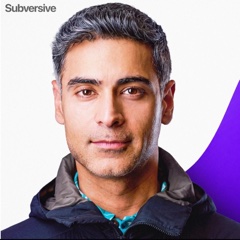
Raj Singh
Cofounder and CEO of Purpose, previously founder of GoMoment
Where to hear and read about Raj Singh1 episode or test

Raj Singh is cofounder and CEO of Purpose, an AI mentor app built with author Mark Manson, and previously founded the hotel texting company GoMoment. The lesson most worth taking from him is to start from distribution, test every commercial variable on small cohorts, then launch at full scale.
how do we get this in the hands of a billion people and then kind of work backwards from there
How Purpose Hit $1M ARR in 14 Days
Raj Singh: the story and the lessons
1Raj Singh's path from GoMoment to Purpose
Singh has built chat products for 12 years, starting young. In 2014 he started GoMoment, which let hotel guests get service by text message. It reached 100 million people, Google invested, and a top-10 hotel tech player acquired it.
GoMoment later became part of Revinate. He had started his first company at 17 and says he is a product guy who loves making people's lives easier.
A year off after the exit made him ask who he was. He joined the acquirer as CMO, then stopped operating. After so long in execution mode he no longer knew who he was, so he used meditation, breath work and coaching to take himself apart and reassemble.
Friends who had sold companies told him to take at least a year off.
He saw that inner work is language, so an LLM could do it cheaply. He spent tens of thousands of dollars on coaches and therapists across 24 countries and judged the price atrocious. Because the change was all language, he saw models cutting the cost by about 1,000x.
His toy prototype let people call in for emotional support, a tarot reading or a therapist-style chat. Friends said it beat a $300 an hour therapist.
A poker game put him next to a founder chasing the same idea. At the end of his 2024 sabbatical he told Mark Manson he planned to make this his next company, and Manson said he was looking at the exact same space. In early 2025 Manson proposed building it together, with Singh building and Manson bringing the audience.
Manson had two decades of audience trust and 20 million books sold. A one-hour lunch stretched to three hours of what Singh calls mind-melding.
2How Purpose reached $1M ARR in two weeks
Singh's team tested messaging, paywalls and pricing before launch. While engineers built the product, the growth team ran tests on small cohorts of Manson's audience. They varied messaging, paywalls, monetization offers and pricing, then launched at full scale with the winning setup.
He says they chose to fire bullets before the cannonball. He ran the same playbook at his last company and chose to speedrun the whole process.
A celebrity cofounder's audience solved the cold start problem. Manson's audience of over 10 million readers and viewers gave enough traffic to test from day one. The team built the product in about six months and hit $1M ARR two weeks after launch.
The result surprised the team on the upside, and revenue kept growing. The $1M figure is stated without supporting data.
The product had to survive a step-function launch. Technology usually scales on a curve, so handling an audience of 10 million arriving at once was hard. Singh says launching without knowing whether it would be a ghost town was nerve-wracking.
Manson's paid courses moved into Purpose as exclusive content. His courses had earned tens of millions of dollars in lifetime revenue and now live only inside Purpose, so the content was already market-validated.
Singh compares it to starting a game at level 12 or 15 instead of level one, which brings harder problems sooner than a company this young would normally face.
3How Singh designs the AI mentor and onboarding
Singh started from psychological science, not from a chat box. The team scanned personality quizzes, the Enneagram, the Big Five and executive tools, found no great consumer options, and built four features: a rapid self-discovery engine, an advanced memory architecture, an intelligent challenge system and guided quests.
Singh cites Sean Puri: different is better than better.
Onboarding aims for an aha moment in 5 to 10 minutes. The goal is that within 5 to 10 minutes the app knows you better than a coach would in two years. A vanilla chat box with an AI attached is, in his words, a commodity.
A user review he reads says that within 10 minutes they were in tears over things no human would say to their face.
He forces users to commit to choices on screen. New users stack rank their values, for example choosing whether autonomy or connection matters more. A custom report on blind spots, growth areas and strengths follows in about 10 minutes.
Committing on a screen draws out answers people would not give in loose conversation.
Singh built an AI with a backbone instead of flattery. Foundation models are tuned for engagement and give all sugar, so Manson prompted the mentor thousands of times to tell hard truths. Over 40% of users report life-changing value.
The tone must not be abrasive, since users may arrive in a sensitive moment, and some people are not a fit. The 40% figure is stated without data.
Humor carries the hard truths. The mentor cracks jokes and makes bad puns, following Manson's instinct for how much sugar makes the medicine go down. The team settled the sugar and medicine ratio after a long internal debate.
He tests what a model already knows before teaching it. The team planned to load Manson's proprietary IP but found the models already knew most psychology. The real work was prompting, iteration and memory management.
His lesson: if you think you will teach an LLM something new, test whether it already knows it.
4Singh's rules for growth, retention and positioning
Copy proven playbooks outside your edge, go all in on your edge. His rule from his last company is to copy what works where Purpose has no advantage. He goes all in only where it can beat anyone.
He calls this standing on the shoulders of giants.
He markets against the alternative users already tried. A/B tests showed that "self-help books don't text back" resonated, since many users had already tried books, therapy or DIY options.
Retention comes from matching what users share to content. One user talks relationships and another finances, and the app routes in-app content and lifecycle messages to match. Singh credits this for above-median retention.
He expects subscribers to stay 10, 20 or 30 years against a usual 3 to 4. That is a hope, not a result, and the retention claim comes without data.
Singh now starts from distribution and works backwards. He says first companies tend to be product first and later ones distribution first. Purpose began by asking how to reach a billion people.
With AI letting anyone build fast, he says distribution has become the name of the game.
He differentiates with validated frameworks, not a celebrity name. Singh finds most rival apps are a famous name plus content, which a chatbot can imitate by being told to answer like that person. Purpose puts scientifically validated frameworks under its Quest feature.
Alignment with the user across the capital stack and every employee is the second long-term edge.
5Working with a celebrity cofounder and protecting the mission
Singh vetted Manson's track record before partnering. He audited which products Manson had promoted and found he had not put his name on a hundred products, so his endorsement kept its value.
They chose a true cofounder relationship, not an endorsement or advisory one.
He planned for the audience to become a ceiling. Before incorporating, Singh and Manson called the audience a huge early blessing and a possible later ceiling. They built Purpose as a larger brand than Manson, welcoming his fans while aiming at a billion people.
Paid ads are already accretive, word of mouth beats expectations, and user stories are the next channel. The real cost of the audience dependency goes unexamined.
Balancing two businesses is the main cofounder challenge. Manson's audience is a separate business built over 20 years, so both founders must communicate well to load balance between the two. Both being in LA helps.
He kept funding and hiring aligned with user outcomes. Singh and Manson funded Purpose themselves and screen investors closely. Hiring screens for mission fit and includes people from Headspace.
The company commits to no ads, no data selling and no engagement maximizing, aiming to counter the "dopamine casino" by getting users off their device.
Singh's frugality is balanced by Manson's focus on feel. He calls himself very frugal, while Manson will skip a video shoot if the vibe is wrong. Singh has come to see that the love in a product shows up for the user.
He hires A+ people as he meets them, not when roles open.

How Purpose Hit $1M ARR in 14 Days
Raj Singh explains how Purpose, an AI mentor app built with author Mark Manson, got users to an aha moment in 5 to 10 minutes, gave a sycophantic LLM a backbone, and used a celebrity cofounder's audience to reach $1M ARR in two weeks. Over 40% of users now call it life-changing less than a year in.
Singh has built chat products for 12 years, starting young. In 2014 he started GoMoment, which let hotel guests get service by text message. It reached 100 million people, Google invested, and a top-10 hotel tech player acquired it.
GoMoment later became part of Revinate. He had started his first company at 17 and says he is a product guy who loves making people's lives easier.
A year off after the exit made him ask who he was. He joined the acquirer as CMO, then stopped operating. After so long in execution mode he no longer knew who he was, so he used meditation, breath work and coaching to take himself apart and reassemble.
Friends who had sold companies told him to take at least a year off.
He saw that inner work is language, so an LLM could do it cheaply. He spent tens of thousands of dollars on coaches and therapists across 24 countries and judged the price atrocious. Because the change was all language, he saw models cutting the cost by about 1,000x.
His toy prototype let people call in for emotional support, a tarot reading or a therapist-style chat. Friends said it beat a $300 an hour therapist.
A poker game put him next to a founder chasing the same idea. At the end of his 2024 sabbatical he told Mark Manson he planned to make this his next company, and Manson said he was looking at the exact same space. In early 2025 Manson proposed building it together, with Singh building and Manson bringing the audience.
Manson had two decades of audience trust and 20 million books sold. A one-hour lunch stretched to three hours of what Singh calls mind-melding.
Singh's team tested messaging, paywalls and pricing before launch. While engineers built the product, the growth team ran tests on small cohorts of Manson's audience. They varied messaging, paywalls, monetization offers and pricing, then launched at full scale with the winning setup.
He says they chose to fire bullets before the cannonball. He ran the same playbook at his last company and chose to speedrun the whole process.
A celebrity cofounder's audience solved the cold start problem. Manson's audience of over 10 million readers and viewers gave enough traffic to test from day one. The team built the product in about six months and hit $1M ARR two weeks after launch.
The result surprised the team on the upside, and revenue kept growing. The $1M figure is stated without supporting data.
The product had to survive a step-function launch. Technology usually scales on a curve, so handling an audience of 10 million arriving at once was hard. Singh says launching without knowing whether it would be a ghost town was nerve-wracking.
Manson's paid courses moved into Purpose as exclusive content. His courses had earned tens of millions of dollars in lifetime revenue and now live only inside Purpose, so the content was already market-validated.
Singh compares it to starting a game at level 12 or 15 instead of level one, which brings harder problems sooner than a company this young would normally face.
Singh started from psychological science, not from a chat box. The team scanned personality quizzes, the Enneagram, the Big Five and executive tools, found no great consumer options, and built four features: a rapid self-discovery engine, an advanced memory architecture, an intelligent challenge system and guided quests.
Singh cites Sean Puri: different is better than better.
Onboarding aims for an aha moment in 5 to 10 minutes. The goal is that within 5 to 10 minutes the app knows you better than a coach would in two years. A vanilla chat box with an AI attached is, in his words, a commodity.
A user review he reads says that within 10 minutes they were in tears over things no human would say to their face.
He forces users to commit to choices on screen. New users stack rank their values, for example choosing whether autonomy or connection matters more. A custom report on blind spots, growth areas and strengths follows in about 10 minutes.
Committing on a screen draws out answers people would not give in loose conversation.
Singh built an AI with a backbone instead of flattery. Foundation models are tuned for engagement and give all sugar, so Manson prompted the mentor thousands of times to tell hard truths. Over 40% of users report life-changing value.
The tone must not be abrasive, since users may arrive in a sensitive moment, and some people are not a fit. The 40% figure is stated without data.
Humor carries the hard truths. The mentor cracks jokes and makes bad puns, following Manson's instinct for how much sugar makes the medicine go down. The team settled the sugar and medicine ratio after a long internal debate.
He tests what a model already knows before teaching it. The team planned to load Manson's proprietary IP but found the models already knew most psychology. The real work was prompting, iteration and memory management.
His lesson: if you think you will teach an LLM something new, test whether it already knows it.
Copy proven playbooks outside your edge, go all in on your edge. His rule from his last company is to copy what works where Purpose has no advantage. He goes all in only where it can beat anyone.
He calls this standing on the shoulders of giants.
He markets against the alternative users already tried. A/B tests showed that "self-help books don't text back" resonated, since many users had already tried books, therapy or DIY options.
Retention comes from matching what users share to content. One user talks relationships and another finances, and the app routes in-app content and lifecycle messages to match. Singh credits this for above-median retention.
He expects subscribers to stay 10, 20 or 30 years against a usual 3 to 4. That is a hope, not a result, and the retention claim comes without data.
Singh now starts from distribution and works backwards. He says first companies tend to be product first and later ones distribution first. Purpose began by asking how to reach a billion people.
With AI letting anyone build fast, he says distribution has become the name of the game.
He differentiates with validated frameworks, not a celebrity name. Singh finds most rival apps are a famous name plus content, which a chatbot can imitate by being told to answer like that person. Purpose puts scientifically validated frameworks under its Quest feature.
Alignment with the user across the capital stack and every employee is the second long-term edge.
Singh vetted Manson's track record before partnering. He audited which products Manson had promoted and found he had not put his name on a hundred products, so his endorsement kept its value.
They chose a true cofounder relationship, not an endorsement or advisory one.
He planned for the audience to become a ceiling. Before incorporating, Singh and Manson called the audience a huge early blessing and a possible later ceiling. They built Purpose as a larger brand than Manson, welcoming his fans while aiming at a billion people.
Paid ads are already accretive, word of mouth beats expectations, and user stories are the next channel. The real cost of the audience dependency goes unexamined.
Balancing two businesses is the main cofounder challenge. Manson's audience is a separate business built over 20 years, so both founders must communicate well to load balance between the two. Both being in LA helps.
He kept funding and hiring aligned with user outcomes. Singh and Manson funded Purpose themselves and screen investors closely. Hiring screens for mission fit and includes people from Headspace.
The company commits to no ads, no data selling and no engagement maximizing, aiming to counter the "dopamine casino" by getting users off their device.
Singh's frugality is balanced by Manson's focus on feel. He calls himself very frugal, while Manson will skip a video shoot if the vibe is wrong. Singh has come to see that the love in a product shows up for the user.
He hires A+ people as he meets them, not when roles open.